
视频生成模型

Search documents
美股异动|谷歌涨超2.3%创新高,此前推出新一代视频生成模型Veo 3.1
Ge Long Hui· 2025-10-16 14:01
Core Viewpoint - Google A (GOOGL.US) shares rose over 2.3%, reaching a record high of $256.96, driven by the launch of the new video generation model Veo 3.1 [1] Group 1: Product Development - Google has introduced the next-generation video generation model Veo 3.1, which features enhancements in audio output, fine editing control, and image-to-video effects [1] - The Veo 3.1 model is being gradually deployed across Google's video editing platforms, including Flow, Gemini applications, Vertex AI platform, and Gemini API [1] Group 2: User Engagement - Since the launch of Flow in May this year, users have created over 275 million videos on the platform [1]

OpenAI“抖音”被嘲“好尬”?!Altman 大秀Sora 2、赶上谷歌Veo 3,但要邀请码才能玩?
AI前线· 2025-10-01 02:24
Core Viewpoint - OpenAI has launched a new application named Sora, which integrates the new model Sora 2, aimed at enhancing video creation, sharing, and viewing experiences [2]. Group 1: Sora 2 Model - OpenAI expresses strong confidence in Sora 2, likening it to a pivotal moment in video technology, similar to GPT-3.5 for text [2]. - Sora 2 has undergone significant optimizations in understanding the physical world, positioning it as the best video generation model available [2]. - Despite its advancements, OpenAI acknowledges that the model is not perfect and still makes mistakes, indicating that further training on video data is necessary to better simulate reality [4]. Group 2: Sora Application Features - The core of the Sora application revolves around the "Cameos" feature, allowing users to create and remix videos, discover personalized video streams, and embed themselves into Sora scenes [5]. - Users can verify their identity and capture their likeness through a short video and audio recording, which enhances the interactive experience [5]. - Initial testing of the "upload yourself" feature has been well-received, with users reporting new friendships formed through the application [5]. Group 3: Community Reception - The community's response to OpenAI's demonstrations has been mixed, with some users expressing excitement while others find the output awkward or unsatisfactory [6][9]. - Specific feedback includes criticism of the editing and audio quality, with some users feeling discomfort due to the unnaturalness of the content [9].


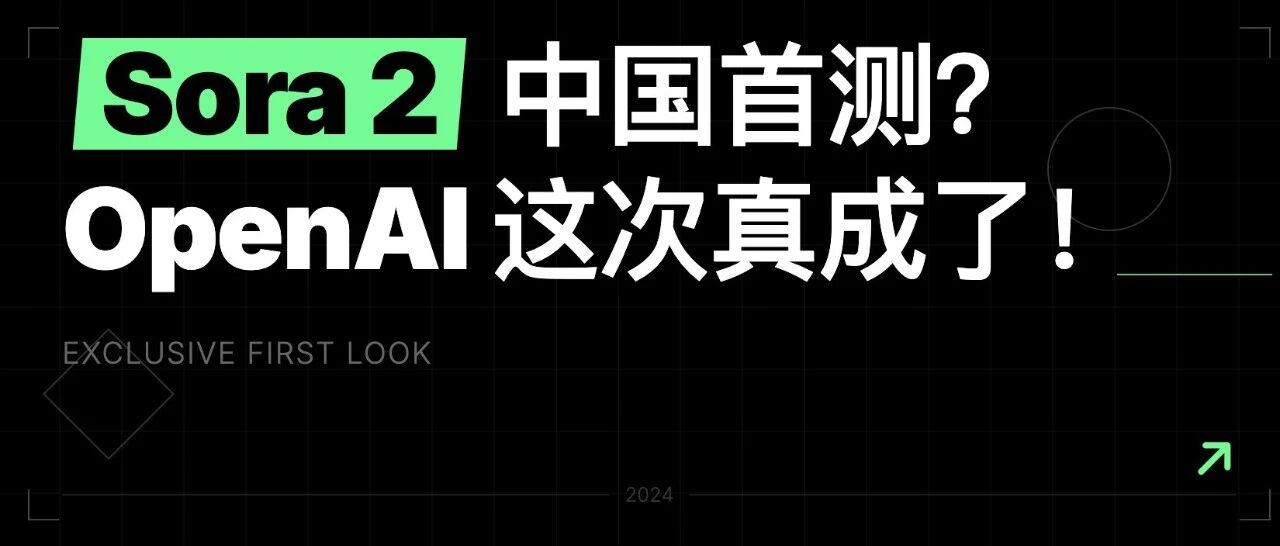
Sora 2 中国首测?Open AI 这次真成了!
歸藏的AI工具箱· 2025-09-30 20:32
Core Viewpoint - Sora 2 is presented as the world's most advanced video generation model, capable of creating high-quality videos with minimal input, including voice cloning and multi-language support, and it features a social app for collaborative video creation [1][17]. Group 1: Model Features - Sora 2 allows users to generate videos by simply recording three numbers, showcasing its advanced voice and video synthesis capabilities [1]. - The model can maintain character consistency while changing backgrounds and scenarios, demonstrating its versatility in video generation [6][7]. - It incorporates automatic camera cuts and scene changes, reflecting an understanding of video composition and storytelling logic [8][11]. Group 2: User Interaction - Users can remix videos by providing simple prompts, allowing for creative alterations to existing content [5]. - The platform supports image uploads for scene generation, enhancing the customization options for users [6]. - Sora 2 includes a social aspect where users can invite friends to collaborate on video projects, resembling a social media experience [1][17]. Group 3: Content Limitations - The model has strict copyright restrictions, preventing the generation of copyrighted content, although it appears to allow some exceptions [11]. - There are challenges with maintaining consistency in certain product representations, indicating areas for improvement in commercial applications [9]. Group 4: Overall Impact - Sora 2 is positioned as a groundbreaking tool for end-users, combining audio, visual, and narrative elements to create complete videos from minimal input [17]. - The model's capabilities suggest a significant advancement in video generation technology, potentially transforming user engagement in content creation [17].
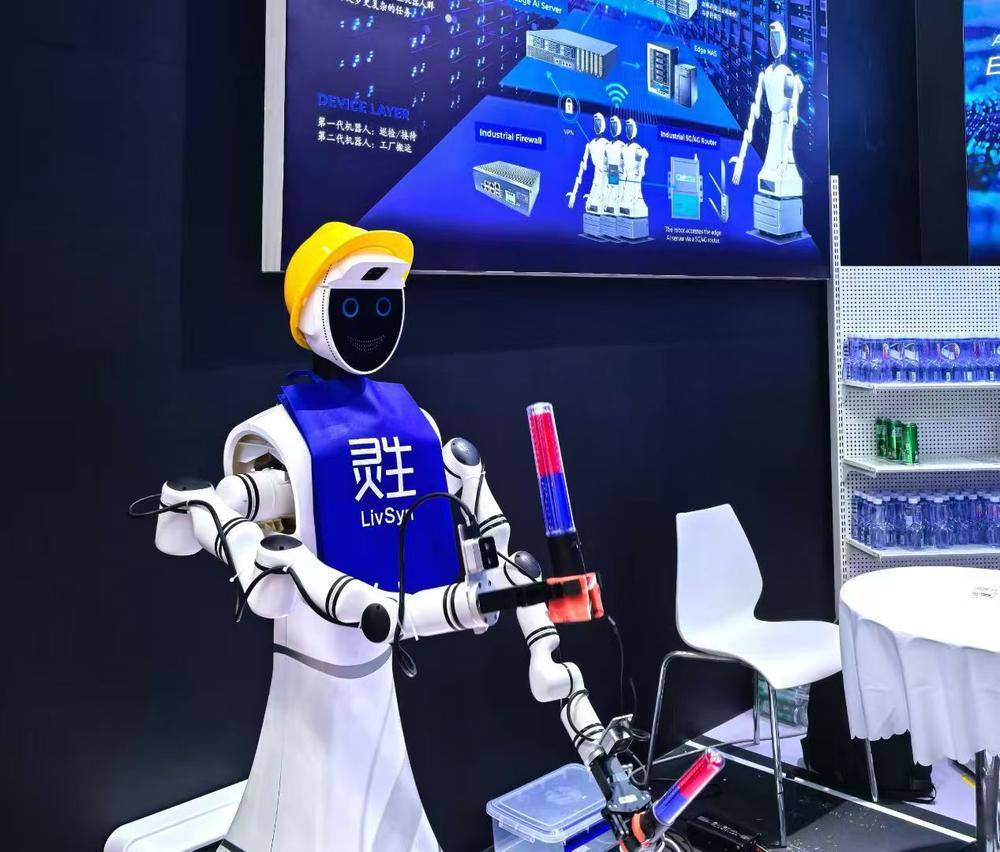
北京跑出未来独角兽:要用“具身 Sora ”做机器人大脑,已融资数千万
Sou Hu Cai Jing· 2025-08-28 00:03
Core Insights - The main argument presented by Yang Hongbing, founder of LingSheng Technology, is that the lack of large-scale deployment of robots is primarily due to the inadequacy of models rather than hardware limitations [2][3] - LingSheng Technology has introduced the RealDualVLA framework, which supports asynchronous operation for complex robotic tasks, leveraging their unique video generation model called "Embodied Sora" [2][3] - The company aims to develop a "brain" for robots that allows them to think and act independently, moving beyond mere remote-controlled operations [6][9] Group 1: Technological Innovations - LingSheng Technology has open-sourced its VLA model and employs a "learn by watching" approach to train robotic models, achieving a success rate of over 95% in task execution [3][17] - The company emphasizes the importance of integrating AI with robotics to create intelligent systems capable of understanding the physical world and executing complex tasks [6][8] - The "Embodied Sora" technology allows robots to learn from generated videos, addressing the data scarcity issue in the industry [15][16] Group 2: Market Position and Strategy - LingSheng Technology positions itself as a key player in the robotics sector by focusing on the development of robotic brains rather than hardware, differentiating itself from traditional robotics companies [9][10] - The company has established partnerships with several large clients, moving from proof of concept (POC) to small-scale orders, indicating a strong market presence [28][30] - The business model is based on an open platform with value-added services, allowing for sustainable commercialization while fostering ecosystem development [23][25] Group 3: Challenges and Future Directions - The industry faces challenges such as data scarcity, the complexity of real-world applications, and the need for high accuracy and stability in robotic operations [31][32] - LingSheng Technology aims to overcome these challenges by enhancing its engineering capabilities and utilizing video generation technology to fill data gaps [32][33] - The company plans to expand its client base significantly while continuing to promote its open-source strategy to attract developers and enhance industry collaboration [44]

可灵AI单季度营收2.5亿元,视频生成模型的赚钱能力正在提升
Xin Lang Cai Jing· 2025-08-22 01:51
Core Insights - Kuaishou's Keling AI has significantly improved its revenue-generating capabilities, with Q2 2025 revenue reaching 250 million yuan, indicating a substantial increase since its commercialization began last July [1] - The CFO of Kuaishou revealed that Keling AI's commercialization progress is ahead of expectations, with projected annual revenue expected to double from initial targets [1] Revenue Performance - Kuaishou's total revenue for Q2 was 35 billion yuan, with online marketing services contributing 19.8 billion yuan and live streaming revenue at 10 billion yuan [1] - Keling AI's contribution to overall revenue remains limited, but its rapid growth demonstrates the commercial viability of video generation models [1] Industry Context - Since the launch of Sora, many major internet companies in China have begun investing in video generation models, although some skepticism remains regarding the long-term profitability of such investments [2][4] - Concerns about high training and inference costs, as well as unclear commercialization prospects, have been prevalent in the industry [4] Technological Advancements - Keling AI has undergone nearly 30 iterations since its launch, improving video quality, semantic understanding, and aesthetic appeal, which enhances its application in marketing and film production [4] - The new architecture developed by Keling AI allows for more efficient resource allocation during different generation stages, significantly reducing training and inference costs [4][6] Business Model and Clientele - Keling AI primarily operates on a subscription-based model, serving video creators and marketing professionals, with clients including companies like Xiaomi and BlueFocus [5] - As of July, Keling AI has produced over 200 million videos and 400 million images, serving more than 20,000 enterprise clients [6] Future Outlook - Kuaishou has increased its investment in Keling AI's inference capabilities, doubling its capital expenditure for 2025 compared to initial budgets [6] - Other internet companies, including Baidu, are beginning to explore video generation models, indicating a shift in perception towards these technologies as revenue-generating assets rather than cost centers [6] Marketing Innovations - Kuaishou is developing marketing material solutions tailored to specific industry needs, such as a dual live-streaming feature for the fashion industry that has doubled marketing material consumption for participating brands [7] - The company aims to expand Keling AI's offerings to engage a broader audience beyond professional creators [7]


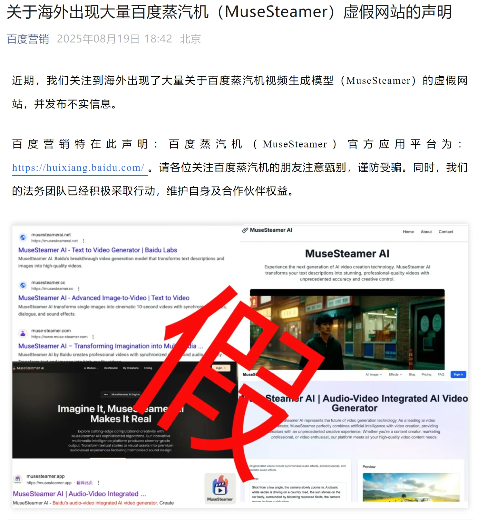
百度辟谣蒸汽机视频生成模型多个海外仿冒网址
Xin Lang Cai Jing· 2025-08-19 11:37
Core Viewpoint - Baidu has issued a warning regarding the proliferation of fake websites related to its video generation model, MuseSteamer, urging users to be cautious and discerning [1] Group 1 - Baidu's MuseSteamer has garnered significant attention since its launch, with an upgrade event scheduled for August 21 to introduce version 2.0, which will include Turbo, Lite, Pro, and audio versions of the model [1] - The MuseSteamer was officially launched on July 2, and on its first day, it received over 100 applications per minute, accumulating more than 300,000 registered users within two weeks [1]

被多家海外网站仿冒,百度蒸汽机视频生成模型最新声明
Xin Lang Ke Ji· 2025-08-19 11:28
Core Insights - Baidu has issued a statement warning users about the proliferation of fake websites related to its video generation model, MuseSteamer [3] - The company will hold an upgrade launch event for MuseSteamer 2.0 on August 21, which will include various models such as Turbo, Lite, Pro, and a voice version [3] - Since its official launch on July 2, MuseSteamer has gained significant attention, with over 300,000 registered users within two weeks and an average of over 100 applications per minute on the first day [3] Product Development - The upcoming MuseSteamer 2.0 version will leverage advanced technologies including multi-modal spatiotemporal planning, deep optimization for Chinese scenarios, and end-to-end modeling for audio and video [3] - The new version aims to enable integrated generation of multi-person audio and video, complex camera movements, cinematic-level character performances, rich shot expressions, and smooth video quality [3]
硅基流动SiliconCloud上线阿里通义万相Wan2.2
Di Yi Cai Jing· 2025-08-15 13:19
Group 1 - SiliconCloud has launched the latest open-source video generation foundational model Wan2.2 from Alibaba's Tongyi Wanshang team [1] - The models include text-to-video model Wan2.2-T2V-A14B and image-to-video model Wan2.2-I2V-A14B, both priced at 2 yuan per video [1]

WRC 2025聚焦(2):人形机器人临近“CHATGPT时刻” 模型架构成核心突破口
Xin Lang Cai Jing· 2025-08-12 06:33
Core Insights - The humanoid robot industry is on the brink of a "ChatGPT moment," with significant breakthroughs expected within 1-2 years driven by policy and demand [1] - The average growth rate for domestic humanoid robot manufacturers and component suppliers is projected to be between 50-100% in the first half of 2025 [1] - The main challenge in the industry is not hardware but the architecture of embodied intelligent AI models, with the VLA model having inherent limitations [1][4] Short-term Outlook (1-2 years) - The domestic market is expected to maintain rapid growth due to policy subsidies and the expansion of application scenarios, with high visibility of orders for complete machines and core components [2] - Key players like Tesla and Figure AI could accelerate global supply chain division and standardization once they achieve mass production [2] Mid-term Outlook (2-5 years) - The integration of end-to-end embodied intelligent models with world models and RL Scaling Law could become the mainstream architecture, facilitating the transition from prototype to large-scale commercialization [2] - Distributed computing is anticipated to become a critical supporting infrastructure, collaborating with 5G/6G and edge computing providers [2] - Investment opportunities include hardware manufacturers entering the mass production phase, AI companies with video generation world model capabilities, and distributed computing centers and edge cloud service providers [2] Long-term Outlook (5+ years) - If end-to-end embodied intelligence and low-latency distributed computing are realized, the market for household and industrial humanoid robots could expand rapidly, potentially reaching annual shipment volumes in the millions [2] - The focus of competition is expected to shift from technological breakthroughs to cost control and ecosystem development [2] Hardware Status - Current humanoid robot hardware can meet most application needs, although optimization is still required in mass production and engineering [3] AI Model Challenges - The VLA model is considered a "foolproof architecture" but struggles with real-world interactions due to insufficient data, and its effectiveness remains limited even after reinforcement learning training [4] - The video generation/world model approach is seen as more promising, allowing for task simulation before real-world application, which may lead to faster convergence [4] RL Scaling Law - Current reinforcement learning training lacks transferability, requiring new tasks to be trained from scratch, which is inefficient [5] - Achieving a scaling law similar to that of language models could significantly accelerate the learning speed of new skills [5] Distributed Computing Trends - Humanoid robots are limited by size and power consumption, with onboard computing equivalent to a few smartphones [6] - Future developments will rely on localized distributed servers to reduce latency, ensure safety, and lower the cost of individual computing units [6]
宇树科技王兴兴:机器人数据关注度有点太高了,最大问题在模型
2 1 Shi Ji Jing Ji Bao Dao· 2025-08-09 13:52
Group 1 - The core viewpoint is that the most important aspect for the robotics industry in the next 2 to 5 years is the development of end-to-end embodied intelligent AI models [1][24] - The current challenge in the robotics field is not the hardware performance, which is deemed sufficient, but rather the inadequacy of embodied intelligent AI models [1][18] - There is a misconception that the data issue is the primary concern; however, the real problem lies in the model architecture, which is not yet good or unified enough [1][21] Group 2 - The VLA (Vision-Language-Action) model combined with Reinforcement Learning (RL) is seen as insufficient and requires further upgrades and optimization [2][21] - The company has developed various models of quadruped and humanoid robots, with the quadruped model GO2 being the most shipped globally in recent years [3][4] - The humanoid robot G1 has become a representative model in the humanoid robot sector, achieving significant sales and market presence [5][6] Group 3 - The company emphasizes the importance of making robots capable of performing tasks rather than just for entertainment or display purposes [9][14] - Recent advancements in AI technology have led to improved performance in robot movements, including complex terrain navigation [11][12] - The company has focused on developing its core components, including motors and sensors, to enhance the performance and cost-effectiveness of its robots [10][24] Group 4 - The robotics industry is experiencing significant growth, with many companies reporting a 50% to 100% increase in business due to rising demand and supportive policies [16][17] - The global interest in humanoid robots is increasing, with major companies like Tesla planning to mass-produce humanoid robots [17][18] - The future of robotics will likely involve distributed computing to manage the computational demands of robots effectively [25][26]