
金融科技创新

Search documents
港股异动 | 云锋金融(00376)涨超5% 近日独立完成首个RWA项目 集团聘请蚂蚁集团前高管蒋国飞为Web3发展委员会主席
智通财经网· 2025-09-19 07:13
Core Viewpoint - Yunfeng Financial (00376) has achieved a significant milestone by successfully tokenizing real-world assets through its blockchain technology team, marking a breakthrough in fintech innovation and the integration of traditional finance with blockchain technology [1] Group 1: Company Developments - Yunfeng Financial's stock rose over 5%, reaching a peak increase of 6.75% to HKD 6.16, with a trading volume of HKD 408 million [1] - The company announced on September 17 that it has completed its first Real-World Asset Tokenization (RWA) project, which involves the tokenization of physical assets from its wholly-owned subsidiary's fund of funds (FOF) [1] - On September 18, it was reported that Yunfeng Financial appointed Jiang Guofei, a former senior executive from Ant Group, as the chairman of its Web3 Development Committee, indicating a strategic move into cutting-edge areas like Web3 [1] Group 2: Industry Implications - The appointment of Jiang Guofei, who previously led blockchain projects at Ant Group, suggests that Yunfeng Financial is addressing key pain points in traditional finance, such as cost, efficiency, and security [1]
余伟文:香港作为亚洲银行业枢纽仍具发展潜力
智通财经网· 2025-09-18 01:41
Core Viewpoint - Hong Kong has significant potential for further development as a banking hub in Asia, despite its already crucial position in the global financial system [1] Group 1: Financial Market Potential - Hong Kong's financial market has room for growth in multiple areas, indicating ongoing opportunities for expansion [1] - The city possesses a mature banking system and a stable financial regulatory environment, which are essential for its role as an international financial center [1] Group 2: Regional Cooperation and Innovation - Strengthening cooperation with regional economies and promoting financial technology innovation are key measures for Hong Kong to solidify its status as a global financial hub [1] - The future focus will be on financial infrastructure development and cross-border financial services to better serve regional and international markets [1] Group 3: Role in Asian Economic Growth - As the Asian economy continues to grow, Hong Kong's role in regional financial cooperation and innovation will become increasingly important [1] - The introduction of more innovative financial products and services is expected to attract global investors, injecting new momentum into Hong Kong's banking sector [1]
马宏伟等:RWA浪潮下上市公司的合规重塑与风险防控
Sou Hu Cai Jing· 2025-09-03 09:04
Group 1 - The core viewpoint of the article is that the tokenization of real-world assets (RWA) is reshaping the global financial ecosystem, presenting significant opportunities for public companies in terms of financing innovation, efficiency improvement, and valuation reconstruction, with compliance being a crucial prerequisite for exploring RWA [2] Group 2 - RWA refers to the mapping of ownership or income rights of physical assets (such as real estate, bonds, and commodities) onto the blockchain in the form of tokens, enabling fragmentation, tradability, and high liquidity [3][4] - Stablecoins serve as a key bridge between traditional finance and decentralized finance, providing low-volatility trading mediums and foundational settlement tools for RWA transactions, thereby enhancing the credit basis and application scenarios for stablecoins [4] Group 3 - The regulatory landscape is rapidly evolving, with the U.S. focusing on stringent regulations for securities-like RWA, emphasizing asset authenticity, information disclosure, and investor suitability management [5] - Hong Kong is actively promoting the development of RWA and stablecoins, aiming to establish itself as an international Web3 financial hub, with a sandbox system for stablecoin issuers requiring full reserve coverage and regular audits [6][7] - Mainland China has adopted a cautious approach, prioritizing risk prevention while exploring the potential of stablecoins, with a focus on digital currency as a core component of its digital payment ecosystem [8] Group 4 - Public companies are motivated to explore RWA due to the need to reduce costs and enhance financing structures, as traditional asset transactions are often complex and costly [10] - Engaging in RWA is seen as a sign of embracing financial technology innovation, attracting new investors and significantly enhancing company valuation and market image [11] - Companies are also preparing for regulatory expectations by conducting technological reserves and compliance explorations to adapt to the evolving regulatory environment [12] Group 5 - Companies face unprecedented challenges in compliance with traditional financial regulations and securities laws when exploring RWA, necessitating precise identification and adherence to compliance boundaries [13] - RWA projects must ensure legal fundraising practices, as any unauthorized fundraising activities could be classified as illegal financial activities [14] - The emergence of "pseudo-RWA" projects poses risks, including questionable asset authenticity and the potential for fraud [15] Group 6 - The misuse of stablecoins in illegal fundraising activities increases the difficulty of regulatory tracking and accountability [16] - Companies must be cautious of market manipulation risks associated with RWA and stablecoin concepts, including information manipulation and selective disclosure [17][19] - Insider trading risks are heightened due to the diverse and hidden nature of insider information generated during RWA project development [22] Group 7 - Companies must adhere to dual compliance principles, ensuring licensed operations and risk isolation through independent entities in compliant jurisdictions [26] - Establishing a value management risk control system is essential, requiring strict adherence to information disclosure principles and transaction monitoring mechanisms [29] - Companies should prioritize substance over form in their disclosures, ensuring clarity and transparency to avoid misleading investors [31]


国泰君安国际(01788.HK)首批结构化产品通证完成“蚂蚁链-以太坊”跨链发行
Ge Long Hui· 2025-08-26 10:24
Core Insights - Guotai Junan International successfully launched its first batch of structured product tokens, including fixed income redeemable tokens and principal-protected tokens linked to US ETFs, marking a significant breakthrough in financial technology innovation [1][2] - The Hong Kong government is actively promoting financial technology development, creating a favorable regulatory environment for innovation [1] - The structured product tokens utilize Ant Group's blockchain technology and RWA solutions, enabling secure cross-chain transactions and transparent, immutable trading data [2] Company Developments - Guotai Junan International leverages its deep traditional financial experience to achieve transparent management of structured product tokens through blockchain smart contracts [1] - The fixed income redeemable token products feature a T+0 settlement mechanism with daily interest accumulation, while the US ETF principal-protected tokens are linked to the performance of US ETFs, offering both asset participation and principal protection [1] - The company aims to expand the variety of token products in response to the Hong Kong government's call for digital asset development, integrating cutting-edge digital financial technologies [2] Industry Trends - The tokenization architecture significantly reduces costs associated with traditional issuance and greatly enhances clearing and settlement efficiency [2] - The highly scalable architecture of the structured product tokens allows for flexible adaptation to future technological iterations and product innovations [2] - The collaboration between Guotai Junan International and Ant Group is expected to drive compliant innovation in token products and promote long-term market development in Hong Kong [2]
美联储终结 2023 年加密监管计划,转向常规化监督
Sou Hu Cai Jing· 2025-08-18 03:08
Core Viewpoint - The Federal Reserve has announced the termination of the "novel activities" regulatory program specifically for overseeing banks' cryptocurrency and fintech-related operations, integrating this oversight into the regular banking supervision framework, marking a new phase in its regulatory strategy towards emerging fintech sectors [1][3][4] Group 1: Regulatory Changes - The specialized regulatory program was initiated in 2023 to monitor the interactions between banks and emerging technologies like cryptocurrencies and fintech, focusing on compliance risks associated with digital asset custody and blockchain payment systems [3] - The Federal Reserve has indicated that after nearly two years of practice, it has significantly enhanced its understanding of the risk characteristics in this sector and the risk management models of banks, thus completing the historical mission of the specialized program [3] - The adjustment reflects a more mature attitude from regulators towards fintech innovation, transitioning from a reactive stance following incidents like the FTX collapse to a more stable regulatory environment as banks' involvement in crypto assets becomes clearer [3] Group 2: Industry Response - The fintech industry has responded positively to the regulatory framework integration, with compliance leaders indicating that this consolidation will help reduce policy uncertainty and allow companies to better plan their innovation paths [3] - However, analysts caution that this regulatory model adjustment does not imply a relaxation of standards, and banks must remain vigilant regarding the risks associated with emerging business models [3][4] Group 3: Long-term Impact - The optimization of the regulatory mechanism reflects the Federal Reserve's approach to balancing the encouragement of financial innovation with the maintenance of systemic stability, which is expected to have a profound impact on the long-term development of the U.S. fintech industry [4]
广州出台88条金融举措支持南沙建设
Nan Fang Ri Bao Wang Luo Ban· 2025-08-13 08:38
Core Insights - The implementation plan aims to enhance financial support for Nansha, positioning it as a key financial hub in the Guangdong-Hong Kong-Macao Greater Bay Area and a demonstration window for financial openness in China [1][3] Group 1: Financial Support for Innovation and Entrepreneurship - The plan includes measures to promote innovative financial services, such as developing new bill discount products and enhancing financing support for technology and advanced manufacturing sectors [1] - It emphasizes the establishment of technology branches by commercial banks in Nansha to explore mixed financing models [1] Group 2: Social and Livelihood Financial Services - Initiatives to facilitate cross-border banking services for Hong Kong and Macao residents, including online credit card activation and digital RMB pilot projects, are outlined [2] Group 3: Development of Specialized Financial Services - The plan supports the Guangzhou Futures Exchange in researching electricity futures and launching more renewable energy futures [2] - It encourages the issuance of green and sustainable bonds by Greater Bay Area enterprises in Hong Kong and Macao [2] Group 4: Interconnectivity of Financial Markets - The plan aims to enhance the functionality of the free trade account system and promote cross-border cooperation between the Guangzhou Futures Exchange and the Hong Kong Stock Exchange [2] Group 5: Cross-Border Financial Innovation and Exchange - Proposals include establishing an international commercial bank in Nansha and attracting foreign sovereign wealth funds and venture capital firms [2] Group 6: Financial Regulatory Mechanisms - The plan emphasizes the need for improved coordination between central and local regulatory bodies and the establishment of risk prevention mechanisms in the Nansha Free Trade Zone [3] Group 7: Support Measures - The implementation plan includes policies to attract international financial talent and support the construction of an international talent special zone in Nansha [3]
“一带一区”联动发展,黄浦区加速建设金融科技新高地
Di Yi Cai Jing· 2025-08-08 13:59
Core Viewpoint - Huangpu District is committed to building a central innovation zone that is globally oriented and future-focused, aiming to enhance its financial technology sector through various initiatives [1][2]. Group 1: Development Initiatives - Huangpu District is constructing a "Bund Financial Cluster + Central Innovation Zone" development model to accelerate the establishment of a financial technology hub [1]. - The district plans to strengthen core technology sourcing, accelerate the gathering of ecological elements, and enrich technology application scenarios to enhance the intensity of financial technology innovation [1][2]. Group 2: Policy Support - The "Implementation Measures for Optimizing and Strengthening Investment Promotion Work to Promote High-Quality Development of the Technology Innovation Industry (Trial)" was released in November last year, focusing on digital technology, life health, and technology service industries [2]. - The policy includes 12 support measures aimed at enhancing original innovation capabilities, cultivating leading technology enterprises, creating a first-class innovation ecosystem, and attracting global technology talents [2]. Group 3: Event and Engagement - The recent salon event is part of Huangpu District's "Government Open Month" series, designed to facilitate dialogue between government and enterprises, showcasing the district's determination to become a new highland for financial technology [3]. - Huangpu District will continue to host a series of themed activities to accelerate the transformation of "AI + Finance" innovation achievements, contributing to Shanghai's goal of becoming a globally leading financial technology center [3].
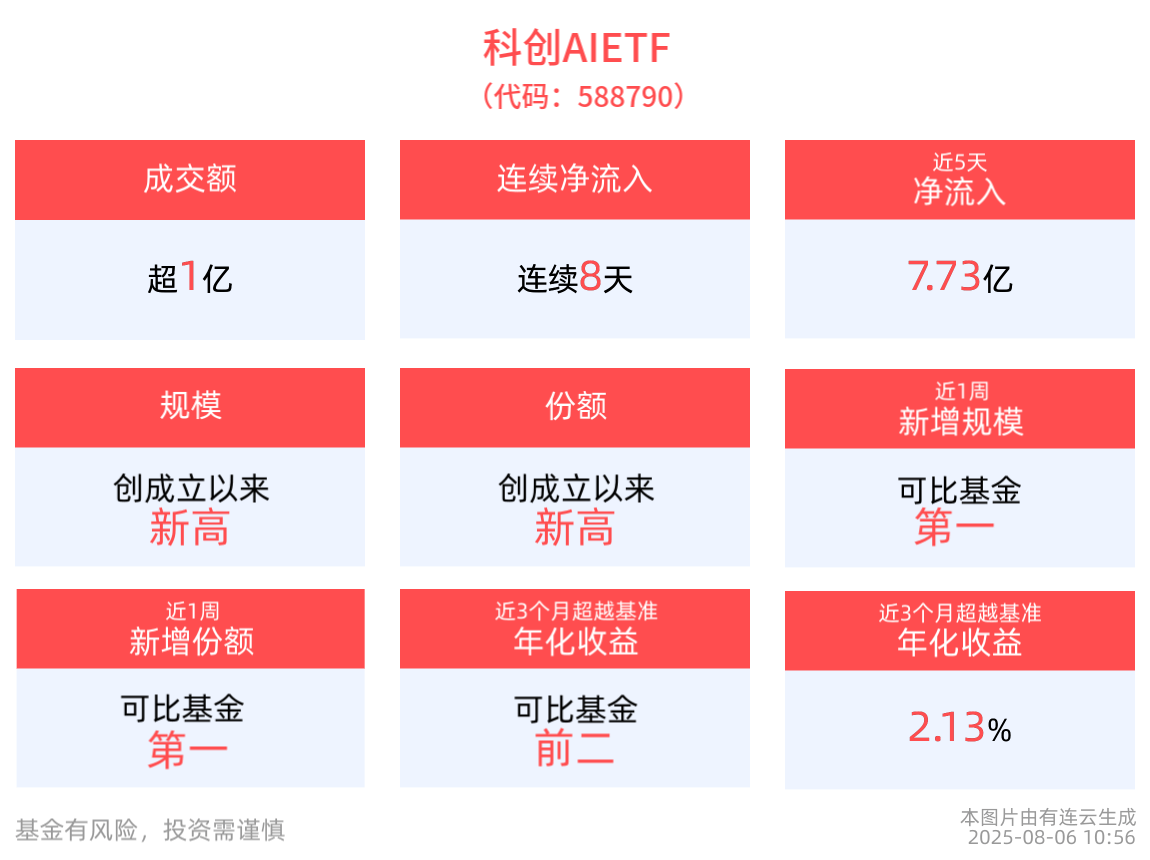
多领域AI应用商业化落地持续加速,科创AIETF(588790)盘中涨近1%,连续8天获资金净流入,推升规模、份额再创新高
Sou Hu Cai Jing· 2025-08-06 03:14
Core Viewpoint - The AI sector in China is experiencing rapid commercialization, particularly in education and human resources, with significant growth in sales and product launches [3][4]. Group 1: Market Performance - As of August 6, 2025, the Shanghai Stock Exchange Sci-Tech Innovation Board Artificial Intelligence Index (950180) increased by 0.99%, with notable gains from stocks like Lanke Technology (688008) and Lingyun Optics (688400) [3]. - The Sci-Tech AI ETF (588790) reached a new high in scale at 6.484 billion yuan, ranking first among comparable funds [4]. - The ETF has seen a net inflow of 1.318 billion yuan over the past eight days, with a peak single-day inflow of 276 million yuan [4]. Group 2: Investment Opportunities - The report suggests focusing on two main investment directions: the AI industry chain, particularly AI applications and computing power, and structural innovations in sectors like financial technology and special IT [4]. - The AI sector is expected to continue driving growth, with new innovations emerging across the industry [4]. Group 3: Fund Performance Metrics - The Sci-Tech AI ETF has achieved a net value increase of 12.64% over the past six months, ranking first among comparable funds [5]. - The ETF's management fee is 0.50%, and the tracking error over the past month is 0.009%, indicating high tracking precision [5]. - The top ten weighted stocks in the index account for 67.36% of the total index weight, highlighting concentrated investment in key players [6][7].
把握新一轮AI创新落地周期,科创人工智能ETF华夏(589010)打开配置窗口!
Mei Ri Jing Ji Xin Wen· 2025-08-05 05:40
Core Viewpoint - The article discusses the performance and potential of the Huaxia Sci-Tech AI ETF (589010), highlighting its slight decline and the opportunities it presents for investing in high-quality assets within the AI and Sci-Tech sectors [1][2]. Market Performance - As of 10:56 today, the Huaxia Sci-Tech AI ETF (589010) is down 0.09%, showing slight fluctuations around the zero axis, indicating a clear consolidation pattern [1]. - The leading stocks in the ETF include Aerospace Hongtu, which rose by 3.19%, and Zhongke Xingtou and Yuntian Lihui, both with gains exceeding 2%. Conversely, Foxit Software led the decline with a drop of 3.03%, along with Hehe Information and Yaxin Security, both falling over 2% [1]. Liquidity and Trading Activity - The trading volume during the session exceeded 12%, with a transaction amount reaching 8.6 million yuan, reflecting active market participation [1]. Industry Insights - GitHub announced that its GitHub Models service now offers free, OpenAI-compatible APIs to all users, aimed at automating project tasks and enhancing development efficiency for enterprise users [1]. - CITIC Securities released a report suggesting that investors should seize the new round of innovation cycles expected in the second half of 2025, with a focus on the AI industry chain and structural innovations in sectors like financial technology and special IT [1]. Investment Directions - Two main investment directions are highlighted: 1. AI Industry Chain: Emphasis on the "AI main line," with optimism regarding opportunities in AI applications and computing power sectors [1]. 2. Prosperity Innovations: Recommendations to pay attention to structural innovation opportunities in areas such as trusted computing, financial technology innovation, and special IT [1].
午评:沪指震荡走强涨0.53% PEEK材料概念股集体爆发
Xin Hua Cai Jing· 2025-08-05 04:04
Market Performance - A-shares showed mixed performance on August 5, with the Shanghai Composite Index rising to 3602.13 points, up 0.53%, and the Shenzhen Component Index increasing by 0.14% to 11056.69 points, while the ChiNext Index fell by 0.26% to 2328.36 points [1] - The total trading volume in the Shanghai and Shenzhen markets reached 1.01 trillion yuan, an increase of 84.9 billion yuan compared to the previous trading day [1] Sector Performance - The PEEK materials sector saw significant gains, with stocks like Zhongxin Fluorine Materials hitting the daily limit, and others like Xinhan New Materials and Nanjing Julong rising over 10% [1] - Other sectors that performed well included consumer electronics, small home appliances, banks, carbon fiber, and photolithography machines [2] - Conversely, the pharmaceutical sector experienced a collective decline, with stocks like Qizheng Tibetan Medicine hitting the daily limit down, and others like Anglikang and Nanjing New Medicine dropping over 9% [1][2] Institutional Insights - Huatai Securities expressed optimism about the commercial real estate sector, highlighting that leading operators' shopping center assets exceed the fair value of investment properties, with C-REITs providing a smoother path for realizing this value [3] - CITIC Securities suggested focusing on the new round of innovation cycle expected in the second half of 2025, particularly in the AI industry chain and structural innovations in fintech and special IT [3] - China International Capital Corporation noted the trend towards lightweight humanoid robots, emphasizing the benefits of lightweight materials like aluminum, magnesium, and PEEK in enhancing performance and safety [3] Industry News - The China Real Estate Association announced initiatives to support the healthy development of small and medium-sized real estate companies, including financial services and sales promotion mechanisms [4]