
银行资产质量

Search documents
农业银行(601288)2025年三季报点评:收入利润继续保持正增长
Ge Long Hui· 2025-11-01 11:53
Core Viewpoint - The company has maintained positive growth in revenue and profit for the first three quarters of 2025, with a year-on-year increase in operating income and net profit, indicating a stable financial performance despite some declines in key ratios [1][2]. Financial Performance - Operating income for the first three quarters reached 550.9 billion yuan, a year-on-year growth of 2.0%, with an increase of 1.2 percentage points compared to the first half of the year [1]. - Net profit attributable to shareholders for the same period was 220.9 billion yuan, reflecting a year-on-year increase of 3.0%, with a slight recovery in growth rate of 0.3 percentage points from the first half [1]. - The annualized weighted average ROE stood at 10.5%, showing a decrease of 0.3 percentage points year-on-year [1]. Asset Growth - Total assets grew by 10.5% year-on-year to 48.1 trillion yuan by the end of the third quarter, with an increase of 11.3% since the beginning of the year [1]. - Deposits increased by 5.8% year-to-date to 32.1 trillion yuan, while total loans rose by 8.3% to 26.9 trillion yuan [1]. - The core Tier 1 capital adequacy ratio was 11.16%, down 0.26 percentage points from the beginning of the year [1]. Interest Margin - The average net interest margin for the first three quarters was 1.30%, a decrease of 15 basis points year-on-year, with a slight widening of the decline by 2 basis points compared to the first half [1]. - Net interest income decreased by 2.4% year-on-year, with the average net interest margin for the third quarter at 1.26%, down 4 basis points from the second quarter [1]. Non-Interest Income - Net fee income grew by 13.3% year-on-year, continuing the high growth trend observed in the mid-year report, primarily driven by increased income from wealth management and fund distribution [2]. - Other non-interest income surged by 31.7% year-on-year, mainly due to increased bond investment income [2]. Asset Quality - The non-performing loan ratio was 1.27% at the end of the third quarter, down 0.03 percentage points from the beginning of the year and 0.01 percentage points from the second quarter [2]. - The provision coverage ratio was 295%, a decrease of 5 percentage points year-on-year, remaining stable compared to the second quarter [2]. Investment Outlook - The company maintains its profit forecast unchanged, expecting net profits attributable to shareholders of 292.4 billion, 301.9 billion, and 313.3 billion yuan for 2025-2027, with year-on-year growth rates of 3.7%, 3.2%, and 3.8% respectively [2]. - The diluted EPS is projected to be 0.78, 0.81, and 0.84 yuan for the same period, with corresponding PE ratios of 10.4, 10.1, and 9.7 times, and PB ratios of 1.03, 0.96, and 0.90 times [2].

银行业绩下行周期接近尾声 资产质量改善趋势确立
Jing Ji Guan Cha Wang· 2025-10-31 11:50
Core Viewpoint - The apparent stability of bank non-performing loan (NPL) ratios conceals deeper structural changes, indicating that the era of "soft landing" achieved through provisioning adjustments and risk rotation is nearing its end [2][8] Group 1: Banking Performance - China Construction Bank reported a 1.44% year-on-year increase in operating income to 560.281 billion yuan for the first three quarters of 2025, with net profit rising by 0.52% to 258.446 billion yuan [3] - The bank's asset quality remains robust, with a non-performing loan ratio of 1.32%, down 0.02 percentage points from the end of the previous year, and a provisioning coverage ratio of 235.05%, up 1.45 percentage points [3] - Other major banks, such as China Bank and Postal Savings Bank, also show varying levels of asset quality, with China Bank's NPL ratio at 1.24% and Postal Savings Bank's NPL ratio at 0.94% [4] Group 2: Risk Assessment - Some joint-stock banks are experiencing thinner provisioning buffers, with Everbright Bank's NPL ratio at 1.26% and a provisioning coverage ratio of 168.92%, nearing regulatory warning lines [5] - In contrast, certain regional banks demonstrate stronger risk resilience, such as Chengdu Bank with an NPL ratio of only 0.68% and a provisioning coverage ratio of 433.08% [6] - The focus of risk has shifted from corporate to retail, with banks like China Merchants Bank reporting an increase in attention loans, indicating rising concerns in personal lending sectors [7] Group 3: Future Outlook - The banking industry is expected to face a genuine stress test as excess provisioning space narrows and retail risks continue to emerge, marking a transition from scale expansion to quality prioritization [2][8] - The ability to balance risk clearance and sustainable profits will determine the future restructuring of the industry [8]








杭州银行(600926):信贷投放积极,利润维持两位数增长
Western Securities· 2025-10-31 11:01
Investment Rating - The investment rating for Hangzhou Bank is "Buy" [6][11] Core Views - Hangzhou Bank reported a revenue of 28.9 billion yuan for Q1-Q3 2025, a year-on-year increase of 1.35%, and a net profit attributable to shareholders of 15.9 billion yuan, up 14.53% year-on-year [1][6] - The non-performing loan ratio at the end of Q3 2025 was 0.76%, unchanged from the end of Q2, with a provision coverage ratio of 513.64%, which decreased by 7.3 percentage points quarter-on-quarter [1][3] - The bank's performance is supported by a narrowing decline in interest margins and a significant increase in credit scale, leading to a sustained recovery in net interest income growth [1][3] Financial Performance - For Q1-Q3 2025, net interest income grew by 9.96% year-on-year, while non-interest income decreased by 24.74% [1][2] - Total assets and total loans grew by 13.76% and 12.68% year-on-year, respectively, with corporate loans increasing by 19.6 billion yuan in Q3 [2][3] - The bank's return on equity (ROE) for the first three quarters was 16.91%, outperforming its peers [3] Asset Quality - The non-performing loan ratio has remained stable at 0.76% for 11 consecutive quarters, indicating strong asset quality [3] - The provision coverage ratio, despite a slight decrease, remains above 500%, suggesting adequate provisions to smooth future profit fluctuations [3] Future Profit Growth - The projected profit growth rates for Hangzhou Bank are 14.13%, 11.14%, and 9.77% for 2025, 2026, and 2027, respectively [3][4]

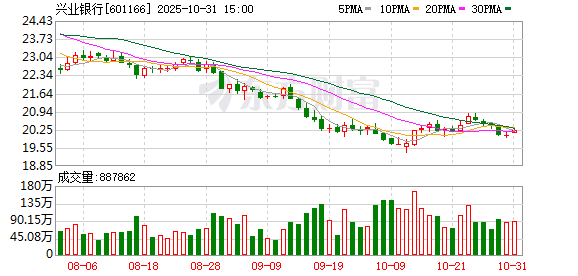
兴业银行三季报:风险收敛 百亿分红“在路上”
Di Yi Cai Jing· 2025-10-31 07:06
Core Viewpoint - Industrial Bank reported its Q3 earnings, revealing a continued decline in revenue but with a narrowing rate of decrease, alongside a proposed cash dividend distribution for 2025 [2][3]. Financial Performance - For the first three quarters, Industrial Bank achieved operating revenue of 161.23 billion yuan, a year-on-year decrease of 1.82%, with the decline rate narrowing by 0.47 percentage points compared to the first half of the year [2]. - Net interest income fell by 0.56% year-on-year, while net fee and commission income increased by 3.79% [2]. - The bank's net profit attributable to shareholders reached 63.08 billion yuan, a slight increase of 0.12% year-on-year [3]. Deposit and Loan Growth - Total deposits amounted to 5.83 trillion yuan, reflecting a growth of 5.47% since the beginning of the year, with the interest rate on deposits decreasing by 32 basis points year-on-year to 1.71% [3]. - Total loans reached 5.99 trillion yuan, up 4.42% year-to-date, with corporate loans increasing by 7.54% and personal loans decreasing by 2.49% [3]. Asset Quality - The non-performing loan balance stood at 64.56 billion yuan, an increase of 30.83 billion yuan from the end of the previous year, with a non-performing loan ratio of 1.08% [4]. - The bank reported a decrease in new non-performing assets and a lower non-performing asset generation rate compared to the previous year [4][5]. Shareholder Activity - Significant shareholder activity was noted, with major shareholders increasing their stakes in Industrial Bank, including the Fujian Provincial Finance Department and other entities [5].

北京银行(601169.SH):前三季度归母净利润210.64亿元,同比增长0.26%
Ge Long Hui A P P· 2025-10-30 15:54
Core Viewpoint - Beijing Bank (601169.SH) reported a slight decline in revenue for the first three quarters of the year, while net profit showed a modest increase, indicating stable performance amidst challenging market conditions [1] Financial Performance - The bank achieved an operating income of 51.588 billion yuan, a year-on-year decrease of 1.08% [1] - The net profit attributable to shareholders reached 21.064 billion yuan, reflecting a year-on-year growth of 0.26% [1] Revenue Composition - Net interest income for the first three quarters was 39.246 billion yuan, representing a year-on-year increase of 1.79% [1] - Net fee and commission income amounted to 3.269 billion yuan, showing a significant year-on-year growth of 16.92% [1] Asset Quality - As of the end of the third quarter, the non-performing loan ratio stood at 1.29%, a decrease of 0.02 percentage points compared to the end of the previous year [1] - The provision coverage ratio was 195.79%, down by 12.96 percentage points from the end of last year [1] Wealth Management - The bank has nearly 100 cooperative distribution agencies and has cumulatively distributed over 3,200 wealth management products, with the scale of personal wealth management distribution exceeding the total increase of the previous year [1]

合计盈利1.07万亿元!六大行,“交卷”
Shang Hai Zheng Quan Bao· 2025-10-30 15:47
Core Viewpoint - The six major state-owned banks in China have reported stable performance in their Q3 2025 results, showcasing robust asset growth and positive profit growth across the board [1][2]. Group 1: Profit Performance - The six major banks achieved a total net profit of 1.07 trillion yuan in the first three quarters, with all banks reporting positive growth in net profit [1][2]. - Individual net profits for the banks are as follows: Industrial and Commercial Bank of China (ICBC) 269.91 billion yuan, Agricultural Bank of China (ABC) 220.86 billion yuan, China Construction Bank (CCB) 257.36 billion yuan, Bank of China (BOC) 177.66 billion yuan, Postal Savings Bank of China (PSBC) 76.56 billion yuan, and Bank of Communications (BoCom) 69.99 billion yuan, with year-on-year growth rates of 0.33%, 3.03%, 0.62%, 1.08%, 0.98%, and 1.9% respectively [2]. - In Q3 alone, BOC's net profit grew by 5.1% year-on-year, attributed to improved asset quality and reduced provision for credit losses [2]. Group 2: Revenue Growth - All six banks reported revenue growth, with total revenues as follows: ICBC 640.03 billion yuan, ABC 550.88 billion yuan, CCB 573.70 billion yuan, BOC 491.20 billion yuan, PSBC 265.08 billion yuan, and BoCom 199.64 billion yuan, reflecting year-on-year growth rates of 2.17%, 1.97%, 0.82%, 2.69%, 1.82%, and 1.80% respectively [2]. - BOC recorded the fastest revenue growth among the banks [2]. Group 3: Net Interest Margin - The net interest margin (NIM) for the six banks has been narrowing, with the following NIMs reported: ICBC 1.28%, ABC 1.30%, CCB 1.36%, BOC 1.26%, PSBC 1.68%, and BoCom 1.20%, all showing a year-on-year decline [3]. - PSBC maintains the highest NIM, reflecting strong performance in the industry [3]. Group 4: Asset Quality - The asset quality of the six banks remains stable, with non-performing loan (NPL) ratios improving as of the end of September: ICBC 1.33%, ABC 1.27%, CCB 1.32%, BOC 1.24%, PSBC 0.94%, and BoCom 1.26%, all showing improvement compared to the end of the previous year [4]. - PSBC continues to have the lowest NPL ratio in the industry [4]. Group 5: Dividend Distribution - Several banks have announced interim dividend plans, pending shareholder approval, with proposed dividends per 10 shares as follows: ICBC 1.414 yuan, ABC 1.195 yuan, CCB 1.858 yuan, BOC 1.094 yuan, PSBC 1.230 yuan, and BoCom 1.563 yuan, totaling a dividend payout of 204.66 billion yuan [4].


苏农银行(603323):保风险、稳投放,盈利稳健增长
Shenwan Hongyuan Securities· 2025-10-30 09:45
Investment Rating - The report maintains a "Buy" rating for Su Nong Bank [3] Core Views - Su Nong Bank reported a revenue of 3.22 billion yuan for the first nine months of 2025, reflecting a year-on-year growth of 0.1%, and a net profit attributable to shareholders of 1.71 billion yuan, up 5.0% year-on-year [1] - The bank's non-performing loan (NPL) ratio remained stable at 0.90% quarter-on-quarter, while the provision coverage ratio decreased by 31 percentage points to 356% [1] - The management's focus on steady profit growth is evident despite challenges such as revenue pressure and VAT adjustments [6] Financial Data and Profit Forecast - Total revenue is projected to grow from 4,045.97 million yuan in 2023 to 4,620.52 million yuan in 2027, with a compound annual growth rate (CAGR) of approximately 4.5% [2] - The net profit attributable to shareholders is expected to increase from 1,742.59 million yuan in 2023 to 2,264.95 million yuan in 2027, with a CAGR of about 7.0% [2] - The bank's return on equity (ROE) is forecasted to decline from 11.62% in 2023 to 9.98% in 2027 [2] Performance Analysis - The bank's net interest income decreased by 3.8% year-on-year in the first nine months of 2025, primarily due to a narrowing interest margin [6] - Non-interest income grew by 7.9% year-on-year, contributing positively to revenue growth [6] - The bank's loan growth accelerated to 8.7% in the third quarter of 2025, driven by increased demand from small and medium-sized enterprises [6][10] Risk Management - The bank's management has adopted a cautious approach to credit expansion, particularly in urban areas, to mitigate risks while maintaining profitability [6] - The NPL generation rate is estimated to stabilize at around 0.8% for the first nine months of 2025, indicating effective risk management practices [9] Market Data - As of October 30, 2025, the closing price of Su Nong Bank's shares was 5.17 yuan, with a price-to-book (PB) ratio of 0.6 and a dividend yield of 5.22% [3] - The bank's market capitalization is approximately 10.436 billion yuan [3]

招商银行(600036):非息持续改善,资产质量优异
Tianfeng Securities· 2025-10-30 08:12
Investment Rating - The investment rating for the company is "Accumulate" (maintained) with a target price not specified [6]. Core Views - The company has shown improvement in both revenue and profit, with a slight decline in revenue of 0.51% year-on-year for the first three quarters of 2025, but a profit increase of 0.52% year-on-year [2]. - The net interest margin remains resilient at 1.87%, with a slight decrease of 1 basis point compared to the first half of 2025 [2]. - Non-interest income has shown overall improvement, with net fee and commission income increasing by 0.9% year-on-year [2]. Financial Performance Summary - For the first three quarters of 2025, the company achieved operating income of approximately 2514.2 billion yuan, with net interest income of 1600.42 billion yuan (YoY +1.74%) and non-interest income of 913.78 billion yuan (YoY -4.23%) [2]. - The company’s total interest-earning assets reached 12.26 trillion yuan, growing by 8.58% year-on-year, with loans and financial investments increasing by 5.78% and 21.17% respectively [3]. - The non-performing loan ratio stands at 0.91%, showing a slight improvement, while the loan provision coverage ratio is at 405.9% [4]. Profit Forecast and Valuation - The company is expected to see a net profit growth of 0.80%, 3.44%, and 4.85% for the years 2025 to 2027 respectively, with corresponding book values per share of 48.54, 54.91, and 60.26 yuan [5]. - The projected operating income for 2025 is 3384 billion yuan, with a slight growth rate of 0.28% [19].
成都银行2025Q3点评:规模保持较快扩张,营收利润双稳健
Xin Lang Cai Jing· 2025-10-29 21:07
Group 1 - The company achieved revenue and net profit of 17.761 billion yuan and 9.493 billion yuan respectively in the first three quarters of 2025, with year-on-year growth of 3.01% and 5.03%, showing a decline in growth rates compared to the first half of the year [1] - Total assets grew by 13.4% year-on-year, exceeding 1.38 trillion yuan by the end of September 2025, indicating steady expansion [1] - The company's net interest margin for Q3 2025 was 1.45%, a decrease of 3 basis points from Q2, while net interest income increased by 8.2% year-on-year to 14.725 billion yuan, reflecting a recovery in growth rate [1] - The non-performing loan ratio was 0.68% at the end of September, a slight increase of 2 basis points from June, but still at a low level, with a provision coverage ratio of 433.08% [1]
江阴银行(002807):Q3营收归母净利润同比稳健提升,净息差回升:——江阴银行(002807):2025年三季度点评
Guohai Securities· 2025-10-29 14:03
Investment Rating - The investment rating for Jiangyin Bank is "Buy" (maintained) [1] Core Views - Jiangyin Bank's Q3 2025 revenue increased by 6.17% year-on-year, while net profit attributable to shareholders rose by 13.38%, supported by significant growth in bond investment income [5] - The bank's total assets grew steadily, with corporate loans performing exceptionally well, and the non-performing loan ratio improved [5] - The net interest margin has rebounded, indicating a positive trend in asset quality [5] Summary by Sections Financial Performance - In Q3 2025, Jiangyin Bank achieved operating revenue of 3.203 billion yuan, up 6.17% year-on-year, with a growth rate increase of 4.84 percentage points compared to the same period last year [5] - The net profit attributable to shareholders reached 1.278 billion yuan, reflecting a year-on-year increase of 13.38%, with a growth rate increase of 6.59 percentage points compared to the previous year [5] - Investment income surged by 53.71% to 9.319 billion yuan, significantly contributing to overall profitability [5] Asset Quality and Growth - As of the end of Q3 2025, Jiangyin Bank's total assets amounted to 208 billion yuan, representing a 3.90% increase from the end of 2024 [5] - Customer deposits totaled 165.1 billion yuan, up 8.73% year-on-year, while total loans reached 132 billion yuan, increasing by 6.31% [5] - Corporate loans specifically grew by 9.92% to 95.2 billion yuan [5] Profitability and Forecast - The net interest margin for the first three quarters of 2025 was 1.56%, an increase of 2 basis points from the first half of 2025 [5] - The non-performing loan ratio improved to 0.85%, down 1 basis point from the first half of 2025, with a provision coverage ratio of 371.91% [5] - Revenue forecasts for 2025-2027 are 4.233 billion, 4.540 billion, and 4.893 billion yuan, with year-on-year growth rates of 6.84%, 7.25%, and 7.78% respectively [7]