
长臂管辖

Search documents
中国式长臂管辖:这场稀土战争,我们赢定了
Sou Hu Cai Jing· 2025-10-14 13:27
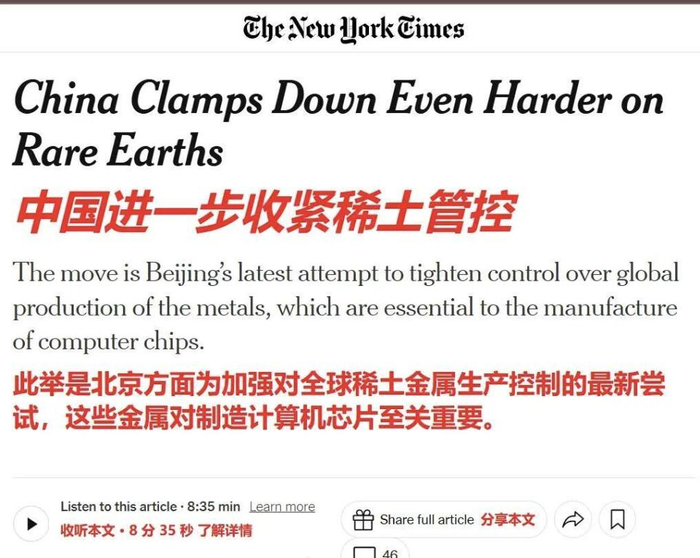
Core Viewpoint - China has escalated its rare earth export controls, invoking national security reasons and implementing a "long-arm jurisdiction" over the global rare earth supply chain, which significantly impacts U.S. military capabilities [1][3][16] Group 1: China's Rare Earth Strategy - China is using advanced technologies such as blockchain tracking and nano-level electronic tagging to monitor the entire rare earth supply chain, ensuring transparency while controlling military exports [11] - The dual-track control system allows for civilian use while restricting military applications, effectively targeting U.S. military needs without disrupting normal trade [11][16] - China's rare earth processing capabilities are unmatched, with the ability to achieve a purity level of 99.999%, creating a monopoly in the market [6] Group 2: Impact on U.S. Military - The U.S. is heavily reliant on China for rare earth processing, with 90% of its rare earth elements processed in China, making it vulnerable to supply chain disruptions [6] - The F-35 fighter jet, for example, requires 417 kilograms of rare earth materials, and the U.S. military's rare earth inventory can only last for six months under current export controls [8] - The production of F-35s has drastically decreased from 143 units in 2022 to an expected 36 units in 2024 due to rare earth supply constraints [8] Group 3: Long-term Strategic Implications - The ongoing U.S.-China competition over rare earths is not just a resource battle but also a technological and strategic one, with China actively controlling standards and technology across the supply chain [16][18] - The U.S. faces significant barriers in establishing its own rare earth production capabilities, which could take 5 to 10 years, leaving China in a position of leverage [13] - China's strategy aims to ensure that the U.S. remains dependent on its rare earth market, thereby maximizing the strategic value of these resources [16][18]

外媒:中国此次的稀土新规在学美国的长臂管辖,但有没有这个能力存在很大问号?
Sou Hu Cai Jing· 2025-10-13 10:32
Core Viewpoint - China's new regulations on rare earths are seen as an attempt to emulate the U.S. long-arm jurisdiction, but there are significant doubts about China's capability to enforce such measures [1] Group 1: Impact on China's Rare Earth Industry - Long-term implications suggest that China's rare earth industry may face setbacks, leading to a reduction in its international market share [1] - The immediate concern is the potential disruption in rare earth supply, which could have significant repercussions for various industries reliant on these materials [3] Group 2: Perception and Response - Singapore's perspective reflects a belief that the U.S. maintains superiority over China, indicating a tendency to align with U.S. views [3] - There is skepticism regarding China's ability to effectively manage its rare earth resources in the face of international pressures, with historical examples cited where China’s assertiveness led to significant consequences for other nations [3]
美国制裁组合拳打击伊朗能源链,中国炼厂与港口成关键变局焦点
Sou Hu Cai Jing· 2025-10-12 23:01
Core Insights - The recent sanctions imposed by the U.S. target Iran's energy trade, specifically aiming to disrupt its cash flow from oil exports [1][9] - The sanctions are a coordinated effort between the U.S. Treasury and State Department, focusing on both logistics and key buyers in the energy supply chain [3][12] Group 1: Sanction Details - Over fifty entities were sanctioned by the Treasury, primarily those facilitating the transportation of Iranian liquefied petroleum gas [3] - The State Department announced measures against around forty additional entities, focusing on major buyers of Iranian petrochemical products [3][12] - The sanctions extend beyond Iranian entities to include a Chinese port and a small private refinery, indicating a broader geographical focus [5][6] Group 2: Impact on Chinese Entities - Shandong Jincheng Petrochemical Group was named in the sanctions for purchasing millions of barrels of Iranian oil since 2023 [6] - The port involved, Lianshan Port, has received millions of barrels of Iranian crude oil via a fleet of "shadow ships," which are vessels that operate under the radar to evade sanctions [6][11] - The sanctions create compliance risks for all entities involved in the supply chain, as any connection to sanctioned entities could lead to increased scrutiny and potential sanctions [6][11] Group 3: Broader Context and Strategy - This round of sanctions is part of a sustained effort since the Trump administration, aimed at pressuring Chinese buyers to sever ties with Iran [7][14] - The U.S. employs a strategy of "peripheral containment," expanding sanctions to third-party participants in the energy trade [14] - The dual approach of the Treasury and State Department aims to create a chilling effect across the entire supply chain, from shipping to refining [12][14] Group 4: Market Reactions and Future Implications - The sanctions are expected to lead to increased costs for insurance and financing, as companies may become more cautious in their dealings with Iranian oil [11] - The "shadow fleet" may adapt by changing flags and using complex corporate structures to continue operations despite sanctions [11] - The ongoing sanctions and their implications will require companies to reassess their risk management strategies and compliance measures [13][15]
《纽约时报》:台积电因芯片含中国稀土,无法向美国出售任何半导体芯片
Xin Lang Cai Jing· 2025-10-12 04:25
Core Insights - The article outlines the implications of China's rare earth export controls as a response to U.S. technology restrictions, highlighting the ongoing tech rivalry between China and the U.S. [1] - The measures taken by China are seen as a legitimate counteraction to U.S. "long-arm jurisdiction," aiming to reshape global industry power dynamics [4][8] Summary by Sections - **U.S. Technology Restrictions** The U.S. has weaponized technology controls under the guise of national security, implementing chip export restrictions since 2022 and planning to blacklist 136 Chinese semiconductor entities by December 2024 [1][4] - **China's Rare Earth Controls** China's new regulations, effective from October 2025, will control not only rare earth materials but also any items with over 0.1% "Chinese content," particularly focusing on sensitive applications like chips below 14nm [4][5] - **Impact on Semiconductor Industry** The restrictions target critical components in the global semiconductor supply chain, affecting companies like ASML and TSMC, which rely on rare earth materials for high-end chip production [5][10] - **Strategic Response** China's measures are framed as a defense against the military use of sensitive technologies, contrasting with U.S. sanctions that often invoke "Taiwan-related" justifications [7][8] - **Legal Framework** China has established a legal framework centered around the Anti-Foreign Sanctions Law and Export Control Law, which further clarifies its operational pathways against U.S. sanctions [8][12] - **Global Supply Chain Dynamics** A RAND Corporation warning indicates that a 90-day disruption in China's rare earth supply could halt production for 78% of U.S. defense contractors, underscoring the importance of resource management in maintaining competitive advantage [10] - **Call for Cooperation** The article emphasizes that true technological competition should be based on open cooperation rather than zero-sum games, advocating for respect for sovereignty and adherence to rules in global tech governance [12]


积极落实元首通话共识,充分发挥磋商机制作用,中美马德里会谈达成框架共识
Huan Qiu Shi Bao· 2025-09-16 23:00
Core Points - The recent talks in Madrid between Chinese and American economic leaders resulted in a basic framework consensus on key trade issues, including the TikTok situation, investment barriers, and promoting economic cooperation [1][2][3] - Both sides expressed a commitment to maintaining a stable and healthy economic relationship, emphasizing mutual respect and equal negotiation [2][4] Group 1: Economic Cooperation - The discussions highlighted the importance of a stable and healthy Sino-American economic relationship, which is crucial for both parties [2][3] - The Chinese side emphasized the need to respect corporate intentions and market principles while addressing the TikTok issue, indicating a willingness to negotiate without compromising core principles [5][6] Group 2: TikTok and Technology Issues - The Chinese government reiterated its opposition to politicizing technology and trade issues, asserting that it will not sacrifice principles or corporate interests for any agreement [5][6] - There was a consensus on addressing TikTok's operational and data security concerns through authorized operations and intellectual property rights, while ensuring compliance with Chinese laws [5][6] Group 3: Regulatory Environment - The Chinese side called for a fair and non-discriminatory business environment for Chinese companies operating in the U.S., including TikTok [6] - The ongoing U.S. sanctions and the expansion of the entity list were criticized by the Chinese representatives, who labeled these actions as unilateral bullying and contrary to international norms [7][8] Group 4: Future Negotiations - The talks are seen as a step towards resolving significant economic differences, with both sides encouraged to continue dialogue and seek further agreements [8] - Experts suggest that the U.S. should abandon unilateral sanctions and respect China's concerns to foster a more stable economic relationship [8]
外交部:中方坚决反对有关方面动辄拿中方说事,坚决反对对中方滥施非法单边制裁和“长臂管辖”
Huan Qiu Wang· 2025-09-15 07:49
Core Viewpoint - The Chinese government defends its energy cooperation with Russia as legitimate and criticizes the U.S. for unilateral economic coercion, which undermines international trade rules and threatens global supply chain stability [1] Group 1: China's Position on Energy Cooperation - China engages in normal economic and energy cooperation with countries including Russia, which is deemed legitimate and justifiable [1] - The U.S. approach is characterized as unilateral bullying and economic coercion, which disrupts international economic rules [1] Group 2: Response to U.S. Actions - The Chinese government asserts that coercive measures by the U.S. are ineffective and do not resolve issues [1] - China maintains a consistent and clear stance on the Ukraine crisis, advocating for dialogue and negotiation as the only viable solution [1] Group 3: China's Stance on Sanctions - China opposes the use of illegal unilateral sanctions and "long-arm jurisdiction" against it [1] - If China's legitimate rights are harmed, it will firmly counteract to protect its sovereignty, security, and development interests [1]
美制裁胡塞武装涉及中企,外交部回应
券商中国· 2025-09-12 10:07
Group 1 - The Chinese Ministry of Foreign Affairs firmly opposes the unilateral sanctions and "long-arm jurisdiction" imposed by the United States, stating that such actions violate international law and the basic principles of international relations [1] Group 2 - The U.S. Treasury Department has announced new sanctions targeting several Chinese companies involved in transporting military-grade components to the Houthi armed group in Yemen, as well as other companies facilitating the delivery of dual-use goods [1]
连续降息三次,美联储定了?7国停止邮寄包裹,中方将反击,特朗普突然痛下黑手
Sou Hu Cai Jing· 2025-08-27 03:11
Group 1 - The Federal Reserve is expected to lower interest rates in September, with a high probability of three rate cuts throughout the year, driven by unexpected declines in U.S. employment data and economic uncertainty [1][3] - The U.S. stock market reacted positively to the Fed's signals, with the Nasdaq reaching new highs, as Wall Street investment banks began to promote a new bull market for U.S. stocks [3] - Seven countries have announced a suspension of package services to the U.S., which is a significant response to U.S. unilateralism and could impact the U.S. logistics and e-commerce sectors [1][5] Group 2 - The suspension of package services is a direct consequence of the U.S. changing its low-value tax exemption policy, which previously allowed for a significant volume of imports without tariffs [5] - The U.S. Treasury has imposed sanctions on two Chinese companies for allegedly facilitating oil transport for Iran, which has drawn strong opposition from China, emphasizing the illegitimacy of unilateral sanctions [5][7] - The U.S. strategy of using financial dominance and sanctions to control global trade is facing resistance, as Chinese companies are adapting and strengthening their risk management capabilities in response to U.S. pressures [7]
抓我人锁你城!中方扣留富国银行高管,华尔街3天蒸发12%逼美服软
Sou Hu Cai Jing· 2025-08-26 04:35
Group 1 - Xu Zewei is an IT manager at Shanghai Jita Semiconductor, which specializes in automotive-grade chips for electric vehicles, achieving a significant breakthrough in 28nm technology with a yield of 92% [3][6] - The company has been impacted by the U.S. accusations against Xu, who is charged with participating in a cyber attack on a U.S. vaccine research institution, with nine counts including telecom fraud and identity theft [3][4] - The U.S. claims are based on an email record, which has been challenged by Xu's defense, citing the commonality of his name in China and the possibility of his email being compromised [4][6] Group 2 - The incident reflects the broader context of U.S. long-arm jurisdiction tactics against foreign executives, similar to past cases involving Huawei and Alstom [6][9] - Italy faces a dilemma in balancing its trade relationships with both China and the U.S., as China is a significant trade partner while the U.S. accounts for 18.7% of Italy's exports [13] - The Italian court ultimately ruled in favor of Xu, stating that the evidence provided by the U.S. was insufficient, marking a significant victory for China in this international legal dispute [15][17]

面对美国“长臂管辖” 巴西最高法院作出裁决捍卫国家司法主权
Yang Shi Xin Wen Ke Hu Duan· 2025-08-20 06:35
Core Viewpoint - The Brazilian Federal Supreme Court ruled that foreign laws, judicial decisions, or administrative orders not approved by Brazilian judicial authorities are ineffective in Brazil, constituting a violation of national sovereignty [1] Group 1: Legal Implications - The ruling emphasizes that any foreign coercive measures against Brazilian citizens can be challenged directly in the Brazilian Supreme Court [1] - The decision reflects a response to U.S. President Trump's imposition of high tariffs and sanctions against Brazilian Supreme Court judges, highlighting the tension between Brazil and the U.S. [1] Group 2: International Relations - The court's decision indicates a growing concern over the use of protectionism and neo-colonialism by more powerful nations against weaker countries [1] - The ruling points out that the fundamental principles of international law are being undermined by certain countries that threaten others with military force [1]