通胀压力

Search documents
通胀压力未减,美国一季度GDP三年来首降,企业盈利承压
Xin Hua Cai Jing· 2025-06-26 13:46
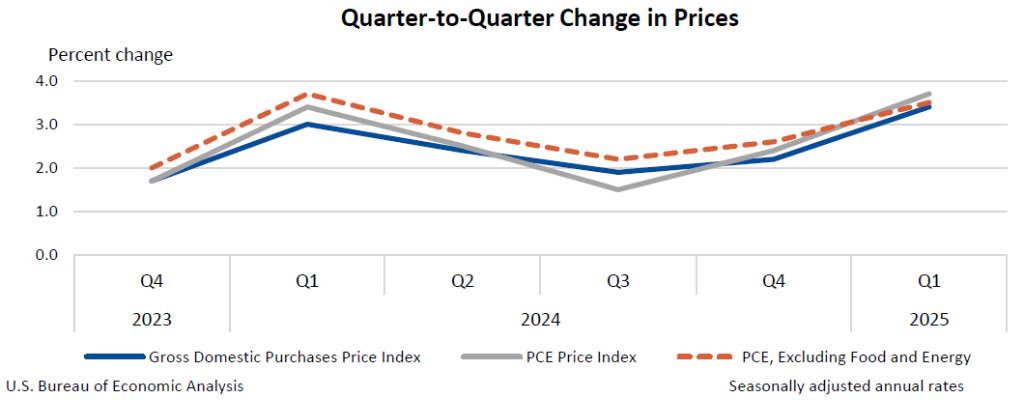
Economic Indicators - The actual GDP decreased by 0.30%, while the current dollar GDP grew by 3.50% [3] - Private domestic purchasers' actual final sales increased by 3.00%, but the import volume surged by 37.9%, significantly lowering GDP by nearly 4.7 percentage points [3] - Government spending saw a year-on-year decline of 4.6%, marking the largest drop since 1986 [3] Industry Performance - The actual value added in the private goods-producing sector fell by 2.8%, and the private services sector decreased by 0.3%, although government sector growth of 2.0% somewhat mitigated the overall decline [4] - The measure of current production profits decreased by $906 million, with a further decline of $275 million compared to previous estimates, indicating severe pressure on corporate earnings [4] Inflation Pressure - Inflation remains a significant concern, with the core PCE price index rising to 3.5%, above the expected 3.4% [5] - The domestic total purchase price index increased by 3.4%, and the PCE price index rose by 3.7%, suggesting a persistent upward trend in prices [5] Corporate Investment - May durable goods orders showed a strong increase of 16.4%, the largest since July 2014, exceeding expectations [6] - Core capital goods orders, a key indicator of business equipment investment, rose by 1.7%, indicating some positive signals in corporate investment despite declining profits [6] Employment Market - Initial jobless claims decreased by 10,000 to 236,000, better than economists' expectations, but layoffs increased, leading to a rise in the number of individuals seeking continued assistance [8] - The unemployment rate is expected to rise from 4.2% in May to 4.3% in June, reflecting instability in the job market [8] Monetary Policy - The Federal Reserve has paused its interest rate cuts, maintaining the benchmark overnight rate between 4.25% and 4.50% since December 2024, indicating a cautious approach amid economic uncertainties [8]

美国一季度GDP终值下修至-0.5% 个人消费创疫情以来最弱表现
Hua Er Jie Jian Wen· 2025-06-26 13:45
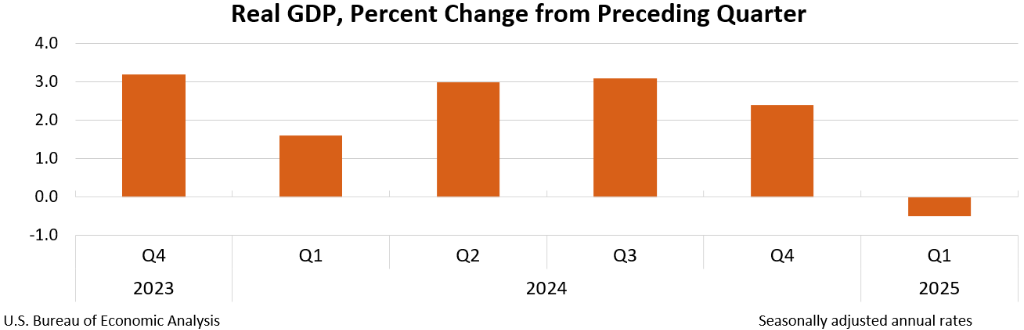
Economic Overview - The U.S. real GDP for the first quarter decreased at an annualized rate of 0.5%, which is worse than the expected decline of 0.2%, marking the first economic contraction in three years [1] - The decline was primarily due to an increase in imports and a decrease in government spending, despite growth in investment and consumer spending [1][4] Consumer Spending - Personal consumption showed the weakest performance since the COVID-19 pandemic, with growth revised down from an initial 1.7% to only 0.5% [6] - The contribution of personal consumption to GDP was only 0.31%, significantly lower than the previously reported 0.80% and 1.21% [7] Investment and Trade - Fixed investment contributed 1.31% to GDP, driven by strong investments in data centers [7] - The trade deficit negatively impacted GDP by approximately 4.76%, slightly better than previous estimates [7] Inflation and Price Indices - The core Personal Consumption Expenditures (PCE) price index rose by 3.5%, indicating persistent inflationary pressures [4][13] - The overall domestic purchases price index increased by 3.4%, reflecting upward adjustments in inflation estimates [13] Future Projections - The next GDP estimate for the second quarter is expected to show a rebound in economic growth, with economists predicting a growth rate of 3% [12]
英国央行行长贝利:开始听到更多关于通过薪资和就业调整来应对通胀压力的迹象。
news flash· 2025-06-26 11:06
Core Viewpoint - The Governor of the Bank of England, Andrew Bailey, has noted an increase in discussions regarding adjustments in wages and employment as a means to address inflationary pressures [1] Group 1 - The Bank of England is observing more signs of wage and employment adjustments being considered to combat inflation [1]
英国央行行长贝利:关于经济中供需整体平衡以及系统内剩余的通胀压力仍存在不确定性。
news flash· 2025-06-26 11:06
Core Viewpoint - The Governor of the Bank of England, Bailey, highlighted ongoing uncertainties regarding the overall balance of supply and demand in the economy, as well as persistent inflationary pressures within the system [1] Group 1 - There is a lack of clarity on the equilibrium between supply and demand in the UK economy [1] - Inflationary pressures remain a concern, indicating that the economic environment is still facing challenges [1]
分析师:黄金周初暴跌后震荡,周四周五能否重返3400?
Sou Hu Cai Jing· 2025-06-25 22:23
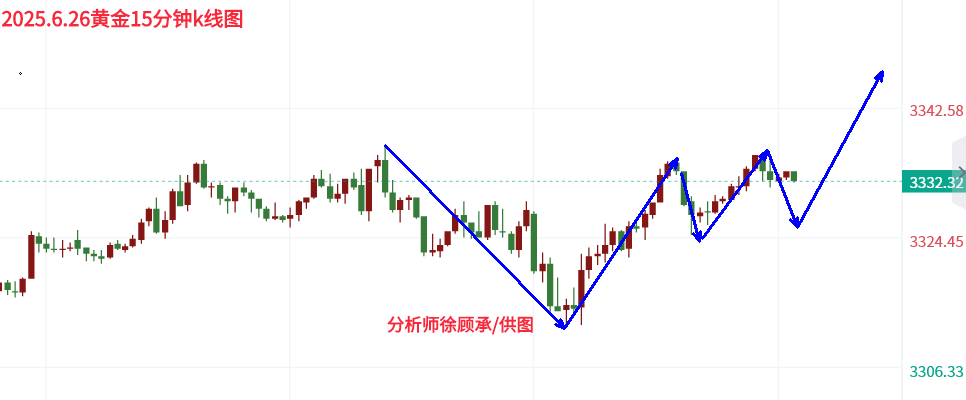
Group 1 - The market sentiment has improved significantly due to a phase ceasefire agreement reached between conflicting parties, which is expected to be implemented in stages [1] - The USD/JPY exchange rate rebounded, the Israeli stock market reached a new high, and US stocks continued to perform strongly, indicating a recovery in overall risk appetite [1] - US inflation data for May showed both CPI and PPI below expectations, with core PPI growth at a one-year low, easing inflationary pressures and increasing market expectations for interest rate cuts by the Federal Reserve [1] Group 2 - Gold prices experienced a significant decline, breaking below the key level of 3350, and further dropping to 3295, indicating a bearish trend [4] - The current price of gold is around 3332, with a focus on the support zone between 3318-3313; if this support holds, there may be a potential rally towards the 3400 mark [4] - The suggested trading strategy for gold includes buying on dips between 3317-3311, with a stop loss at 3304 and a target range of 3340-3360 [5]
鲍威尔:不会在FOMC货币政策决定中考虑联邦债务问题。财政政策能加重通胀(压力),但美联储不会对这种风险表态。
news flash· 2025-06-25 14:38
Core Viewpoint - The Federal Reserve, led by Powell, will not consider federal debt issues in its monetary policy decisions, indicating a separation between fiscal and monetary policy considerations [1] Group 1 - Fiscal policy can exacerbate inflationary pressures, but the Federal Reserve will not publicly address this risk [1]
热点思考 | 封锁“霍尔木兹”,不可信的承诺?(申万宏观·赵伟团队)
申万宏源宏观· 2025-06-25 12:38
Group 1 - The article discusses the potential for Iran to block the Strait of Hormuz, highlighting that while the feasibility is high, economic constraints and pressure from Gulf countries may limit this possibility [3][13][77] - Following the ceasefire announcement between Israel and Iran on June 24, market concerns regarding the blockade have significantly decreased, with the implied probability of Iran blocking the Strait dropping from 53% to 17% [3][20][77] - Historical data shows that Iran's threats to block the Strait have typically resulted in short-term price increases for oil, with significant supply disruptions potentially pushing prices above $130 per barrel if a blockade were to occur [4][28][47] Group 2 - The article outlines that approximately 20% of global oil consumption is transported through the Strait of Hormuz, and a blockade could create a supply gap of 8.56 million barrels per day, even with alternative pipeline routes [4][37][47] - The impact of oil price fluctuations on inflation is discussed, indicating that a $10 per barrel change in oil prices could affect the annual CPI inflation by about 0.2 percentage points in the U.S. [5][51][78] - The relationship between rising oil prices and the U.S. dollar is explored, suggesting that a significant increase in oil prices could strengthen the dollar, as it has historically shown a correlation with oil price movements [5][61][78] Group 3 - The article notes that the influence of rising oil prices on gold prices is ambiguous, as increases in oil prices can lead to higher inflation expectations while also pushing nominal interest rates up, creating conflicting effects on gold [6][68][78] - Historical analysis indicates that during previous oil supply shocks, gold prices have reacted variably, often driven by geopolitical tensions rather than oil price movements alone [6][68][78]