
半导体

Search documents
董明珠言论被曲解 广汽集团澄清“格力芯片”替代传闻
Sou Hu Cai Jing· 2026-01-20 10:58
Core Viewpoint - GAC Group clarifies that recent claims regarding Gree's chips replacing half of GAC's automotive chips are inaccurate and stem from a misinterpretation of a conversation between executives [1] Group 1: Company Statements - GAC Group issued a statement on January 20, 2026, to address rumors about Gree's chips replacing a significant portion of its automotive chips, emphasizing that such claims are not factual [1] - The discussion between GAC's Chairman Feng Xingya and Gree's Chairman Dong Mingzhu was focused on the integration of smart ecosystems and was characterized as a strategic exchange, with no formal agreements reached [1] Group 2: Background Information - The rumors originated from a video where Feng introduced GAC's high-end electric vehicle model, Hyper GT, mentioning that it contains 1004 chips with Chinese intellectual property, to which Dong humorously responded about future collaboration [1] - Gree Electric has been investing in semiconductor development since 2018, focusing on power semiconductors, but lacks evidence of large-scale production capabilities for automotive-grade chips [2] Group 3: Industry Context - Automotive chips, particularly those for smart driving and cockpit control, require high reliability and safety standards, with a lengthy validation process of 18 to 36 months to enter mainstream automotive supply chains [2] - GAC Group's current chip supply chain primarily relies on leading international manufacturers and local Tier 1 suppliers, indicating a strategy focused on increasing domestic sourcing rather than relying on a single supplier [2]




德业股份:公司出资8600万元设立基金,出资占比78.18%
Xin Lang Cai Jing· 2026-01-20 10:56
Group 1 - The core point of the article is that the company has signed a partnership agreement with Ningbo Xichen Private Fund Management Co., Ltd. to establish a joint investment fund aimed at promoting sustainable development [1] - The total committed capital for the investment fund is 110 million yuan, with the company contributing 86 million yuan, representing 78.18% of the total investment [1] - The fund will primarily focus on investing in projects within the robotics industry chain, artificial intelligence, semiconductors, new materials, and new energy sectors [1]

人口对我国一级市场的影响
叫小宋 别叫总· 2026-01-20 09:46
Core Viewpoint - The article discusses the impact of declining population on both primary and secondary markets in China, highlighting the challenges and opportunities that arise from this demographic shift [1][2]. Group 1: Negative Aspects - Fundraising pressure is increasing as the population concentrates in a few large cities, putting financial strain on many smaller cities [4]. - Local governments are facing survival pressures, especially those relying on fundraising from smaller cities, as traditional fundraising methods may no longer be effective [5]. - The number of high-net-worth individuals around the age of 50 is rapidly declining, which poses challenges for wealth management institutions that rely on this demographic for fundraising [6]. - The decline in population will affect growth expectations across various industries, leading to a decrease in market valuations for listed companies. Investors are shifting their focus from growth expectations to cash flow security [7]. - Labor-intensive and traditional businesses will face multiple challenges regarding revenue, profit, cash flow, and valuation, necessitating a long-term adjustment across the industry [7]. - There may be an increase in preventive savings among residents, leading to a significant shift of funds from the secondary market back to banks [8]. - Overall demand growth is slowing, putting pressure on consumer sectors, which will see reduced growth potential and no longer command valuation premiums [9][10]. Group 2: Positive Aspects - Certain sectors are expected to benefit from demographic changes, including the silver economy, health care, single economy, self-care economy, innovative pharmaceuticals, and international expansion [11][12]. - The decline in population may lead the primary market to focus more on hard technology and high-end manufacturing, with products and services that can replace human labor being favored [14]. - The article suggests looking at Japan's aging population for insights into potential business changes and new market opportunities [12]. Group 3: Recommendations for Investment Managers - Investment managers in institutions affected by population decline should consider updating their resumes and exploring new job opportunities [16]. - Those not currently focused on hard technology should consider transitioning to this sector unless their current field has a strong competitive advantage [16]. - Utilizing AI tools can significantly enhance information collection and work efficiency, helping investment managers adapt to the changing landscape [17][18].


独家专访麦楷亚洲联合主席:科技超级大国崛起,中国市场不可错过
21世纪经济报道· 2026-01-20 09:12
Core Viewpoint - The Hong Kong IPO market is expected to regain its position as the global leader in 2025, raising over 285.8 billion HKD, driven by various factors including the shift of Chinese tech companies towards local listings due to geopolitical risks and the modernization of listing procedures in Hong Kong [1][2][4]. Group 1: Market Performance - In 2025, the global IPO market showed strong performance despite tariff impacts, with the US market seeing 203 companies complete IPOs, raising 44.1 billion USD, a nearly 50% increase from the previous year [7]. - The Hong Kong market outperformed expectations, ending a three-year slump and surpassing Nasdaq to reclaim the top position in global IPO fundraising [7][8]. Group 2: Factors Contributing to Hong Kong's Success - Investor focus has shifted towards China as a tech superpower, with the "DeepSeek moment" indicating that the innovation gap between China and the US has closed [4][8]. - Hong Kong serves as an international financial hub that meets the listing needs of mainland companies while minimizing geopolitical risks [4][8]. - The Hong Kong Stock Exchange has modernized its listing processes for industries such as artificial intelligence and life sciences [4][8]. Group 3: Future Outlook - The Asia-Pacific region is expected to dominate the IPO landscape, with seven out of the top ten global IPOs in 2025 coming from this region, reflecting a strong desire for change and openness to risk [3][12]. - Bernstein predicts that 2026 could be a record year for the IPO market, supported by a stable US economy, gradual easing of Federal Reserve policies, and a healthy competitive environment among companies [3][14]. Group 4: Investment Trends - The average first-day return for Hong Kong IPOs was 37%, significantly outperforming the Hang Seng Index, while US IPOs had an average return of 15% [9]. - Two emerging strategies for Chinese companies are identified: the "China Home Base" strategy focusing on local listings to avoid geopolitical risks, and the "Chinese Multinational Corporations" strategy seeking global branding and potential US listings [10][11].

锡价短期下跌,中长期投资价值凸显
Jianghai Securities· 2026-01-20 09:10
Investment Rating - The industry investment rating is upgraded to "Overweight" [1] Core Views - The short-term decline in tin prices highlights the medium to long-term investment value [4] - The macro environment is tightening, leading to a decrease in risk appetite [5] - Supply and demand dynamics are weakening, with insufficient fundamental support [7] - The industry chain is experiencing transmission difficulties, causing accelerated capital withdrawal [8] - Despite short-term pressures, tin remains a strategic metal with increasing importance in high-growth sectors [8] Summary by Sections Industry Performance - Over the past 12 months, the industry has shown strong relative performance with returns of 82.53% compared to the CSI 300 index [2] Supply and Demand - Supply side: Significant accumulation of visible inventory indicates a loosening of market supply, with production and export activities in major raw material regions recovering [7] - Demand side: Facing seasonal and structural challenges, traditional sectors lack large-scale replenishment motivation, while emerging sectors have not provided sufficient incremental demand [7] Market Sentiment - The tightening macro environment has suppressed market sentiment, with a strong dollar negatively impacting commodity prices like tin [5] - Regulatory measures aimed at curbing speculation have led to a significant reduction in market risk appetite [5] Investment Recommendations - The significant pullback in tin prices poses short-term pressure on related listed companies, with potential compression of profit growth [8] - Long-term investment opportunities in the tin sector are still worth monitoring, particularly in companies like Xingye Yinxin, Xiyu Shares, and Huaxi Nonferrous [8]
6倍牛股澄天伟业拟定增募资8亿元加码热门赛道,此前实控人及一致行动人完成大额减持
Mei Ri Jing Ji Xin Wen· 2026-01-20 05:51
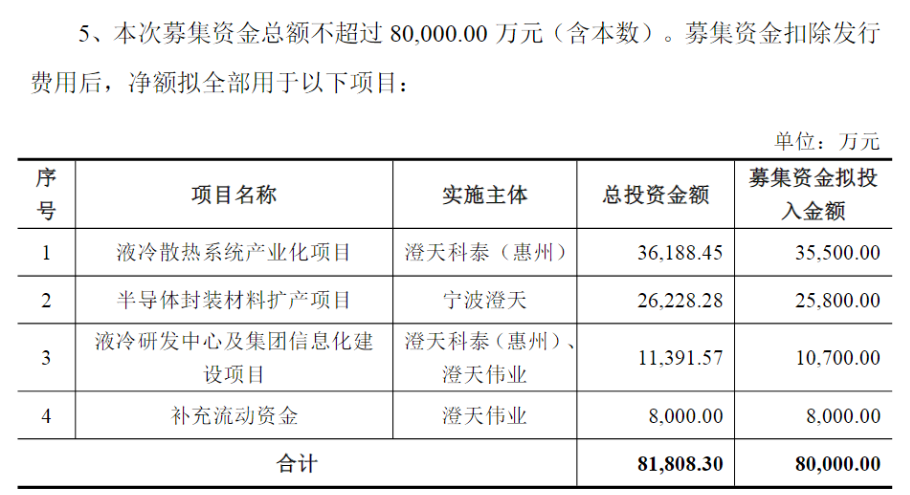
Group 1 - The company plans to raise 800 million yuan through a private placement to invest in popular technology sectors such as liquid cooling and semiconductors [1][2] - The funds will be allocated to four main projects: 355 million yuan for liquid cooling system industrialization, 258 million yuan for semiconductor packaging material expansion, 107 million yuan for liquid cooling R&D center and group information technology construction, and 80 million yuan for working capital [1][2] - The private placement requires approval from the shareholders' meeting and must be reviewed by the Shenzhen Stock Exchange and registered with the China Securities Regulatory Commission before implementation [2] Group 2 - The company's stock price has shown strong performance, increasing from a low of 8.57 yuan in February 2024 to a high of 67.6 yuan in August 2025, representing a maximum increase of 688.8% [3] - Despite the stock price surge, the company's net profit remains low, with revenues of 535 million yuan, 394 million yuan, and 360 million yuan from 2022 to 2024, and non-recurring net profits of 34.1 million yuan, -2.2 million yuan, and -645,500 yuan respectively [3] - In the first three quarters of 2025, the company achieved revenues of 310 million yuan, a year-on-year increase of 24.48%, and a non-recurring net profit of 6.2 million yuan, a year-on-year increase of 204.03% [3] Group 3 - The actual controller and their concerted actors have reduced their holdings by nearly 6% in the past six months, raising concerns about the timing of the private placement announcement [3][5] - Two significant reduction events occurred in 2025, with the first involving a 2.9573% reduction by two concerted actors and the second involving a similar reduction by the actual controller and another concerted actor [4][5] - The timing of the large-scale reduction before the private placement announcement has drawn attention to the potential implications for transparency and information disclosure [6][7]
午评:沪指跌0.3% 地产、银行等板块上扬 军工板块下挫
Zheng Quan Shi Bao Wang· 2026-01-20 04:49
Core Viewpoint - The A-share market is experiencing a downward trend, with major indices showing significant declines, influenced by various macroeconomic factors and sector performance [1]. Market Performance - As of the midday close, the Shanghai Composite Index fell by 0.3% to 4101.62 points, the Shenzhen Component Index dropped by 1.22%, and the ChiNext Index decreased by 1.83% [1]. - Approximately 3400 stocks in the A-share market were in the red, with total trading volume across the Shanghai, Shenzhen, and North exchanges reaching about 1.87 trillion yuan [1]. Sector Analysis - Sectors such as military, non-ferrous metals, and steel are experiencing declines, while real estate, insurance, banking, and semiconductors are showing upward movement [1]. - Active concepts include phosphate-related stocks and the "China Special Valuation" theme [1]. Market Sentiment and Future Outlook - According to Zhongyin Securities, the "spring fever" market is facing short-term pressure due to a complex overseas macro environment, increased uncertainty in the Federal Reserve's monetary policy, and domestic regulatory efforts to stabilize the market [1]. - The risk appetite is not the only factor influencing pricing themes; sector catalysts and positioning are also crucial. The likelihood of "one sector rising while another falls" is greater than "synchronous declines" in the current market context [1]. - Recent changes in trading volume proportions among the top ten concept sectors indicate an increase in semiconductor, photovoltaic, and robotics sectors, with high potential for AI application catalysts in the future [1]. - The short-term adjustment is attributed to previous overvaluations and emotional impacts from event disturbances, but the underlying logic of the AI application trend remains intact, suggesting that the market may continue to perform well [1].
ETF午评 | 房地产产业链领涨,地产ETF涨3%
Ge Long Hui· 2026-01-20 04:02
Market Overview - The three major A-share indices collectively declined in the morning session, with the Shanghai Composite Index down 0.3%, the Shenzhen Component Index down 1.22%, and the ChiNext Index down 1.83% [1] - The total trading volume in the Shanghai and Shenzhen markets reached 186.54 billion yuan, an increase of 58.9 billion yuan compared to the previous day [1] - Over 3,300 stocks in the market experienced declines [1] Sector Performance - The chemical, cultural media, real estate, insurance, banking, airport shipping, retail, and semiconductor sectors showed the highest gains [1] - Conversely, the commercial aerospace, CPO, controllable nuclear fusion, minor metals, battery, and military sectors faced the largest declines [1] ETF Performance - Domestic demand sectors saw a broad increase, with the real estate industry chain leading the gains; specific ETFs such as Huabao Fund Real Estate ETF, Guotai Fund Building Materials ETF, and Yinhua Fund Real Estate ETF rose by 3.22%, 2.99%, and 2.87% respectively [1] - In the Hong Kong market, consumer stocks also rose, with ETFs like Huitianfu Fund Hong Kong Stock Connect Consumer 50 ETF and Fuguo Fund Hong Kong Stock Connect Consumer ETF increasing by 2.15% and 2.02% respectively [1] Specific Sector Declines - The commercial aerospace sector led the declines, with satellite ETFs from E Fund, GF Fund, and others dropping by 5% [2] - The photovoltaic sector also experienced a pullback, with photovoltaic ETFs and leading ETFs from GF Fund declining by 3.61% and 3.59% respectively [2]
赛腾股份跌2.02%,成交额12.38亿元,主力资金净流出1.52亿元
Xin Lang Cai Jing· 2026-01-20 03:09
Group 1 - The core viewpoint of the news is that Saiteng Co., Ltd. has experienced fluctuations in stock price and trading volume, with a notable increase in stock price year-to-date and over recent trading periods [1][2]. - As of January 20, Saiteng's stock price decreased by 2.02% to 52.42 CNY per share, with a total market capitalization of 14.215 billion CNY [1]. - The company has seen a year-to-date stock price increase of 21.01%, with a 19.90% rise over the last five trading days and a 25.44% increase over the last 20 days [1]. Group 2 - Saiteng Co., Ltd. was established on June 19, 2007, and went public on December 25, 2017, focusing on the research, design, production, sales, and technical services of automation production equipment [2]. - The company's main business revenue composition includes 76.79% from automation equipment, 18.95% from fixtures, 3.77% from technical services, and 0.49% from other sources [2]. - As of September 30, the company reported a revenue of 2.535 billion CNY for the first nine months of 2025, a year-on-year decrease of 20.62%, and a net profit attributable to shareholders of 401 million CNY, down 15.61% year-on-year [2]. Group 3 - Saiteng has distributed a total of 567 million CNY in dividends since its A-share listing, with 211 million CNY distributed over the past three years [3]. - As of September 30, 2025, the number of shareholders increased by 20.73% to 48,400, while the average circulating shares per person decreased by 17.17% to 5,618 shares [2][3]. - Among the top ten circulating shareholders, Hong Kong Central Clearing Limited holds 1.8856 million shares, an increase of 762,100 shares compared to the previous period [3].

稀有金属ETF基金(561800)备受关注,获资金连续4天净流入,小金属资源战略价值凸显
Xin Lang Cai Jing· 2026-01-20 03:09
Group 1: Market Performance - The CSI Rare Metals Theme Index decreased by 2.85% as of January 20, 2026, with leading declines from companies like Western Materials and Xiamen Tungsten [1] - The Rare Metals ETF Fund (561800) recorded a turnover of 8.81% and a transaction volume of 19.0686 million yuan [1] - As of January 19, 2026, the Rare Metals ETF Fund reached a new high with a total scale of 218 million yuan and 196 million shares [1] Group 2: Fund Inflows and Returns - The Rare Metals ETF Fund experienced continuous net inflows over the past four days, with a peak single-day net inflow of 7.3539 million yuan, totaling 18.5361 million yuan [1] - The fund's net value increased by 77.53% over the past six months, ranking 87 out of 4110 in the index stock fund category, placing it in the top 2.12% [1] - Since its inception, the fund achieved a maximum monthly return of 24.02%, with the longest consecutive monthly increase lasting six months and a total increase of 79.55% [1] Group 3: Policy and Price Trends - Starting January 1, 2026, silver is included in the strategic material management with an export license system, leading to over 80% exit rate for small enterprises and pushing prices of tungsten, antimony, and germanium higher [2] - The carbon lithium futures price broke 170,000 yuan/ton, reaching a new high for the year, while tungsten ore and ammonium paratungstate prices surged over 200% from December 2025 to January 2026 [2] - Strategic small metals have limited reserves and high extraction difficulty, with increasing demand from sectors like new energy and semiconductors, exacerbating supply-demand conflicts [2] Group 4: Lithium Battery Sector - Prices for upstream raw materials in lithium batteries have generally increased, with battery-grade lithium carbonate rising by 64.40% since early December 2025 and lithium hydroxide by 77.51% [3] - The lithium battery industry is experiencing sustained growth, with a year-on-year increase of over 30% in power battery installations and stable new energy vehicle sales at over 50% [3] - The Rare Metals ETF Fund (561800) tracks the CS Rare Metals Index, which has a high content of energy metals like lithium and cobalt, positioning it to benefit from ongoing trends [3]