
碳达峰

Search documents
“只此青绿”成“美丽山东”鲜明底色
Zhong Guo Xin Wen Wang· 2025-09-23 08:56
Group 1 - The core idea of the article emphasizes Shandong's commitment to the "Green Water and Green Mountains are Golden Mountains and Silver Mountains" philosophy, showcasing its efforts in ecological protection and high-quality development over the past 20 years [1][4] - Shandong has established 32 national ecological civilization construction demonstration zones and 11 innovation bases for the "Green Water and Green Mountains" practice, reflecting its extensive commitment to ecological initiatives [4] - The province is focusing on green transformation in key industries such as petrochemicals and steel, aiming for a low-carbon and high-quality development model [6][7] Group 2 - Shandong's energy structure is increasingly green, with plans to reduce coal power and enhance renewable energy sources, including a target of 115 million kilowatts of installed capacity for new energy and renewable energy by 2024 [6][7] - The average PM2.5 concentration in Shandong is projected to reach 35.5 micrograms per cubic meter in 2024, marking the best level since monitoring began, while the GDP is expected to grow by 5.7% [7] - The province is implementing innovative mechanisms to convert ecological value into economic benefits, such as the issuance of "forest tickets" in villages to stimulate local economies through eco-tourism and related industries [9][11]


国家公园法将施行;五年来高排放车辆淘汰近两千万辆丨碳中和周报
2 1 Shi Ji Jing Ji Bao Dao· 2025-09-22 12:24
Group 1: National Park Law Implementation - The first National Park Law in China will take effect on January 1, 2026, aiming to protect representative natural ecosystems and promote sustainable use of natural resources [2] - The law establishes a legal framework for a national park system, emphasizing strict protection and integrated management of natural resources [2] - It encourages public participation in conservation efforts and aims to foster awareness of ecological protection among the public [2] Group 2: High-Emission Vehicle Elimination - The Ministry of Ecology and Environment announced that nearly 20 million high-emission vehicles will be eliminated during the 14th Five-Year Plan period [3][4] - Significant reductions in PM2.5 concentrations are targeted, with expected decreases of 18%, 10%, and 20% in key regions by 2024 compared to 2020 levels [3] - The campaign includes comprehensive measures such as coal management and pollution source tracking, achieving notable progress in water and soil protection [4] Group 3: Carbon Market Development - As of September 18, 2025, China's carbon market has seen a cumulative transaction volume of 714 million tons and a total transaction value of approximately 49.96 billion yuan [5][6] - The establishment of a regulatory framework for carbon trading is underway, supporting China's climate change initiatives [5] - The carbon market is recognized as a key mechanism for achieving carbon peak and carbon neutrality goals [6] Group 4: Climate Change and Industry Restructuring - The year 2024 is projected to be the first year to exceed the 1.5°C temperature threshold set by the Paris Agreement, indicating a concerning trend in global warming [7][8] - Experts emphasize the need for intensified emission reduction efforts to meet climate targets and ensure sustainable development [7][8] Group 5: Renewable Energy Consumption in Inner Mongolia - Inner Mongolia has issued a notification to optimize the mechanism for renewable energy consumption, focusing on both mandatory and voluntary consumption [9] - The initiative aims to enhance green electricity consumption and promote the integration of renewable energy with industry [9] Group 6: Low-Carbon Initiatives and Events - The "Low-Carbon China Tour" and Climate Action Week series of events were launched to showcase China's efforts in energy transition and public engagement [10][11] - The events highlight the role of enterprises like Southern Power Grid in promoting green development and their participation in international climate discussions [10][11] Group 7: Clean Energy Expo in Shandong - The 2025 Shandong Clean Energy Industry Expo was held to facilitate innovation and collaboration in the clean energy sector [13][14] - The event aims to strengthen partnerships between enterprises and research institutions to support the region's energy transition [13][14] Group 8: Sustainable Strategy by Yinyu Water Zhongtian - Yinyu Water Zhongtian has set a net-zero target for 2040 and aims to achieve various sustainability goals by 2030 [15][16] - The strategy includes low-carbon construction, climate risk adaptation, and waste management initiatives to promote a circular economy [15][16]
国家公园法将施行;五年来高排放车辆淘汰近两千万辆
2 1 Shi Ji Jing Ji Bao Dao· 2025-09-22 12:04
Carbon Neutrality Policy - China's first National Park Law will be implemented on January 1, 2026, establishing a legal framework for the protection and sustainable use of natural ecosystems [2] - The law aims to create a natural protection system centered around national parks, emphasizing strict protection and public participation in ecological education [2] Pollution Prevention Achievements - The Ministry of Ecology and Environment announced the elimination of nearly 20 million high-emission vehicles during the 14th Five-Year Plan, contributing to significant reductions in PM2.5 concentrations in key regions [3][4] - The country has made substantial progress in water pollution control, with over 90% of black and odorous water bodies in cities being eliminated [4] Carbon Market Development - As of September 18, 2025, China's carbon market has seen a cumulative transaction volume of 714 million tons and a total transaction value of approximately 49.96 billion yuan, indicating a stable market operation [5] - The establishment of a comprehensive regulatory framework for carbon trading is seen as a key support for achieving carbon peak and carbon neutrality goals [5] Climate Change and Industry Impact - The year 2024 is projected to be the first year to exceed the 1.5°C temperature control target set by the Paris Agreement, highlighting the urgency for enhanced emission reduction measures [6][7] - Experts emphasize the need for more effective reduction strategies to meet climate goals and ensure sustainable development [6][7] Local Initiatives - Inner Mongolia has introduced a notification to optimize the green electricity consumption mechanism, focusing on mandatory and voluntary consumption to enhance the region's green energy competitiveness [7][8] - The "Low Carbon China Tour" and Climate Action Week series of events were launched to showcase China's efforts in energy transition and public engagement in climate action [9][10] Corporate Practices - The 2025 Shandong Clean Energy Industry Expo provided a platform for showcasing innovations and fostering collaboration in the clean energy sector [11][12] - Yin Yu Water Zhongtian has set a net-zero target for 2040, with a comprehensive sustainable strategy that includes quantifiable goals for low-carbon construction and operations [12][13]
固态电池空间广阔,关注创业板新能源ETF国泰(159387)
Mei Ri Jing Ji Xin Wen· 2025-09-22 09:57
Group 1 - The core viewpoint is that the power battery industry is experiencing steady growth, with China's total installed capacity expected to exceed 600 GWh in 2025, driven by the increasing production and sales of new energy vehicles and the booming energy storage market [1] - In the first half of 2025, China's total installed capacity of power batteries reached 299.6 GWh, representing a year-on-year growth of 47.3%, continuing the growth momentum from 2024 [1] - Solid-state batteries are entering a phase of accelerated commercialization, with significant application prospects in new energy vehicles, low-altitude vehicles, and consumer electronics due to their higher safety and energy density [1] Group 2 - According to CICC, solid-state batteries are expected to achieve large-scale production in the eVTOL and consumer electronics sectors first, which will drive down costs and eventually lead to mass production in the power sector [1] - It is estimated that by 2030, global solid-state battery shipments will reach 808 GWh, with demand for all-solid-state batteries expected to exceed 150 GWh, corresponding to power, eVTOL, and consumer electronics with penetration rates of 3%, 40%, and 15% respectively [1] - Investors interested in solid-state batteries can consider the New Energy Vehicle ETF (159806), which closely tracks the China New Energy Vehicle Index and has over 40% weight in solid-state battery-related stocks [2]

国家能源局等部门关于推进能源装备高质量发展的指导意见
国家能源局· 2025-09-22 08:37
Core Viewpoint - The article emphasizes the importance of promoting high-quality development of energy equipment as a crucial part of building a new energy system, supporting the goals of carbon peak and carbon neutrality, and advancing new industrialization [3][4]. Overall Requirements - The development strategy is guided by Xi Jinping's thoughts, focusing on energy security and transition, with technology innovation as the driving force and high-quality energy equipment development as the main direction [4]. - By 2030, the goal is to achieve a self-controlled supply chain for key energy equipment, with significant advancements in high-end, intelligent, and green development [4]. Accelerating Energy Exploration and Development Equipment Transformation - Focus on coal safety and efficiency, advancing technologies for complex geological conditions and large-scale mining [5]. - Develop key technologies for oil and gas exploration, enhancing production capabilities in deep and unconventional fields [5]. Enhancing Energy Conversion Equipment Quality - Promote upgrades in coal, gas, and nuclear power equipment, and improve the quality of renewable energy equipment [6]. - Breakthroughs in low-cost, flexible, and reliable coal power technologies are emphasized [6][7]. Promoting Energy Storage Equipment - Develop a safe and efficient energy storage technology system, focusing on large-capacity and long-life storage equipment [9]. - Key technologies for battery management and physical storage are highlighted [9]. Hydrogen Energy Equipment Development - Accelerate the development of reliable and efficient hydrogen production equipment, focusing on scalable off-grid hydrogen production technologies [10]. - Emphasize the development of materials and technologies for hydrogen storage and transportation [10]. Strengthening Energy Transmission Equipment Technology - Focus on breakthroughs in energy transmission technologies for electricity, coal, oil, and gas [11][12]. - Develop key equipment for long-distance and efficient transmission of fossil energy [12]. Promoting Digital and Intelligent Upgrades of Energy Equipment - Emphasize the importance of digitalization and intelligence in energy equipment, covering the entire process from extraction to transmission [13][14]. Promoting Green and High-End Development of Energy Equipment - Focus on green materials and technologies for recycling and extending the life of energy equipment [15]. - Establish a comprehensive lifecycle management system for energy equipment [15]. Optimizing the Industrial Innovation Ecosystem - Strengthen the role of enterprises in innovation, encouraging collaboration between industry, academia, and research [16]. - Support the establishment of innovation platforms and enhance the quality management of energy equipment [17][18]. Enhancing International Cooperation - Encourage energy enterprises to participate in international technology research and cooperation, expanding international industrial chain layouts [19][20]. Implementation Measures - Relevant departments are tasked with coordinating and supervising the implementation of these guidelines, ensuring effective execution of key objectives [20].
国家能源局科技司相关负责同志就《关于推进能源装备高质量发展的指导意见》答记者问
国家能源局· 2025-09-22 08:37
Core Viewpoint - The article discusses the "Guiding Opinions on Promoting High-Quality Development of Energy Equipment" issued by four government departments, emphasizing the importance of energy equipment in building a new energy system and achieving carbon neutrality goals [2][3]. Summary by Sections Background of the Guiding Opinions - The issuance of the Guiding Opinions is rooted in the central government's emphasis on manufacturing development, with directives aimed at strengthening the manufacturing sector and ensuring that key technologies are domestically controlled [3]. Overall Goals of the Guiding Opinions - The Guiding Opinions aim for significant advancements in the energy key equipment industry by 2030, focusing on self-sufficiency, high-end, intelligent, and green development, with a goal of establishing a globally leading technology and industry system [4]. Key Tasks Proposed - The Guiding Opinions outline 13 key tasks across six areas for high-quality development of energy equipment: 1. Accelerate the transformation and upgrading of energy exploration and development equipment, focusing on coal and oil/gas extraction [5]. 2. Enhance the quality and efficiency of energy conversion equipment, targeting fossil fuel and renewable energy generation [5]. 3. Promote the large-scale application of energy storage equipment, emphasizing safety and efficiency [5]. 4. Strengthen technological breakthroughs in energy transmission equipment, covering electricity, coal, oil, and natural gas [5]. 5. Advance the digital and intelligent upgrade of energy equipment across the entire process from extraction to transmission [5][6]. 6. Foster green and high-end development of energy equipment, including recycling and remanufacturing [6]. Implementation Measures - The Guiding Opinions propose seven measures to optimize the industrial innovation ecosystem, including enhancing the role of enterprises, building industry platforms, and encouraging the application of first sets of equipment [8].

重磅!四部门发布重要指导意见
中国能源报· 2025-09-22 07:45
Core Viewpoint - The article emphasizes the importance of advancing the high-quality development of energy equipment in China to achieve a self-controlled, high-end, intelligent, and green energy equipment industry by 2030, supporting the construction of a new energy system and ensuring energy security and transition [1][3]. Overall Requirements - The development strategy is guided by Xi Jinping's thoughts and aims to integrate energy security and transition, focusing on technological innovation and high-quality energy equipment development [3]. Energy Exploration and Development Equipment - The focus is on upgrading coal mining and oil and gas exploration equipment to enhance efficiency and safety, with specific technological breakthroughs outlined for both sectors [4]. Energy Conversion Equipment - The article discusses the need for advancements in fossil energy power generation and renewable energy equipment, aiming for low-carbon, high-efficiency technologies [6][7]. Energy Storage Equipment - Emphasis is placed on developing large-capacity, high-parameter, and long-life energy storage technologies, including various battery types and physical storage methods [9][10]. Energy Transmission Equipment - The focus is on improving the technology for the transmission of electricity, coal, oil, and natural gas, aiming for a safe and low-carbon energy distribution network [11][12]. Digital and Intelligent Upgrades - The article highlights the importance of digitalization and intelligence in energy equipment, promoting a closed-loop system for sensing, planning, decision-making, and execution [13]. Green and High-End Development - There is a strong emphasis on green development, including the use of recyclable materials and technologies for energy equipment, aiming for a circular economy [14][15]. Innovation Ecosystem - The article calls for strengthening the role of enterprises in innovation, enhancing collaboration between industry, academia, and research, and supporting the establishment of innovation platforms [16][18]. Policy Support - It outlines the need for increased policy support for energy equipment innovation, including funding and incentives for research and development [19][20].
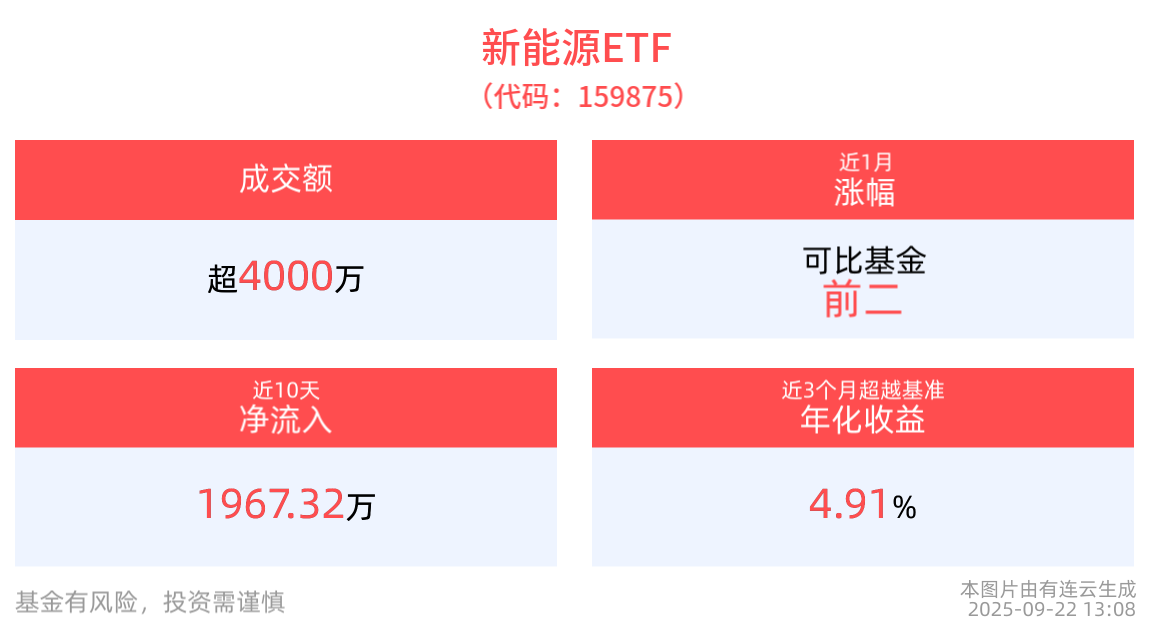
储能有望实现行业竞争格局优化,新能源ETF(159875)蓄势调整,帝尔激光领涨成分股
Xin Lang Cai Jing· 2025-09-22 05:45
Group 1: Market Performance - The New Energy ETF has a turnover rate of 3.85% during trading, with a transaction volume of 43.23 million yuan [2] - As of September 19, the New Energy ETF's latest scale reached 1.129 billion yuan, with a total inflow of 19.67 million yuan over the last 10 trading days [2] - The New Energy ETF's net value has increased by 58.12% over the past year [2] Group 2: Investment Opportunities - The highest monthly return since the inception of the New Energy ETF was 25.07%, with the longest consecutive monthly increase lasting 4 months and a maximum increase of 31.31% [2] - The average return during the months of increase is 8.03% [2] - The global push for "carbon neutrality" positions the development of new energy as a long-term strategic direction, with China aiming for peak carbon emissions by 2030 and carbon neutrality by 2060 [2] Group 3: Industry Trends - Despite high market penetration of new energy vehicles, there remains significant potential for replacing traditional fuel vehicles based on ownership ratios [2] - The energy storage market is experiencing explosive growth, crucial for addressing the intermittency issues of wind and solar power generation, with domestic energy storage bidding volumes in August showing several-fold year-on-year growth [2] - According to Shenwan Hongyuan, the short-term focus remains on event-driven themes and price increase themes, while the medium-term outlook is optimistic for a structural bull market, particularly in the photovoltaic sector [3] Group 4: Company Performance - As of August 29, 2025, the top ten weighted stocks in the China Securities New Energy Index include CATL, Sungrow, Longi Green Energy, China Nuclear Power, and others, collectively accounting for 42.78% of the index [5] - Notable stock performances include CATL with a slight decline of 0.18% and Sungrow with an increase of 0.80% [5]






CGI深度 | 迈向碳达峰的“十五五”:挑战、行动和投融资
中金点睛· 2025-09-21 23:54
Core Viewpoint - The article emphasizes that the "15th Five-Year Plan" (2026-2030) is a critical period for achieving carbon peak goals in China, highlighting the need for targeted actions in green investment and carbon reduction strategies [2][3]. Group 1: Key Actions for Carbon Peak - Three key action areas for achieving carbon peak during the "15th Five-Year Plan" are identified: industrial structure "de-redundancy," economic activity "electrification," and power generation structure "cleanliness" [3][4]. - The total green investment demand in these areas is estimated to reach 17.5 trillion yuan, with a cumulative reduction of 1.6 billion tons of carbon emissions, potentially driving an annual GDP growth of 1.2% [3][7]. Group 2: Carbon Peak Goals and Challenges - The article quantifies the carbon peak goals, projecting a 65% reduction in carbon intensity by 2030 and an increase in non-fossil energy share to approximately 25% [8][9]. - Challenges include the rising share of high-energy-consuming industries and a slowdown in electrification progress, which have increased carbon reduction pressures [4][15]. Group 3: Industrial Structure "De-redundancy" - The focus on industrial structure "de-redundancy" aims to optimize supply-side structures to reduce the share of high-energy-consuming industries, with a continued emphasis on capacity governance in sectors like cement and steel [4][30]. - The expected reduction in the share of secondary industries from 36% to around 33% during the "15th Five-Year Plan" is anticipated to support a GDP growth rate of around 5% [23][30]. Group 4: Economic Activity "Electrification" - The electrification of industrial, transportation, and building sectors is projected to contribute significantly to carbon reduction, with expected electrification rates of 35%, 12%, and 65% respectively by 2030 [36][57]. - The electrification process is expected to face challenges in balancing economic efficiency and emission reduction effectiveness [35][36]. Group 5: Power Generation Structure "Cleanliness" - The article highlights the need for a transition to non-fossil energy sources, with an anticipated addition of 1.17 billion kilowatts of non-fossil energy capacity during the "15th Five-Year Plan" [65][66]. - The flexibility of the power system will be crucial, requiring investments in coal power flexibility upgrades, energy storage, and demand response mechanisms [66][67].

迈向“十五五”碳达峰 “2025中国碳中和发展力指数”发布
Zheng Quan Ri Bao Wang· 2025-09-21 14:14
Core Insights - The "2025 China Carbon Neutral Development Index" reveals significant progress in carbon reduction and green transformation in China, marking the fifth anniversary of the "dual carbon" goals [1][2] - The index serves as a comprehensive tool to evaluate regional carbon neutrality potential and practical outcomes, reflecting systemic changes in economic and social development under the "dual carbon" strategy [1][2] Group 1 - The index shows a score distribution among provinces ranging from 41 to 79, with an average score of approximately 56.32 [2] - Leading provinces such as Zhejiang, Guangdong, Beijing, Jiangsu, and Shanghai have maintained high scores, demonstrating mature experiences in energy structure adjustment and industrial upgrading [2] - Key cities like Shenzhen, Guangzhou, Hangzhou, Changsha, and Qingdao have shown notable improvements in green industries, technological innovation, and green finance, with an average score increase of 1.89 points from 2024 [2] Group 2 - The research team emphasizes the need for technological innovation to address issues such as high carbon industry path dependence and insufficient market mechanisms during the "14th Five-Year Plan" period [3] - The focus for the "15th Five-Year Plan" should be on building a clean, low-carbon, safe, and efficient energy system, enhancing carbon pricing and green finance mechanisms, and ensuring effective policy implementation and data supervision [3] - The goal is to achieve carbon peak by 2030 and lay a solid foundation for carbon neutrality by 2060 [3]