
光伏建筑一体化

Search documents
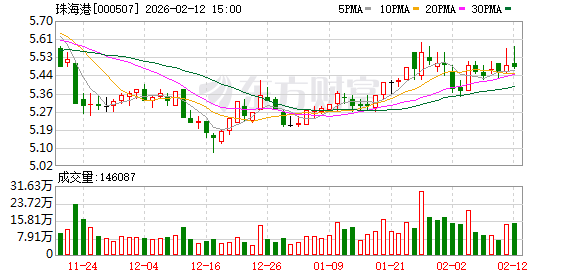
珠海港:公司积极布局了海上风电、分布式光伏及光伏建筑一体化等项目
Zheng Quan Ri Bao· 2026-02-12 13:41
Core Viewpoint - Zhuhai Port has been actively expanding its business through acquisitions and investments in various sectors, including renewable energy projects [2] Group 1: Acquisitions and Investments - The company has acquired the Hong Kong-listed company Xinghua Port and privatized it [2] - It has also gained control over the Shenzhen-listed company Xiouqiang Shares [2] - The company holds a stake in the Hong Kong-listed Tianlun Gas and has acquired the controlling interest in its parent company, Qihong Dock [2] Group 2: Business Expansion in Renewable Energy - Zhuhai Port is actively investing in offshore wind power, distributed photovoltaic, and photovoltaic building integration projects [2] Group 3: Financial Reporting and Compliance - The company conducts annual goodwill assessments and tests in accordance with enterprise accounting standards [2] - It strictly adheres to relevant regulations for external disclosures [2]


【百强透视】96%溢价豪礼!创维“一拆一退”,光伏独立上市引爆股价
Sou Hu Cai Jing· 2026-01-21 06:05
Core Viewpoint - Skyworth Group has announced a dual plan for privatization and the spin-off of its solar business, aiming to provide shareholders with a combination of cash and high-growth equity, while also signaling a strategic shift from traditional home appliances to renewable energy [2][3]. Summary by Sections Privatization and Spin-off Plan - The plan involves two main steps: first, Skyworth intends to independently list its solar business on the Hong Kong Stock Exchange, distributing shares to existing shareholders at a ratio of approximately 0.37 shares of solar business for each Skyworth share held, with a theoretical value of about HKD 6.13 per share [3][6]. - Simultaneously, the company will implement privatization, offering shareholders a choice between receiving HKD 4.03 in cash or one share of the newly privatized company [3][5]. Shareholder Returns - Shareholders opting for the cash option will receive a total return of approximately HKD 10.16, representing a premium of 96.15% over the last closing price of HKD 5.18 prior to the announcement [5][6]. Business Transition - The move reflects the necessity for traditional home appliance businesses to adapt amid pressures from declining demand and increased competition, with Skyworth's smart home appliance revenue facing growth limitations [9][11]. - The solar business has emerged as a key growth driver, with revenue from this segment reaching HKD 138.36 billion in the first half of 2025, a significant increase of 53.5% year-on-year, and accounting for over 38% of total revenue [11][13]. Future Strategic Plans - The spin-off of the solar business is seen as the first step in a broader strategy, with plans to eventually list other segments such as energy storage and automotive electronics, aiming to create a renewable energy industry cluster [13].

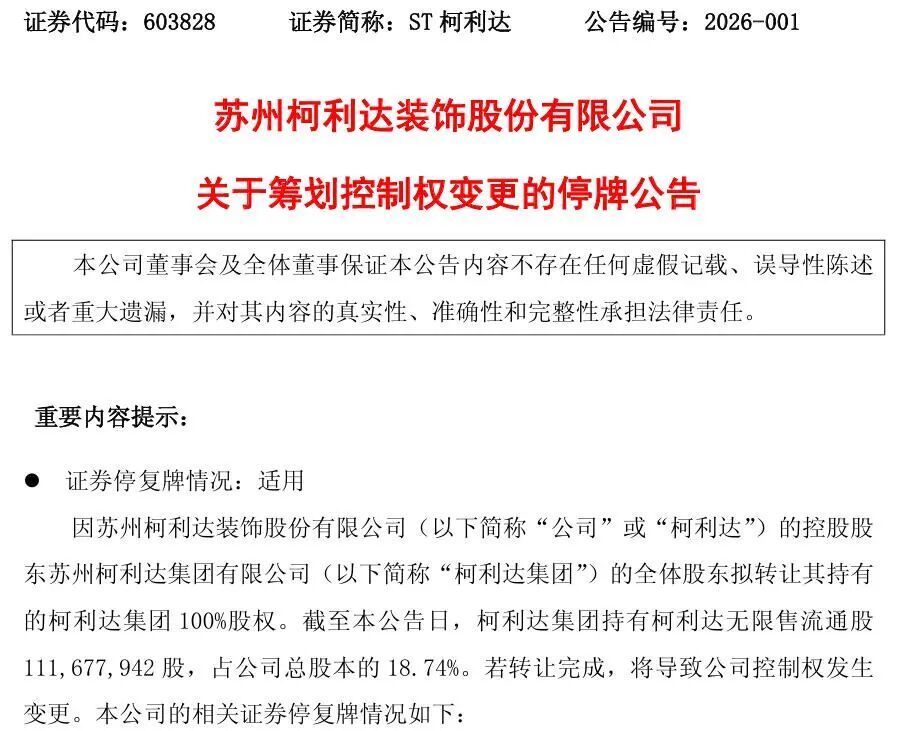
603828,筹划控制权变更,停牌,年内股价翻倍
Zheng Quan Shi Bao· 2025-12-31 13:43
Core Viewpoint - ST Keli Da announced that its controlling shareholder, Suzhou Keli Da Group, intends to transfer 100% of its equity, which may lead to a change in the company's control [2] Group 1: Shareholder Changes - Suzhou Keli Da Group holds 112 million unrestricted circulating shares, accounting for 18.74% of the company's total equity [2] - The transfer of shares is currently in planning and carries uncertainties, leading to a suspension of the company's stock starting January 5, 2026, for up to two trading days [2] Group 2: Previous Share Transfer Agreement - In November, ST Keli Da announced a share transfer agreement with Cui Jianquan, where 40 million shares (6.71% of total equity) would be transferred at a price of 6.16 CNY per share, totaling 246 million CNY [4] - This transfer will not change the controlling shareholder or adversely affect company governance [4] Group 3: Financial and Operational Issues - ST Keli Da has faced continuous operating losses and received negative opinions on its internal control audit reports from accounting firms, leading to risk warnings [4][5] - The controlling shareholder has been found to occupy company funds through third-party suppliers, with 170 million CNY repaid by the end of 2024 [5] Group 4: Governance and Compliance Measures - The company is taking steps to strengthen internal controls, enhance compliance awareness, and prevent future fund occupation by the controlling shareholder [6] - Measures include introducing strategic shareholders, appointing new directors, and improving governance structures [6]

苏州柯利达装饰股份有限公司 关于2025年第三季度业绩说明会 召开情况的公告
Zheng Quan Ri Bao· 2025-12-04 04:53
Group 1 - The company held a Q3 2025 performance briefing on December 3, 2025, via the Shanghai Stock Exchange's online platform, with key executives participating to address investor inquiries [1] - The company reported a revenue of 1.189 billion yuan for the first nine months of 2025, reflecting a year-on-year decline of 30.48% [2] - The company has expanded into new business areas such as prefabricated decoration and photovoltaic building integration, aligning with national policies and industry trends [2][3] Group 2 - Future profit growth drivers include alignment with national policies, a solid foundation in core businesses, and the development of new business areas [3] - The company emphasizes technological innovation, focusing on key technologies like BIM and AI, and aims to enhance operational efficiency through digital management [3] - The management strategy involves strengthening governance structures and mitigating operational risks while pursuing a market strategy of deepening presence in Jiangsu and expanding nationwide [3]
“十五五”与碳达峰之一:碳达峰行业梳理:“碳达峰”将推动能源结构转型、产业低碳化和技术创新-20251023
Xiangcai Securities· 2025-10-23 11:20
Core Insights - The report emphasizes that China's "carbon peak" is closely related to the Nationally Determined Contributions (NDC) [3][11][12] - The third round of NDC announced by President Xi Jinping expands the scope to cover all economic sectors and sets absolute reduction targets for greenhouse gas emissions [13][12] - The report indicates that while China's carbon emissions continue to rise, the growth rate is showing signs of convergence [5][9] Industry Analysis - As of Q3 2025, certain industries such as cement, aluminum, electricity, and steel are nearing or have achieved carbon peaking, while sectors like transportation and petrochemicals face significant challenges [6][24][25] - The report outlines that achieving carbon peaking in high-energy-consuming industries will require deep decarbonization, technological innovation, and capacity optimization [27][30] - The transition to a cleaner energy system is highlighted as a priority, with increased investments in non-fossil energy sources, including large-scale wind and solar projects, and upgrades to smart grid systems [6][29] Investment Recommendations - The report suggests focusing on sectors that have undergone significant adjustments, such as banking and insurance, as well as areas related to environmental protection and renewable energy [30] - It is anticipated that carbon peaking-related investment directions will become a major focus as the "14th Five-Year Plan" is implemented [30]
对话英利集团董事长苗青:很多新的场景出现,背后源于技术和产品的创新
Xin Lang Ke Ji· 2025-10-17 07:49
Core Insights - The 2025 Sustainable Global Leaders Conference will be held from October 16 to 18 in Shanghai, focusing on sustainable development and innovation in technology [1] Group 1: Company Innovations - Yingli Group's Chairman, Miao Qing, highlighted the importance of technological and product innovation in creating new scenarios [1] - The establishment of Jiasheng Photovoltaics aims to integrate photovoltaic technology into building materials, known as Building-Integrated Photovoltaics (BIPV) [1] - BIPV not only serves the function of power generation but also meets all building requirements, necessitating different lifespans for the products [1] Group 2: Product Lifecycle and Requirements - Traditional photovoltaic products have a lifecycle of 25 years, while the buildings incorporating these technologies will have an extended lifecycle [1] - The buildings must also comply with various safety standards, including fire and wind resistance, which imposes new technical requirements on the products [1] Group 3: Sustainability Goals - The company aims for broader applications of BIPV, either by replacing traditional photovoltaic materials or by enhancing building functionalities, contributing to green sustainability [1]
经济日报丨美丽城市建设从能源转型开始
国家能源局· 2025-08-14 02:58
Core Viewpoint - The article emphasizes the importance of energy transition in building green and low-carbon beautiful cities, which is crucial for high-quality urban development [2][4]. Group 1: Energy's Role in Urban Development - Energy is a vital support for urban high-quality development, providing power for transportation, industry, commerce, and residential life [2]. - Sufficient and stable energy supply attracts investment, promotes industrial and service sector growth, creates job opportunities, and drives economic growth [2]. - The rational use of energy can improve urban living conditions and environments [2]. Group 2: Historical Context of Energy Revolutions - Historical energy revolutions have significantly propelled urban evolution, with the shift from wood to coal leading to the industrial revolution and urban expansion [3]. - The transition to oil and electricity further enhanced industrial efficiency, accelerated urbanization, and diversified urban functions [3]. Group 3: Challenges and Opportunities in Energy Transition - The extensive use of fossil fuels has led to severe environmental issues, prompting a global consensus on addressing climate change [4]. - Embracing clean energy is essential for building green and low-carbon cities, while energy transition acts as a catalyst for urban industrial upgrading [4]. - The future competitiveness of cities will be reshaped and enhanced through this energy transformation [4]. Group 4: Strategies for Energy Transition - Energy transition requires a comprehensive approach across the entire production, transmission, and consumption chain [4]. - Local development of distributed renewable energy sources, such as rooftop solar, and utilizing long-distance clean energy transmission are key strategies [4]. - Implementing energy-saving concepts in various sectors and establishing smart energy management systems can enhance energy efficiency [4]. Group 5: Closing the Energy Transition Loop - Accelerating the electrification of public transport, logistics, and private vehicles, along with improving charging infrastructure, is crucial [5]. - Promoting alternative heating solutions and encouraging green consumption among residents are necessary steps [5]. - Challenges such as high storage technology costs and insufficient grid capacity for renewable energy integration need to be addressed through robust policy support and top-level design [5].
【能源广角】美丽城市建设从能源转型开始
Jing Ji Ri Bao· 2025-08-14 00:11
Group 1 - The central urban work conference emphasizes the construction of green and low-carbon beautiful cities, indicating a direction for urban development in the new era [2] - Energy transition is crucial for the realization of the beautiful city blueprint, as it significantly impacts the quality and sustainability of urban development [2][4] - Energy is a vital support for high-quality urban development, providing power for various sectors such as transportation, industry, commerce, and residential life [2] Group 2 - Historical energy revolutions have greatly propelled urban evolution, with the shift from biomass to coal, and then to oil and electricity, leading to increased urbanization and industrialization [3] - The extensive use of fossil fuels has resulted in severe environmental issues, prompting a global consensus on addressing climate change and the need for energy transition [4] - Embracing clean energy is essential for building green and low-carbon cities, while energy transition acts as a catalyst for urban industrial upgrading [4] Group 3 - Urban energy transition requires a comprehensive approach across the entire production, transmission, and consumption chain, focusing on both local and distant clean energy sources [4][5] - Implementing energy-saving concepts in various sectors and promoting smart energy management systems can enhance energy efficiency and reduce waste [5] - The transition path is challenging due to high storage technology costs and insufficient grid capacity for renewable energy, necessitating strong policy support and top-level design [5]

中经评论:美丽城市建设从能源转型开始
Jing Ji Ri Bao· 2025-08-13 23:51
Group 1 - The central urban work conference emphasizes the construction of green and low-carbon beautiful cities, indicating a direction for urban development in the new era [1] - Energy transition is crucial for the realization of the beautiful city blueprint, as it supports high-quality urban development and is essential for various sectors such as transportation, industry, commerce, and residential life [1][2] - Historical energy revolutions have significantly driven urban evolution, with coal, oil, and electricity playing pivotal roles in enhancing industrial production efficiency and urbanization [2] Group 2 - The extensive use of fossil fuels has led to severe environmental issues, prompting a global consensus on addressing climate change and presenting new opportunities for high-quality urban development [3] - Embracing clean energy is central to building green and low-carbon cities, while energy transition acts as a catalyst for urban industrial upgrading and the cultivation of new productive forces [3] - Urban energy transition requires a comprehensive approach across the entire production, transmission, and consumption chain, focusing on local and distant clean energy development [3][4] Group 3 - The transition towards clean energy involves electrifying public transport, logistics, and private vehicles, as well as promoting energy-efficient appliances among residents [4] - Challenges such as high storage technology costs and insufficient grid capacity for renewable energy integration test the wisdom and determination of urban managers [4] - There is a need for improved top-level design and stronger policy support to guide cities on their transition paths, encouraging diverse and replicable experiences for different urban contexts [4]
美丽城市建设从能源转型开始
Jing Ji Ri Bao· 2025-08-13 22:10
Core Viewpoint - The central urban work conference emphasizes the construction of green and low-carbon beautiful cities, highlighting the importance of energy transition in achieving high-quality urban development [1] Group 1: Energy's Role in Urban Development - Energy is a crucial support for high-quality urban development, providing power for transportation, industry, commerce, and residential life [1] - A stable energy supply attracts investment, promotes industrial and service sector growth, creates job opportunities, and drives economic growth [1] - Proper energy utilization can improve urban living conditions and environments [1] Group 2: Historical Context of Energy Revolutions - Historical energy revolutions have significantly propelled urban evolution, with the transition from wood to coal leading to the industrial revolution and urban expansion [2] - The oil and electricity eras further enhanced industrial efficiency, increased labor demand, and accelerated urbanization, resulting in more complex urban functions [2] Group 3: Challenges and Opportunities in Energy Transition - The extensive use of fossil fuels has led to severe environmental issues, prompting a global consensus on addressing climate change through energy transition [3] - Embracing clean energy is essential for building green and low-carbon cities, while energy transition acts as a catalyst for urban industrial upgrading [3] - The future competitiveness of cities will be reshaped and enhanced through this energy transformation [3] Group 4: Systematic Approach to Energy Transition - Urban energy transition requires a comprehensive approach across the entire production, transmission, and consumption chain [3] - Local development of distributed renewable energy sources and the utilization of long-distance clean energy transmission are crucial for reducing carbon emissions [3] - Implementing energy-saving concepts in various sectors and establishing smart energy management systems can optimize energy use [3] Group 5: Closing the Energy Transition Loop - Accelerating the electrification of public transport, logistics, and private vehicles, along with improving charging infrastructure, is vital [4] - Promoting alternative heating solutions and encouraging green consumption among residents are necessary steps [4] - Challenges such as high storage technology costs and insufficient grid capacity for renewable energy need to be addressed through robust policy support and top-level design [4]