
金融强国

Search documents
中央金融办副主任王江:加快建设金融强国,为中国式现代化提供有力支撑
Xin Hua She· 2025-11-05 12:26
Core Insights - The article emphasizes the strategic importance of accelerating the construction of a financial power in China as part of the broader goal of achieving socialist modernization [2][3][4] - It outlines the necessity of a robust financial system to support high-quality development and address risks in the financial sector [3][7] Group 1: Significance of Building a Financial Power - Accelerating the construction of a financial power is essential for the comprehensive establishment of a modern socialist country, as a strong financial system is a key support for modernization [2][3] - The construction of a financial power is not isolated but must be rooted in and serve a high-level socialist market economy [2][3] Group 2: Key Tasks and Measures - The financial system must enhance support for major strategies, key areas, and weak links, such as establishing a technology finance system to support innovation [3][7] - There is a need to strengthen the central bank system and improve the monetary policy framework to maintain the stability of the RMB and promote its internationalization [7][8] - The article highlights the importance of promoting the healthy and stable development of capital markets to adapt to the needs of technological innovation and new industries [7][8] Group 3: Principles and Theoretical Framework - The construction of a financial power must adhere to the principles outlined in the 20th Central Committee, emphasizing the leadership of the Party as a fundamental characteristic of China's financial development [4][6] - The financial power construction is characterized by its systematic, innovative, and practical nature, requiring a deep understanding of its main features and essential tasks [4][5] Group 4: Key Financial Elements - Building a financial power requires strengthening six key financial elements: a strong currency, a powerful central bank, robust financial institutions, an international financial center, effective financial regulation, and a talented workforce [5][6] Group 5: Regulatory and Legal Framework - The article stresses the need for comprehensive financial regulation, including enhancing oversight across various financial activities and ensuring early detection and management of financial risks [8][9] - It calls for the completion of financial legislation to guide and regulate the financial sector effectively [8][9]
“十五五”加快建设金融强国有哪些主要任务和重要举措?中央金融办王江回应
Xin Hua She· 2025-11-05 11:38
Core Viewpoint - The article emphasizes the importance of accelerating the construction of a financial powerhouse in China as part of the national modernization strategy, highlighting key tasks and initiatives outlined in the 15th Five-Year Plan [1]. Group 1: Major Tasks and Initiatives - Continuous improvement of the central bank system, including the establishment of a robust monetary policy framework and a comprehensive macro-prudential management system, while maintaining the stability of the RMB exchange rate and promoting its internationalization [2]. - Deepening the "five major articles" of finance, which includes enhancing financial support for technological independence, promoting green transformation, and developing a sustainable inclusive finance system [2]. - Promoting the healthy and stable development of capital markets by improving their inclusiveness for new industries and technologies, and establishing a comprehensive regulatory system for listed companies [2]. Group 2: Financial Infrastructure and Regulation - Further optimization of financial institutions and infrastructure, encouraging various financial entities to focus on their core businesses and improve governance [3]. - Accelerating the construction of international financial centers, particularly in Shanghai and Hong Kong, to enhance their influence and support the development of offshore RMB business [3]. - Comprehensive enhancement of financial regulatory capabilities, including strengthening oversight across all financial activities and improving early warning mechanisms for financial risks [3]. Group 3: Legal Framework - Strengthening financial legal construction by completing financial legislation and enhancing enforcement against illegal financial activities, ensuring a zero-tolerance approach to violations [3].
学习贯彻党的二十届四中全会精神中央宣讲团在金融系统宣讲
Xin Hua She· 2025-11-05 06:10
Core Insights - The report emphasizes the significance of the 20th Central Committee's Fourth Plenary Session and the importance of Xi Jinping's speech, particularly in the context of the "14th Five-Year Plan" period for achieving socialist modernization [1][2] - The "14th Five-Year Plan" period is identified as a critical time for promoting high-quality financial development and accelerating the construction of a financial power [1] - The report outlines the need for comprehensive implementation of the session's directives, focusing on risk prevention, strong regulation, and promoting high-quality development within the financial system [1] Group 1 - The report highlights the importance of understanding the major significance of the Fourth Plenary Session and Xi Jinping's key messages [1] - It stresses the need to strengthen the leadership and construction of the Party within the financial system [1] - The report calls for a focused approach to implementing specific tasks to support the goals set by the Central Committee during the "14th Five-Year Plan" [1] Group 2 - The financial system is urged to prioritize risk prevention and regulatory strength as part of its mainline work [1] - The report indicates that the financial sector must actively contribute to achieving the objectives outlined by the Central Committee [1] - A visit to the Agricultural Bank of China was conducted to discuss the implementation of the session's spirit and financial services at the grassroots level [2]
我看“十五五”|张晓晶:支持科技创新,资本市场是“主战场”
Xin Jing Bao· 2025-11-05 02:25
《建议》提出要"加快建设金融强国"并明确了一系列部署,同时提出要"建立功能完善的资本市场"。如 何理解"功能完善"?未来五年金融支持强国建设,资本市场可以发挥怎样的作用?就此,新京报贝壳财 经记者对话了中国社会科学院国家金融与发展实验室主任张晓晶。 打开百度APP畅享高清图片 《中共中央关于制定国民经济和社会发展第十五个五年规划的建议》(以下简称《建议》)于10月28日 公布,为"十五五"时期中国的发展擘画了蓝图。 张晓晶长期从事宏观经济金融形势跟踪分析,其曾领衔编制并发布年度中国国家资产负债表与季度宏观 杠杆率, 参与、主持国家"十一五"至"十四五"规划的研究与评估工作;主持中财办重大委托课题及多 项国家社科基金重大招标课题。 中国社会科学院国家金融与发展实验室主任张晓晶。中国社会科学院官网截图 把建设高水平的资本市场作为金融强国的一个"标配" 新京报贝壳财经:"十五五"规划提出要"加快建设金融强国"并明确了一系列部署,在你看来,资本市场 可以发挥怎样的作用? 张晓晶:"十五五"规划建议专门以大篇幅阐述了如何推进金融强国建设,这也表明中央正在着力推动金 融强国战略在"十五五"期间加快落地实施。 此次规划不仅 ...


我看“十五五”|张晓晶:支持科技创新,资本市场是“主战场”
Bei Ke Cai Jing· 2025-11-05 01:42
Core Viewpoint - The "15th Five-Year Plan" emphasizes the acceleration of building a financial powerhouse and outlines a series of deployments, particularly focusing on establishing a well-functioning capital market [2][4]. Group 1: Role of Capital Market - The capital market is seen as a crucial component in supporting the construction of a financial powerhouse, with a significant emphasis on its role in financing technology innovation [4][8]. - The capital market is identified as the "main battlefield" for supporting technological innovation, which is a positive signal for the A-share market [8]. - The capital market's ability to support technology innovation is highlighted as superior to that of the banking system, which is essential for achieving self-reliance in technology [8][10]. Group 2: Financial Support for Technology - Effective financial support for technological advancement is deemed essential; without it, the concept of a financial powerhouse is considered hollow [5][6]. - The focus should be on accurately and efficiently allocating financial resources to the field of technological innovation, emphasizing the importance of risk pricing and management [6][7]. - The current financial system has shortcomings in recognizing and assessing the value of intangible assets, which are crucial for innovation [6]. Group 3: Capital Market Functionality - A well-functioning capital market should balance both financing and investment development, moving beyond merely supporting state-owned enterprises [10][11]. - Investor protection and the ability to achieve reasonable returns through capital market investments are critical for a healthy capital market [10]. - The capital market must play a unique role in supporting technological innovation, leveraging its advantages in risk allocation compared to the banking system [10][11]. Group 4: Economic Growth Model - The transformation of China's economic growth model requires not only technological innovation but also consumer-driven growth and domestic circulation [8]. - The capital market can significantly contribute to the development of consumer products and industries, enhancing household consumption through increased property income [8].

加快建设金融强国,积极参与国际金融治理
2 1 Shi Ji Jing Ji Bao Dao· 2025-11-04 23:21
Core Viewpoint - The article emphasizes the importance of accelerating the construction of a financial powerhouse in China as outlined in the "15th Five-Year Plan" proposal, highlighting the need for enhanced competitiveness and influence in the global financial landscape [1] Group 1: Financial System Development - The proposal mentions the need to improve the central bank system and establish a robust monetary policy framework alongside a comprehensive macro-prudential management system to ensure effective monetary policy transmission [2] - It highlights the importance of balancing monetary policy's intensity, timing, and rhythm to avoid excessive liquidity while maintaining sufficient market liquidity through various tools [2] - The focus is on enhancing the financial support for technological innovation and industrial transformation through structural monetary policy tools [3] Group 2: Financial Services and Inclusion - The "five major financial initiatives" aim to support national strategies and optimize financial resource allocation, including technology finance, green finance, inclusive finance, pension finance, and digital finance [4] - The proposal emphasizes the need for a more inclusive and adaptable capital market system to better serve the real economy and promote high-quality economic development [5] Group 3: Financial Institution Optimization - The proposal calls for optimizing the financial institution system, encouraging institutions to focus on their core businesses and improve governance [6] - It stresses the importance of enhancing the global competitiveness of large financial institutions while supporting the development of small and medium-sized financial institutions [6] Group 4: Financial Regulation and Openness - The proposal advocates for comprehensive financial regulation, emphasizing proactive risk prevention and the use of technology in regulatory practices [7] - It outlines the need for a safe and efficient financial infrastructure to support the stable operation of the financial system and enhance China's voice in global financial governance [8] - The proposal also discusses the transition from market-access-based openness to institutional openness, aiming for a comprehensive open financial ecosystem [9]
21评论丨加快建设金融强国,积极参与国际金融治理
2 1 Shi Ji Jing Ji Bao Dao· 2025-11-04 22:43
Core Viewpoint - The recent release of the "Suggestions on Formulating the 15th Five-Year Plan for National Economic and Social Development" emphasizes the importance of accelerating the construction of a financial powerhouse, highlighting the need for enhanced competitiveness and influence in the global financial landscape [2] Group 1: Financial Development Goals - The 15th Five-Year Plan sets the overarching requirement of building a financial powerhouse, with a focus on enhancing China's global financial competitiveness and participation in international financial governance reform [2] - The plan identifies the construction of a modern industrial system and technological innovation as key strategic tasks that require robust financial support [2] Group 2: Monetary Policy and Macro-Prudential Management - The plan calls for the improvement of the central bank system and the establishment of a comprehensive macro-prudential management framework to ensure effective monetary policy transmission [3] - Emphasis is placed on balancing the timing and intensity of monetary policy, avoiding excessive liquidity while ensuring sufficient support for economic recovery [3] - The plan advocates for enhanced coordination between monetary and fiscal policies to support major projects and maintain financial stability [3] Group 3: Macro-Prudential Management System - A comprehensive macro-prudential management system will be developed to monitor systemic risks more accurately and maintain financial market stability [4] - The plan includes optimizing the macro-prudential assessment framework and enhancing the regulatory focus on systemically important financial institutions [4] - The toolbox for macro-prudential policies will be expanded to address potential liquidity risks and ensure coordinated efforts among various regulatory frameworks [4] Group 4: Financial Sector Innovations - The plan outlines the development of five key areas: technology finance, green finance, inclusive finance, pension finance, and digital finance, which are essential for supporting national strategies and optimizing financial resource allocation [5] - Technology finance aims to create a robust support system for technological innovation, while green finance focuses on facilitating the transition to a low-carbon economy [5] - Inclusive finance seeks to provide targeted financial support to small and micro enterprises and rural sectors, contributing to common prosperity [5] Group 5: Capital Market Development - The plan emphasizes enhancing the inclusiveness and adaptability of capital market systems, promoting direct financing through equity and bond markets [6] - It aims to shift the focus from financing-led to balanced investment and financing, encouraging long-term capital to enter the market [6] - The development of various financial products, including futures and asset securitization, will be prioritized to support the real economy [6] Group 6: Financial Institution Optimization - The plan proposes optimizing the financial institution system to ensure that various financial entities focus on their core businesses and improve governance [7] - It highlights the importance of small and medium-sized financial institutions and encourages policies to support their development [7] - Large financial institutions are urged to enhance their global competitiveness and adapt to international markets [7] Group 7: Financial Regulation and Risk Management - The plan calls for strengthening financial regulation and enhancing collaboration between central and local regulatory bodies to build a comprehensive risk prevention and resolution system [8] - It emphasizes the need for proactive risk monitoring and the application of regulatory technology to improve risk management capabilities [8] - The legal framework for financial regulation will be updated to address the challenges posed by digital finance and complex financial products [8] Group 8: Financial Infrastructure Development - The plan stresses the importance of building a secure and efficient financial infrastructure to support the stable operation of the financial system [9] - A robust financial infrastructure will enhance service delivery to the modern industrial system and improve China's influence in global financial governance [9] Group 9: Financial Openness and International Cooperation - The plan outlines a strategy for deepening financial openness, transitioning from market access to institutional openness [10] - It aims to create a comprehensive open ecosystem that includes the development of the Shanghai International Financial Center and the promotion of digital currency [10] - The plan emphasizes the need to balance openness with security, using macro-prudential management and regulatory measures to mitigate risks [10]
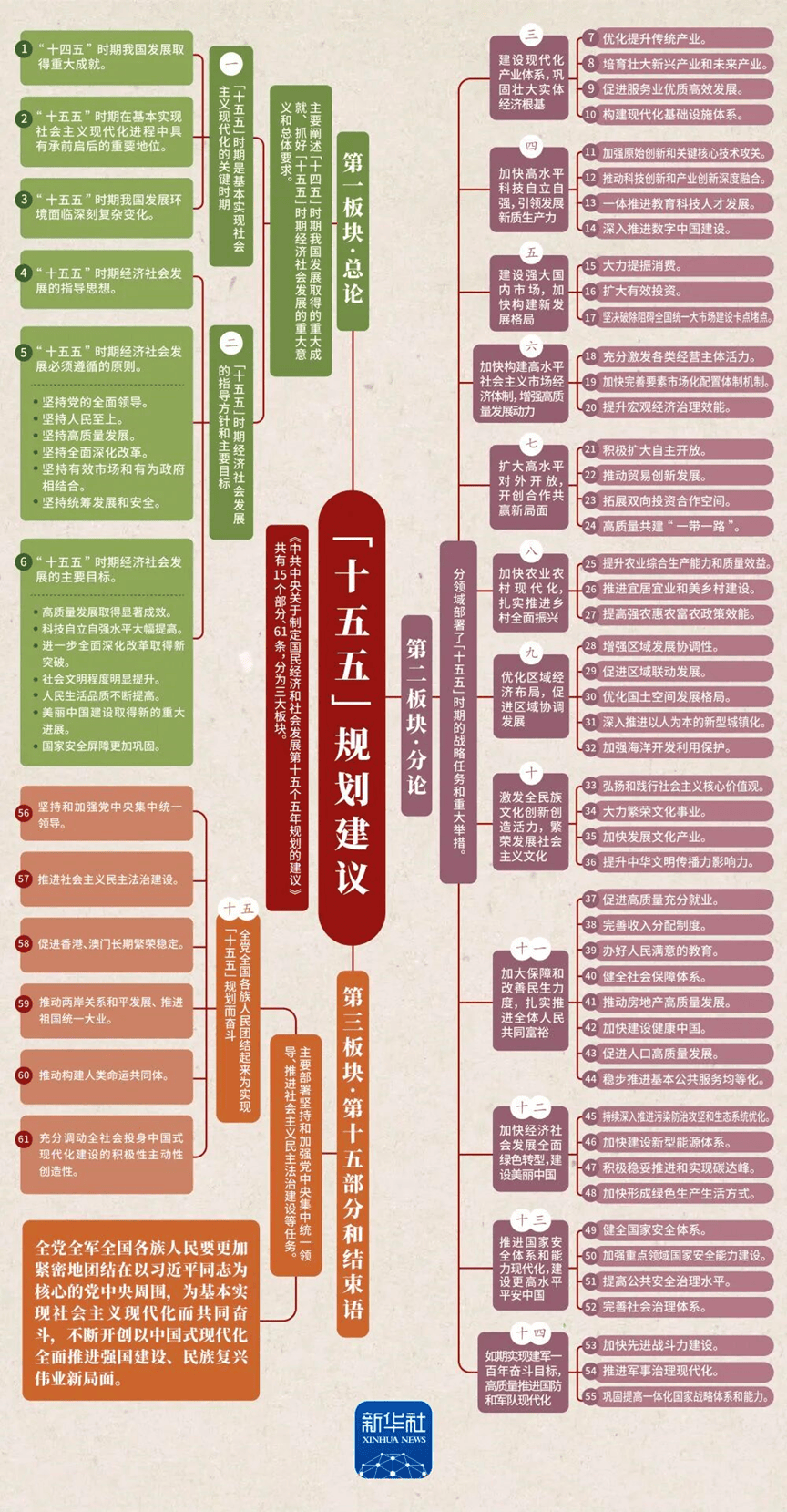
十五五规划,释放的9大信号!
Sou Hu Cai Jing· 2025-11-04 18:30
Core Insights - The "15th Five-Year Plan" is a critical roadmap for China's socio-economic development from 2026 to 2030, focusing on high-quality growth and strategic deployment towards modernization by 2035 [3][5]. Group 1: Economic Performance and Goals - During the "14th Five-Year Plan," China's GDP grew at an average rate of 5.5%, reaching 134 trillion RMB, with per capita GDP increasing from $10,632 in 2020 to $13,445 in 2024 [5]. - The "15th Five-Year Plan" aims for significant milestones, including a 70% urbanization rate by 2028, achieving carbon peak by 2030, and a 90% penetration rate for AI applications [3][5]. Group 2: Development Priorities - The plan outlines five main development lines: infrastructure, technology, finance, consumption, and livelihood [4]. - Infrastructure development will focus on major projects like the Sichuan-Tibet Railway and the national water network, which are expected to stabilize the economy [8]. - Technology will shift from factor-driven to innovation-driven growth, emphasizing high-end manufacturing, AI, and energy reform [9][10]. Group 3: Financial Sector - The financial sector is deemed essential for national competitiveness, with a focus on building a robust financial system characterized by strong institutions and regulatory frameworks [10][11]. Group 4: Consumption and Livelihood - The plan addresses insufficient domestic demand, proposing measures to increase household income and reduce consumption burdens, aiming for a consumption rate of 39.9% by 2024 [14][15]. - It emphasizes the importance of public investment in education, healthcare, and social security to stimulate consumption [17][18]. Group 5: Social Policies - The "15th Five-Year Plan" will tackle challenges in public service equality, income stability, and aging population issues, with a focus on health and education [21][22]. - It aims to enhance the quality of life through initiatives in healthcare, childcare, and social welfare, including the introduction of a national childcare subsidy [88][90]. Group 6: Market and Global Integration - The plan emphasizes the establishment of a unified national market to eliminate local protectionism and market fragmentation, which is crucial for enhancing internal stability [40][66]. - It encourages global integration through the "China + N" strategy, promoting international collaboration and investment [72]. Group 7: Key Signals for the Future - The plan reiterates the importance of economic construction, aiming for per capita GDP to reach the level of a moderately developed country by 2035 [74]. - It highlights the commitment to common prosperity, with specific targets for income distribution and social welfare improvements [76][78]. - The focus on "anti-involution" aims to streamline competition and improve industry standards, particularly in emerging sectors like renewable energy and technology [87].
证监会将推出更多有力度的开放举措 积极支持香港推出国债期货 丰富香港离岸人民币风险管理工具
Qi Huo Ri Bao Wang· 2025-11-04 17:15
Group 1 - The core achievements of China's capital market opening during the 14th Five-Year Plan include comprehensive industry access, significant growth in foreign ownership of securities, funds, and futures companies, and the optimization of the Qualified Foreign Institutional Investor (QFII) system [1] - As of now, 269 companies have achieved overseas listings, and foreign investors hold A-shares worth 3.4 trillion yuan, becoming a significant market participant [1] - The China Securities Regulatory Commission (CSRC) aims to enhance cross-border investment facilitation, deepen cooperation between mainland and Hong Kong capital markets, and strengthen regulatory capabilities and risk prevention in an open environment [2] Group 2 - The CSRC has launched a plan to optimize the QFII system, focusing on improving access management, investment operation efficiency, and expanding investment scope [2] - The CSRC emphasizes the importance of international institutions and long-term capital in contributing to China's development and encourages them to discover investment opportunities, provide precise financing services, and maintain market stability [3] - The CSRC is committed to enhancing policy stability, transparency, and predictability while promoting effective communication with international investors [2][3]
学习贯彻党的二十届四中全会精神|学习贯彻党的二十届四中全会精神中央宣讲团在金融系统宣讲
Xin Hua Wang· 2025-11-04 16:01
当日下午,王江到中国农业银行北京市分行营业部,了解营业网点金融服务情况,围绕学习贯彻全会精 神、做好"十五五"时期金融工作与一线工作人员进行座谈。 新华社北京11月4日电(记者吴雨)11月4日,学习贯彻党的二十届四中全会精神中央宣讲团在金融系统 宣讲,中央宣讲团成员、中央金融办分管日常工作的副主任、中央金融工委分管日常工作的副书记王江 作宣讲报告。 王江在宣讲中结合金融系统实际对加快建设金融强国等有关内容进行了解读。他表示,"十五五"时期是 推动金融高质量发展、加快建设金融强国的关键时期。要全面贯彻全会部署,深入研究谋划"十五五"时 期金融重点工作,加强金融系统党的领导和党的建设,坚持防风险、强监管、促高质量发展工作主线, 以钉钉子精神抓好具体工作落实,坚决把党中央决策部署落到实处,推动金融强国建设取得新的重大进 展,为实现党中央确定的"十五五"目标任务提供有力支撑。 报告会上,王江从深刻领会全会的重大意义特别是习近平总书记重要讲话精神,深刻认识"十五五"时期 在基本实现社会主义现代化进程中的重要地位,深刻把握"十五五"时期经济社会发展的指导方针、主要 目标、战略任务和重大举措,坚持和加强党的全面领导等方面, ...