
股权投资

Search documents
万业企业:全资子公司拟2.99亿元参与发起设立股权投资基金
news flash· 2025-07-11 08:01
Group 1 - The company, Wanye Enterprise (600641.SH), announced that its wholly-owned subsidiary, Nantong Wanye, plans to invest as a limited partner in the establishment of the Chongqing Liangjiang Chip Venture Capital Private Equity Fund, committing a capital contribution of 299 million yuan, which accounts for 29.90% of the fund [1] - The fund's primary investment focus will be on integrated circuits and their upstream and downstream industries, while also considering investments in high-quality enterprises that align with national policy directions and possess core technologies and broad market prospects [1] - The transaction constitutes a related party transaction as the fund managers and general partners are affiliated parties, namely Shanghai Semiconductor Equipment Materials Industry Investment Management Co., Ltd. and Shanghai Chip Venture Management Partnership [1]

以试点创新突破科技金融发展瓶颈
Jing Ji Ri Bao· 2025-07-08 21:56
Core Viewpoint - The establishment of Asset Investment Companies (AICs) by banks is seen as a crucial step to enhance support for technology-driven enterprises and address the challenges in the equity investment market in China [1][2][3] Group 1: AIC Establishment and Purpose - The third AIC, named "Zhaoyin Financial Asset Investment Co., Ltd.", has been approved for establishment with a registered capital of 15 billion yuan, fully owned by China Merchants Bank [1] - The expansion of AICs is expected to activate market vitality, optimize capital allocation, and promote the synergy between industry and finance [1] Group 2: Challenges in the Equity Investment Market - A report from the Bank of China Research Institute indicates that in 2024, there will be 10,727 equity market investment transactions totaling 16,026 billion yuan, representing declines of 21.6% and 28.8% respectively compared to the previous year [2] - Issues such as an imbalanced capital supply structure, excessive reliance on government platforms, and limited exit channels are leading to a decrease in capital's risk tolerance [2] Group 3: AIC's Role in Addressing Challenges - The AICs are positioned to activate the market by leveraging policy adjustments to attract social capital, creating a chain reaction of investment [2] - AICs are expected to enhance service capabilities due to their unique advantages, including extensive customer resources and a mature risk control mechanism [3] - AICs aim to connect technological innovation with industrial upgrades, with over 80% of their investments in strategic sectors like semiconductors and renewable energy [3] Group 4: Future Considerations for AICs - There are ongoing challenges that need to be addressed, such as improving market-oriented operational mechanisms and enhancing collaboration with other financial institutions [3]
十年镜鉴,百年人寿股权投资再启航: 新时期下符合保险资金特点的股权投资策略
13个精算师· 2025-07-08 14:29
Core Viewpoint - The article discusses the evolution of Bai Nian Life Insurance's equity investment business, highlighting its transition from a prosperous phase to a period of reflection and strategic restructuring, ultimately aiming for a renewed start in the investment landscape [2][19][20]. Historical Context - Bai Nian Life Insurance was an early participant in China's equity investment market, starting its investment activities in 2014 and accumulating nearly 10 billion RMB in investments across various strategic emerging industries such as healthcare, TMT, consumer goods, advanced manufacturing, and hard technology [2]. - The company established a strong reputation as a professional investor through collaborations with leading institutions like Sequoia Capital and CITIC Industrial Fund during its "golden era" of equity investment [2][5]. Current Strategy Adjustment - The company is currently adjusting its equity investment strategy to better align with the characteristics of insurance funds, leveraging past experiences while adapting to new policy environments and market opportunities [3][6]. - Bai Nian Life Insurance is focusing on enhancing its investment management system, including establishing a scientific decision-making mechanism and a comprehensive risk control system [6][11]. Strategic Opportunities - Since 2024, the regulatory environment has been optimized to encourage insurance funds to increase investments in strategic emerging industries, providing Bai Nian Life Insurance with significant historical opportunities for its equity investment business [8]. - The rapid development of sectors like artificial intelligence, renewable energy, biomedicine, and high-end manufacturing presents a broad market space for equity investments [8]. Investment Philosophy - The company emphasizes the unique advantages of insurance funds, such as stable sources and long payment cycles, advocating for a long-term value investment approach [9][11]. - Bai Nian Life Insurance aims to focus on the intrinsic value and long-term potential of enterprises, utilizing in-depth fundamental analysis to identify high-quality investment opportunities [11]. Risk Management - The company is committed to strengthening its risk management framework, implementing rigorous standards and processes for investment decision-making, post-investment management, and exit strategies [12]. Client Value Creation - Bai Nian Life Insurance plans to enhance synergy between its equity investment and dividend insurance businesses, aiming to create stable and sustainable returns for clients [14][15]. - The company is also dedicated to fulfilling social responsibilities through investments in enterprises that have a positive social impact, aligning with ESG investment principles [15]. Strategic Planning for Renewal - The company will adopt a phased approach to its renewed equity investment strategy, starting with lower-risk projects and gradually expanding its investment scope [17]. - Bai Nian Life Insurance aims to leverage innovation in investment models and management practices to establish new competitive advantages [17].


“零售之王”AIC牌照落地 银行系股权投资迎来小高潮
Hua Er Jie Jian Wen· 2025-07-08 13:23
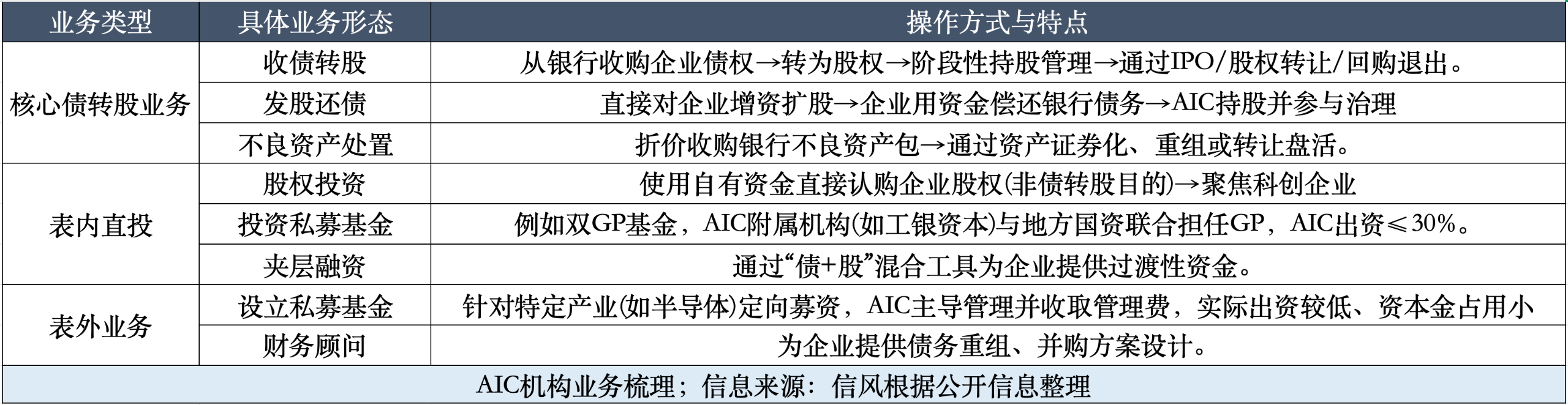
Core Viewpoint - The banking sector's financial asset investment companies (AICs) are shifting their focus from resolving non-performing assets to equity investments, as evidenced by the recent approval of China Merchants Bank's AIC, which highlights a broader trend in the industry [1][7]. Group 1: Regulatory Changes and Market Entry - China Merchants Bank has become the third joint-stock bank to hold an AIC license, following Industrial Bank and CITIC Bank [2]. - The regulatory landscape for AICs has evolved significantly since 2024, with the pilot program expanding from Shanghai to 18 cities, and the investment cap for AICs increasing from 4% to 10% of total assets [4][25]. - The rapid approval of AIC licenses for major joint-stock banks indicates a growing interest and participation in equity investment activities within the banking sector [5][30]. Group 2: Capital and Investment Strategy - China Merchants Bank's AIC, with a registered capital of 15 billion yuan, reflects its commitment to equity investment, surpassing its peers in the joint-stock banking sector [8]. - The establishment of AICs is seen as a means to enhance banks' capabilities in direct equity investments and integrated financial services [12][28]. - Historically, AICs were primarily focused on debt-to-equity swaps, but recent regulatory changes have allowed for a broader range of equity investment activities [14][24]. Group 3: Performance and Future Outlook - The performance of AICs has shown significant growth, with the profit growth rate of AICs outpacing that of their parent banks, indicating their potential to contribute to overall profitability [30]. - The shift towards equity investment is expected to align with market demands for long-term capital allocation, particularly in high-tech sectors [28][34]. - Challenges remain, including high capital consumption and reliance on IPOs for exits, which may impact the profitability of AICs [33][34].

福田汽车: 关于参与认购基金份额暨关联交易的公告
Zheng Quan Zhi Xing· 2025-07-08 10:19
Group 1 - The company plans to invest 500 million RMB in the Beijing Anpeng Science and Technology Automotive Industry Investment Fund, becoming a limited partner in the fund [3][4][14] - The fund aims to strengthen the company's supply chain stability and cost control, while also investing in cutting-edge technologies to reduce innovation risks [1][14] - The investment does not exceed 5% of the company's latest audited net assets, thus does not require shareholder approval [2][3] Group 2 - The fund was established on April 29, 2025, with a total committed capital of 2.4 billion RMB, and will focus on equity investments in clean energy, intelligent networking, high-end equipment manufacturing, and new materials [6][14] - The fund's management is handled by Shenzhen Anpeng Equity Investment Fund Management Co., Ltd., which is a wholly-owned subsidiary of Beijing Automotive Group Investment Co., Ltd. [11][12] - The fund has a lifespan of 15 years, with an investment period of 3 years and an exit period of 9 years [6][10] Group 3 - The board of directors unanimously approved the investment proposal, with all independent directors agreeing that the transaction is fair and will not harm the interests of the company or its shareholders [4][5] - The company has not engaged in similar transactions with the same related party in the past 12 months, ensuring compliance with regulatory requirements [2][3] - The investment is expected to enhance the company's competitive strength and overall profitability by leveraging professional investment management capabilities [14]

中际联合: 中际联合关于全资子公司参与认购股权投资基金份额暨对外投资的进展公告
Zheng Quan Zhi Xing· 2025-07-07 16:06
Overview - The company, Zhongji United (Beijing) Technology Co., Ltd., through its wholly-owned subsidiary, Zhongji United (Beijing) Equipment Manufacturing Co., Ltd., has signed a partnership agreement to invest in a private equity fund, contributing 20 million RMB [1] Investment Details - The investment is made in the Chengdu Zizhi Lianjin Venture Capital Partnership (Limited Partnership), which has been registered with the Asset Management Association of China since August 20, 2024, with registration code SANF44 [1] - The fund manager and general partner of Zizhi Lianjin is Beijing Mingshi Private Fund Management Co., Ltd. [1] Changes in Partnership - The partnership agreement has undergone several changes, including the admission of new limited partners and capital adjustments: - New partner Chengdu Angel Equity Investment Fund Co., Ltd. will contribute 50 million RMB by June 30, 2029 [2] - The registered capital of the partnership has been increased from 25.2 million RMB to 33.66 million RMB [2] - Additional new partners include Sequoia Yuhui (Xiamen) Equity Investment Partnership and Zigong Innovation Capital Investment Co., Ltd., with respective contributions of 12 million RMB and 30 million RMB [2][3] Fund Structure and Contributions - As of the announcement date, the total registered capital of the Zizhi Lianjin fund is 54.3 million RMB, with various partners contributing different amounts [4][9] - The fund's structure includes multiple partners, with Zhongji United (Beijing) Equipment Manufacturing Co., Ltd. being one of the limited partners [4][9] Impact on Company - The changes in the partnership and the addition of new limited partners are in compliance with investment regulations and do not harm the interests of the partnership or its partners [10] - The company's investment amount and method remain unchanged, and the new partnership agreement is not expected to adversely affect the company's financial or operational status [10]

国泰海通 · 晨报0708|固收、公用事业、中小与股权研究、地产
国泰海通证券研究· 2025-07-07 14:36
Group 1 - The "Big and Beautiful" Act passed in the U.S. Congress will increase the debt ceiling by $5 trillion, leading to a significant surge in U.S. Treasury bond issuance, creating historical supply challenges for the market [3] - The act proposes a $4 trillion tax cut and a reduction of at least $1.5 trillion in spending over the next decade, which the Congressional Budget Office estimates will result in an additional $2.8 trillion deficit over the same period [3][4] - Historical data shows that the U.S. has raised the debt ceiling over seventy times since its establishment in 1917, indicating that the so-called "debt crisis" is primarily a political tool rather than a genuine sovereign credit risk [4][6] Group 2 - The recent increase in the debt ceiling alleviates short-term default risks but introduces significant supply-side shocks to the Treasury market, with upward pressure on short-term Treasury yields [5] - The upcoming peak in Treasury maturities in 2025, combined with a growing fiscal deficit, will necessitate increased Treasury issuance, which is expected to drive up yields, particularly in the context of the Federal Reserve's balance sheet reduction [5][6] - The long-term risks associated with deferred debt issues include rising interest rates, concerns over fiscal sustainability, and increased market risk premiums, which could spill over into the global financial market [6] Group 3 - The electricity market is experiencing upward pressure on prices, with expectations that electricity price increases may outpace coal price rises due to extreme weather conditions and increased demand for thermal power generation [11][12] - The national electricity load reached a historical high of 1.465 billion kilowatts, with significant contributions from air conditioning loads, indicating a robust demand environment [12] - The introduction of new high-voltage direct current projects aims to enhance electricity supply and optimize pricing structures, reflecting a strategic shift in energy management [13]

清科2025年中国股权投资基金有限合伙人榜单正式揭晓
投资界· 2025-07-04 12:05
Core Viewpoint - The article discusses the 2025 China Private Equity Investment Fund Limited Partner Rankings, highlighting the challenges and transformations in the private equity market, particularly the role of long-term capital and government guidance funds in revitalizing the sector [3][4]. Group 1: Market Overview - The Chinese private equity market has faced downward pressure over the past year, with a slowdown in fundraising and investment activities [3]. - Despite these challenges, long-term capital from insurance companies, banks, and national funds is entering the market, providing new liquidity [3]. - State-owned capital is becoming a dominant force, enhancing collaboration with various LPs to empower technological innovation and industrial development [3]. Group 2: Rankings and Lists - The article presents the "Top 50 China Government Guidance Funds of the Year 2025," with the Shenzhen Municipal Government Investment Guidance Fund ranked first [6][11]. - It also includes the "Top 50 China VC/PE Institutional Limited Partners of the Year 2025," with CICC Capital at the top of the list [25][26]. - Additional rankings include the "Top 10 China Provincial Government Guidance Funds" and the "Top 30 China County-level Government Guidance Funds," showcasing the diversity of government-led investment initiatives [10][21]. Group 3: Future Outlook - The article suggests that as the private equity market begins to recover in terms of exits and fundraising, the dynamics between LPs and GPs will evolve, warranting further observation [3].
腾讯创投等入股晨壹基金
news flash· 2025-07-04 03:32
天眼查App显示,7月4日,上海晨峦企业管理合伙企业(有限合伙)发生工商变更,新增广西腾讯创业投 资有限公司、无锡晨壹成长股权投资基金(有限合伙)、厦门金圆展鸿二期股权投资合伙企业(有限合 伙)、珠海众烨投资企业(有限合伙)等为合伙人。公开信息显示,晨壹基金由原华泰联合证券总裁刘晓丹 创立,其首只基金于2020年3月完成备案,并通过非公开募集方式开展业务。2024年3月,原阿里巴巴集 团董事会主席兼首席执行官张勇加入,进一步强化管理团队。(智通财经) ...

新华网: 新华网股份有限公司关于全资子公司新华网创业投资有限公司参与投资设立新华网盛石清能(南通)股权投资基金合伙企业(有限合伙)的公告
Zheng Quan Zhi Xing· 2025-07-03 16:27
Core Viewpoint - The company, Xinhua Net Co., Ltd., announces its full subsidiary, Xinhua Net Venture Capital Co., Ltd., has participated in the establishment of a partnership investment fund named Xinhua Net Shengshi Qingneng (Nantong) Equity Investment Fund Partnership (Limited Partnership) with several other investment firms, with a total subscription amount of RMB 35.01 million, where Xinhua Net Venture Capital contributes RMB 15 million [1][2][14]. Investment Overview - The partnership fund has a total subscribed capital of RMB 35.01 million, with Xinhua Net Venture Capital as a limited partner contributing RMB 15 million [1][2]. - The investment is aimed at leveraging professional institutions' resources and advantages in the investment field to achieve medium to long-term investment returns while controlling risks [13]. Partner Information - The general partner of the fund is Shanghai Shengshi Capital Management Co., Ltd., which has a registered capital of RMB 100 million and was established on November 15, 2018 [2][3]. - Other partners include Shanghai Changfeng Huixin Equity Investment Fund Management Co., Ltd., Nantong Shenghui Enterprise Management Partnership (Limited Partnership), Guangzhou Guodian Pingyun Capital Management Co., Ltd., and Luzhou Huijin Equity Investment Partnership (Limited Partnership) [1][2]. Financial Data - As of December 31, 2024, Shengshi Capital reported total assets of RMB 60.38 million and net assets of RMB 43.53 million [3][4]. - Xinhua Net Venture Capital reported total assets of RMB 127.63 million and net assets of RMB 121.76 million as of December 31, 2024 [5]. Investment Target - The fund will invest in Huisheng Clean Energy Technology Group Co., Ltd. [10]. Investment Decision Process - Investment decisions will follow the procedures outlined in the partnership agreement, particularly regarding conflicts of interest and related transactions [10]. Post-Investment Management - The fund manager will monitor the invested enterprises continuously and manage exit strategies according to the partnership agreement [10][12]. Revenue Distribution - The distribution of profits will follow a structured process, ensuring that all partners receive returns based on their contributions [11][12].
