绿色能源

Search documents
今年公募基金新发行突破1400只
Jin Rong Shi Bao· 2025-11-20 01:28
Core Insights - The public fund issuance market has seen a surge in subscriptions this year, with multiple stock ETFs focusing on cutting-edge fields like artificial intelligence and high-end manufacturing being launched intensively [1] Group 1: Fund Issuance Trends - In the past four years, 2022 marked a peak with 1,424 new funds established, raising a total of 1.47 trillion yuan; in 2023, the number of new funds decreased to 1,267, with a total scale down by 22.69% to 1.13 trillion yuan; in 2024, the number further contracted to 1,143, but total scale slightly increased by 5.06% to 1.19 trillion yuan [2] - As of November 19 this year, 1,401 new funds have been established, nearing the historical high of 2022, with a year-on-year increase of 22.57%; however, the total fundraising scale is 996.61 billion yuan, down 16.31% year-on-year [2] - The most significant change in the public fund market this year is that stock funds have become the largest category, with an issuance scale of 645 billion yuan, accounting for 31.01% of the total market scale, surpassing bond funds for the first time [2][3] Group 2: Shift in Fund Types - In 2022, bond funds dominated the market with a scale share of 47.65%, reflecting a strong risk-averse sentiment; over the next three years, the weight of equity products has continued to rise, with stock funds surpassing 20% in 2023 and further increasing in 2024 [3] - The rise of index-based investment is closely related to this shift; in 2025, 762 new stock funds were established, with 96.59% being index products; thematic ETFs focusing on artificial intelligence, high-end manufacturing, and green energy have also been launched, with individual products generally raising over 1.5 billion yuan [3] - The transition from bond funds to stock funds indicates a change in investor risk appetite, as some previously conservative funds are migrating towards risk assets due to the profitability of the equity market [3] Group 3: Fund of Funds (FOF) and Policy Impact - After experiencing a low point in issuance in 2024, the number of new FOFs increased to 78 in 2025, with a significant rise in those targeting retirement, reflecting the growing demand for personal retirement investment amid pension system reforms [4] - The fund issuance market has shown a more stable and healthy rhythm this year, with a quarterly increase in issuance: 310 in Q1, 370 in Q2, 458 in Q3, and 263 so far in Q4 [5] - The average subscription days for new funds have significantly decreased from 26 days in 2022 to about 16 days in 2025, attributed to the widespread adoption of electronic sales channels and improved investor education [5] Group 4: Market Outlook - The dual drivers of policy and funding have contributed to the changes in the issuance market; a joint implementation plan by six departments in January aimed at increasing the allocation of long-term funds to equity assets, providing strong support for the development of stock funds [5] - The structure of funding is also undergoing profound changes, with long-term institutional funds like insurance and annuities flowing into the market, while individual investors are increasingly entering through index funds, with their holding proportion rising from 35% in 2022 to 58% [5] - As market performance improves, more investors are expected to enter the market through fund products, creating a positive cycle that further promotes the healthy development of public funds [6]
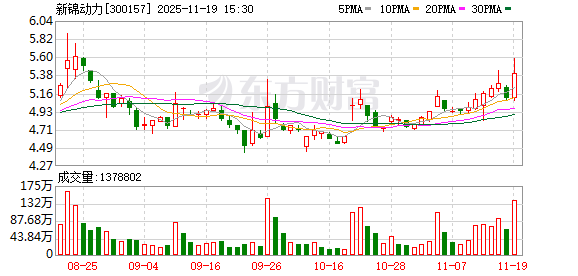
新锦动力:公司陆续承接了152万吨/年零碳氢氨项目(一期)P1压缩机等并已完成交付
Mei Ri Jing Ji Xin Wen· 2025-11-19 13:31
Group 1 - The company is expanding its business into the green hydrogen and ammonia sector, leveraging its extensive experience and technology in synthetic ammonia equipment [2] - The company has successfully undertaken projects including a 152,000 tons/year zero-carbon hydrogen ammonia project and a total contracting project for a green hydrogen and ammonia integration facility [2] - The company aims to continuously monitor industry developments and actively broaden the application scenarios of its products in the green energy field [2]


芯片行业,一桩收购
半导体芯闻· 2025-11-19 10:32
Group 1 - Taiwan's semiconductor giant Panjit has approved the acquisition of 95% of Torex Vietnam Semiconductor, a subsidiary of Japan's Torex, to expand its product line and enhance its capabilities in automotive-grade power semiconductor packaging and testing [2] - The investment is aimed at strengthening Panjit's manufacturing base in Southeast Asia, enhancing production flexibility and supply chain resilience amid geopolitical uncertainties and global supply chain restructuring [2] - Torex Vietnam, established in 2008, specializes in semiconductor component packaging and testing services, utilizing patented Ultra Small Package (USP) technology [2] Group 2 - Vietnam aims to establish its first semiconductor manufacturing plant by 2026, highlighting its ambition to secure a position in the global chip supply chain [3] - The country has launched a national semiconductor industry development strategy for 2030, along with a talent cultivation plan and a list of 11 strategic technologies and products, including chips [3] - As of August 2025, Vietnam has approximately 170 foreign direct investment projects in the semiconductor and high-tech sectors, with a total registered capital of nearly $11.6 billion [3]

佛燃能源(002911) - 002911佛燃能源投资者关系管理信息20251119
2025-11-19 08:22
2.公司为什么选择投资绿色甲醇项目? 答:2023 年至 2025 年,国家发改委、国家能源局分别发布政策, 鼓励绿色甲醇等为代表的绿色液体燃料产业的发展,公司投资绿色甲醇 项目,是公司积极响应国家新能源发展战略的重要部署,可紧跟绿色燃 料及化工市场趋势,抢占行业先机。近年来,国际海事组织(IMO)提 出"2023 战略",《欧盟海运燃料条例》提出 2025、2050 年目标,对 国际航运减排要求日趋严格,而使用以绿色甲醇为代表的清洁燃料,则 成为船舶节能减排的重要途径。在全球碳减排的大背景下,随着欧盟法 规和 IMO 减排政策的逐步执行,绿色甲醇作为一种碳排放更少、使用更 经济的绿色燃料具有广泛的市场前景和增长潜力。公司作为综合能源服 务商,致力于构建绿色能源服务共同体,近年来积极布局氢能、光伏等 绿色低碳能源,此次投资绿色甲醇项目,是公司在绿色氢基能源领域的 重要部署,有利于构建公司中长期可持续发展的产业优势。 证券代码:002911 证券简称:佛燃能源 佛燃能源集团股份有限公司投资者关系活动记录表 编号:2025011 | | 特定对象调研 □分析师会议 | | --- | --- | | 投资者关系 ...
热闹赛场 硬核科技
Ren Min Ri Bao Hai Wai Ban· 2025-11-19 06:59
Group 1 - The integration of technology in the National Games showcases advancements in smart venues, AI assistance, and automated services, enhancing the overall experience for spectators and participants [1][2] - The smart command center at Bao'an Sports Center utilizes real-time data from thousands of devices, improving operational efficiency and safety during the event [1] - The use of renewable energy is highlighted, with all venues in the Shenzhen area powered by green electricity, resulting in a reduction of approximately 50,000 tons of carbon emissions, equivalent to planting 2.7 million trees [1] Group 2 - The event serves as a test of urban operational capabilities, with technologies like autonomous driving and smart traffic systems facilitating efficient movement of people and goods [2] - Many technologies implemented during the Games are expected to have lasting impacts beyond the event, contributing to industrial upgrades and improving daily life for various communities [2] - The National Games not only provide a platform for athletic competition but also act as a catalyst for technological innovation and urban development, enhancing the quality of life in cities [2]
国内首个多介质绿色能源通道项目前期工作启动
Xin Hua Wang· 2025-11-19 02:50
Core Insights - The National Pipeline Group has initiated the feasibility study for the Chifeng-Jinzhou hydrogen pipeline project, aiming to enhance high-quality energy development in Liaoning Province [1] - This project is expected to become the largest and longest transportation channel for hydrogen, ammonia, and methanol in China, marking a significant step in the green energy infrastructure sector [1] Group 1: Project Overview - The pipeline will start from Chifeng City in Inner Mongolia and end at Jinzhou Port in Liaoning Province, featuring a parallel layout for hydrogen, methanol, and liquid ammonia [1] - The total length of the pipeline is 290 kilometers, making it the first multi-medium green energy corridor in the country [1] Group 2: Strategic Importance - The Chifeng-Jinzhou project represents the National Pipeline Group's proactive engagement in strategic emerging industries, focusing on the green hydrogen-based energy sector [1] - The company is developing a technical system for carbon transportation of hydrogen and ammonia, aiming to create a unified national network for green hydrogen energy delivery [1] Group 3: Economic Impact - This initiative is expected to transform regional resource endowments into industrial development momentum, fostering a complementary and high-quality regional economic layout [1] - It reflects the National Pipeline Group's commitment to ensuring national energy security [1]
储能政策密集落地!绿色能源ETF(562010)摸高0.88%!机构:新型储能或迎加速发展期
Xin Lang Ji Jin· 2025-11-19 02:29
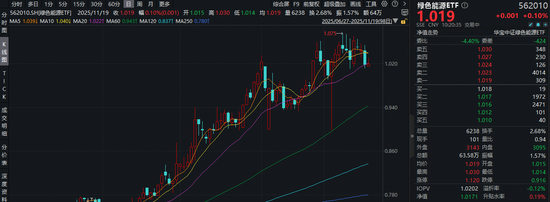
Core Viewpoint - The green energy ETF (562010) shows stable performance with a slight increase, while key stocks in the sector exhibit mixed results, indicating ongoing market dynamics in the green energy space [1][3]. Market Performance - The green energy ETF reached a peak increase of 0.88% during trading, currently up by 0.1% [1]. - Key stocks such as Ganfeng Lithium, Tianqi Lithium, and Zhongmin Resources showed strong performance with increases of 3.52%, 3.42%, and 3.11% respectively [1]. - Conversely, stocks like Trina Solar, JinkoSolar, and Jinglong Electric experienced declines of 2.22%, 1.43%, and 1.28% respectively [1]. Policy and Industry Developments - The National Development and Reform Commission and the Energy Administration issued guidelines on November 16 to promote the consumption and regulation of new energy, including the integration of new energy storage into the capacity price mechanism [3]. - Longi Green Energy announced the acquisition of Suzhou Jingkong Energy to enter the energy storage sector, expanding its business layout [3]. - The 2025 New Energy Battery Industry Development Conference highlighted that China's new energy storage installed capacity accounts for over 40% of the global total, indicating rapid industry innovation [3]. Future Outlook - Zheshang Securities expresses optimism about the potential in the green energy sector due to several factors: 1. A synchronized increase in both domestic and international demand, leading to a favorable period for energy storage [3]. 2. Efficiency improvements and cost reductions benefiting the photovoltaic industry, supported by favorable policies and technological advancements [3]. 3. Expanding overseas market opportunities, opening up new profit growth spaces for the industry [3]. ETF Composition - The green energy ETF passively tracks the green energy index, with the top three sectors being batteries, photovoltaic equipment, and electricity, collectively accounting for over 75% of the index weight as of the end of October [3]. - The top ten weighted stocks in the index include CATL, Sungrow Power Supply, Changjiang Electric, BYD, Longi Green Energy, Yiwei Lithium Energy, Huayou Cobalt, Ganfeng Lithium, Tongwei Co., and Xianlead Intelligent [3].
证券代码:002053 证券简称:云南能投 公告编号:2025-143
Zhong Guo Zheng Quan Bao - Zhong Zheng Wang· 2025-11-19 00:42
登录新浪财经APP 搜索【信披】查看更多考评等级 本公司及董事会全体成员保证信息披露内容的真实、准确、完整,没有虚假记载、误导性陈述或重大遗 漏。 云南能源投资股份有限公司(以下简称"公司")于日前收到会泽县发展和改革局中标通知书,确定公司 为会泽县大竹山风电场项目投资开发主体的中标人。具体情况公告如下: 一、项目概况 该项目位于云南省曲靖市会泽县娜姑镇东侧附近,场址成风条件较好,具备布置风机的条件,预计装机 容量2.5万千瓦。 二、交易对手方介绍 公司本次中标会泽县大竹山风电场项目,交易对手方为会泽县发展和改革局。 最近一个会计年度类似业务情况:公司于2024年12月获得会泽县轿子光伏发电项目、披嘎打厂箐光伏发 电项目开发权,公司于2024年12月4日披露了《关于获得会泽县85MW光伏发电项目开发权的公告》 (公告编号:2024-146)。 公司与会泽县发展和改革局不存在关联关系。 三、对公司的影响 公司本次获得会泽县大竹山风电场项目开发权,有利于公司紧抓战略机遇,积极践行国家和云南省能源 发展战略,加快绿色能源建设步伐,提升公司新能源装机规模、市场地位和经营业绩,促进公司新能源 业务的做强做优做大,推动公 ...

“十五五”时期香港会有更好发展
Ren Min Ri Bao· 2025-11-18 22:50
南非驻港总领事莫宏飞会后表示,中国"十五五"时期聚焦可持续发展、技术创新、绿色能源与社会公 平,这些不仅惠及中国自身发展,更能对全球产生积极影响。此外,中国对创新与数字经济的重视,既 能带动全球技术进步,也能创造更多国际合作契机。 香港新西兰商会主席卫德云认为,中国"十五五"规划建议为持续发展、创新突破与民生改善指明了路 径。香港凭借自身独特优势,完全有能力深度参与规划实施、助力目标落地,尤其可发挥在金融服务、 航空海运、高校科研等领域的专长。他向记者表示,香港、澳门在参与粤港澳大湾区建设的同时,可借 助大湾区进一步辐射更广阔的内地。 据新华社香港电(记者王昕怡)外交部驻港特派员公署近日举办中国共产党二十届四中全会精神专题宣 介会。出席活动的外国驻港领团及商会人士在会后表示,"十五五"规划建议中对香港发展的角色与定位 科学精准、具有前瞻性,尤其是关于香港巩固和提升三大中心地位的战略指引,让外国驻港人士深切感 受到发展机遇、看好香港的发展。 外交部驻港公署特派员崔建春在会上表示,中国经济将为世界提供更多发展机遇、优良营商环境、广阔 创新舞台和绿色发展条件。香港和澳门既有国家的坚实支持,又与世界其他地区保持紧密联 ...
从规模领先到质量引领 中集集团深化智能制造升级
Zheng Quan Shi Bao· 2025-11-18 18:08
Core Insights - CIMC has transitioned from "scale leadership" to "quality leadership" over the past five years, establishing a solid foundation in technology, industry, capital, and governance to integrate deeply into national strategies and participate in global competition [1] Group 1: Business Transformation and Strategy - CIMC has set "high-end, intelligent, and green" as the core strategy for its transformation and upgrade, focusing on enhancing its influence in the global high-end equipment sector [1] - During the 14th Five-Year Plan, CIMC has solidified its leading position in high-end manufacturing, concentrating on logistics and energy equipment, and has cultivated nine national-level "manufacturing single champion" products [1] - The company has established three national-level smart factories and two fully connected 5G factories, advancing its industrial manufacturing from 3.0 to 4.0 [1] Group 2: Clean Energy Initiatives - Guided by the "dual carbon" goals, CIMC has developed a full industrial chain layout for clean energy, including hydrogen energy, energy storage, LNG, and green methanol [1] - The company has implemented projects such as the co-production of hydrogen from coke oven gas and LNG, and is advancing a bio-green methanol factory, contributing to carbon reduction pathways [1] Group 3: New Business Development - CIMC has achieved significant results in expanding its emerging business, securing a $1.5 billion national first FLNG modification total package order and launching the world's first modular container wind turbine nacelle and ultra-large modular data center projects [2] - The company has leveraged capital market reforms to diversify financing for its subsidiaries, enhancing the synergy between capital and industry, which provides stable funding support for technological research and capacity expansion [2] Group 4: Shareholder Returns and Market Position - CIMC has adhered to the principle of "sharing development results," with cumulative cash dividends exceeding 5 billion yuan over five years and a dividend payout ratio maintained above 30% [2] - The company has established a collaborative repurchase structure between A-shares and H-shares, improved disclosure quality, and strengthened market value management and shareholder communication [2]