
合成生物学

Search documents
康弘药业(002773) - 002773康弘药业投资者关系管理信息20250829
2025-08-29 10:08
Group 1: Market Position and Product Development - Kanghong Pharmaceutical's KANGBAIXIPU has established a leading position in the Chinese ophthalmology market, with expectations for high-concentration KANGBAIXIPU to launch by 2028, further solidifying market presence [2][3] - The company's gene therapy platform is projected to receive approval for its ophthalmic products around 2030, enhancing its product lineup in the retinal disease sector [2][3] Group 2: Clinical Trials and Safety Data - KH631's Phase I clinical trial data shows excellent safety, with results expected in the first half of 2026 for all subjects, indicating no significant racial differences in safety and preliminary efficacy signals [3][4] - KH607 is currently advancing to Phase II clinical trials, with Phase I and IIa trials demonstrating good safety and efficacy [7] Group 3: Financial Guidance and Investment - For the first half of 2025, sales expenses are projected to increase by approximately 7.85%, management expenses by about 1.41%, and R&D investment by around 16.45% [8] - R&D investment is expected to account for approximately 9.26% of revenue in the first half of 2025, up from 8.51% in the same period last year [8] Group 4: Future Projections - The company anticipates a revenue growth of 5%-15% for 2025 compared to 2024, with net profit expected to increase by the same percentage [8] - The commercialization prospects for innovative drugs depend on various factors, including efficacy, safety, and market competition [7]

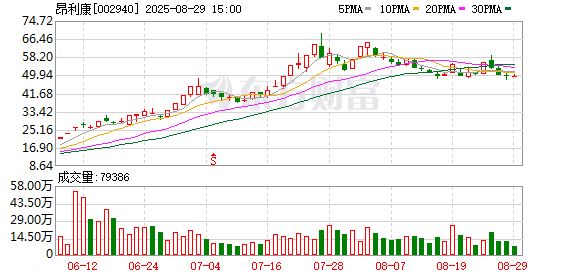
昂利康:目前在原料药的生产过程中,暂未使用AI的方法
Zheng Quan Ri Bao· 2025-08-29 08:43
Core Insights - The company announced that it has not yet utilized AI methods in the production process of raw materials [2] - The establishment of Jinhe Bio in 2023 aims to apply synthetic biology in the production of raw materials [2] - The company has achieved full enzyme-based production processes for cephalosporin raw materials, leading to cost reduction and efficiency improvement [2] - In preliminary research for penicillin raw materials, Jinhe Bio has completed enzyme process validation for products like amoxicillin and has developed the capability for independent enzyme preparation [2]

无锡晶海(836547):北交所信息更新:氨基酸原料药新锐技术升级,全球化布局焕发新动能升
KAIYUAN SECURITIES· 2025-08-29 07:23
Investment Rating - The investment rating for Wuxi Jinghai is maintained at "Outperform" [1][2] Core Views - The company reported a revenue of 203 million yuan in H1 2025, representing a year-on-year growth of 18.67%, and a net profit attributable to shareholders of 37.30 million yuan, up 34.77% year-on-year [2] - The company is actively expanding its overseas market share and has established a wholly-owned subsidiary in Singapore, with plans to set up subsidiaries in the Netherlands and the United States [3] - The company is focusing on technological upgrades and has initiated research on high-purity amino acid production technologies, which are expected to enhance its competitive edge in the amino acid market [3] Financial Summary - The total market capitalization of the company is 21.12 billion yuan, with a circulating market capitalization of 9.68 billion yuan [1] - The company's revenue is projected to grow from 402 million yuan in 2025 to 607 million yuan in 2027, with corresponding net profits expected to rise from 73 million yuan to 103 million yuan during the same period [4][6] - The company's earnings per share (EPS) are forecasted to increase from 0.94 yuan in 2025 to 1.32 yuan in 2027, with a price-to-earnings (P/E) ratio decreasing from 29.0 to 20.6 over the same period [4][6]
聚杰微纤2025年上半年实现营收3.05亿元 新材料布局加速落地
Zheng Quan Shi Bao Wang· 2025-08-29 02:40
Core Viewpoint - 聚杰微纤 is accelerating its layout in new materials, achieving a revenue of 305 million yuan and a net profit of 41.25 million yuan in the first half of 2025, indicating strong growth potential in various advanced material applications [1][2]. Group 1: Financial Performance - In the first half of 2025, the company reported a revenue of 305 million yuan and a net profit of 41.25 million yuan [1]. - The company plans to distribute a cash dividend of 1.0 yuan per 10 shares, totaling 14.92 million yuan, reflecting its commitment to shareholder returns and confidence in future operations [3]. Group 2: Strategic Development - 聚杰微纤 is focusing on advanced applications in industrial fabrics, new energy membrane materials, and smart fibers, with several products entering the application testing phase [1][2]. - The company has established a comprehensive supply chain system, ensuring full control over the production process from molecular structure design to finished product manufacturing [2]. Group 3: Product Innovation - 聚杰微纤 is making significant progress in cutting-edge areas such as hydrogen production membrane materials, waterproof and breathable membranes for jackets, and drive fibers for humanoid robots [2]. - The high-end biomimetic material brand "Musues" aims to replace and surpass natural suede, showcasing the company's philosophy of "weaving technology with warmth" [2]. Group 4: Market Positioning - The company is not only a materials manufacturer but also positions itself as a trusted partner that enhances customer experiences through technology [2]. - 聚杰微纤 is committed to deepening the integration of materials and technology, addressing societal needs for energy and health [2].
申万宏源证券晨会报告-20250829
Shenwan Hongyuan Securities· 2025-08-29 00:44
Group 1: Snow Peak Technology (603227) - The company is positioned as a leader in the civil explosives and chemical industry in Xinjiang, with a dual business layout of "civil explosives + chemicals" [10][12] - Revenue forecasts for 2025-2027 are projected at 6.582 billion, 7.665 billion, and 8.613 billion yuan, with corresponding net profits of 545 million, 820 million, and 1.035 billion yuan, indicating growth rates of -19%, 51%, and 26% respectively [12] - The company benefits from a significant regional advantage in Xinjiang, where the scarcity of ammonium nitrate is highlighted, and the entry of Guangdong Hongda is expected to facilitate the scale-up of explosives production [12] Group 2: Meituan (03690) - The company maintains a "buy" rating despite a decrease in profits due to increased competition in the food delivery and instant retail sectors, with adjusted net profits for 2025-2027 revised to -4.5 billion, 38.5 billion, and 57.6 billion yuan [11][15] - The core local business revenue grew by 7.7% year-on-year to 65.3 billion yuan, but operating profit fell by 75.6% to 3.7 billion yuan, indicating significant pressure on profit margins [13][15] - The company is actively expanding its logistics network and enhancing service quality, with a peak daily order volume exceeding 150 million in July [13][15] Group 3: Banking Sector Insights - Industrial Bank (601166) reported a revenue of 110.5 billion yuan in 1H25, a decrease of 2.3%, but net profit increased by 0.2% to 43.1 billion yuan, indicating a recovery in profitability [17][19] - CITIC Bank (601998) achieved a revenue of 105.8 billion yuan in 1H25, down 3%, while net profit rose by 2.8% to 36.5 billion yuan, reflecting stable asset quality [21][23] - Su Nong Bank (603323) reported a slight revenue increase of 0.2% to 2.28 billion yuan in 1H25, with net profit growing by 5.2% to 1.18 billion yuan, showcasing a robust fundamental performance [25][26]



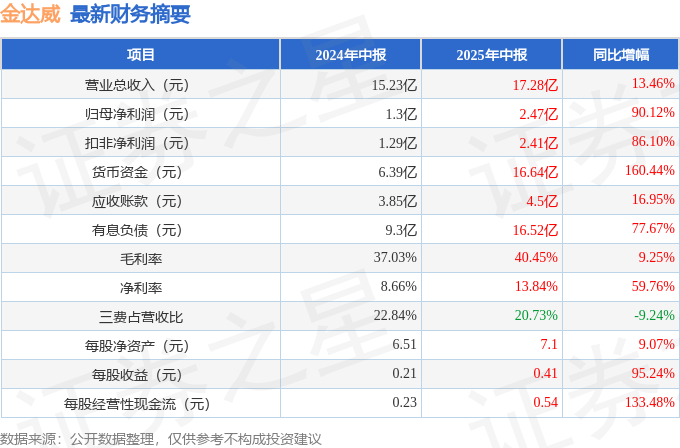
金达威2025年中报简析:营收净利润同比双双增长,盈利能力上升
Zheng Quan Zhi Xing· 2025-08-28 22:59
Core Insights - The company Jin Dawei (002626) reported a significant increase in revenue and profit for the first half of 2025, with total revenue reaching 1.728 billion yuan, a year-on-year increase of 13.46%, and net profit attributable to shareholders of 247 million yuan, up 90.12% [1] - The company's gross margin improved to 40.45%, reflecting a year-on-year increase of 9.25%, while the net margin rose to 13.84%, an increase of 59.76% [1] - The company has a strong cash position, with cash and cash equivalents increasing by 160.44% to 1.664 billion yuan [1] Financial Performance - Total revenue for 2025 was 1.728 billion yuan, compared to 1.523 billion yuan in 2024, marking a 13.46% increase [1] - Net profit for 2025 was 247 million yuan, up from 130 million yuan in 2024, representing a 90.12% increase [1] - The company's operating cash flow per share increased by 133.48% to 0.54 yuan [1] Profitability Metrics - Gross margin for 2025 was 40.45%, up from 37.03% in 2024, a 9.25% increase [1] - Net margin improved to 13.84% from 8.66% in the previous year, a 59.76% increase [1] - The company's total expenses (selling, administrative, and financial) decreased by 9.24% to 3.58 billion yuan, accounting for 20.73% of revenue [1] Business Model and Operations - The company primarily engages in the research, production, and sales of nutritional health foods and feed additives, with a significant portion of its production occurring domestically and a high export ratio [6] - The company utilizes synthetic biology for the large-scale production of various raw materials, including Coenzyme Q10 and NMN, and aims to reduce production costs for competitive advantage [7] - In the health food sector, the company operates two major brands, Doctor's Best and Zipfizz, and has established a full industry chain from raw material supply to brand operation [8] Debt and Receivables - The company's interest-bearing debt reached 1.652 billion yuan, reflecting a 77.67% increase from the previous year [1] - The accounts receivable to profit ratio stood at 131.52%, indicating a need for monitoring the company's receivables situation [4]

创新药价值持续释放 康弘药业上半年营收净利双增
Zhong Zheng Wang· 2025-08-28 14:09
Core Viewpoint - Kanghong Pharmaceutical, a leader in ophthalmic innovative drugs, reported a revenue of 2.454 billion yuan for the first half of 2025, representing a year-on-year growth of 6.95%, and a net profit attributable to shareholders of 730 million yuan, up 5.41% year-on-year [1] Group 1: Financial Performance - The company achieved a revenue of 2.454 billion yuan in the first half of 2025, with a year-on-year increase of 6.95% [1] - The net profit attributable to shareholders was 730 million yuan, reflecting a growth of 5.41% compared to the previous year [1] Group 2: Innovation and Product Development - The biopharmaceutical segment generated 1.345 billion yuan in revenue, marking a 14.66% increase and accounting for 54.83% of total revenue [2] - The core product, Conbercept, continues to grow, with ongoing Phase II clinical trials for a high-concentration formulation [2] - The company is expanding its focus on gene therapy and synthetic biology, with the gene therapy drug KH631 entering Phase II clinical trials [2] - KH658, another gene therapy product, has been approved for clinical trials in both China and the U.S., with research results published in Nature Communications [2] Group 3: Synthetic Biology and Traditional Chinese Medicine - The injectable KH617, the first product from the synthetic biology platform, is currently in Phase II clinical trials, with related research presented at major conferences [3] - The traditional Chinese medicine segment generated 797 million yuan in revenue, a 6.30% increase, with strong demand for key products [3] - The company’s proprietary product, Shugan Jieyu capsules, has been recognized as a second-level protected variety by the National Medical Products Administration [3] Group 4: Capacity Expansion - The gene drug production base project is expected to be operational by January 2026, enhancing the company's ability to respond to commercial orders and support new indications [4] - The production base will facilitate the industrialization of gene drugs, improving supply chain security and cost control [4] Group 5: Automation and Efficiency - The intelligent production workshop of the subsidiary Jishengtang has entered trial operation, achieving full automation from raw material input to drying [5] - The workshop's DCS control system significantly reduces energy consumption, achieving over 89% energy savings compared to traditional methods [5][6]
莱茵生物上半年营收8.37亿元 独家新品RM2撬动全球减糖市场
Quan Jing Wang· 2025-08-28 13:36
Core Viewpoint - 莱茵生物's half-year report for 2025 shows strong revenue growth and significant improvements in cash flow, driven by robust performance in its plant extraction and natural sweetener segments [1][2][3]. Group 1: Financial Performance - In the first half of 2025, the company achieved operating revenue of 837 million yuan, a year-on-year increase of 15.37% [1]. - The net profit attributable to shareholders reached 38.11 million yuan, with net operating cash flow of 295 million yuan, reflecting a remarkable growth of 895.28% [1]. Group 2: Plant Extraction Business - The plant extraction market is expanding steadily, with China's plant extract exports reaching 1.544 billion USD in the first half of 2025, up 3.78% year-on-year [2]. - 莱茵生物's plant extraction business generated revenue of 821 million yuan, a year-on-year increase of 15.92%, significantly outpacing the export growth rate [2]. Group 3: Natural Sweetener Segment - The natural sweetener business reported revenue of 397 million yuan, growing by 7.67% year-on-year, with the sales of monk fruit extract increasing by 20.35% and revenue surging by 63.61% [3]. - The company has established a comprehensive supply chain in monk fruit extraction, with an annual raw material processing capacity exceeding 60,000 tons [3]. Group 4: Other Extract Products - Tea extract products generated revenue of 108 million yuan, up 20.90% year-on-year, while other extract products achieved revenue of 315 million yuan, growing by 26.33% [4]. Group 5: Technological Innovation - The company is focusing on synthetic biology to enhance its competitive edge in the plant extraction industry, aiming to establish a dual technology route of natural extraction and biosynthesis [5]. - 莱茵生物 has become the first company to fully realize the de novo synthesis of monk fruit sweeteners, with products like RebM series in mass production [5]. Group 6: New Product Development - RebM2, a new sweetener developed by 莱茵生物, combines the advantages of traditional sweeteners while eliminating their drawbacks, offering superior sweetness and stability [6]. - The product has received FDA GRAS certification, allowing entry into the U.S. market, and is expected to launch in the domestic market soon [7]. Group 7: Global Expansion and Supply Chain - The company has successfully upgraded its U.S. plant, enhancing production capabilities and supply chain responsiveness, which will support its international market expansion [8]. - In the first half of 2025, the company completed over 100 million yuan in share buybacks and distributed cash dividends of 72.63 million yuan [8].

保龄宝(002286) - 投资者关系活动记录表
2025-08-28 07:42
Financial Performance - In the first half of 2025, the company achieved total revenue of 139,923.89 million yuan, a year-on-year increase of 18.02% [3] - The net profit attributable to shareholders, after deducting share-based payment expenses, was 9,532.72 million yuan, with a year-on-year growth of 32.15% [3] - The second quarter of 2025 saw revenue of 71,444.25 million yuan, a year-on-year increase of 12.63% and a quarter-on-quarter growth of 4.33% [3] Product Performance - The three core products (prebiotics, dietary fiber, and sugar-reducing sweeteners) generated revenue of 66,354.78 million yuan, a year-on-year increase of 32.15% [3] - Sugar-reducing sweeteners achieved revenue of 37,152.41 million yuan, growing by 61.22% [3] - Prebiotics generated revenue of 18,867.03 million yuan, with a year-on-year growth of 20.23% [3] - The revenue share of the three core products accounted for 47.42% of total revenue, an increase of 5.07% compared to the previous year [3] Cost Management - The overall gross margin for the first half of 2025 improved to 13.17%, up by 1.36% from the previous year [3] - The gross margin for the three core products was 17.94%, an increase of 1.93% year-on-year [3] - The company implemented cost control measures, including optimizing production processes and enhancing supply chain management to mitigate rising raw material costs [4] Business Development - In 2024, the company established projects for the annual production of 2,000 tons of DHA algae oil and 2,500 tons of HMOs (human milk oligosaccharides), which are expected to commence production in the second half of 2025 [5] - The company received approval for its HMO application as a new food nutrition fortifier in July 2025 [5] - The company is actively pursuing new product development in the field of synthetic biology, with several patents and trademarks registered in the first half of 2025 [6] Market Trends - The company noted that corn prices have been fluctuating, impacting production costs and gross margins [8] - The company’s products are primarily used in beverages, dairy products, functional foods, and health products, which typically do not exhibit significant seasonality [8] Strategic Initiatives - The establishment of a subsidiary in the United States is part of the company's strategy to enhance international business operations [9] - The company is focusing on expanding its market presence and product offerings in the field of synthetic biology and prebiotics [7]

富祥药业股价下跌5.55% 半年报显示亏损收窄
Jin Rong Jie· 2025-08-27 20:24
Group 1 - The stock price of Fuxiang Pharmaceutical on August 27 was 10.05 yuan, down 0.59 yuan or 5.55% from the previous trading day [1] - The company primarily engages in the research, production, and sales of active pharmaceutical ingredients and intermediates for anti-infection drugs, while also expanding into lithium battery electrolyte additives and synthetic biology microbial protein [1] - Fuxiang Pharmaceutical is the largest supplier of sulbactam globally and the only domestic supplier in the sulbactam field certified by international standards [1] Group 2 - According to the company's 2025 semi-annual report, it achieved operating revenue of 515 million yuan in the first half of the year, a year-on-year decrease of 24.6%, with a net profit attributable to the parent company of -6.91 million yuan, an improvement from a loss of 22.46 million yuan in the same period last year [1] - In the lithium battery electrolyte additive business, the company has established an annual production capacity of 8,000 tons for VC products and 3,700 tons for FEC products [1] - The company has a production capacity of 1,200 tons per year in the microbial protein sector and is constructing a project with an annual capacity of 20,000 tons [1] Group 3 - On August 27, the net inflow of main funds into Fuxiang Pharmaceutical was 17.78 million yuan, accounting for 0.39% of the circulating market value; over the past five days, the cumulative net inflow was 20.96 million yuan, representing 0.46% of the circulating market value [2]
