太空算力

Search documents
算力突围的终极战场不在硅谷,而在太空轨道
Hua Er Jie Jian Wen· 2025-12-27 06:12
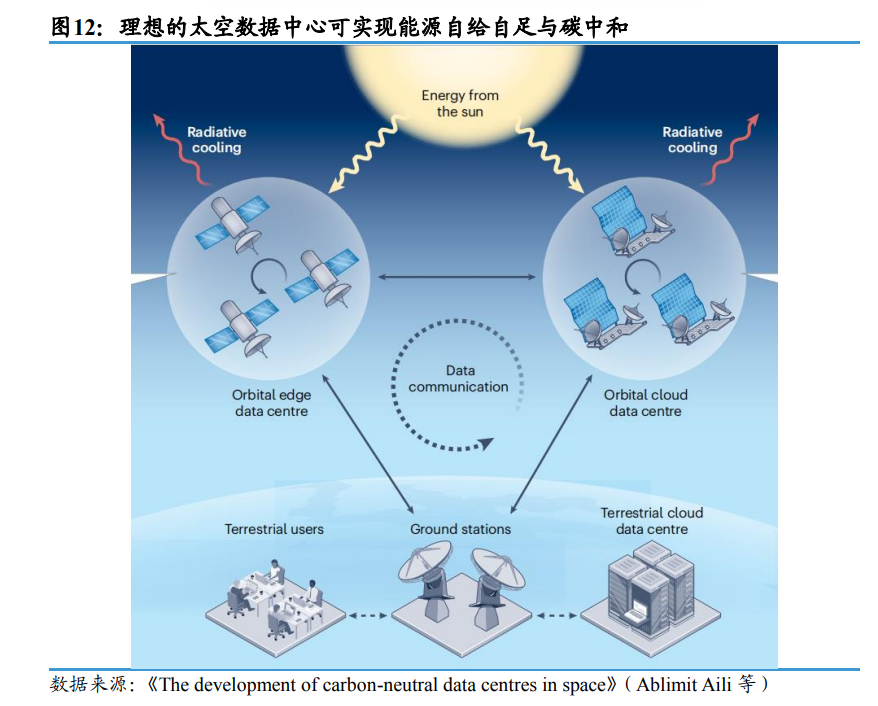
Core Insights - The next trillion-dollar computing opportunity is shifting from crowded power grids on Earth to the quiet of space, driven by tech giants like Elon Musk, Jeff Bezos, and Jensen Huang [1] - The concept of space computing is evolving from "Earth sensing and computing" to "space sensing and computing," addressing the physical constraints of energy and heat management on Earth [1][4] - Companies are taking concrete actions, such as Google's plan to build a distributed satellite cluster and Starcloud's successful training of a space-based large language model [1] Group 1: Physical Constraints and Energy Needs - Ground-based computing expansion faces two major physical constraints: energy consumption and heat dissipation [4] - The International Energy Agency (IEA) estimates that global data centers will consume 415 terawatt-hours (TWh) in 2024, with projections to double by 2030 [4] - Morgan Stanley reports a potential 20% power shortfall for U.S. data centers in the coming years due to the rapid demand for AI model training [5] Group 2: Advantages of Space Computing - Space offers a perfect solution for energy and heat management, with solar energy density reaching 1360 W/m² and a cosmic background temperature of 3K (approximately -270°C) [6][7] - A cost analysis shows that a 40MW data center cluster would incur $140 million in energy costs on Earth over ten years, compared to only $2 million in space [7][9] - The energy cost ratio between ground and space computing is approximately 70 to 1, highlighting the long-term economic advantages of space computing [7] Group 3: Major Players and Developments - The development of space computing is characterized by major players leading the exploration and commercialization efforts [10] - Starcloud is transitioning from technology validation to commercial service, with plans to launch the Starcloud-1 satellite in November 2025 [11] - Google aims to define future space computing standards through its "Solar Catcher" project, which involves building a distributed satellite cluster using its TPU technology [14][15] Group 4: Infrastructure and Ecosystem - The U.S. has established a vertically integrated industry system in space computing, from chips to services, led by major companies [18][20] - SpaceX has created the only scalable infrastructure capable of supporting in-orbit computing, leveraging its high-power satellite platform and low-cost launch capabilities [16][20] - The U.S. government supports the industry through risk-sharing mechanisms and diverse commercial demands, providing ongoing funding and market support [21] Group 5: China's Strategic Approach - China's approach to space computing is characterized by a clear national strategy, focusing on a dual-track development of dedicated computing constellations and intelligent remote sensing constellations [24] - The "Three-Body Computing Constellation" project aims to establish a space-based computing network with high-performance capabilities [25][28] - China's policies, such as the "14th Five-Year Plan," are driving the systematic deployment of space computing technologies [31]



蜂拥进场!主力坐不住了 借道ETF狂买这个板块近500亿元!军工、芯片却遭甩卖
Mei Ri Jing Ji Xin Wen· 2025-12-27 05:42
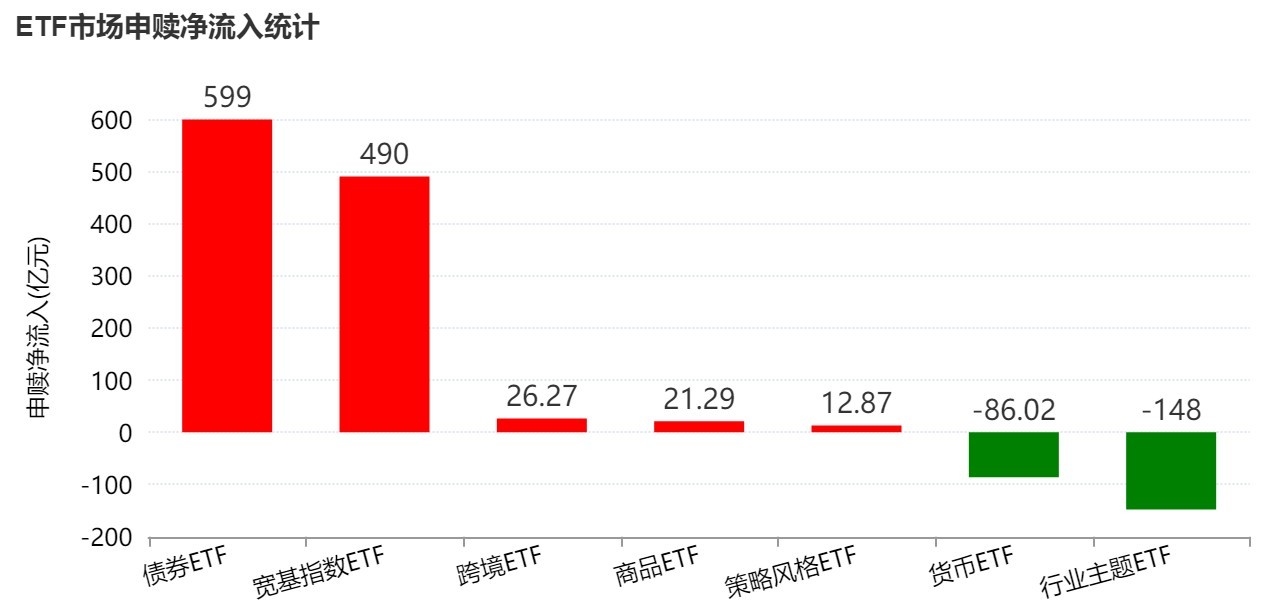
Core Viewpoint - The stock indices showed mixed performance this week, with significant capital inflow into the CSI A500-related ETFs, while certain industry-themed ETFs, particularly in the military sector, faced substantial outflows [1][2][10]. Group 1: Market Performance - The total trading volume in the Shanghai and Shenzhen markets reached 9.73 trillion yuan, with the Shanghai market accounting for 4.05 trillion yuan and the Shenzhen market 5.68 trillion yuan [2]. - The Shanghai Composite Index closed at 3963.68 points, up 1.88% for the week, while the Shenzhen Component Index closed at 13603.89 points, up 3.53% [2]. - A total of 380.69 billion yuan net inflow was recorded for stock ETFs and cross-border ETFs, with broad-based index ETFs seeing a net inflow of 490 billion yuan [2]. Group 2: ETF Inflows and Outflows - The CSI A500-related ETFs experienced a net inflow of 493 billion yuan this week [5]. - In contrast, 64 industry-themed ETFs saw a net outflow exceeding 1 billion yuan, with significant losses in military-related ETFs [13]. - The top ten large-scale broad-based index ETFs collectively faced a net outflow of 17.85 billion yuan, with the CSI 300 ETF alone seeing a net outflow of 34.08 billion yuan [7]. Group 3: Industry Themes - Industry-themed ETFs such as satellite, new energy, and gaming ETFs attracted significant capital, with net inflows of 15.51 billion yuan, 13.04 billion yuan, and 11.92 billion yuan respectively [10]. - Conversely, military-related ETFs faced substantial outflows, with the military leader ETF and military ETF seeing reductions of 26.66 billion and 12.48 billion shares, respectively, resulting in net outflows of 19.42 billion yuan and 16.11 billion yuan [12][13]. - Analysts suggest that the recent capital inflow into the CSI A500 index reflects a strategic positioning by long-term capital in anticipation of structural market changes [22]. Group 4: Future Outlook - Analysts predict that as macroeconomic data impacts diminish, liquidity and risk appetite will increasingly influence the market, potentially leading to a "spring rally" characterized by significant index movements [9]. - The upcoming launch of two new ETFs tracking Hong Kong stocks and AI-related sectors is expected to attract additional investor interest [23].
沪指8连涨追平年内纪录 市场成交额重返2万亿元
Shang Hai Zheng Quan Bao· 2025-12-26 18:58
Market Overview - The A-share market continued its upward trend on December 26, with resource sectors like non-ferrous metals and oil & petrochemicals performing strongly, leading to a collective rise in the three major stock indices [2] - The Shanghai Composite Index closed at 3963.68 points, up 0.10%, marking its eighth consecutive trading day of gains, matching the annual record for consecutive increases [2] - The Shenzhen Component Index rose by 0.54% to 13603.89 points, while the ChiNext Index increased by 0.14% to 3243.88 points [2] - The trading volume in the Shanghai and Shenzhen markets returned to over 2 trillion yuan, reaching 21602 billion yuan, an increase of 235.7 billion yuan from the previous day [2] Commercial Aerospace Sector - The commercial aerospace sector saw a surge, with related stocks experiencing a wave of limit-up trading [3] - Leading stock Shenjian Co. achieved a "limit-up" on December 26, marking its seventh consecutive day of gains, while China Satellite also hit a limit-up, achieving three consecutive days of gains and nearing a market capitalization of 100 billion yuan [3] - On December 26, China successfully launched 17 low-orbit satellites using the Long March 8A rocket from Hainan, marking a successful mission [3] - According to data from Dongfang Caifu Research Center, the global number of rocket launches reached 337 in 2023, surpassing the previous record of 263 in 2024 [3] - Open Source Securities reported that the decreasing launch costs and increasing in-orbit computing power could create a "multi-launch, multi-saving" model for China's commercial aerospace sector [3] Lithium Battery Sector - The lithium battery sector remained active, with stocks like Hainan Mining and Yongxing Materials hitting the limit-up [4] - Futures prices for lithium carbonate reached a new high, surpassing 130,000 yuan per ton, with an increase of over 8% [4] - Dongguan Securities noted that the new energy vehicle market is currently in a peak sales period, with strong demand for energy storage, maintaining high demand for lithium batteries [5] - The lithium battery supply chain is expected to see a slight increase in production in December, with overall industry conditions remaining stable [5] - Recent measures by the Guangxi Futures Exchange aimed to manage risks in lithium carbonate futures trading, indicating potential volatility in prices [5] Foreign Investment Outlook - Foreign institutions have released optimistic forecasts for the Chinese stock market in 2026, with UBS Wealth Management predicting continued upward momentum despite geopolitical uncertainties [5][6] - UBS highlighted that technology sectors, including AI, are key drivers for long-term profit growth in the Chinese stock market, with significant investments in R&D [6] - Goldman Sachs projected a potential 38% increase in the Chinese stock market by the end of 2027, driven by corporate profit growth of 14% and 12% in 2026 and 2027, respectively [6]
商业航天+太空算力,产业链最新热门公司名单
Sou Hu Cai Jing· 2025-12-26 16:40
Core Insights - The Chinese commercial space industry is at a critical development juncture, transitioning from a state-driven model to one driven by market competition and enterprise initiatives, supported by strong national policies [1] - The industry has seen significant changes in infrastructure, technology, and market access over the past decade, leading to the emergence of numerous new companies focused on satellite manufacturing, control operations, and data services [1] Group 1: Frequency and Orbit Resources - Limited orbital positions and communication frequencies have become strategic resources, with the "first come, first served" rule applying globally [2] - SpaceX's Starlink program is leading with over 10,000 satellites launched, while China's satellite constellations, such as GW and G60, are lagging behind in progress [2] Group 2: Current Challenges - High launch costs remain a major barrier to industry proliferation, with domestic satellite launch fees ranging from 50,000 to 150,000 RMB per kilogram, significantly higher than SpaceX's costs [3][21] - The number of launches is not meeting demand, causing delays in satellite constellation construction, with a 15%-20% lag behind planned schedules [4][26] - China's heaviest rocket, Long March 5, has a near-Earth orbit capacity of about 25 tons, which is insufficient compared to SpaceX's Falcon 9 and Starship capabilities [5][27] Group 3: Solutions for Breakthrough - Reusable rockets are essential for cost reduction, with domestic companies like Blue Arrow achieving significant milestones in reusable rocket technology [6][36] - The satellite manufacturing process is entering an "industrial production" phase, utilizing mass production and modular approaches to lower costs and increase efficiency [7][39] - New commercial launch sites, such as the Hainan Commercial Space Launch Site, are being established to support high-frequency launch demands [8][40] Group 4: Space Computing - Space computing is emerging as a new value space, leveraging unique advantages such as near-unlimited power from solar energy and low cooling costs due to the cold environment of space [9][11] - The industrialization of space computing is accelerating, with Chinese institutions developing various satellite constellations aimed at enhancing space computing capabilities [10][11] Group 5: Notable Companies and Investment Themes - Key companies in the commercial space industry include StarMap Control, CASIC, Aerospace Hongtu, and others involved in satellite manufacturing, control operations, and data services [12] - The space computing industry chain includes companies like Shunhao Co., Potevio Technology, and others focused on satellite computing and data services [12]
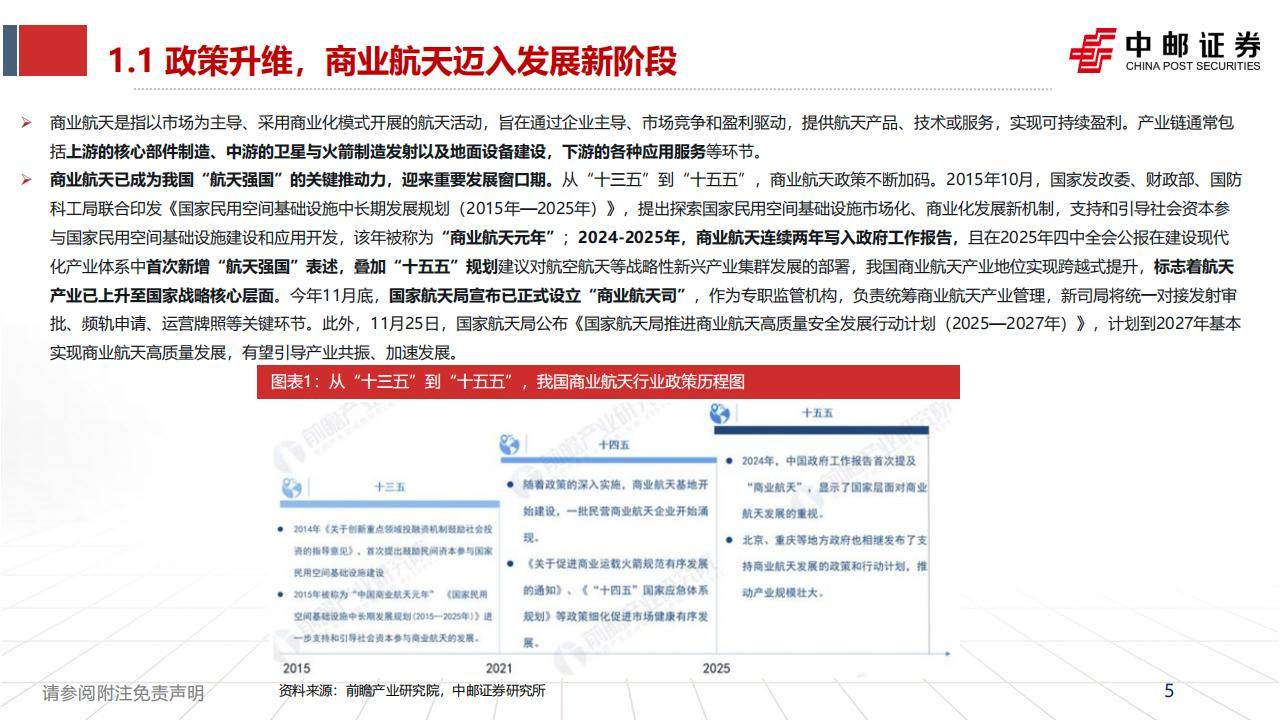
商业航天“蓄势待发”:火箭射上去,价格打下来
第一财经· 2025-12-26 13:06
Core Viewpoint - The article emphasizes that the Chinese commercial aerospace industry is entering a rapid development phase, driven by government policies and capital investments, particularly in the areas of rocket launches and satellite applications [3][4][5]. Group 1: Policy and Investment - The National Venture Capital Guidance Fund has officially started operations, focusing on increasing investments in early-stage projects in aerospace and other innovative sectors [3]. - The Shanghai Stock Exchange has released guidelines for commercial rocket companies, allowing them to apply for listing under specific standards that emphasize "hard technology" attributes [3]. Group 2: Industry Development and Challenges - The commercial aerospace industry is facing a bottleneck in rocket launches, characterized by low supply, insufficient payload capacity, and high costs, which limits the economic feasibility of deploying large satellite constellations [7][10]. - The industry is experiencing a significant push for rocket capacity expansion, particularly for satellite internet and space computing deployments, with companies like Zhongke Xingtou actively engaging in the entire aerospace value chain [7][11]. Group 3: Technological Advancements and Market Dynamics - The focus on reducing costs through the maturation of reusable rocket technology and the mass production of satellites is critical for the industry's future [8][12]. - The successful launch of new rocket models and the ability to secure customer orders are essential for establishing a sustainable commercial value in the aerospace sector [12][16]. Group 4: Market Growth and Financial Metrics - By 2025, the Chinese commercial aerospace industry is projected to reach a scale of 2.5 to 2.8 trillion yuan, with an annual growth rate exceeding 20% and over 600 companies operating in the sector [15]. - The total financing in the industry is expected to reach 18.6 billion yuan in 2025, with satellite applications receiving the highest funding [15]. Group 5: Regulatory Environment and Future Directions - The establishment of the Commercial Aerospace Department aims to enhance regulatory efficiency and coordination across various aspects of the industry, including launch approvals and satellite operation licenses [18]. - The focus for the future will be on creating a commercial closed-loop system and optimizing regulatory frameworks to support large-scale, high-adhesion commercial applications [15][17].

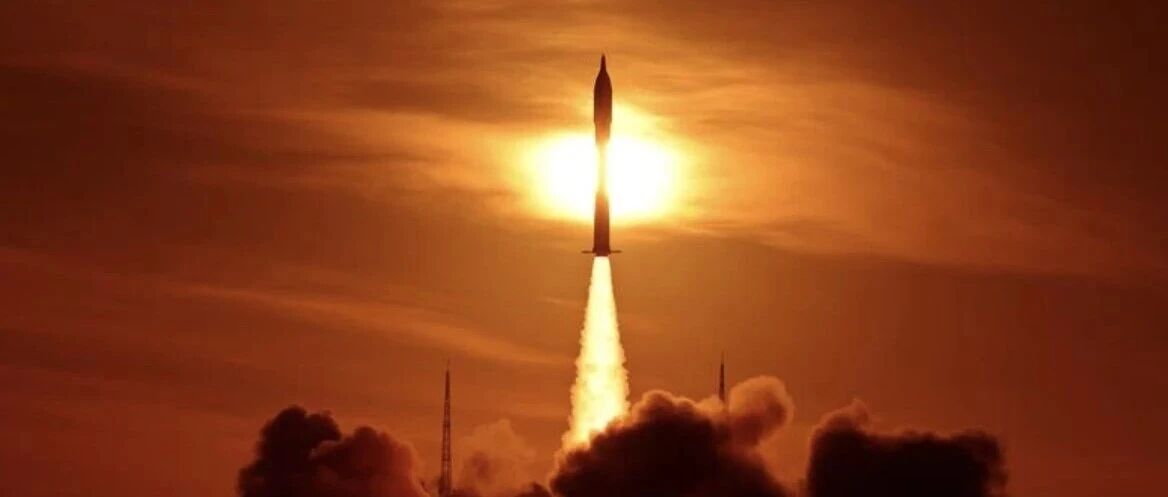
商业航天“蓄势待发”:火箭射上去,价格打下来
Di Yi Cai Jing· 2025-12-26 12:16
Core Insights - The Chinese commercial space industry is experiencing a significant push due to favorable policies and capital influx, with the National Venture Capital Guidance Fund officially launched to support early-stage projects in aerospace [1] - The industry is currently facing a "three shortages" situation: a lack of rockets, launch sites, and satellites, which poses a bottleneck for development [5][9] Group 1: Industry Development - The launch of the National Venture Capital Guidance Fund aims to enhance investment in early-stage aerospace projects, particularly in active innovation regions [1] - The Shanghai Stock Exchange has released guidelines for commercial rocket companies, emphasizing the importance of "hard technology" and prioritizing companies involved in national projects [1] - The commercial space sector is expected to grow significantly, with projections indicating a market size of 2.5-2.8 trillion yuan by 2025, with a compound annual growth rate of over 20% [10] Group 2: Technological Advancements - The industry is at a critical juncture for technological breakthroughs and scale expansion, focusing on reducing costs through reusable rocket technology and mass satellite manufacturing [4] - The successful launch of the "Yixian-A" satellite by a student team demonstrates the potential for innovative satellite applications in the commercial space sector [2] - Companies are accelerating technological advancements, with expectations for new rocket models to achieve competitive launch costs close to those of SpaceX by 2025-2026 [7] Group 3: Market Dynamics - The current imbalance in the commercial space ecosystem highlights the rocket launch segment as a key constraint, with limited supply and high costs affecting satellite deployment [3] - The demand for satellite resources is increasing, but the supply of launch sites is insufficient, leading to delays in satellite launches [8][9] - The industry is witnessing a surge in IPO activities, with over 10 companies initiating listing processes, primarily in rocket manufacturing [5][6] Group 4: Regulatory Environment - The establishment of the Commercial Space Administration aims to enhance regulatory efficiency and support the development of the commercial space sector [13] - The recent action plan emphasizes the need for low-cost, reliable, and reusable rockets, as well as the development of commercial launch sites and integrated measurement and control systems [12][13] - The industry is encouraged to explore new application scenarios and products to support a trillion-level market [11]
A股光伏巨头晶科能源,获马斯克"点赞"!公司回应
Shang Hai Zheng Quan Bao· 2025-12-26 07:30
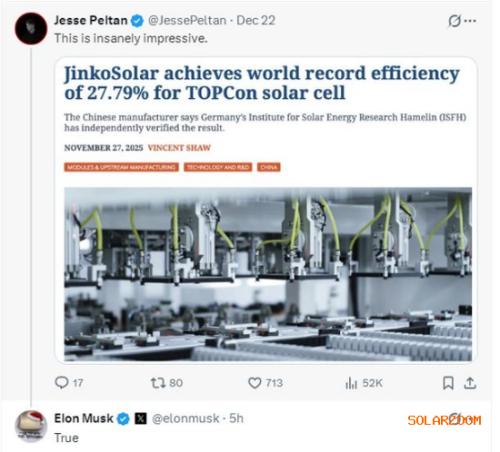
Core Insights - JinkoSolar has achieved a new world record for solar cell efficiency, reaching 27.79% based on its TOPCon technology platform, certified by the German Institute for Solar Energy Research (ISFH) [1][3][6] - Elon Musk acknowledged this achievement on social media, highlighting the significance of energy technology advancements in the context of increasing energy demands in the U.S. [1][3][8] Technology and Innovation - The record-breaking efficiency is attributed to a series of innovative advancements in the TOPCon technology, including new passivation contact techniques, ultra-low optical parasitic absorption, and novel metallization methods [6][7] - The integration of these technological breakthroughs has significantly enhanced the solar cell's performance, demonstrating the ongoing potential of the TOPCon platform to lower the levelized cost of electricity (LCOE) and support global energy transition efforts [6][7] Future Developments - JinkoSolar is also developing perovskite-TOPCon tandem solar cells, which have achieved a conversion efficiency of 34.76%, further solidifying the company's leadership in next-generation solar technology [7] - The company plans to scale up production of these advanced technologies, aiming to provide more efficient and reliable solar products to global customers [7]

中国卫星三连板,卫星产业ETF、卫星ETF、卫星ETF易方达涨超3%,本月涨超28%
Ge Long Hui· 2025-12-26 07:28
Group 1 - The core viewpoint of the news highlights the significant growth in China's satellite industry, with the satellite sector ETFs experiencing a rise of over 3% and more than 28% this month, indicating strong market performance [1] - The China Satellite Industry Index covers a comprehensive range of the satellite industry, including manufacturing, launching, communication, navigation, remote sensing, and applications, benefiting from the industry's beta [1] - The satellite industry chain is currently in its early stages, with leading companies expected to benefit first from the emerging trends, as indicated by the focus on leading firms in the top ten constituents of the index [1] Group 2 - Dongxing Securities anticipates that during the 14th Five-Year Plan period, commercial space will become a crucial engine for high-quality technological development in China, with an expected acceleration in satellite launches by 2026 [2] - The involvement of private commercial rocket companies is expected to complement national efforts, supporting the high-frequency launch demand [2] - The investment opportunities in China's satellite internet industry chain are viewed positively for 2026 [2] Group 3 - Guotai Haitong Securities suggests that ground computing power is nearing physical limits, and space computing power may offer a solution, transitioning from "ground computing" to "space computing" [3] - Major global players like Google, SpaceX, and Starcloud are exploring space computing capabilities, with differentiated paths towards commercial expansion [3] - The development of China's space computing is characterized by a clear structure of "dedicated computing constellations" and "intelligent remote sensing constellations," indicating a systematic approach to technology validation and deployment [3]

初灵信息(300250.SZ):公司未涉及太空算力方面业务
Ge Long Hui· 2025-12-26 06:57
责任编辑:钟离 格隆汇12月26日丨初灵信息(300250.SZ)在投资者互动平台表示,公司未涉及太空算力方面业务。 财经频道更多独家策划、专家专栏,免费查阅>> ...

卫星概念股午后大幅拉升,相关ETF涨约4%
Mei Ri Jing Ji Xin Wen· 2025-12-26 06:12
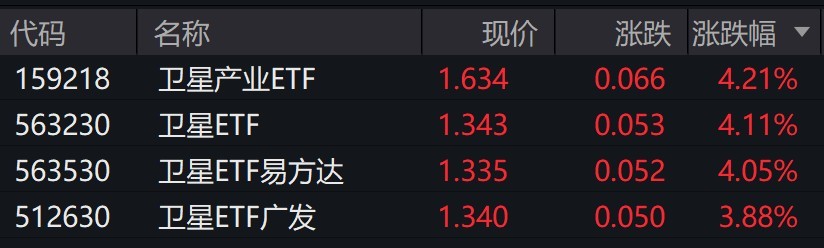
Core Viewpoint - Satellite concept stocks experienced a significant surge in the afternoon, with China Satellite and Beidou Star reaching their daily limit up [1] Group 1: Market Performance - Satellite-related ETFs rose approximately 4% [1] - Specific ETF performance includes: - Satellite Industry ETF (Code: 159218) at 1.634, up 0.066 (4.21%) - Satellite ETF (Code: 563230) at 1.343, up 0.053 (4.11%) - Satellite ETF E Fund (Code: 563530) at 1.335, up 0.052 (4.05%) - Satellite ETF GF (Code: 512630) at 1.340, up 0.050 (3.88%) [2] Group 2: Industry Outlook - Analysts indicate that with decreasing launch costs and improved in-orbit computing power, the future of space computing is expected to develop a "more launches, more savings" model [2] - The ongoing technological iterations and improved supporting infrastructure are anticipated to drive commercial aerospace towards a transformative industry change with scalable commercial value [2]