
云计算

Search documents
工业富联:2025年全年净利润同比预增51.00%—54.00%
2 1 Shi Ji Jing Ji Bao Dao· 2026-01-28 08:51
Core Viewpoint - The company, Industrial Fulian, expects a significant increase in net profit for 2025, driven by strong growth in cloud computing and communication equipment sectors [1] Financial Projections - The company anticipates a net profit attributable to shareholders of 35.1 billion to 35.7 billion yuan for 2025, representing a year-on-year increase of 51.00% to 54.00% [1] - The projected net profit excluding non-recurring gains and losses is expected to be between 34 billion and 34.6 billion yuan, reflecting a year-on-year growth of 45.00% to 48.00% [1] Cloud Computing Business - In 2025, revenue from cloud service provider servers is expected to grow by over 180% year-on-year [1] - For Q4 2025, the revenue from cloud service provider servers is projected to increase by over 30% quarter-on-quarter and over 250% year-on-year [1] - Revenue from AI servers for cloud service providers is expected to grow by over 300% year-on-year in 2025, with Q4 2025 revenue increasing by over 50% quarter-on-quarter and over 5.5% year-on-year [1] Communication and Mobile Network Equipment - The company’s high-speed switch business is expected to continue its strong growth, achieving a year-on-year revenue increase of 1300% for 800G and above high-speed switches in 2025 [1] - In Q4 2025, revenue from 800G and above high-speed switches is projected to grow by over 450% year-on-year [1] Precision Components Business - The precision component business is expected to achieve double-digit growth in shipment volume compared to the previous year, supported by mature technology and a stable customer supply system [1]

通信行业月报:光模块上游关键物料供应持续紧张,AWS规模部署空芯光纤-20260128
Zhongyuan Securities· 2026-01-28 08:29
Investment Rating - The report maintains an "Outperform" investment rating for the communication industry [2][9]. Core Insights - The communication industry index outperformed the Shanghai Composite Index in December 2025, rising by 12.82% compared to +2.06% for the Shanghai Composite Index and +2.28% for the CSI 300 Index [8][14]. - Key material supply for optical modules remains tight, with major players like Longfei and Hengtong winning bids for China Unicom's hollow-core fiber cable procurement [8][9]. - The retail sales of communication equipment in China increased by 20.9% year-on-year in December 2025, driven by the demand for smartphones [8][41]. - The global smartphone shipment is projected to grow by 2% year-on-year in 2025, reaching 1.25 billion units, with AI smartphones expected to penetrate 34% of the market [8][29]. - The export value of optical modules from China decreased by 15.6% year-on-year in 2025, while Thailand's communication equipment exports surged by 152.1% [8][9]. Summary by Sections Market Review - The communication industry index rose by 12.82% in December 2025, outperforming major indices [14]. - Sub-sectors such as cables and network equipment saw significant gains, with increases of 22.05% and 19.44% respectively [15][19]. Industry Tracking - The capital expenditure of major cloud providers in North America reached $112.43 billion in Q3 2025, a 76.9% increase year-on-year [25][28]. - AI applications are driving cloud business growth, with major companies like Amazon, Microsoft, Google, and Meta significantly increasing their capital expenditures [25][29]. - The Chinese ICT market is expected to grow to approximately $889.43 billion by 2029, with a CAGR of 7.0% [39][40]. Domestic Telecom Industry - Telecom business revenue in China reached 1.6096 trillion yuan from January to November 2025, a year-on-year increase of 0.9% [48]. - The number of 5G mobile phone users reached 1.193 billion by November 2025, accounting for 65.3% of total mobile phone users [49]. - The number of fixed broadband users with gigabit access reached 239 million, representing 34.3% of total users [52].





马云,最新动态曝光
Mei Ri Jing Ji Xin Wen· 2026-01-28 07:16
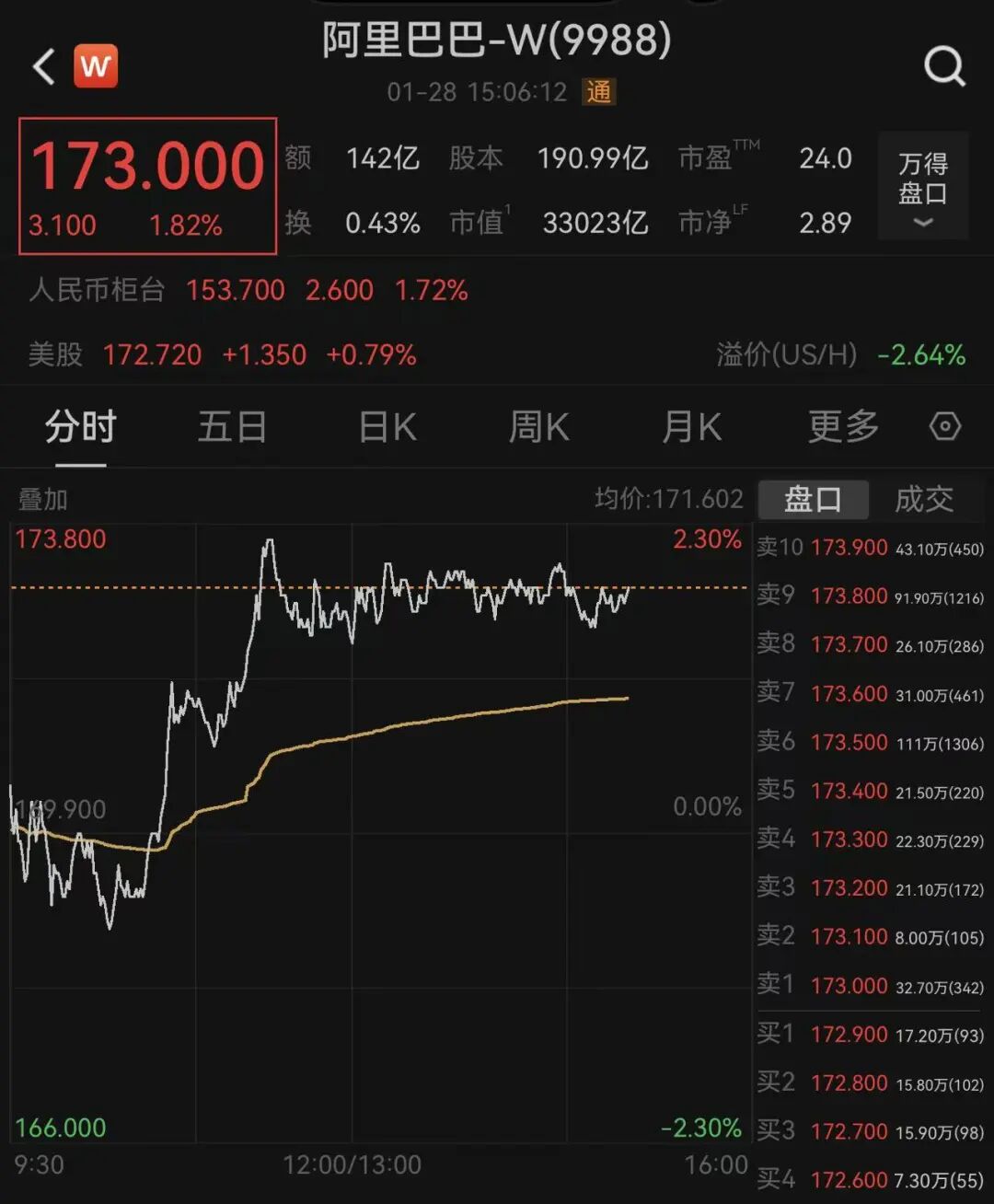
Group 1 - Jack Ma shared insights on AI and education, emphasizing that AI presents both challenges and opportunities for rural education, urging a focus on teaching children how to effectively use AI rather than competing with it [1] - He highlighted that the gap in the AI era is not technological but rather in curiosity, imagination, creativity, judgment, and collaboration skills [1] - The future of education should encourage students to think creatively and uniquely, rather than just memorizing information [1] Group 2 - The Jack Ma Foundation, established in December 2014, focuses on various philanthropic areas including education, healthcare, and women's leadership, with a strong emphasis on rural education initiatives [2] - Jack Ma previously stated that technology should enhance human life and that AI should be designed to understand and serve humanity better [2] - Alibaba's CEO, Wu Yongming, echoed similar sentiments about the evolution of human-AI collaboration and the potential of AI to amplify human intelligence [2] Group 3 - Wu Yongming described large models as the next generation operating system and AI cloud as the next generation computer, predicting that only a few super cloud computing platforms will exist globally [3] - Alibaba is investing 380 billion in AI infrastructure, with plans for significant increases in computational power by 2032, projecting a tenfold increase in energy consumption for global data centers [3] - The evolution towards Artificial Super Intelligence (ASI) is outlined in three stages: emergence of intelligence, autonomous action, and self-iteration [3] Group 4 - Alibaba's financial performance showed a 5% year-on-year revenue increase to 247.795 billion, exceeding market expectations, while adjusted EBITA fell by 78% to 9.073 billion [4] - The net profit attributable to ordinary shareholders decreased by 52% to 20.99 billion, with non-GAAP net profit down 72% to 10.352 billion [4] - As of the latest report, Alibaba's stock price increased by 1.82% [5]

奥飞数据16.95亿定增告吹,总经理同日辞任!国联民生曾提示风险
Quan Jing Wang· 2026-01-28 06:26
Core Viewpoint - Aofei Data has decided to terminate its plan for a private placement of A-shares originally intended to raise 1.695 billion yuan, citing business development and strategic planning considerations [1][2]. Group 1: Termination of Private Placement - The private placement was intended to fund the "New Generation Cloud Computing and Artificial Intelligence Industrial Park" project, which aimed to enhance the company's IDC infrastructure in North China [2]. - The termination of the private placement was officially confirmed by the Shenzhen Stock Exchange on January 27 [1]. - Aofei Data stated that the decision would not significantly impact its operations or harm the interests of shareholders, particularly minority shareholders [2]. Group 2: Management Changes - Aofei Data's former General Manager, Huang Zhanpeng, resigned from his positions due to personal family reasons and held 124,100 shares, representing 0.01% of the total share capital [1]. Group 3: Financial Performance - Despite the termination of the private placement, Aofei Data reported strong financial performance for the first three quarters of 2025, with revenue reaching 1.824 billion yuan, a year-on-year increase of 15.33% [5]. - The net profit attributable to shareholders was 145 million yuan, up 37.29%, and EBITDA was 827 million yuan, reflecting a 38.77% increase [5]. - The company's IDC services generated approximately 1.387 billion yuan in revenue, a 42.22% increase, driven by improved data center deployment rates and energy management [5]. Group 4: Capital Structure and Financing - Since its listing in 2018, Aofei Data has raised a total of 2.637 billion yuan through direct financing, with cash dividends amounting to only 113 million yuan [5]. - The company's asset-liability ratio was reported at 75.83% as of the end of the third quarter of 2025, indicating a high level of financial leverage [5].


奥飞数据16.95亿定增告吹,总经理同日辞任!国联民生曾提示风险 | A股融资快报
Quan Jing Wang· 2026-01-28 06:12
Core Viewpoint - Aofei Data (300738) has decided to terminate its plan to issue A-shares to specific investors for the year 2025, which was originally intended to raise 1.695 billion yuan [1][2] Group 1: Termination of Fundraising - The termination of the fundraising plan was based on the company's actual business development, future strategic planning, and project progress after careful consideration and communication with relevant parties [2] - The company emphasized that this decision will not have a significant impact on its business operations or harm the interests of shareholders, especially minority shareholders [2] Group 2: Management Changes - On the same day, Aofei Data announced the resignation of its former general manager, Huang Zhanpeng, due to personal family reasons, and he will no longer hold any position in the company [1] Group 3: Financial Performance - Despite the termination of the fundraising, Aofei Data reported strong financial performance for the first three quarters of 2025, with revenue reaching 1.824 billion yuan, a year-on-year increase of 15.33%, and a net profit attributable to shareholders of 145 million yuan, up 37.29% [4] - The company's EBITDA was 827 million yuan, reflecting a 38.77% increase, and the gross profit margin improved significantly by 5.29 percentage points to 34.99% compared to the same period in 2024 [4] Group 4: IDC Business Growth - The IDC services, as the core revenue source, generated approximately 1.387 billion yuan, a year-on-year increase of 42.22%, mainly benefiting from improved data center deployment rates and energy management optimization [5] - As of the end of September 2025, the total number of operational cabinets exceeded 57,000, representing a 33% increase compared to the end of 2024 [5] Group 5: Financial Structure - Aofei Data has raised a total of 2.637 billion yuan through direct financing since its listing eight years ago, with cumulative cash dividends amounting to only 113 million yuan [4] - The company's asset-liability ratio was high at 75.83% as of the end of the third quarter of 2025, leading to an increase in financial expenses [6]

头部科技公司纷纷加码AI基础设施与应用生态,机构称港股逐渐形成AI全产业链上市体系
Mei Ri Jing Ji Xin Wen· 2026-01-28 05:35
Core Insights - The Hang Seng Index opened up by 0.73%, while the Hang Seng Tech Index rose by 0.56%, indicating a positive market sentiment at the beginning of the year [1] - Major sectors such as precious metals and biomedicine showed strong performance, with popular ETFs like Hang Seng ETF (159920) and Hang Seng China Enterprises ETF (159850) both increasing by nearly 1% [1] - Tencent and Baidu announced significant cash red envelope initiatives of 1 billion and 500 million yuan respectively to boost user growth, highlighting the competitive landscape in AI applications [1] - The AI cloud computing market is expected to grow significantly, with China potentially becoming a leader in AI application development [1] Market Dynamics - According to招商国际, the Hong Kong stock market is currently in an earnings vacuum period, with high growth expectations for new economy sectors driving market confidence [1] - The appreciation of the RMB is favorable for Hong Kong stocks, and domestic policies are focusing on technological innovation and expanding domestic demand [1] - The Hong Kong market is gradually forming a comprehensive AI industry chain, attracting capital and alleviating IPO fundraising pressure [1] - The reduction in unlock scale in January and February is expected to ease selling pressure, contributing to a potential "spring rally" with a focus on growth styles [1] Notable Investment Targets - Core broad-based Hong Kong stock: Hang Seng ETF (159920) [2] - AI and platform economy: Hang Seng Tech Index ETF (513180) [2] - Focus on the development of Chinese enterprises in Hong Kong: Hang Seng China Enterprises ETF (159850) [2]
ETF午评 | 两只巴西ETF涨停,大宗商品板块掀涨停潮,黄金股ETF涨超8%
Ge Long Hui· 2026-01-28 05:12
Market Overview - The three major A-share indices showed mixed performance in the morning session, with the Shanghai Composite Index up by 0.49%, the Shenzhen Component Index up by 0.09%, and the ChiNext Index down by 0.37% [1] - The total trading volume in the Shanghai, Shenzhen, and Beijing markets reached 19,307 billion yuan, an increase of 402 billion yuan compared to the previous day [1] - Over 3,500 stocks in the market experienced declines [1] Sector Performance - The sectors that saw significant gains included gold, non-ferrous metals, oil and natural gas, chemical industry, coal, agriculture, real estate, securities, port shipping, copper cable high-speed connections, and cloud computing [1] - Conversely, sectors that faced declines included photovoltaic equipment, biopharmaceuticals, photolithography machines, military equipment, education, and PEEK materials [1] ETF and Commodity Trends - Two Brazilian ETFs hit the daily limit up [1] - The commodity sector experienced a surge, with the Yongying Fund Gold Stock ETF and the Huaxia Fund Gold Stock ETF rising by 8.56% and 8.47%, respectively [1] - The Huatai-PB Fund China-Korea Semiconductor ETF increased by 5.35%, while oil stocks strengthened, with the Yinhua Fund Oil and Gas Resources ETF rising by 4.73% [1] - The photovoltaic sector declined, with the Sci-Tech Innovation Board New Energy ETF and the E Fund New Energy ETF falling by 3% and 2.99%, respectively [1] - The machinery sector also saw a downturn, with the Machinery ETF dropping by 2.84% [1]
国证国际港股晨报-20260128
国投证券(香港)· 2026-01-28 04:58
Group 1: Core Insights - The report highlights that China's industrial profits have turned positive for the first time in four years, with a growth of 0.6% in 2025 [4] - The technology sector, including cloud computing, short video concepts, AI applications, and mobile gaming stocks, has shown significant upward movement, with notable gains from companies like MINIMAX-WP and Kingsoft Cloud [3][4] - The report indicates that the demand for AI computing power is expected to remain high, driven by investments in AI infrastructure, such as NVIDIA's $2 billion investment in CoreWeave [4] Group 2: Company Overview - The specific company, Dongpeng Beverage, is recognized as a leading functional beverage company in China, holding the top market position by sales volume for four consecutive years [7] - Dongpeng Beverage's revenue for 2023, 2024, and the first nine months of 2025 is projected to be 11.2 billion, 15.8 billion, and 16.8 billion RMB respectively, reflecting year-on-year growth rates of 32%, 40%, and 34% [7][8] - The company's flagship product, Dongpeng Energy Drink, has shown a compound annual growth rate (CAGR) of 27.3% from 2022 to 2024, with a significant revenue contribution from the newly launched Dongpeng Sports Drink [8] Group 3: Industry Status and Outlook - The Chinese soft drink market is expected to grow at a CAGR of 4.7% from 2019 to 2024, reaching a market size of 1.25 trillion RMB, with functional beverages being the fastest-growing segment [9] - The energy drink market, a subset of functional beverages, is projected to reach 1.114 trillion RMB, accounting for 67% of the functional beverage market [9] - The competitive landscape of the functional beverage market is concentrated, with the top five companies holding a combined market share of 61.6% [9] Group 4: Strengths and Opportunities - Dongpeng Beverage benefits from strong brand recognition and a well-established sales network covering over 4.3 million retail points across China [10] - The company maintains a cost-leading position and has a comprehensive digital capability that enhances operational efficiency [10] - The report emphasizes the potential for growth through brand building, supply chain upgrades, and expansion into overseas markets [14] Group 5: IPO Information - The IPO for Dongpeng Beverage is scheduled from January 26 to January 29, 2026, with trading commencing on February 3, 2026 [12] - The company anticipates raising approximately 10 billion HKD, with a significant portion allocated for capacity expansion and brand development [14][13] - The expected market capitalization post-IPO is approximately 166.39 billion HKD, with a projected PE ratio of 34.5x based on anticipated net profits [15]
突然爆发,20%涨停!两大利好突袭,“龙虾时刻”上演?
Xin Lang Cai Jing· 2026-01-28 04:19
Core Insights - The article highlights a significant surge in interest and investment in AI technologies, particularly with the launch of the AI Agent project Clawdbot, which has gained over 58,000 stars on GitHub within a month, marking a 62% increase in daily engagement [1][2][8] - Google Cloud has announced a price increase for its data transmission services, effective May 1, 2026, with North American rates doubling, indicating a pivotal shift in the long-standing trend of decreasing cloud service prices [2][8] - The demand for AI computing power is expected to rise dramatically, driven by the increasing integration of AI into workflows, which could lead to explosive growth in token demand and benefit the entire AI industry chain [3][8] Industry Developments - Google Cloud's price adjustments will affect three service categories: CDN Interconnect, Direct Peering, and Carrier Peering, with North American data transmission costs rising from $0.04 to $0.08 per GB, European costs from $0.05 to $0.08, and Asian costs from $0.06 to $0.085 [2][8] - The AI computing rental sector is experiencing a boom, with companies like Meiliyun seeing significant stock price increases, and AWS announcing a 15% price hike for its EC2 machine learning capacity blocks, marking its first price adjustment in nearly 20 years [3][9] - NVIDIA's investment of $2 billion in CoreWeave aims to enhance AI computing capabilities, further validating the high demand for AI cloud infrastructure [9][10] Competitive Landscape - CoreWeave, originally a cryptocurrency mining company, has shifted its focus to AI cloud computing and GPU rental services, reflecting the growing importance of AI infrastructure [4][9] - Alibaba has launched its flagship AI model, Qwen3-Max-Thinking, which boasts over 1 trillion parameters and has outperformed leading models in key performance benchmarks, positioning it as a strong competitor in the AI landscape [10][11] - The increasing capabilities of domestic giants like ByteDance, Alibaba, and Tencent are expected to significantly boost the demand for AI cloud infrastructure in China [11]



激进投资者Fivespan购入云计算公司Appian 6.2%的股份
Xin Lang Cai Jing· 2026-01-28 04:08
Core Viewpoint - Activist investor Fivespan Partners has acquired a 6.2% stake in cloud computing and enterprise software company Appian and plans to discuss business strategy with its management and board amid a decline in its stock price [1] Group 1: Shareholder Activity - Fivespan Partners reported its stake in Appian through a 13-D filing, which is required when an investor holds more than 5% and intends to push for changes [1] - The stock price of Appian has dropped 86% over the past five years, leading to a market capitalization of approximately $2 billion [1] Group 2: Market Concerns - Concerns among investors regarding the impact of artificial intelligence on Appian's business have contributed to the stock's decline [1] - As of the latest report, Appian's stock closed at $29.89 [1] Group 3: Investor Sentiment - Some investors believe that Appian is a misunderstood company with a highly loyal customer base, including the U.S. government [1]