
全国统一大市场

Search documents
财政部公布2026年重点任务
Xin Lang Cai Jing· 2025-12-28 04:58
格隆汇12月28日丨全国财政工作会议12月27日至28日在北京召开。会议要求,2026年财政工作抓好以下 重点任务。一是坚持内需主导,支持建设强大国内市场。大力提振消费,深入实施提振消费专项行动。 积极扩大有效投资,加大对新质生产力、人的全面发展等重点领域投入。加快推进全国统一大市场建 设,规范税收优惠、财政补贴政策。二是支持科技创新和产业创新深度融合,加快培育壮大新动能。进 一步增加财政科技投入,完善财政科技经费管理,强化企业科技创新主体地位。实施制造业重点产业链 高质量发展行动,开展新一批制造业新型技术改造城市试点,加快构建现代化产业体系。三是推进城乡 融合和区域联动,拓展发展空间。扎实推进乡村全面振兴,积极支持以人为本的新型城镇化,促进区域 协调发展。四是进一步强化保基本、兜底线,切实加强民生保障。促进居民就业增收,支持办好人民满 意的教育,提高医疗卫生服务保障水平,完善社会保障体系,在满足民生需求中拓展发展空间。五是推 动经济社会发展全面绿色转型,加快建设美丽中国。推进污染防治攻坚,加强生态系统保护和修复,健 全绿色低碳发展支持政策,协同推进降碳、减污、扩绿、增长,增强绿色发展动能。六是加强国际财经 ...
财政部长最新发声,信息量很大
Huan Qiu Wang· 2025-12-28 04:58
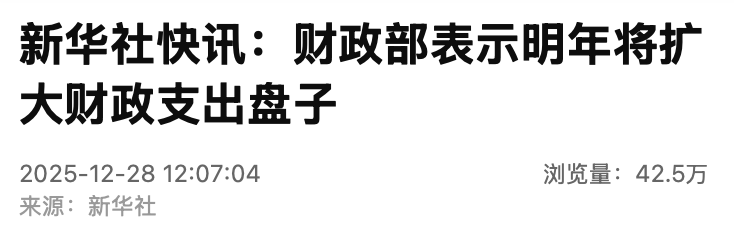
财政部表示明年将扩大财政支出盘子 财政部部长蓝佛安在12月27日至28日举行的全国财政工作会议上表示,明年将继续实施更加积极的财政政策。"更加积极"既体现在资金规模上,更体现在 提高资金使用效益上。其中,明年将扩大财政支出盘子,确保必要支出力度;优化政府债券工具组合,更好发挥债券效益。 财政部:明年将推动相关公共服务随人走、可携带 财政部部长蓝佛安在12月27日至28日举行的全国财政工作会议上表示,明年将完善财政转移支付分配机制,推动相关公共服务随人走、可携带,重点解决 农业转移人口子女教育、社会保险等问题。 财政部:明年财政将促进居民就业增收 财政部:2026年继续实施更加积极的财政政策 12月27日至28日,全国财政工作会议在北京召开。 财政部部长蓝佛安在12月27日至28日举行的全国财政工作会议上表示,将进一步强化保基本、兜底线,切实加强民生保障。明年将促进居民就业增收:统 筹就业补助资金、失业保险基金等各类资金,引导支持企业稳岗扩岗、重点群体就业创业等;积极发挥税收、社会保障、转移支付等调节作用,多渠道增 加居民收入。 财政部表示明年继续安排资金支持消费品以旧换新 财政部部长蓝佛安在12月27日至28 ...

财政部重磅发声:多渠道增加居民收入
Wind万得· 2025-12-28 04:37
全国财政工作会议 12 月 27 日至 28 日在北京召开,财政部释放重磅政策信号。 财政部部长蓝佛安表示,明年将促进居民就业增收:统筹就业补助资金、失业保险基金等各类资金,引导支持企业稳岗扩岗、重点群体就业创业等; 积 极发挥税收、社会保障、转移支付等调节作用,多渠道增加居民收入。 据新华社报道,此次 全国财政工作会议 指出, 2026 年继续实施更加积极的财政政策。一是扩大财政支出盘子,确保必要支出力度。二是优化政府债券工 具组合,更好发挥债券效益。三是提高转移支付资金效能,增强地方自主可用财力。四是持续优化支出结构,强化重点领域保障。五是加强财政金融协 同,放大政策效能。 会议要求, 2026 年财政工作抓好以下重点任务 : 坚持内需主导,支持建设强大国内市场。大力提振消费,深入实施提振消费专项行动。积极扩大有效投资,加大对新质生产力、人的全面发展等重点领域 投入。加快推进全国统一大市场建设,规范税收优惠、财政补贴政策。 支持科技创新和产业创新深度融合,加快培育壮大新动能。进一步增加财政科技投入,完善财政科技经费管理,强化企业科技创新主体地位。实 施制造 业重点产业链高质量发展行动,开展新一批制造业新型 ...

财政部部署2026年六大重点任务
21世纪经济报道· 2025-12-28 04:31
Core Viewpoint - The article outlines the key tasks and strategies for China's fiscal policy in 2026, emphasizing the importance of maintaining a proactive fiscal policy to support economic growth and social stability [5][6]. Group 1: Fiscal Policy Strategies - The meeting highlighted the need for a more proactive fiscal policy, focusing on maintaining spending intensity and supporting key projects to stimulate consumption [5]. - There will be a significant increase in investment in basic research and support for digital transformation in small and medium-sized enterprises [5]. - The government aims to enhance social welfare by improving employment policies, increasing scholarship standards, and establishing a childcare subsidy system [5]. Group 2: Risk Management and Reform - The meeting emphasized the importance of managing risks in key areas, including the replacement of hidden debts and the orderly transformation of financing platforms [5]. - Fiscal and tax reforms will be deepened, including the implementation of zero-based budgeting and improvements to the VAT refund policy [5][6]. - The article stresses the need for enhanced international financial cooperation and the successful completion of significant international meetings [5]. Group 3: Key Tasks for 2026 - The focus will be on boosting domestic demand and supporting the construction of a strong domestic market, with actions to stimulate consumption and effective investment [7]. - There will be an emphasis on integrating technological and industrial innovation, with increased fiscal support for technology and the modernization of industrial systems [7][8]. - The government plans to promote rural revitalization and regional coordinated development, ensuring basic social welfare and enhancing the social security system [8]. Group 4: Management and Governance - The article calls for comprehensive improvements in fiscal management, emphasizing the need for high-level management to drive quality fiscal development [9]. - It highlights the importance of balancing risk management with long-term mechanisms, particularly in government debt management [9]. - The meeting encourages a strong commitment to the leadership of the Communist Party, reinforcing the need for unity and focus in fiscal reforms [9].

财政部:2026年继续实施更加积极的财政政
Jing Ji Guan Cha Wang· 2025-12-28 04:26
Core Viewpoint - The National Financial Work Conference held in Beijing from December 27 to 28 emphasizes the continuation of a more proactive fiscal policy in 2026 [1]. Group 1: Key Tasks for Fiscal Work in 2026 - Expand the fiscal expenditure base to ensure necessary spending intensity [2]. - Optimize the government bond tool mix to better leverage bond effectiveness [2]. - Improve the efficiency of transfer payment funds to enhance local financial autonomy [2]. - Continuously optimize the expenditure structure to strengthen support for key areas [2]. - Strengthen fiscal and financial collaboration to amplify policy effectiveness [2]. Group 2: Support for Domestic Demand and Economic Growth - Focus on domestic demand, supporting the construction of a strong domestic market, boosting consumption, and implementing special actions to stimulate consumption [3]. - Actively expand effective investment, increasing input in key areas such as new productivity and comprehensive human development [3]. - Accelerate the establishment of a unified national market and standardize tax incentives and fiscal subsidy policies [3]. Group 3: Innovation and Development - Support the deep integration of technological and industrial innovation, increasing fiscal investment in technology and enhancing management of fiscal technology funds [3]. - Strengthen the role of enterprises in technological innovation and implement high-quality development actions for key manufacturing industry chains [3]. - Launch new pilot cities for technological transformation in manufacturing [3]. Group 4: Social and Regional Development - Promote urban-rural integration and regional collaboration to expand development space [3]. - Advance comprehensive rural revitalization and support people-centered new urbanization [3]. - Facilitate coordinated regional development [3]. Group 5: Social Welfare and Green Transition - Strengthen basic social safety nets and enhance livelihood security [3]. - Promote employment and income growth, improve education and healthcare services, and refine the social security system [3]. - Accelerate the green transformation of economic and social development, focusing on pollution prevention and ecological protection [3]. Group 6: International Cooperation - Enhance international financial and economic cooperation and support high-level opening-up [3]. - Promote reforms in global economic and financial governance and deepen global partnerships [3]. - Strengthen international economic and trade cooperation and implement favorable tax policies for the Hainan Free Trade Port [3].
准2万亿城市,终于“破零”了
首席商业评论· 2025-12-28 04:12
Core Viewpoint - Nanjing is on the verge of becoming the first city in Jiangsu province to achieve a trillion-yuan software industry, which is crucial for its economic growth and competitiveness as it aims to surpass a GDP of 2 trillion yuan by 2025 [5][8][24]. Group 1: Economic Pressure - Nanjing's GDP reached 18,500.81 billion yuan last year, making it a strong contender for the 2 trillion yuan mark, but it faces significant competition from cities like Ningbo, Qingdao, and others that have also set similar targets [5][9]. - The pressure to advance economically is evident, as Nanjing has no trillion-yuan industry yet, unlike other major cities in the Yangtze River Delta region [6][12]. - The city has acknowledged the need for a "breakthrough battle" in its industry to enhance its competitiveness [6][8]. Group 2: Industry Development Challenges - Nanjing's software industry has not kept pace with national growth rates, with several other cities showing faster growth in software business revenue [8][14]. - The city has historically lagged in developing new industries, with traditional sectors like chemical and steel seeing significant migration, leading to a lack of new industry growth [14][18]. - The private economy in Nanjing is weaker compared to cities like Suzhou and Hangzhou, which affects its overall industrial development [17][18]. Group 3: Strategic Opportunities - Nanjing possesses strong research and development capabilities and is positioned to leverage its geographical advantages to expand its influence beyond its immediate region [17][20]. - The city is actively implementing policies to support the growth of its headquarters economy, attracting major companies like Huawei and Xiaomi to establish regional offices [18][20]. - Nanjing aims to enhance its role as a strategic hub within the Yangtze River Delta, focusing on high-level collaboration and innovation to drive economic growth [22][24].

如何深入整治“内卷式”竞争
Xin Lang Cai Jing· 2025-12-28 02:56
深化制度保障,纵深推进全国统一大市场建设。加快推进"五统一、一开放",破除阻碍全国统一大市场 建设的堵点卡点,促进有效市场和有为政府更好结合,为优化资源配置、扩大内需、缓解同质化竞争提 供制度保障。持续深入推进政府职能转变,优化完善政府政绩考核体系,健全政府不当干预市场竞争行 为治理规则,规范地方政府经济促进行为,破除地方保护和市场分割,清理行业壁垒,打通区域"小循 环",畅通释放内需潜力的"大循环",为企业创造更加稳定、透明和可预期的发展环境。 巩固动态平衡,供需两侧协同施策稳根基。将扩大内需战略同深化供给侧结构性改革有机结合起来,推 动供给和需求达到更高水平均衡。在需求侧大力提振居民消费,要进一步优化收入分配格局,加大投资 于人力度,提升公共服务水平,加强社会保障体系建设,切实增强居民实际消费能力和消费意愿;同 时,优化消费环境,加快清理限制性措施。在供给侧持续深化结构性改革,要坚持智能化、绿色化、融 合化方向,发展智能制造、绿色制造、服务型制造,分类开展行业治理,大力推动重点行业产能治理, 以高质量的供给适配不断升级的需求,形成需求牵引供给、供给创造需求的更高水平动态平衡。此外, 要统筹国内国际两个大局 ...
河南加速拥抱统一大市场
Xin Lang Cai Jing· 2025-12-27 22:49
Core Viewpoint - The article highlights the significant reforms in Henan province aimed at optimizing the business environment and reducing institutional transaction costs, particularly through the "enterprise migration" initiative and regulatory improvements [1][2]. Group 1: Enterprise Migration Reform - The "enterprise migration" reform in Henan has drastically reduced the time required for businesses to relocate, from an average of one month to as little as two days for online processing [1][2]. - The reform simplifies the migration process by consolidating multiple administrative steps into a single application to the destination's registration authority, thus enhancing efficiency and reducing bureaucratic barriers [2]. - As of November 2025, over 50,000 enterprise migration applications have been processed in Henan, with 27,000 in Zhengzhou alone, indicating a trend of net inflow of businesses [3]. Group 2: Regulatory Improvements - The "one industry, one inspection" initiative aims to streamline regulatory checks by having multiple departments conduct joint inspections with a unified checklist, reducing the frequency and duration of inspections by over 50% [4][6]. - The introduction of technology, such as the "fair competition smart review platform," enhances the precision of regulatory oversight by using AI and big data to identify potential risks in policy documents [5]. - The shift towards "service-oriented law enforcement" emphasizes preventive measures and guidance for businesses, fostering a supportive regulatory environment rather than solely punitive actions [6][7]. Group 3: Case Studies and Impact - A notable case illustrates the effectiveness of the new regulatory approach, where a business was guided to rectify pricing issues without facing penalties, demonstrating a balance between legal compliance and social responsibility [7][8]. - The implementation of "first violation exemption" policies has led to thousands of cases being resolved without penalties, saving businesses significant amounts in fines [8]. - Collaborative efforts between regulatory bodies and leading enterprises in regions like Xuchang have resulted in the development of industry standards that enhance service quality across sectors [9].

从高铁发展看今日中国(今日谈)
Ren Min Ri Bao· 2025-12-27 21:56
随着陕西西安至延安高铁开通运营,中国高铁营业里程突破5万公里。高铁发展不断迈上新台阶,从中 能看到我国发展的万千气象。 科技支撑,见证创新中国。高铁技术树起国际标杆,靠的是创新驱动、持续攻关。"十四五"时期,我国 加快高水平科技自立自强,推动发展向新向优。 高效流通,折射活力中国。高铁串点成线、织线成网,助力人享其行、物畅其流。今天的中国,全国统 一大市场建设向纵深推进,增强经济发展内生动力和活力。 (文章来源:人民日报) 跨山越海,共建幸福中国。一批革命老区、欠发达地区迈入"高铁时代"。坚持全国一盘棋,完善东西部 协作机制,共同富裕之路越走越宽。 抚今追昔,中国的现代化程度已超越先辈设想。新征程上,用好发展机遇、潜力和优势,我们定能创造 令人刮目相看的新奇迹。 ...
找准定位变身“循环枢纽”——郑州探索融入全国统一大市场建设调查
Qi Huo Ri Bao Wang· 2025-12-27 16:32
Core Viewpoint - The establishment of a unified national market is a significant initiative for constructing a new development pattern and promoting high-quality development, with Zhengzhou playing a crucial role as a key hub in this process [1]. Group 1: Hard and Soft Connectivity - Zhengzhou Airport has become the first comprehensive cargo distribution center in China, achieving seamless connections between air, rail, subway, and road transport, with a cargo volume exceeding 820,000 tons in 2025, a 24% increase from the previous year [2]. - The logistics efficiency revolution includes the completion of new highways, increasing Zhengzhou's total highway mileage to 660 kilometers by the end of 2025, and the successful launch of four "iron-sea direct transport" routes, achieving a 20% increase in containerized rail-water transport [2]. - The integration of transportation and postal services has reduced logistics costs from 18% to below 12% of the total value of goods shipped from Zhengzhou to the Yangtze River Delta [3]. Group 2: Digital Empowerment - Zhengzhou has implemented a digital reform plan in the bidding and tendering sector to enhance market environment quality, aiming for a fair, efficient, and transparent process [7]. - The city has streamlined the enterprise migration process, reducing the time required from 21 days to under 6 days, resulting in an 80% efficiency improvement [8]. - The "Zhenghao Rong" platform has provided financial support to over 1.1 million enterprises, with a total credit scale of 99.47 billion yuan, and an average credit approval time of 2.17 days, which is 56.6% faster than traditional channels [9]. Group 3: Market-Oriented Reforms - Zhengzhou has been designated as one of the national pilot cities for comprehensive market-oriented resource allocation reforms, with a focus on breaking down barriers to free flow and efficient allocation of resources [11]. - The city has implemented a "standard land" transfer policy for industrial land, resulting in the supply of over 34,000 acres of land [12]. - Zhengzhou's data resource transaction volume reached 4.877 billion yuan in 2025, positioning it among the top cities in the country for data marketization [12]. Group 4: Open Economy and Trade - Zhengzhou has established a cross-border e-commerce base, facilitating rapid delivery of goods, such as salmon, to consumers within 24 hours [13]. - The city has achieved a foreign trade import and export volume of 508.58 billion yuan in the first ten months of 2025, an 18% increase year-on-year [14]. - The cultural and tourism sectors have seen significant growth, with over 820 micro-short film production companies established, employing more than 30,000 people [14]. Group 5: Strategic Positioning - Zhengzhou's strategic location and infrastructure, including a comprehensive high-speed rail network, position it as a key node in the domestic circulation of goods and services [15]. - The city aims to enhance its urban capabilities and drive quality, efficiency, and dynamic changes through its integration into the national unified market [15].