
期权策略

Search documents
能源化工期权策略早报-20250521
Wu Kuang Qi Huo· 2025-05-21 06:27
1. Report Industry Investment Rating No relevant content provided. 2. Core Viewpoints of the Report - The energy - chemical sector is divided into energy, alcohols, polyolefins, rubber, polyesters, alkalis, and others. For each sector, options strategies and suggestions are provided for selected varieties. Each option variety's strategy report includes analysis of the underlying market, research on option factors, and option strategy recommendations [8]. - The overall strategy is to construct option portfolio strategies mainly as sellers, along with spot hedging or covered strategies to enhance returns [2]. 3. Summary by Related Catalogs 3.1 Futures Market Overview - The report presents the latest prices, price changes, price change rates, trading volumes, volume changes, open interests, and open interest changes of various energy - chemical option underlying futures contracts, such as crude oil, liquefied petroleum gas (LPG), methanol, etc. For example, the latest price of crude oil SC2507 is 468, with a price increase of 3 and a price change rate of 0.69% [3]. 3.2 Option Factors - Volume and Open Interest PCR - The volume and open interest PCR of various option varieties are provided. The volume PCR and open interest PCR are used to describe the strength of the option underlying market and the turning point of the underlying market respectively. For example, the volume PCR of crude oil is 0.75 with a change of - 0.23, and the open interest PCR is 0.75 with a change of - 0.00 [4]. 3.3 Option Factors - Pressure and Support Levels - From the perspective of the strike prices with the largest open interest of call and put options, the pressure and support levels of option underlying are analyzed. For example, the pressure level of crude oil is 570 and the support level is 400 [5]. 3.4 Option Factors - Implied Volatility - The report shows the at - the - money implied volatility, weighted implied volatility, change in weighted implied volatility, annual average implied volatility, call implied volatility, put implied volatility, 20 - day historical volatility, and the difference between implied and historical volatility of various option varieties. For example, the at - the - money implied volatility of crude oil is 28.69%, and the weighted implied volatility is 31.72% with a change of - 1.34% [6]. 3.5 Strategy and Suggestions for Each Option Variety 3.5.1 Energy - related Options - **Crude Oil**: Fundamentally, OPEC+ plans to increase supply, but the actual increase is limited, and US shale oil production has recovered. The market has shown a pattern of short - term recovery followed by a decline. Option strategies include constructing a short neutral call + put option combination strategy and a long collar strategy for spot hedging [7]. - **Liquefied Petroleum Gas (LPG)**: The expected Saudi CP prices are rising. The market is in a weak and bearish state. Strategies involve constructing a short bearish call + put option combination strategy and a long collar strategy for spot hedging [9]. 3.5.2 Alcohol - related Options - **Methanol**: Port inventory is decreasing, and the market has shown a pattern of recent increase followed by a decline. Strategies include a bull call spread strategy, a short neutral call + put option combination strategy, and a long collar strategy for spot hedging [9]. - **Ethylene Glycol**: Port inventory is decreasing, and the market is in a short - term bullish state. Strategies include a bull call spread strategy, a short volatility strategy, and a long collar strategy for spot hedging [10]. 3.5.3 Polyolefin - related Options - **Polypropylene**: PP production enterprise inventory is decreasing, and the market has shown a pattern of recent increase followed by a decline. Strategies include a bull call spread strategy and a long collar strategy for spot hedging [10]. 3.5.4 Rubber - related Options - **Rubber**: Natural rubber social inventory has a slight increase. The market has shown a pattern of recent increase followed by a decline. Strategies include a bull call spread strategy and a short neutral call + put option combination strategy [11]. 3.5.5 Polyester - related Options - **PTA**: PTA and polyester loads are rising. The market is in a bullish state with high - level fluctuations. Strategies include a bull call spread strategy and a short bullish call + put option combination strategy [12]. 3.5.6 Alkali - related Options - **Caustic Soda**: Downstream demand is weak, and inventory pressure is high. The market is in a short - term volatile state. Strategies include a short bearish strangle option combination strategy and a covered call strategy for spot hedging [13]. - **Soda Ash**: The start - up rate is decreasing, and inventory is rising. The market is in a weak bearish state. Strategies include a bear put spread strategy, a short neutral call + put option combination strategy, and a long collar strategy for spot hedging [13]. 3.5.7 Other Options - **Urea**: Enterprise inventory is decreasing, and the market has shown a pattern of recent increase followed by a shock. Strategies include a bull call spread strategy, a short neutral call + put option combination strategy, and a long collar strategy for spot hedging [14]. 3.6 Option Charts - For each option variety, there are price trend charts, volume and open interest charts, open interest PCR and trading volume PCR charts, implied volatility charts, historical volatility cone charts, and charts showing pressure and support levels, providing visual data for market analysis [16][37][57] etc.
能源化工期权策略早报-20250519
Wu Kuang Qi Huo· 2025-05-19 09:12
能源化工期权 2025-05-19 | 期权品种 | 标的合约 | 最新价 | 涨跌 | 涨跌幅 | 成交量 | 量变化 | 持仓量 | 仓变化 | | --- | --- | --- | --- | --- | --- | --- | --- | --- | | | | | | (%) | (万手) | | (万手) | | | 原油 | SC2507 | 463 | 1 | 0.30 | 9.58 | 1.43 | 3.03 | 0.35 | | 液化气 | PG2507 | 4,206 | 7 | 0.17 | 3.50 | 0.27 | 5.26 | -0.30 | | 甲醇 | MA2507 | 2,308 | -15 | -0.65 | 1.30 | -0.08 | 0.64 | 0.08 | | 乙二醇 | EG2509 | 4,497 | 8 | 0.18 | 35.10 | 2.80 | 29.17 | 0.53 | | 聚丙烯 | PP2509 | 7,124 | 2 | 0.03 | 28.19 | -9.77 | 41.96 | -0.03 | | 聚氯乙烯 | V2509 | 4,9 ...
农产品期权策略早报-20250519
Wu Kuang Qi Huo· 2025-05-19 09:12
1. Report Industry Investment Rating There is no information provided regarding the industry investment rating in the given content. 2. Core Viewpoints of the Report - The agricultural product sector includes beans, oils, agricultural by - products, soft commodities, grains, and others. Each sector has specific option strategies and suggestions for selected varieties [8]. - The overall market shows different trends: oilseeds and oils are in a range - bound consolidation, with oils and beans showing a weak trend; agricultural by - products are in a volatile market; soft commodities like sugar face resistance and decline, while cotton continues a weak rebound; grains such as corn and starch gradually recover and then consolidate in a narrow range [2]. - For option strategies, it is recommended to construct option combination strategies mainly as sellers, along with spot hedging or covered strategies to enhance returns [2]. 3. Summary by Related Catalogs 3.1 Futures Market Overview - Different agricultural product options have various price changes, trading volumes, and open interest changes. For example, the price of soybean No. 1 (A2507) is 4,185 with a 0.48% increase, and its trading volume is 12.22 million lots with a decrease of 9.30 million lots compared to the previous period [3]. 3.2 Option Factors - Quantity and Open Interest PCR - The quantity PCR and open interest PCR of different option varieties are used to describe the strength of the option underlying market and the turning point of the underlying market. For instance, the quantity PCR of soybean No. 1 is 0.55 with a change of 0.23, and the open interest PCR is 0.62 with a change of 0.02 [4]. 3.3 Option Factors - Pressure and Support Levels - The pressure and support levels of different option varieties are determined by the strike prices of the maximum open interest of call and put options. For example, the pressure level of soybean No. 1 (A2507) is 4,500, and the support level is 4,000 [5]. 3.4 Option Factors - Implied Volatility - The implied volatility of different option varieties, including at - the - money implied volatility, weighted implied volatility, etc., is used to analyze the market's expectation of future price fluctuations. For example, the at - the - money implied volatility of soybean No. 1 is 11.9%, and the weighted implied volatility is 14.76% with a change of - 0.04% [6]. 3.5 Option Strategies and Suggestions 3.5.1 Oilseeds and Oils Options - **Soybean No. 1 and No. 2**: The fundamental situation shows that the oil mill operation rate is about 50.62%. The market trend of soybean No. 1 has been in a high - level consolidation and decline recently. Option strategies include constructing a short neutral call + put option combination strategy and a long collar strategy for spot hedging [7]. - **Soybean Meal and Rapeseed Meal**: The daily average trading volume of soybean meal has decreased. The market shows a weak short - term trend. Option strategies include constructing a bear spread strategy for put options, a short bearish call + put option combination strategy, and a long collar strategy for spot hedging [9]. - **Palm Oil, Soybean Oil, and Rapeseed Oil**: The palm oil inventory in Malaysia has increased. The market trend of palm oil shows a recovery and then a decline. Option strategies include constructing a short neutral call + put option combination strategy and a long collar strategy for spot hedging [10]. - **Peanut**: The peanut market has shown a rebound after a long - term weak trend. Option strategies mainly focus on spot long - position hedging by holding spot long + buying put options + selling out - of - the - money call options [11]. 3.5.2 Agricultural By - products Options - **Pig**: The pig market is in a wide - range consolidation. Option strategies include constructing a short neutral call + put option combination strategy and a covered call strategy for spot long - position [11]. - **Egg**: The egg market shows a weak short - term trend. Option strategies include constructing a bear spread strategy for put options, a short bearish call + put option combination strategy [12]. - **Apple**: The apple market has shown a high - level decline recently. Option strategies include constructing a short neutral call + put option combination strategy [13]. - **Jujube**: The jujube market is in a weak downward trend. Option strategies include constructing a bear spread strategy for put options, a short wide - straddle option combination strategy, and a covered call strategy for spot hedging [14]. 3.5.3 Soft Commodities Options - **Sugar**: The sugar market is in a narrow - range consolidation. Option strategies include constructing a short neutral call + put option combination strategy and a long collar strategy for spot hedging [14]. - **Cotton**: The cotton market has shown a recovery after a decline. Option strategies include constructing a short neutral call + put option combination strategy and a covered call strategy for spot long - position [15]. 3.5.4 Grains Options - **Corn and Starch**: The corn market is in a rectangular - range consolidation. Option strategies include constructing a short neutral call + put option combination strategy [15].
期权交易:策略选择与市场应对的艺术
Qi Huo Ri Bao Wang· 2025-05-19 00:22
Core Viewpoint - The article discusses various options trading strategies, emphasizing their unique applications and the need for flexibility in adapting to market conditions to achieve stable investment returns [1]. Options Strategy Overview - Options trading revolves around predicting and utilizing market volatility, with strategies categorized into single-leg, double-buy, double-sell, spread, arbitrage, and multi-leg strategies [2][4][5][6]. Double-Buy Strategy - The double-buy strategy involves buying both call and put options, anticipating significant market volatility without a clear direction, making it appealing during high uncertainty [7]. - However, it faces challenges such as time decay and the need for increased volatility to be profitable, which can lead to substantial losses if volatility does not rise [8]. Double-Sell Strategy - The double-sell strategy entails selling both call and put options to collect premiums, providing stable income during calm market conditions [9]. - The primary risk arises from significant market movements, which can lead to considerable losses, especially in trending markets where implied volatility spikes [10]. Spread Strategy - The spread strategy involves buying and selling options with different strike prices or expiration dates, creating a portfolio with specific risk-return characteristics [11][12]. - It allows for flexibility in response to market trends, with various types such as vertical spreads and butterfly spreads tailored for different market conditions [12]. Arbitrage Strategy - The arbitrage strategy combines options with the spot (or futures) market to profit from price discrepancies, requiring a deep understanding of both markets [13]. Multi-Leg Strategy - The multi-leg strategy constructs complex portfolios using multiple options contracts, such as the Iron Condor, which can yield profits in stable markets while limiting risk [14]. Market Scenarios and Strategy Matching - The choice of options strategy should align with market conditions, such as bullish, bearish, or sideways trends, to optimize investment returns [15][16][17][18]. Strategy Adjustment - Options strategies must be adjusted based on market trends, volatility changes, and time decay to maintain optimal performance [19][20][21][22]. Practical Case Studies - Case studies illustrate the application of various strategies in different market conditions, demonstrating how investors can capitalize on market movements through appropriate options strategies [23][24][25][26]. Risk Management in Options Trading - Effective risk management is crucial in options trading, involving setting stop-loss orders, controlling position sizes, and diversifying investments to mitigate risks [27][28][30]. Psychological Management - Maintaining a calm and rational mindset is essential for successful options trading, helping investors avoid emotional decision-making that can lead to losses [31][32][33]. Future Outlook for Options Trading - The future of options trading may see increased strategy diversification, deeper technical analysis, and more refined risk management practices as markets evolve [40][41][42][43]. Conclusion - Options trading requires a blend of market understanding, strategic precision, risk management, and psychological control to navigate the complexities of the market successfully [44].
野村Q1持仓:仍偏爱期权策略 减持英伟达(NVDA.US)、特斯拉(TSLA.US)
智通财经网· 2025-05-16 10:56
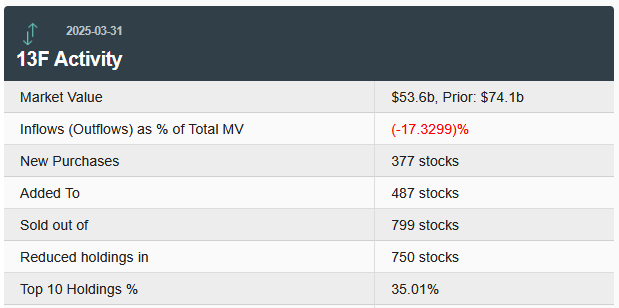
Core Viewpoint - Nomura's first-quarter holdings report for the period ending March 31, 2025, shows a significant decrease in total market value, dropping from $74.1 billion to $53.6 billion, a decline of approximately 28% [1][2]. Holdings Summary - Total market value of Nomura's holdings is $53.6 billion, down from $74.1 billion [1][2]. - The fund added 377 new stocks, increased holdings in 487 stocks, reduced holdings in 750 stocks, and completely sold out of 799 stocks [1][2]. - The top ten holdings account for 35.01% of the total market value [1][2]. Top Holdings - The largest holding is Coinbase bonds (DEBT-COIN) with a market value of approximately $4.095 billion, representing 7.65% of the portfolio, showing a substantial increase of 879.53% in shares held [3][5]. - The second largest holding is Meta call options with a market value of about $2.995 billion, accounting for 5.59% of the portfolio, with a decrease of 35.53% in shares held [3][5]. - The third largest holding is iShares Russell 2000 put options with a market value of approximately $2.371 billion, representing 4.43% of the portfolio, with an increase of 98.99% in shares held [3][5]. - Other notable holdings include Nvidia call options, SPDR S&P 500 put options, and Tesla [3][4]. Changes in Holdings - The top five purchases by percentage change include Coinbase bonds, iShares Russell 2000 put options, SPDR S&P 500 call options, Nike, and Electronic Arts put options [5][7]. - The top five sales by percentage change include Tesla put options, Nvidia put options, Tesla call options, Tesla, and Invesco QQQ Trust put options [6][7].


金融期权策略早报-20250516
Wu Kuang Qi Huo· 2025-05-16 10:50
Group 1: Report Overview - Report title: Financial Options Strategy Morning Report [1] - Date: May 16, 2025 [1] - Analysts: Lu Pinxian, Huang Kehan [2] Group 2: Market Review - Stock market: The Shanghai Composite Index, large-cap blue-chip stocks, small and medium-cap stocks, and ChiNext stocks showed high-level fluctuations [2] - Financial market important indices: The Shanghai Composite Index closed at 3,380.82, down 0.68%; the Shenzhen Component Index closed at 10,186.45, down 1.62%; the Shanghai 50 Index closed at 2,740.30, down 0.49%; the CSI 300 Index closed at 3,907.20, down 0.91%; the CSI 500 Index closed at 5,715.30, down 1.45%; the CSI 1000 Index closed at 6,057.04, down 1.68% [3] - Option underlying ETFs: Most ETFs closed lower, with varying degrees of decline in prices, trading volumes, and turnovers [4] Group 3: Option Factor Analysis - Volume and open interest PCR: The volume and open interest PCR of most option varieties showed different degrees of change, reflecting the market's sentiment and expectations [5] - Pressure and support points: The pressure and support points of each option variety were analyzed based on the strike prices with the largest open interest of call and put options [7] - Implied volatility: The implied volatility of most option varieties was below the historical average, indicating relatively low market expectations of future price fluctuations [9] Group 4: Strategy and Recommendations - Option strategies: For ETF options, it is suitable to construct covered strategies, neutral double-selling strategies, and vertical spread combination strategies; for index options, it is suitable to construct neutral double-selling strategies and arbitrage strategies between synthetic futures and futures [2] - Sector-specific strategies: Different option strategies were recommended for different sectors, including financial stocks, large-cap blue-chip stocks, medium-sized stocks, small and medium-cap stocks, and ChiNext stocks [11][12][13][14]
金属期权策略早报-20250516
Wu Kuang Qi Huo· 2025-05-16 09:15
金属期权 2025-05-16 金属期权策略早报 | 卢品先 | 投研经理 | 从业资格号:F3047321 | 交易咨询号:Z0015541 | 邮箱:lupx@wkqh.cn | | --- | --- | --- | --- | --- | | 黄柯涵 | 期权研究员 | 从业资格号:F03138607 | 电话:0755-23375252 | 邮箱:huangkh@wkqh.cn | 金属期权策略早报概要:(1)有色金属盘整震荡偏上,构建做空波动率策略策略;(2)黑色系大幅反弹回暖,适 合构建卖方期权组合策略;(3)贵金属多头趋势方向上高位震荡,构建牛市价差组合策略、做空波动率策略和现 货避险策略。 表1:标的期货市场概况 | 期权品种 | 标的合约 | 最新价 | 涨跌 | 涨跌幅 | 成交量 | 量变化 | 持仓量 | 仓变化 | | --- | --- | --- | --- | --- | --- | --- | --- | --- | | | | | | (%) | (万手) | | (万手) | | | 铜 | CU2506 | 78,490 | 100 | 0.13 | 11.02 | ...
农产品期权策略早报-20250516
Wu Kuang Qi Huo· 2025-05-16 09:15
Group 1: Report Summary - Report title: "Agricultural Product Options Strategy Morning Report" [1] - Core view: Oilseeds and oils agricultural products are in a range-bound consolidation, with oils and beans showing a weak trend, while agricultural by-products maintain a volatile trend. Soft commodities like sugar face resistance and decline, and cotton continues a weak rebound. Grains such as corn and starch gradually recover and then consolidate in a narrow range. Strategies suggest constructing option portfolios mainly as sellers, along with spot hedging or covered strategies to enhance returns [2] Group 2: Market Overview - Futures market: The latest prices, price changes, trading volumes, and open interest of various agricultural product futures are presented, including soybeans, soybean meal, palm oil, etc [3] - Option factors: Volume and open interest PCR, pressure and support levels, and implied volatility of different agricultural product options are provided [4][5][6] Group 3: Strategy Recommendations Oilseeds and Oils Options - Soybeans: Fundamental data shows changes in soybean meal transactions. The market has been in a high-level consolidation after a rebound. Options' implied volatility is at a relatively high historical level, and the open interest PCR indicates a weak market. Strategies include constructing a neutral call + put option combination, and a long collar strategy for spot hedging [7] - Soybean meal and rapeseed meal: The basis and inventory of soybean meal have changed. The market has shown a weakening trend. Options' implied volatility is below the historical average, and the open interest PCR indicates a weak market. Strategies include a bear spread strategy for directional trading, a short neutral call + put option combination, and a long collar strategy for spot hedging [9] - Palm oil, soybean oil, and rapeseed oil: Palm oil production data shows an increase. The market has been in a downward trend after a high-level decline. Options' implied volatility is below the historical average, and the open interest PCR indicates a bearish market. Strategies include a short neutral call + put option combination and a long collar strategy for spot hedging [10] - Peanuts: Spot prices and oil mill data are presented. The market has been in a weak rebound after a long - term decline. Options' implied volatility is at a low historical level, and the open interest PCR indicates a weak market. Strategies include a long collar strategy for spot hedging [11] Agricultural By - product Options - Pigs: Pig price and supply - demand data are provided. The market has been in a range - bound consolidation. Options' implied volatility is at a relatively high historical level, and the open interest PCR indicates a weak market. Strategies include a short neutral call + put option combination and a covered call strategy for spot hedging [11] - Eggs: Egg inventory data shows an increase. The market has been in a weak downward trend. Options' implied volatility is at a high level, and the open interest PCR indicates a weak market. Strategies include a bear spread strategy for directional trading and a short bearish call + put option combination [12] - Apples: Apple cold - storage inventory data shows a decrease. The market has been in a volatile decline after a high - level breakthrough. Options' implied volatility is below the historical average, and the open interest PCR indicates a weak market. Strategies include a short neutral call + put option combination [12] - Jujubes: Jujube inventory data shows an increase. The market has been in a rebound after a decline. Options' implied volatility is at a low level, and the open interest PCR indicates a weak market. Strategies include a bear spread strategy for directional trading, a short wide - straddle option combination, and a covered call strategy for spot hedging [13] Soft Commodity Options - Sugar: Sugar production, sales, and inventory data are presented. The market has been in a weakening trend after a high - level shock. Options' implied volatility is at a low historical level, and the open interest PCR indicates a range - bound market. Strategies include a short neutral call + put option combination and a long collar strategy for spot hedging [13] - Cotton: Cotton spinning and weaving factory operating rates and inventory data are provided. The market has been in a rebound after a decline. Options' implied volatility is at a low level, and the open interest PCR indicates a release of bearish forces. Strategies include a short neutral call + put option combination and a covered call strategy for spot hedging [14] Grain Options - Corn and starch: Corn sales progress data shows an increase. The market has been in a volatile rise and then a decline. Options' implied volatility is at a low historical level, and the open interest PCR indicates a range - bound market. Strategies include a short neutral call + put option combination [14]
能源化工期权策略早报-20250516
Wu Kuang Qi Huo· 2025-05-16 09:15
Report Information - Report Title: Energy and Chemical Options Strategy Morning Report [1] - Report Date: May 16, 2025 - Research Analysts: Lu Pinxian, Huang Kehan Investment Rating - No investment rating for the industry is provided in the report. Core Viewpoints - The energy and chemical sector includes energy, alcohols, polyolefins, rubber, polyesters, alkalis, and others. Strategies mainly involve constructing option portfolios with a focus on sellers, as well as spot hedging or covered strategies to enhance returns [2][8]. Summary by Relevant Catalogs 1. Market Overview of Underlying Futures - Various energy and chemical option underlying futures contracts are presented, including details such as the latest price, price change, percentage change, trading volume, volume change, open interest, and open interest change. For example, the latest price of crude oil (SC2507) is 462, with a decrease of 10 and a decline rate of 2.14% [3]. 2. Option Factors - Volume and Open Interest PCR - The volume and open interest PCR of different option varieties are provided, which are used to describe the strength of the option underlying market and the turning point of the market. For instance, the volume PCR of crude oil is 1.22, and the open interest PCR is 0.77 [4]. 3. Option Factors - Pressure and Support Levels - From the perspective of the strike prices with the largest open interest of call and put options, the pressure and support levels of option underlyings are analyzed. For example, the pressure level of crude oil is 560, and the support level is 400 [5]. 4. Option Factors - Implied Volatility - The implied volatility of options is presented, including at - the - money implied volatility, weighted implied volatility, and the difference between implied and historical volatility. For example, the at - the - money implied volatility of crude oil is 31.63%, and the weighted implied volatility is 34.36% [6]. 5. Strategy and Recommendations for Different Option Varieties Energy - Related Options - **Crude Oil**: The fundamental situation involves OPEC + increasing supply and the US maintaining production cuts. The market shows a pattern of short - term recovery followed by a decline. Implied volatility is at a relatively high level, and the open interest PCR indicates the release of short - selling power. Strategies include constructing a neutral call + put option combination for volatility, and a long collar strategy for spot hedging [7]. - **LPG**: The fundamental situation is that the cost of imported gas from the Middle East supports domestic prices. The market is in a weak, bearish state. Implied volatility fluctuates around the historical average, and the open interest PCR indicates a weak market. Strategies include constructing a bearish call + put option combination for volatility, and a long collar strategy for spot hedging [9]. Alcohol - Related Options - **Methanol**: The fundamental situation is that port and enterprise inventories have increased, and downstream demand has weakened. The market shows a recent upward trend. Implied volatility is declining and fluctuating around the historical average, and the open interest PCR indicates support. Strategies include constructing a bullish call spread for direction, a bullish call + put option combination for volatility, and a long collar strategy for spot hedging [9]. - **Ethylene Glycol**: The fundamental situation is that port inventories are expected to decrease. The market shows a short - term bullish trend. Implied volatility is at a relatively high level, and the open interest PCR indicates a strong, oscillating market. Strategies include constructing a bullish call spread for direction, a short - volatility strategy for volatility, and a long collar strategy for spot hedging [10]. Polyolefin - Related Options - **Polypropylene**: The fundamental situation is that the inventories of production enterprises and traders have increased. The market shows a recent upward trend. Implied volatility fluctuates above the historical average, and the open interest PCR is above 1. Strategies include constructing a bullish call spread for direction, and a long collar strategy for spot hedging [10]. Rubber - Related Options - **Rubber**: The fundamental situation is that the import volume has increased, and the capacity utilization rate of tire enterprises has decreased. The market shows a short - term bullish trend. Implied volatility fluctuates around the average, and the open interest PCR is below 0.6. Strategies include constructing a bullish call spread for direction, a bullish call + put option combination for volatility [11]. Polyester - Related Options - **PTA**: The fundamental situation is that polyester load has increased, and PTA inventory is decreasing. The market shows a bullish trend. Implied volatility is at a relatively high level, and the open interest PCR indicates a strengthening market. Strategies include constructing a bullish call spread for direction, and a bullish call + put option combination for volatility [12]. Other Options - **Caustic Soda**: The fundamental situation is that factory inventories and the start - up rate have changed. The market is in a weak, oscillating state. Implied volatility is decreasing and below the average, and the open interest PCR indicates a weak market. Strategies include constructing a bearish wide - straddle option combination for volatility, and a covered call strategy for spot hedging [13]. - **Soda Ash**: The fundamental situation is that domestic production has decreased. The market shows a recent bearish trend. Implied volatility is rising but below the historical average, and the open interest PCR indicates a weak, oscillating market. Strategies include constructing a bearish call spread for direction, a neutral call + put option combination for volatility, and a long collar strategy for spot hedging [13]. - **Urea**: The fundamental situation is that production capacity utilization has rebounded, and inventories have changed. The market shows a recent bullish trend. Implied volatility has decreased and is below the average, and the open interest PCR indicates strong bullish power. Strategies include constructing a bullish call spread for direction, a bullish call + put option combination for volatility, and a long collar strategy for spot hedging [14].
能源化工期权策略早报-20250515
Wu Kuang Qi Huo· 2025-05-15 06:44
能源化工期权 2025-05-15 能源化工期权策略早报 | 卢品先 | 投研经理 | 从业资格号:F3047321 | 交易咨询号:Z0015541 | 邮箱:lupx@wkqh.cn | | --- | --- | --- | --- | --- | | 黄柯涵 | 期权研究员 | 从业资格号:F03138607 | 电话:0755-23375252 | 邮箱:huangkh@wkqh.cn | 能源化工期权策略早报概要:能源类:原油、LPG;聚烯烃类期权:聚丙烯、聚氯乙烯、塑料、苯乙烯;聚酯类期 权:对二甲苯、PTA、短纤、瓶片;碱化工类:烧碱、纯碱;其他能源化工类:橡胶等。 策略上:构建卖方为主的期权组合策略以及现货套保或备兑策略增强收益。 表1:标的期货市场概况 | 期权品种 | 标的合约 | 最新价 | 涨跌 | 涨跌幅 | 成交量 | 量变化 | 持仓量 | 仓变化 | | --- | --- | --- | --- | --- | --- | --- | --- | --- | | | | | | (%) | (万手) | | (万手) | | | 原油 | SC2507 | 478 | 0 ...