
云原生

Search documents
2025云产业和标准应用大会在京召开
Xin Hua Wang· 2025-11-08 01:00
Core Insights - The "2025 Cloud Industry and Standard Application Conference" was successfully held in Beijing, focusing on cloud computing industry development, standard system construction, technology trends, and ecological collaboration [1][2] - The China Electronic Technology Standardization Institute aims to enhance the standardization of cloud computing, supporting high-quality development and global competitiveness [1] - The Ministry of Industry and Information Technology emphasizes the critical role of cloud computing in fostering new productive forces and driving industrial transformation [1][2] Group 1 - The cloud computing sector in China has established a comprehensive standard system, with a total of 45 national standards published, and is actively participating in international standardization efforts [2] - The "Cloud Computing Comprehensive Standardization System Construction Guide (2025 Edition)" aims to formulate over 30 national or industry standards by 2027, serving more than 1,000 enterprises [2] - The conference released the "2025 Enterprise AI Cloud Industry Ecosystem Map," outlining the collaborative innovation landscape of the industry [3] Group 2 - Experts from leading organizations such as Huawei Cloud and the University of Science and Technology of China shared insights on the integration of cloud computing and artificial intelligence, computational power applications, and cloud-native technologies [3] - The conference recognized outstanding contributions in cloud computing standardization by awarding excellent working group leaders, member units, and individuals [3]
报告征集 | 中国工业软件行业发展研究报告
艾瑞咨询· 2025-11-06 00:02
Group 1 - The article emphasizes the importance of digital transformation in China's manufacturing industry, highlighting the need for industrial software as a strategic component for achieving informationization, digitization, and intelligence in manufacturing [2][6]. - Since the introduction of "Made in China 2025" in 2015, there has been a continuous push for high-end manufacturing and the integration of new technologies, with significant policy support at both international and local levels [2][5]. - The Chinese industrial software market has shown rapid growth, with revenues reaching 241.4 billion yuan in 2021, marking a year-on-year increase of 22.3%, although there remains a significant gap compared to foreign products [2][6]. Group 2 - The report aims to provide insights into the characteristics of the Chinese industrial software market and the specific conditions of key segments, as well as to identify quality service providers [3][5]. - The research will cover two main aspects: the current market situation of industrial software suppliers, including product and service offerings, market size, and competitive landscape, and the impact of emerging technologies like industrial large models and cloud-native solutions [5][6]. - The report will also analyze the development background of industrial software, including key concepts, driving forces, and the necessity and value of its development in China [6][10]. Group 3 - The report will include a comprehensive overview of the industrial software supply chain, detailing product and service types, market dynamics, and competitive strategies of key players [9][10]. - It will explore the current state of industrial software development, including challenges faced by companies, such as technological bottlenecks and brand recognition issues [2][10]. - The findings will aim to provide actionable insights and recommendations for stakeholders in the industrial software sector to enhance their competitiveness and adapt to market changes [5][12].


Omdia:2030年全球电信网络市场规模预计将达到248亿美元
智通财经网· 2025-11-04 06:19
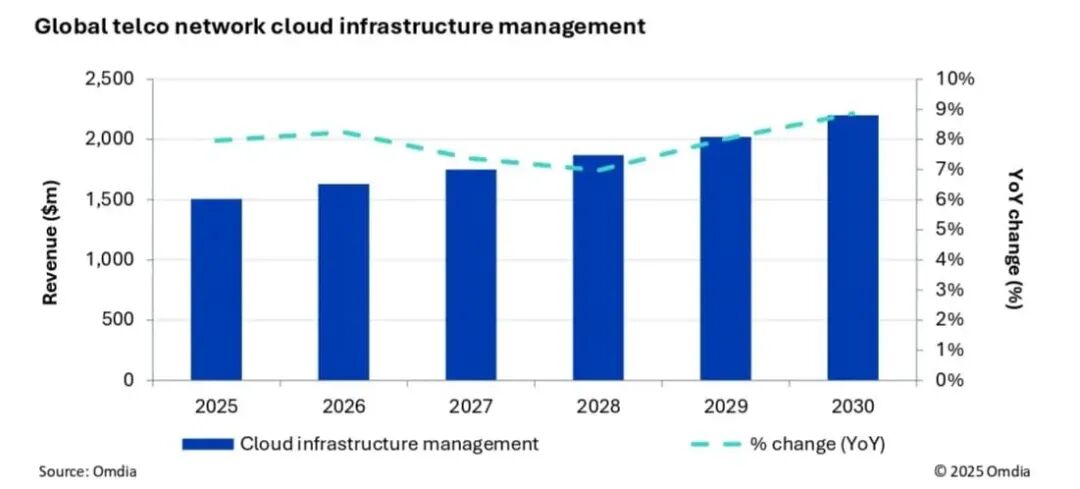
Core Insights - The global telecom cloud infrastructure and software spending is projected to grow from $17.4 billion in 2025 to $24.8 billion by 2030, with a compound annual growth rate (CAGR) of 7.3% [1] - Communication service providers (CSPs) are significantly accelerating their investments in cloud technology, with a projected growth rate of 12% in 2025, double that of 2024 [1] - The momentum is driven by the maturity of cloud-native tools, automation frameworks, and the deep integration of AI and generative AI in network operations [1] Industry Trends - AI Infrastructure: Over 62% of operators consider AI/ML support a critical factor in their cloud infrastructure decisions, with companies like NVIDIA, Red Hat, and VMware tailoring local AI capabilities for telecom environments [4] - Cloud-Native Growth: Spending on Kubernetes-based platforms is expected to grow at a CAGR of 25%, while spending in virtual machine (VM) environments is slowing down [4] - Public Cloud Adoption: The usage rate of public cloud for network workloads is expected to rise from 3% in 2024 to 13% by 2030, with major cloud service providers launching dedicated solutions for the telecom industry [4] - Vendor Landscape: Red Hat leads the telecom cloud platform market with a 25% market share [4] Recommendations for Technology Suppliers - To align with the cloud-native transformation and automation goals of telecom operators, technology suppliers are advised to adopt CI/CD pipelines and GitOps practices for the full lifecycle automation of clusters and network workloads [5]
兴业银行中层调整兴银理财一副总回归总行招行科技干将加盟
Xin Lang Cai Jing· 2025-10-31 10:35
Group 1 - The core point of the news is that Industrial Bank reported a slight decline in operating income for the first three quarters of 2025, while net profit showed a modest increase, indicating a stabilization in performance compared to earlier periods [1][2] - Industrial Bank achieved operating income of 161.23 billion yuan, a year-on-year decrease of 1.82%, with the decline narrowing by 0.47 percentage points compared to the first half of the year [1] - The bank's net profit attributable to shareholders reached 63.08 billion yuan, reflecting a year-on-year growth of 0% [1] Group 2 - The bank plans to implement a mid-term dividend for 2025, proposing a distribution of 5.65 yuan per 10 shares [1] - In personnel changes, the bank has seen a return of key executives to its wealth management subsidiary, with new appointments in the second half of the year [2] - The wealth management subsidiary, Xingyin Wealth Management, has increased its registered capital from 5 billion yuan to 10 billion yuan, making it the largest wealth management subsidiary among national joint-stock banks in terms of capital [2] Group 3 - As of June 30, 2025, Xingyin Wealth Management managed products totaling 2.32 trillion yuan, maintaining the second position in the market [3] - The subsidiary's fixed income products accounted for 2.27 trillion yuan, while equity products and mixed products were significantly smaller at 67.32 billion yuan and 349.32 billion yuan, respectively [3] - Xingyin Wealth Management has been recognized for its comprehensive wealth management capabilities, ranking first among national wealth management institutions for thirty consecutive quarters [3] Group 4 - Industrial Bank has been actively recruiting financial technology talent, with recent appointments from major financial institutions to enhance its technological capabilities [4] - The bank's investment in information technology reached 8.38 billion yuan in 2024, representing 3.95% of its operating income [4] - As of the end of 2024, the bank employed 7,840 technology personnel, making up 13.51% of its total workforce, the highest proportion among its peers [4]

卓易信息(688258):深度报告:AI+编程核心标的未来可期
Jianghai Securities· 2025-10-31 09:05
Investment Rating - The report assigns an investment rating of "Buy (First Coverage)" with a current price of 64.70 CNY and a target price of 101.82 CNY over a 12-month period [1][5]. Core Insights - The report highlights that the IDE (Integrated Development Environment) business is expected to be the core growth driver for the company, with significant revenue growth projected from 2025 to 2027 [5][33]. - The company is strategically positioned in the AI and programming sector, leveraging AI technologies to enhance its IDE products [5][27]. - The global software development tools market is projected to grow from 6.517 billion USD in 2025 to 14.680 billion USD by 2031, with a CAGR of 14.5% [28]. Company Overview - The report details that Jiangsu Zhuoyi Information Technology Co., Ltd. was established in May 2008 and went public on the Shanghai Stock Exchange in December 2019 [13][19]. - The company’s main business segments include IDE business, core firmware for cloud computing devices, and cloud services [13][33]. Financial Performance - The company’s projected revenues for 2025, 2026, and 2027 are 414.33 million CNY, 583.64 million CNY, and 827.17 million CNY, respectively, with year-on-year growth rates of 28.12%, 40.87%, and 41.72% [6][5]. - The net profit attributable to the parent company is expected to reach 93.87 million CNY in 2025, 154.42 million CNY in 2026, and 289.99 million CNY in 2027, with significant growth rates of 185.84%, 64.50%, and 87.79% [6][5]. IDE Industry Analysis - The IDE industry is characterized by a deep integration with AI technologies, enhancing development efficiency and reducing errors [27][31]. - The report notes that the current market for IDEs is dominated by foreign companies, with a lack of domestic players capable of mature IDE development and commercialization [27][28]. - Key trends in the IDE industry include AI programming support, low-code technology applications, and cloud-native support [31][32]. Business Segments - The company’s IDE products include SnapDevelop, EazyDevelop, PowerBuilder, and PowerServer, targeting various customer segments including large enterprises and independent software developers [36][37]. - The cloud computing firmware business provides essential BIOS and BMC firmware for computing devices, serving major clients like Intel and Huawei [44][45]. - The cloud services segment focuses on IoT cloud services, primarily targeting government and enterprise clients [47]. Management and Ownership - The report indicates that the company is controlled by its actual controllers, Xie Qian and Wang Ye, who together hold a 40.74% stake [20][23]. - The core management team has a strong educational background and stability, with key figures having long tenures in the company [23][24]. Stock Incentive Plan - In May 2025, the company announced a stock incentive plan aimed at core technical and key personnel, with performance targets set for the IDE business from 2025 to 2027 [25][26].

国发股份第三季度盈利199万元 同比扭亏为盈
Zheng Quan Shi Bao Wang· 2025-10-31 03:51
Core Insights - Guofang Co., Ltd. reported a net profit of 1.99 million yuan in Q3 2025, marking a turnaround from a loss in the same period last year, with total revenue reaching 85.34 million yuan [1] - The company achieved a total revenue of 239 million yuan in the first three quarters of the year [1] Group 1: Financial Performance - In Q3 2025, Guofang Co., Ltd. turned a profit primarily due to increased investment income from the Huada Gongying No. 1 Fund, which rose by 3.8571 million yuan compared to the previous year [1] - The company improved its collection of accounts receivable, recovering significant amounts from long-aged receivables, resulting in a reversal of credit impairment losses amounting to 5.2167 million yuan compared to the same period last year [1] - As of September 30, 2025, the company had cash and cash equivalents totaling 133 million yuan [1] Group 2: Management and Strategic Developments - The company has seen a change in leadership with the appointment of new executives, including Chairman Jiang Ye and President Zhang Xiaowei, who are optimistic about the company's future [2] - Jiang Ye has increased his stake in the company by acquiring 4.8049 million shares for a total of 30.0166 million yuan, positioning him among the top ten shareholders [2] - In August 2025, the company’s shareholders approved a plan to raise up to 300 million yuan through a simplified procedure, not exceeding 20% of the net assets from the previous year [2] Group 3: Industry Engagement - In July 2025, the company’s executives visited DaoCloud, a leading cloud-native operating system provider, signaling an interest in exploring opportunities in the AI sector [2]

均降40%的GPU成本,大规模Agent部署和运维的捷径是什么?| 直播预告
AI前线· 2025-10-28 09:02
Core Insights - The article discusses the challenges and solutions for large-scale deployment and operation of AI agents in enterprises, emphasizing the need for innovation in this area [2]. Group 1: Event Details - The live broadcast is scheduled for October 28, 2025, from 19:30 to 20:30 [5]. - The theme of the live broadcast is "Accelerating Hundredfold Startup: What are the Shortcuts for Large-scale Agent Deployment and Operation?" [3][7]. Group 2: Guest Speakers - The live broadcast features key speakers including Yang Haoran, the head of Alibaba Cloud's Serverless Computing, and Zhao Yuying, the chief editor of Geekbang Technology [4]. Group 3: Key Topics - The discussion will cover the technological transition from "Cloud Native" to "AI Native" [8]. - It will highlight the AgentRun platform, which claims to achieve a hundredfold acceleration and an average reduction of 40% in GPU costs [9]. - The session will address the full lifecycle governance of AI agents, from development to operation [9]. - Future evolution of Serverless AI will also be a topic of discussion [9].

软件企业加速“出海”完善产业全球化布局
Zheng Quan Ri Bao· 2025-10-20 16:41
Group 1: Industry Overview - China's software business exports reached $40.44 billion from January to August this year, showing a year-on-year growth of 6.4% [1] - The global AI hardware and software market is expected to reach between $780 billion and $990 billion by 2027, with an average growth rate of 40% to 55% [2] - The average growth rate for applications and transaction platforms is projected to be between 60% and 85%, presenting significant globalization opportunities for Chinese companies [2] Group 2: Company Strategies - Several listed companies are implementing globalization strategies to accelerate their software business expansion [4] - For instance, Hengsheng Electronics has launched an integrated solution for foreign investment in domestic markets, providing cross-border support for revenue swap transactions [4] - Anheng Information Technology is focusing on global digital security governance, utilizing AI to enhance its product offerings and localizing solutions for overseas markets [4] Group 3: Market Trends - The global software industry is transitioning from a "cloud-first" to an "AI-first" approach, creating new opportunities for Chinese manufacturers [3] - Companies are leveraging their advantages in mobile internet and efficient iteration to convert these into exportable products and services [2][3] - The emphasis on product data compliance and localization is crucial for software companies to optimize overseas profit growth [3] Group 4: Partnerships and Collaborations - Kingsoft Office signed a strategic cooperation agreement with Oman Telecommunications to promote WPS365 in Oman, enhancing customer experience in the GCC region [5] - The company has provided services to users in over 220 countries, with a global monthly active device count of 651 million, reflecting an 8.56% year-on-year increase [5] - Companies are encouraged to integrate "global usability" into their products to ensure stable performance across different jurisdictions and cloud conditions [5]

报告征集 | 中国工业软件行业发展研究报告
艾瑞咨询· 2025-10-15 01:29
Group 1 - The article emphasizes the importance of digital transformation in China's manufacturing industry, particularly in the context of the "Made in China 2025" initiative, which aims to upgrade the manufacturing sector through digitalization and innovation [2][6] - The industrial software market in China has shown significant growth, with revenues reaching 241.4 billion yuan in 2021, reflecting a year-on-year increase of 22.3% [2] - Despite the growth, there are notable gaps between domestic industrial software products and their foreign counterparts, including issues like technological bottlenecks and brand recognition challenges [2][6] Group 2 - The report aims to provide insights into the characteristics of the Chinese industrial software market and the specific conditions of key segments, helping enterprises plan future development paths [3][5] - It will analyze the supply side of industrial software, including product and service offerings, market size, and competitive landscape [5][6] - The report will also explore the impact of emerging technologies, such as industrial large models and cloud-native solutions, on various players in the industrial software sector [5][6] Group 3 - The report will consist of three main parts: the background of industrial software development, market development conditions, and industry insights [6][12] - The background section will clarify key concepts, development drivers, and the urgency of advancing industrial software in China [10][12] - The market section will provide an overview of the industrial software supply chain, key player types, product and service offerings, and current market dynamics [10][11]

2025中国超融合信创实践指南-亿欧智库
Sou Hu Cai Jing· 2025-09-28 17:13
Core Insights - The report by EO Intelligence focuses on the hyper-converged infrastructure (HCI) market in China, analyzing the overall market situation, application implementation, construction methodology, vendor practices, and future trends. Market Overview - Hyper-converged architecture integrates resources through Software-Defined Storage (SDS) and Software-Defined Networking (SDN), addressing the complexities and high TCO of traditional IT architectures. However, challenges such as talent shortages and complex technology routes persist. The market is expected to grow continuously from 2020 to 2029, reaching 24.8 billion yuan by 2024, with further growth anticipated by 2029. Companies like H3C and SmartX hold significant market shares. The integration of AI with hyper-convergence, supported by technologies like NVIDIA GPUs, enhances IT efficiency and promotes cloud-native development [1][2][41]. Application Implementation - Hyper-converged infrastructure is advancing in various sectors. In government, the focus is on office automation software, aiming for a 70%-80% domestic CPU localization rate by 2027. In healthcare, major hospitals are gradually adopting hyper-converged architectures to support systems like HIS and PACS, improving data processing efficiency. The education sector plans phased IT architecture upgrades by 2027 and 2035, with hyper-convergence aiding resource integration. Each sector faces challenges related to ARM vs. x86 architecture choices and data security [1][2][41]. Construction Methodology - The implementation of hyper-converged infrastructure is phased from 2022 to 2027, starting with office automation and expanding to manufacturing systems. Emphasis is placed on IT planning and business alignment, selecting appropriate CPUs (e.g., ARM-based Kunpeng, Phytium, x86-based Zhaoxin), operating systems (UOS, KylinOS), and databases (OceanBase, openGauss). POC testing is crucial for performance validation, alongside strengthening security measures like SM2/SM3/SM4 encryption [2][3]. Vendor Practices - Major vendors like Inspur, Lenovo, and Huawei provide comprehensive solutions, while foreign products from VMware and Nutanix offer high flexibility. In finance, compliance and resource pooling are emphasized, while in healthcare, solutions focus on rapid deployment and simplified operations, such as H3C UIS, which can be deployed in 30 minutes, and Huawei FusionCube, which enhances system reliability [2][3]. Future Trends - The hyper-converged infrastructure will deepen collaboration with cloud vendors and enhance Kubernetes integration to support containerized applications. AIOps will simplify management and improve intelligence levels. The combination of edge computing and HCI will meet real-time processing needs for AI and IoT, with lightweight HCI becoming a significant direction to drive the industry towards efficiency, security, and intelligence [2][3].
