日元汇率

Search documents
周一日元兑主要货币普遍走低
Mei Ri Jing Ji Xin Wen· 2025-10-07 01:02
Core Viewpoint - The Japanese yen has depreciated against major currencies, with the largest decline against the Australian dollar, which has risen by 2.2191% against the yen [1] Currency Performance - The US dollar has also strengthened against the yen, closing at 150.368, an increase of 1.941% [1] - Over the past five trading days, the US dollar has appreciated by 1.183% against the yen [1]
日本车企在扩大美国以外销路,应对高关税常态
日经中文网· 2025-09-21 00:33
Core Viewpoint - Japanese automakers are expanding their sales outside the U.S. due to the impact of U.S. tariff policies, with Mitsubishi and Mazda adjusting their export strategies to mitigate profit declines from the U.S. market [2][4][5]. Group 1: Tariff Impact - The U.S. government reduced tariffs on Japanese cars from 27.5% to 15%, but this is still significantly higher than the previous 2.5% before spring [4]. - The tariff reduction will have a substantial impact on Mitsubishi, with an estimated loss of 32 billion yen in the fiscal year 2025 [4]. - Japanese automakers are focusing on expanding markets outside the U.S. to compensate for declining profits from U.S. operations [2][4]. Group 2: Mitsubishi's Strategy - Mitsubishi is leveraging its strong brand image in design and off-road performance to enhance profitability in the South American market [5]. - The company has begun exporting vehicles from Brazil to neighboring countries like Argentina, which were previously only sold in Brazil [4][5]. Group 3: Mazda's Adjustments - Mazda is reducing exports of small cars from Mexico to the U.S. due to low profit margins and is redirecting these vehicles to other regions [5][7]. - The company has seen a significant drop in exports to the U.S., with a 57% decrease in "Mazda3" exports and a 37% decrease in "CX-30" exports in August [7]. Group 4: Overall Industry Outlook - Japanese automakers, except Nissan, are projecting profitability for the fiscal year 2025, largely due to the depreciation of the yen [8]. - Companies are enhancing cost competitiveness to maintain profitability even if the exchange rate shifts to 110 yen per dollar [8]. - The automotive market in the U.S. is experiencing price increases, which may lead to a decline in sales, making the expansion into non-U.S. markets critical [8].


参与1985年《广场协议》的前日本官员警告:低利率+弱日元将推高通胀
智通财经网· 2025-09-12 11:27
Group 1 - The core viewpoint is that Japan's low interest rates and weak yen may accelerate inflation, necessitating the Bank of Japan's consideration of these factors in its monetary policy [1][2] - The former senior currency diplomat emphasizes that Japan's interest rates are excessively low, contributing to the yen's weakness, which could lead to higher import costs and inflation [1] - The Bank of Japan has recently raised short-term interest rates to 0.5% after a decade of negative interest rates, aiming for a sustainable 2% inflation target [1] Group 2 - The former diplomat suggests that if the Bank of Japan gradually tightens its monetary policy and reduces the interest rate differential with the U.S., the yen's weakness could be corrected [2] - Historical context is provided, indicating that after the Plaza Accord, the yen appreciated significantly, leading to a public backlash and subsequent monetary easing that contributed to Japan's asset bubble [2] - There is a growing recognition that a stronger yen could be an opportunity for Japan to reduce its reliance on exports and shift towards a new growth model [2] Group 3 - There is a notable shift in sentiment regarding the strong yen, with increasing awareness of the impact of a weak yen on the cost of living for ordinary Japanese households [3] - Nomura's recent research indicates that if the Bank of Japan incorporates the uncertainties from the new government coalition into its monetary policy, the likelihood of a rate hike in October may decrease, with the next expected hike in January 2026 [3]
周一日元兑主要货币多数走低
Mei Ri Jing Ji Xin Wen· 2025-08-12 00:47
Group 1 - The Japanese yen has depreciated against most major currencies, with the largest decline against the US dollar, which rose by 0.2816% [1] - Over the past five trading days, the US dollar has appreciated by a cumulative 0.7056% against the yen [1]
人民币汇率最新数据出炉,你的钱换值了还是贬了?
Sou Hu Cai Jing· 2025-08-06 16:47
Core Insights - Exchange rate fluctuations significantly impact various aspects of daily life, including overseas consumption, investment decisions, and travel plans [1][2][8] Group 1: Impact on Overseas Study and Travel - Minor differences in exchange rates can accumulate, leading to substantial losses when exchanging currency for studying abroad or traveling [3] - For those planning to study or travel abroad, current exchange rates should be monitored closely to optimize currency exchange [9][10] Group 2: Cross-Border E-commerce and Purchasing - Prices of overseas goods fluctuate in real-time with exchange rate changes, affecting cross-border e-commerce and purchasing decisions [5][8] Group 3: Financial Investments and Corporate Earnings - Exchange rate volatility influences the profitability of multinational companies, which in turn affects stock market performance and returns on foreign currency investment products [6][8] - Companies engaged in import and export activities face direct impacts on their operating costs due to exchange rate changes [7][8] Group 4: Currency Trends Analysis - The current exchange rate of the Chinese Yuan against the US Dollar shows a slight increase of 0.14% since August 1, indicating a stable outlook for the Yuan [9] - The Euro has depreciated recently due to economic weaknesses in the Eurozone, suggesting potential savings for travelers or students in Europe [10] - The Japanese Yen has appreciated slightly due to increased demand for safe-haven currencies amid global uncertainties, but caution is advised for those planning to exchange Yen [11] Group 5: Emerging Market Currency Performance - The performance of various emerging market currencies reflects their respective economic fundamentals, with the Korean Won showing significant depreciation [15] - The Malaysian Ringgit has strengthened, indicating a stable economic foundation [16] - The Russian Ruble remains supported by energy exports, while currencies like the South African Rand and Turkish Lira exhibit high volatility due to inflation and interest rate factors [17][18] Group 6: Future Outlook for the Chinese Yuan - Recent policy signals suggest that the Chinese Yuan will maintain a pattern of "two-way fluctuations and stable ranges," requiring close monitoring of policy developments for strategic adjustments [19]

日本央行行长植田和男:日元汇率并未大幅偏离日本央行的预期
news flash· 2025-07-31 07:34
Core Viewpoint - The Governor of the Bank of Japan, Kazuo Ueda, stated that the yen's exchange rate has not significantly deviated from the central bank's expectations [1] Group 1 - The Bank of Japan is closely monitoring the yen's exchange rate in relation to its monetary policy objectives [1] - The statement reflects the central bank's confidence in its current economic strategies and outlook [1]
植田和男称日元汇率未偏离日本央行预期,日元回吐部分涨幅。
news flash· 2025-07-31 07:33
Core Viewpoint - The Japanese yen's exchange rate has not deviated from the expectations of the Bank of Japan, leading to a partial reversal of its recent gains [1] Group 1 - The yen's recent fluctuations are closely monitored by the Bank of Japan, indicating a stable outlook for the currency [1] - The comments from Ueda Kazuo suggest confidence in the current monetary policy framework [1]
日本央行行长植田和男:日元汇率并未大幅偏离日本央行的预期。希望从更多硬性数据中观察关税的影响。
news flash· 2025-07-31 07:25
Core Viewpoint - The Governor of the Bank of Japan, Kazuo Ueda, stated that the yen's exchange rate has not significantly deviated from the central bank's expectations [1] Group 1 - The Bank of Japan is monitoring the impact of tariffs through more concrete data [1]
日元本周涨约0.8%
news flash· 2025-07-25 20:58
Core Viewpoint - The US dollar against the Japanese yen experienced a slight increase of 0.44% to 147.66 yen, despite a weekly decline of 0.77%, indicating a W-shaped downward trend throughout the week [1] Currency Performance Summary - The euro against the Japanese yen rose by 0.36%, with a cumulative weekly increase of 0.20% [1] - The British pound against the Japanese yen fell by 0.15%, resulting in a total weekly decline of 0.66% [1]
美元兑人民币或保持震荡走势
Sou Hu Cai Jing· 2025-07-21 13:46
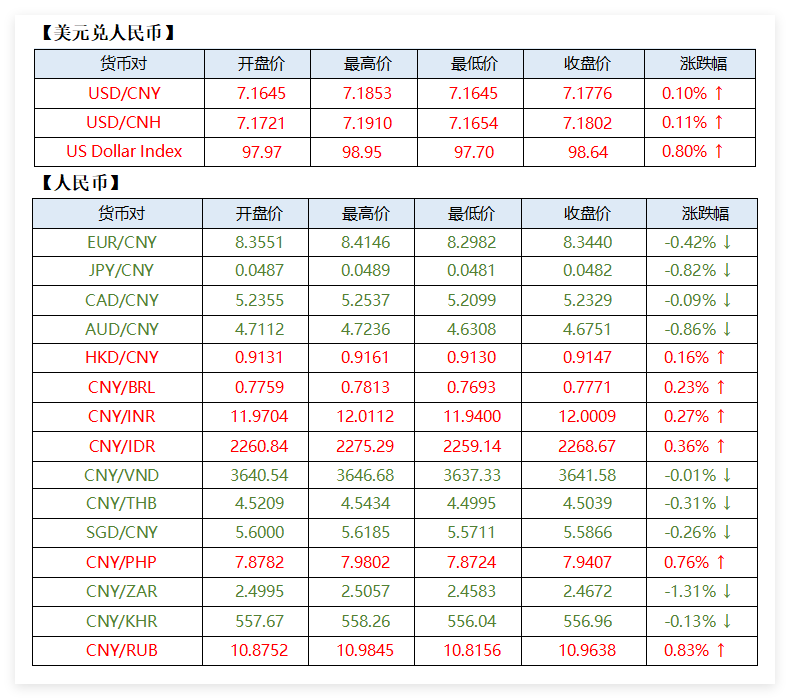
Group 1: Market Overview - The US Dollar Index increased by 0.80% to close at 98.64, with a weekly high of 98.95 [1] - USD/CNY rose by 0.10% to 7.1776, while USD/CNH increased by 0.11% to 7.1802 [1] - The Chinese Yuan showed mixed performance against other currencies, with notable declines against EUR, JPY, and AUD [1] Group 2: Economic Data Focus - Key economic data releases include the US Leading Economic Index for June, expected to decline from -0.1% to -0.2% [2] - The Eurozone's manufacturing and services PMI for July are anticipated to improve, while the US manufacturing PMI is expected to drop from 52.9 to 52.5 [2][4] - The US durable goods orders for June are forecasted to decrease significantly by 10.5% after a previous increase of 16.4% [2] Group 3: Central Bank Decisions - The European Central Bank (ECB) is expected to maintain interest rates during its upcoming meeting, with market focus on President Lagarde's comments regarding future monetary policy [3][11] - The market anticipates that the ECB will continue to reference inflation and tariff policies in its future decisions, which could impact the Euro's value [3][11] Group 4: Currency Trends - The USD/CNY is expected to remain stable around 7.18, influenced by the performance of the US Dollar Index [9][10] - The Euro is projected to face downward pressure if the ECB signals potential rate cuts, especially with upcoming PMI data expected to show improvement [11] - The Japanese Yen is under pressure due to inflation data and impending tariffs from the US, with the USD/JPY reaching a high of 149.18 [15]