科技股

Search documents
沪指逼近4030点!还能向上突破吗?
Guo Ji Jin Rong Bao· 2025-11-13 15:46
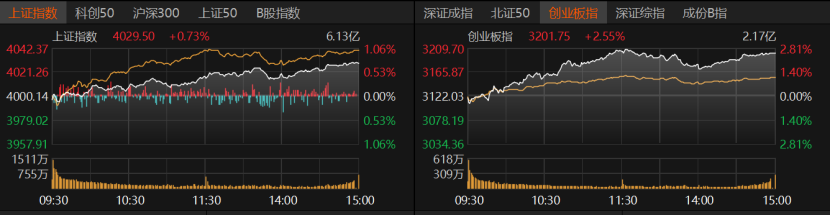
Core Viewpoint - The A-share market has seen a significant increase in both trading volume and stock prices, with the Shanghai Composite Index approaching 4030 points and the ChiNext Index rising by 2.55% [1][4]. Market Performance - The total trading volume exceeded 2 trillion yuan, reaching 2.07 trillion yuan, indicating a healthy market environment [5][11]. - A total of 3952 stocks rose, reflecting a positive market sentiment [1]. Sector Highlights - The electric power equipment sector experienced a notable surge, with a 4.31% increase, driven by favorable policies and market demand [7][11]. - The non-ferrous metals sector also performed well, with a 4.01% rise, supported by government initiatives aimed at boosting the industry [9][11]. - The lithium battery sector saw significant gains, attributed to increased demand for energy storage solutions [10][11]. Investment Strategies - Investors are advised to maintain a balanced portfolio, incorporating both growth and value stocks, while being mindful of market trends [3][15]. - The focus remains on technology stocks, particularly in AI and related fields, despite some short-term profit-taking [12][14]. - The market is expected to continue its oscillation between sectors, with opportunities in both cyclical and growth stocks [14][15]. Policy Impact - Recent government policies, including the "2025 World Power Battery Conference" and the "New Energy System Development Blue Book," have catalyzed growth in the electric power equipment sector [11]. - The "Non-ferrous Metals Industry Stabilization and Growth Work Plan" aims to enhance the recycling of resources and boost production targets, further supporting the non-ferrous metals sector [11]. Conclusion - The current market dynamics suggest a healthy trading environment with potential for continued growth in key sectors, particularly electric power equipment and non-ferrous metals, driven by supportive policies and market demand [11][12].

腾讯财报再超预期,外媒称其成“科技股避风港”
Xin Lang Cai Jing· 2025-11-13 09:37
Group 1 - Tencent Holdings reported revenue of 192.87 billion yuan, a 15% year-on-year increase from 167.19 billion yuan, with a net profit of 63.13 billion yuan and earnings per share of 6.779 yuan [1] - Domestic gaming revenue reached 42.8 billion yuan, up 15% year-on-year, driven by new games like "Delta Action" and sustained growth from long-term products such as "Honor of Kings" and "Peacekeeper Elite" [1] - International gaming revenue was 20.8 billion yuan, a 43% year-on-year increase (42% at constant exchange rates), supported by strong performance from Supercell games and new releases [1] Group 2 - Financial technology and enterprise services revenue amounted to 58.2 billion yuan, a 10% year-on-year increase, with growth in commercial payment activities and consumer loan services [1] - General and administrative expenses rose 18% year-on-year to 34.2 billion yuan, primarily due to increased R&D spending, especially in AI-related projects [2] - Tencent has made advancements in its mixed-language model, enhancing complex reasoning capabilities, particularly in programming, mathematics, and science [2] Group 3 - As of the end of September, WeChat had 1.41 billion monthly active users, a 2% year-on-year increase [3] - Investors are increasingly viewing Tencent as a safer investment amid concerns over potential AI bubbles and rising concentration in tech stocks [3] - Despite a 59% increase in Tencent's stock price this year, its earnings-based valuation remains significantly discounted compared to global tech peers like Amazon and Nintendo [3] Group 4 - Analysts suggest that Tencent's advertising business could be another highlight, benefiting from AI-driven system upgrades that allow more ads to be displayed on video accounts [3][4] - There is an expectation that if Tencent exceeds market expectations again, it would not be surprising, as the market has not fully accounted for the profit growth potential from AI [4]

私募把脉科技股行情,攻守兼备平衡有术
Zhong Guo Zheng Quan Bao· 2025-11-13 05:21
Core Viewpoint - The A-share technology sector is experiencing structural differentiation, with active segments like power grids and robotics, while previously leading areas like computing power are undergoing corrections. This has sparked debates in the private equity circle regarding investment strategies and optimization of portfolios [1] Group 1: Investment Strategies - Many private equity firms are adopting a long-term bullish view on the "core technology stocks" while focusing on short-term high-low switches as a key strategy [1] - Investment opportunities in the AI sector should not be judged solely on the "new vs. old" dimension, as both "old AI" (like optical modules and PCBs) and "new AI" are expected to benefit from global AI development [3] - The current market trend shows funds shifting from previously high-performing areas like computing chips to sectors like electricity and semiconductors, indicating a rotation strategy [4] Group 2: Market Dynamics - The high concentration in the AI sector has become a consensus, but many private equity firms view this as a signal to refine their investment choices rather than exit the market [5] - A simplified verification system for investing in technology stocks emphasizes the importance of real technological application, profitability, and R&D efficiency [5] - The strategy of "watching performance" and "buying in batches" is recommended to manage risks and costs effectively [5] Group 3: Future Outlook - Private equity firms maintain a strong confidence in the long-term trends of core technology industries like AI and semiconductors, with a focus on application deployment and potential industry breakthroughs [7] - The AI computing infrastructure is expected to remain in high demand until 2026, driven by capital expenditures from overseas cloud vendors and accelerated domestic investments [7] - Emerging technologies and applications, such as advancements in open-source models and increased token usage, are anticipated to create new, unpriced demands in the industry [8] Group 4: Sector Focus - There is a growing interest in niche areas like storage chips, AI glasses, and AI edge hardware, which are seen as potential growth sectors [8]
红利风向标 | 牛市或抚平每一处“洼地”,高股息红利策略或持续占优!
Xin Lang Ji Jin· 2025-11-13 03:34
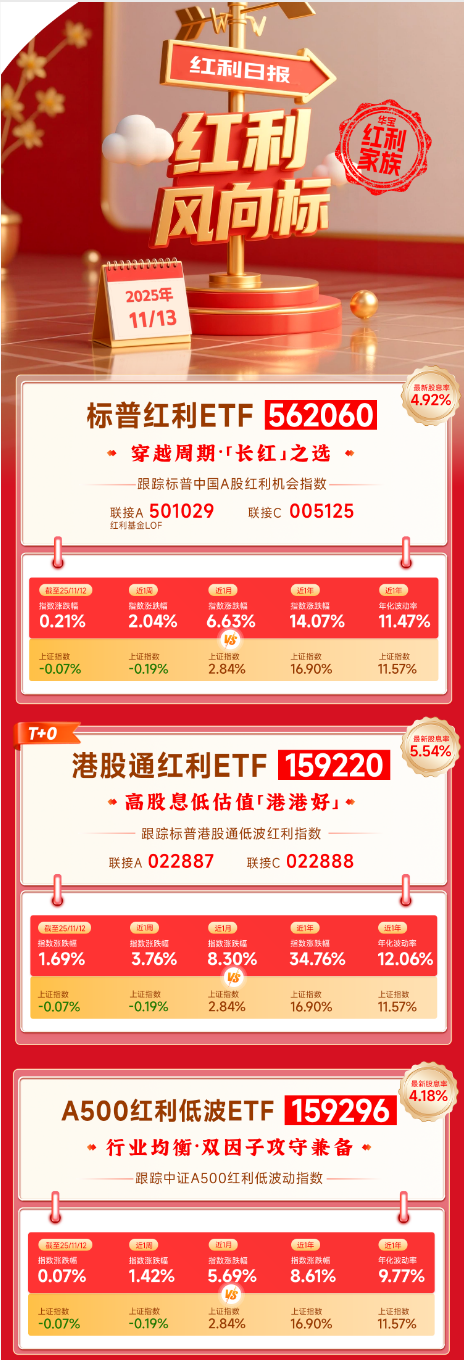
Core Insights - The market is currently shifting from a focus on technology stocks to a broader range of sectors, indicating a potential change in investment strategy [2][3] Group 1: Market Performance - The S&P China A-Share Dividend Opportunity Index has shown a 4.92% increase [1] - The Shanghai Composite Index has experienced a slight decline of 0.07% over the past week, but a 2.84% increase over the past year [1] - The annualized volatility for the S&P China A-Share Dividend Opportunity Index is reported at 11.47% [1] Group 2: ETF Performance - The Hong Kong Stock Connect Dividend ETF has recorded a 34.76% increase over the past year, with an annualized volatility of 12.06% [1] - The A500 Dividend Low Volatility ETF has shown a 5.69% increase over the past year, with an annualized volatility of 9.77% [2] - The 300 Cash Flow ETF has achieved a 12.70% increase over the past year, with an annualized volatility of 1.72% [2]
美股科技股下挫 英伟达跌超3% 加密货币超14万人爆仓 美元跳水
2 1 Shi Ji Jing Ji Bao Dao· 2025-11-11 15:59
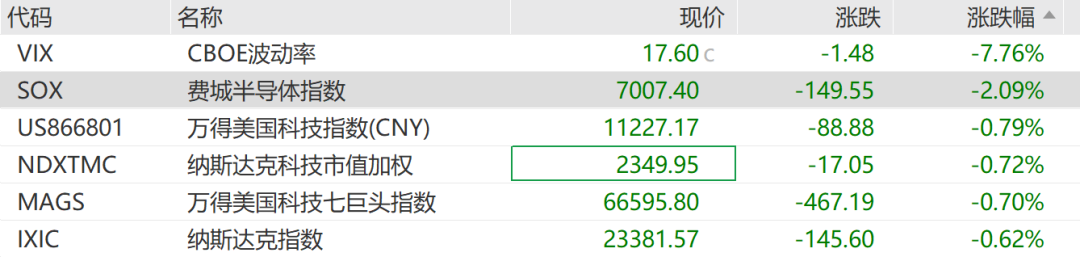
Market Overview - US stock market opened mixed, with technology stocks under pressure, leading to declines in related indices [1] - The CBOE Volatility Index (VIX) decreased by 1.48 points, or 7.76%, to 17.60 [2] - The Philadelphia Semiconductor Index (SOX) fell by 149.55 points, or 2.09%, closing at 7007.40 [2] - Major tech stocks like Micron Technology, ARM, and Lam Research dropped over 4%, while NVIDIA fell over 3% [2] Company Specifics - SoftBank Group announced the sale of its entire stake in NVIDIA, valued at $5.83 billion [2] - CoreWeave reported a Q3 operating profit margin below expectations, resulting in a decline of over 12% in its stock price [2] Chinese Stocks - The Nasdaq China Golden Dragon Index showed mixed performance among popular Chinese stocks, with New Oxygen rising nearly 9% and Wanwu Xingsheng and Century Internet increasing over 5% [3] - On the downside, Yipeng Energy fell over 13%, and Hesai Technology dropped over 5% [3] Commodity Market - Gold prices surged, nearing $4150 per ounce before slightly retreating, while WTI and ICE Brent crude oil both rose over 1% [5] - Citic Securities maintains a bullish long-term outlook on gold due to weak economic indicators and increased market volatility [5] Cryptocurrency Market - The cryptocurrency market experienced a significant downturn, with Bitcoin dropping to $103,881 and Ethereum falling below $3,500, marking a nearly 2% decline in the last 24 hours [5][6] - Over 142,000 traders faced liquidation, with total liquidation amounting to $417 million [6]

早盘直击|今日行情关注
申万宏源证券上海北京西路营业部· 2025-11-11 02:50
Group 1 - The core viewpoint of the article highlights an improvement in inflation data, leading to a temporary shift in market investment styles, with CPI rising from -0.3% to 0.2% and PPI improving from -2.3% to -2.1% [1] - The recent slight improvement in inflation data indicates a reduction in price downward pressure, with rising prices in upstream resources and some industrial products triggering local market hotspots [1] - The consumer sector, which had been quiet for a long time, has seen a significant rebound due to the CPI returning to positive territory, reflecting the main characteristics of the year-end consolidation market: sector rotation, unclear main lines, and balanced allocation [1] Group 2 - On Monday, the stock market experienced a rebound with increased trading volume, with the Shanghai Composite Index consolidating before a strong upward movement, closing near its highest point [1] - The Shenzhen Component Index showed weaker performance compared to the Shanghai Composite, primarily adjusting throughout the day before finally turning upward, closing above the 5-day moving average [1] - The market's focus is expected to remain on the macroeconomic data for October, which will guide adjustments in asset and industry allocation based on economic conditions [1]

基金档案之七:25Q3,固收+规模突破2万亿
HUAXI Securities· 2025-11-10 13:28
Fund Performance - In Q3 2025, the median return of fixed income + funds was 2.18%[1] - Convertible bond funds led with a median return of 13.01%[1] - Aggressive convertible bond enhancement funds followed with a median return of 5.58%[1] - Stock enhancement products achieved a median return of 2.44%[1] - Mild convertible bond enhancement funds lagged with a median return of 0.75%[1] Fund Scale Growth - The total scale of fixed income + funds exceeded 2 trillion yuan, reaching 2,076.47 billion yuan, an increase of 594.89 billion yuan from Q2 2025[2] - Fixed income + funds accounted for 19.3% of the broad bond fund market, up from 13.5%[2] - Stock enhancement funds saw the largest scale increase, growing by 366.34 billion yuan[2] - Mild convertible bond enhancement products increased by 135.19 billion yuan, while aggressive convertible bond and convertible bond funds grew by 54.78 billion yuan and 38.59 billion yuan, respectively[2] Top Performing Funds - The average return of top-performing stock enhancement funds was 6.42%, with the only fund exceeding 10% being Huatai-PB Dual Benefit Enhancement at 10.97%[4] - The average return of top-performing convertible bond enhancement funds was 13.23%, with Jin Ying Yuan Feng leading at 22.28%[4] - Notable convertible bond funds included Southern Changyuan Convertible Bond and Huaxia Convertible Bond Enhancement, with returns of 28.73% and 27.29%, respectively[4] Risk Considerations - Past performance of funds does not guarantee future returns, as future performance is influenced by macroeconomic conditions, market volatility, and style shifts[5]
前十月超九成债基上涨 南方昌元可转债债券涨39%
Zhong Guo Jing Ji Wang· 2025-11-09 23:29
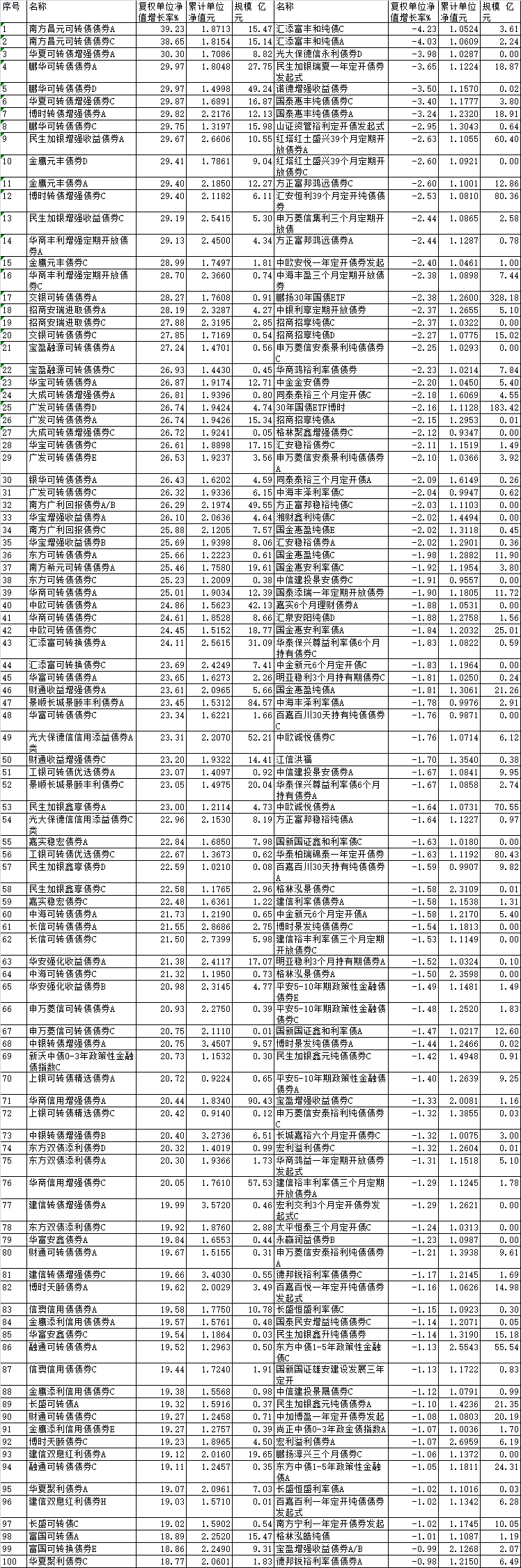
Core Insights - In the first ten months of the year, 92% of the 6,758 comparable bond funds reported positive performance, with 6,221 funds increasing in value [1] - The top three performing funds were Southern Changyuan Convertible Bond A, Southern Changyuan Convertible Bond C, and Huaxia Convertible Bond Enhanced A, with increases of 39.23%, 38.65%, and 30.30% respectively [1] - The overall performance of bond funds has been strong, with only seven funds experiencing a decline of over 3% [4] Fund Performance - Southern Changyuan Convertible Bond A and C had significant holdings in convertible bonds, with 81.90% and 16.21% in stocks, respectively [1] - Huaxia Convertible Bond Enhanced, managed by He Jiaqi, has a focus on technology stocks, benefiting from the sector's growth [2] - Penghua Convertible Bond A, managed by Wang Shiqian, also showed strong performance with a 29.97% increase, focusing on convertible bonds and high-performing stocks [3] Manager Experience - Liu Wenliang, the manager of Southern Changyuan Convertible Bond, has over 10 years of experience in the industry [1] - He Jiaqi, managing Huaxia Convertible Bond Enhanced, has over 9 years of experience [2] - Wang Shiqian, managing Penghua Convertible Bond A, has more than 7 years of experience [3] Declining Funds - The funds with the largest declines were primarily long-term pure bond funds, with the largest drop being 3.65% for Minsheng Jia Yin Rui Xia One-Year Open Bond [4] - Other declining funds included Shanzheng Zichan Yuli and Hongta Hongtu Shengxing, with declines ranging from 2.44% to 2.95% [4]
小登有分歧,老登在分化
远川投资评论· 2025-11-06 07:06
Group 1 - The article discusses the ongoing debate in the A-share market regarding the future of high-growth technology stocks versus undervalued domestic demand sectors, highlighting the contrasting views of fund managers [2] - Fund managers are increasingly cautious about the AI sector's high valuations, with some suggesting a diversified investment approach to mitigate potential volatility [4][5] - The article notes that while some fund managers are focusing on domestic consumption, others are still optimistic about the real estate sector as a recovery opportunity, despite current market challenges [17][22] Group 2 - The performance of fund managers who missed the tech rally varies, with some expressing regret while others maintain a focus on domestic demand, particularly in the service sector [12][14] - The article emphasizes the importance of domestic consumption as a long-term investment theme, with fund managers like Zhang Kun heavily investing in traditional sectors like liquor [14][23] - The real estate sector is viewed as a potential recovery area, but current data shows it struggling to stabilize, leading to a cautious outlook among investors [23][26]

积极看涨?
第一财经· 2025-11-05 10:41
Core Viewpoint - The market has shown a strong rebound driven by technology stocks and favorable policies, with major indices closing with long lower shadow candlesticks, indicating strong buying support at lower levels and a short-term technical recovery [4]. Market Performance - The market exhibited a broad-based rally, with a good profit-making effect, particularly in the energy storage and new energy sectors, leading to a surge in stocks related to electric power and grid equipment, as well as significant gains in photovoltaic and lithium battery concepts [5]. - The total trading volume in the two markets was 8 trillion, down 2.36%, indicating a continuous decrease in trading volume and a cautious stance from investors, with a lack of willingness to chase high prices [6]. Fund Flow and Sentiment - There was a net outflow of institutional funds while retail investors showed a net inflow, reflecting a cautious optimism among institutions focusing on sectors with clear policy support and performance certainty, such as electric grid equipment and regional themes [7]. - Retail investor sentiment has improved, with increased participation in speculative trading, particularly in electric grid equipment and Hainan Free Trade Zone stocks, as the market's strong rebound after a deep bottom has boosted retail investors' expectations for further gains [8]. Index and Positioning - The Shanghai Composite Index closed at 3969.25, reflecting the overall market performance [9]. - As of November 5, 27.76% of investors increased their positions, while 17.17% reduced their holdings, indicating a general inclination towards adding to positions [11].