
股市反弹

Search documents
美国银行“打脸”悲观派:若无衰退,美股将狂飙17%!
Jin Shi Shu Ju· 2025-05-15 05:25
Group 1 - The core viewpoint is that despite weak sentiment data indicating an impending economic downturn, if a recession does not materialize, the U.S. stock market could experience a significant rally, potentially in double digits [1] - Historical data shows that when ISM manufacturing and consumer surveys decline sharply without leading to a recession, the U.S. stock market has averaged a 17% increase over the following 12 months [1] - Current conditions are favorable for a potential market rebound, as soft data contrasts sharply with strong hard data, indicating a historical extreme gap between pessimistic sentiment and optimistic facts [1] Group 2 - Despite a weak GDP performance in Q1 attributed to tariff disruptions, the company anticipates a significant reversal in Q2, projecting a 2% GDP growth and a potential rise in the S&P 500 index to nearly 6900 points if a recession is avoided [2] - Additional bullish factors for the summer U.S. stock market include progress in trade negotiations, policy shifts towards tax cuts and deregulation, and the return of manufacturing from emerging markets [2]

美股涨得令人发愁!反噬风险越来越大
Jin Shi Shu Ju· 2025-05-14 12:28
Core Insights - U.S. stock investors are entering a strong market rebound, but face new challenges ahead [1] - The rebound is driven by progress in trade negotiations, economic resilience, and reduced market volatility [1] - Despite a three-month pause in U.S.-China trade tensions, risks remain, particularly the potential for a rapid market correction [1] Group 1: Market Performance - Since April's low, the U.S. stock market has rebounded significantly, with the S&P 500 index showing a recovery that may be faster than previous bear markets [4][6] - The market's recovery is unprecedented, with the speed of decline and subsequent rebound reminiscent of the 2020 pandemic market conditions [4] - High-risk thematic stocks have surged, with some experiencing losses of up to 60% since February, now regaining favor among investors [7] Group 2: Investor Behavior - Systematic strategies and quantitative models are driving the market higher, with a notable increase in trading activity, particularly among hedge funds [10][11] - Retail investors, typically late to join market rebounds, have been actively buying during the sell-off period [10] - Professional investors remain cautious, with asset managers holding light positions in S&P 500 futures, indicating a potential disconnect in market sentiment [11] Group 3: Technical Indicators and Risks - Technical indicators suggest that the stock market rebound may continue, with market breadth not overly extended and resistance levels manageable [12] - However, the strong upward momentum raises concerns about an asymmetric risk-return profile, where high prices and low volatility could lead to sharp reversals if positive news ceases [12] - Factors driving the current market rally have not yet been reflected in hard economic data, raising concerns about the sustainability of investor optimism [12][13]

关税战“躺赢”!美银:印度取代日本成基金经理最爱亚洲股市
智通财经网· 2025-05-14 11:22
印度股市近期因与邻国巴基斯坦的冲突而承压。4月22日,克什米尔地区发生袭击事件,造成26名平民死亡。两国于5 月10日同意停火,本周开盘后两国股市应声飙升。 这些发现支持了印度最近的市场趋势,自4月2日美国总统唐纳德·特朗普推出关税以来,印度股市反弹。由于印度对本 土消费的依赖程度高于出口,关税引发的全球市场波动促使投资者将印度视为相对避风港。 外资大举涌入印度股市 自4月2日以来,印度基准股指Nifty 50指数的表现超过了许多亚洲股市,仅次于日本和印尼股市。 智通财经APP获悉,美国银行证券最新的月度调查显示,印度已取代日本成为基金经理最青睐的亚洲股市,因为这个 南亚国家可能受益于全球贸易紧张局势下的供应链转移。 调查显示,42%的基金经理表示增持了印度股票,39%的人增持了日本股票,6%的人增持了中国股票。泰国的情况最 差。共有109位受访者回答了该调查的区域性问题,他们的资产总额达2340亿美元。 包括Ritesh Samadhiya在内的美国银行证券策略师在5月13日的报告中表示:"印度成为最受青睐的市场,被认为可能受 益于关税影响后供应链的重新调整。在印度,基础设施和消费仍然是投资者密切关注的主要 ...

过去六周只是噩梦一场?“买入美国”交易回来了
Jin Shi Shu Ju· 2025-05-12 12:35
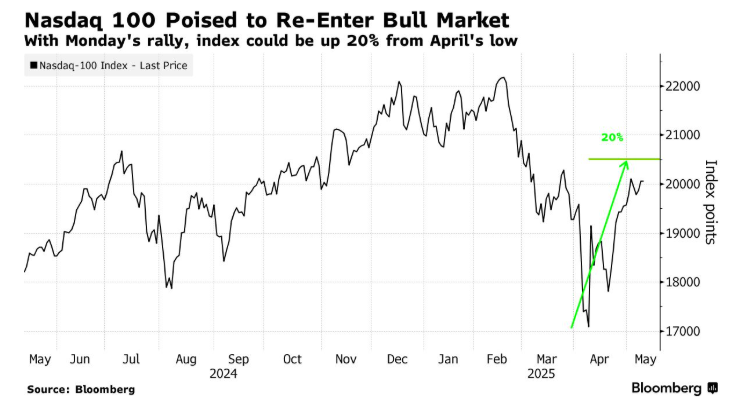
Group 1 - The recent high-level talks between China and the US have led to a significant rebound in the US stock market, with the S&P 500 index expected to rise nearly 4% at the opening [1][3] - The Nasdaq 100 index is poised to re-enter a bull market, with major tech stocks like Nvidia, Tesla, and Apple anticipated to surge over 5% in early trading [3][4] - The agreement to lower tariffs marks an important milestone in the relationship between the two economic giants, although concerns remain about the lack of details and the risk of renewed conflicts [3][4] Group 2 - The trade tensions have already impacted companies, with firms like UPS, Ford, and Mattel retracting their earnings guidance due to the uncertainty surrounding tariffs [5] - Analysis indicates that, on average, 6.1% of the revenue for S&P 500 companies in 2024 will come from sales to China or Chinese companies [6] - The S&P 500 index has recovered about half of its nearly 19% decline since peaking in February, driven by a shift in market sentiment towards optimism regarding trade policies [7]
美股悄悄涨了14%:一场“散户”买出来的大反攻
阿尔法工场研究院· 2025-05-11 10:12
Core Viewpoint - The recent stock market rebound is primarily driven by retail investors buying on dips, while institutional investors remain cautious due to concerns over economic slowdown and trade tensions [1][7]. Group 1: Market Dynamics - The S&P 500 Index rebounded 14% within a month after hitting a low on April 8, leading to discussions on when institutional investors might re-enter the market [1]. - Retail investors have been consistently buying stocks for 21 weeks, marking the longest buying streak since 2008, while institutional investors have been selling at near-historic rates [7]. - The volatility of the S&P 500 Index has decreased, with a 17-point drop in actual volatility, allowing investors to increase asset allocations [3]. Group 2: Investor Sentiment - Institutional investors are hesitant to adjust their expectations for potential Federal Reserve rate cuts, as uncertainty in the economy persists [6]. - Retail investors appear unaffected by trade policies and have continued to invest, with some focusing on large tech companies like Nvidia and Amazon [7][8]. - Some investment firms are adopting a more defensive stance, favoring sectors like healthcare and utilities due to improved earnings prospects [11]. Group 3: Future Outlook - Analysts are closely monitoring the S&P 500 Index, noting that a rise to 5,800 points could trigger a shift in buying behavior among commodity trading advisors [12]. - The market's internal performance remains weak, and some observers are cautious about chasing what they perceive as a fading rebound [12].

美股极速“变脸”:押注特朗普打赢贸易战
Jin Shi Shu Ju· 2025-05-08 09:37
Group 1 - The core viewpoint of the articles suggests that despite a significant rebound in the stock market since April, driven by optimistic corporate earnings and strong macroeconomic data, there is skepticism regarding the sustainability of this optimism due to ongoing trade tensions and the lack of a concrete trade agreement [1][2][3] - The S&P 500 index has risen 13% since its low of 4982 points on April 8, indicating a strong market performance, but experts warn that investors may be overly optimistic about the resolution of trade issues [1] - Analysts from BCA Research and Goldman Sachs express concerns that the market's current pricing reflects an overly favorable outlook on economic growth, with expectations of growth exceeding 1% this year, which contrasts with more cautious predictions [3] Group 2 - The articles highlight that President Trump has indicated progress in trade negotiations, yet no formal agreements have been reached, and he has emphasized the lack of urgency in signing any deals [3][4] - Trump's upcoming press conference is anticipated to announce a significant trade agreement with a major country, potentially the UK, marking the first agreement since the imposition of high tariffs on multiple countries [4] - The discussions around trade agreements involve various proposals from the U.S.'s top trading partners, with indications that a deal could be reached soon, although the specifics remain unclear [3][4]