风险管控

Search documents
光大银行酝酿新一届董事会 15人候选人名单透露哪些信号?
Jing Ji Guan Cha Wang· 2025-09-28 08:37
Core Points - China Everbright Bank is undergoing a board restructuring with the nomination of 15 candidates for its 10th board, indicating a new governance structure [1][2] - The continuity of leadership is reflected in the re-nomination of current executives, including Chairman Wu Lijun and Vice Chairman Cui Yong, which aligns with market expectations [2] - The nomination of three new independent directors suggests an optimization of the board's professional composition, addressing challenges in digital transformation and risk management [1][3] Board Restructuring - The candidate list for the 10th board shows a "core stability and structural optimization" characteristic, with many current executives receiving re-nominations [2] - Wu Lijun is set to continue as Chairman from January 2024, while Gao Cheng will officially become President in August 2024, indicating a formalization of their roles [2] - The inclusion of Zhao Jingjing, a new candidate with asset management and regulatory experience, may enhance future board decision-making [2] Independent Director Updates - The independent director system is crucial for modern corporate governance, with six candidates nominated, including three incumbents and three new candidates [3][4] - New independent directors possess diverse and strong professional backgrounds, enhancing the board's expertise in finance, accounting, and investment [3][4] - The independent directors have passed qualification reviews and committed to independence, ensuring compliance and governance integrity [4] Organizational Structure Adjustments - Alongside the board restructuring, the bank approved two organizational adjustments, including renaming the "Corporate Finance/Strategic Client Department" [5][6] - The adjustments may indicate a strategic upgrade in serving large enterprises and institutional clients, as well as a focus on cross-border and supply chain finance [6] - The simultaneous board and organizational changes reflect the bank's intent to optimize governance and execution layers, supporting strategic implementation [6][7] Strategic Implications - The restructuring and adjustments signify a dual upgrade in governance structure and strategic direction, crucial in a competitive banking environment [6][7] - The resilience of governance, agility of strategy, and innovation in business will form the new competitive foundation for the bank [7]

伊朗国际货运与普通物流的不同:政策适配及服务差异
Sou Hu Cai Jing· 2025-09-28 05:35
Core Insights - The core difference between Iranian international freight and standard logistics lies in policy adaptability and service system completeness [1][3] - Iranian international freight offers specialized solutions tailored to the unique characteristics of the Iranian market, while standard logistics focuses on standardized services for general scenarios [1] Policy Adaptation - Iranian international freight providers have a deeper understanding of local policies, including customs regulations, trade policies, and foreign exchange management requirements [1] - They can track policy changes in real-time and adjust operational plans accordingly, reducing the risk of cargo delays due to policy misinterpretation [1] - Standard logistics often uses generic customs clearance templates, which may lead to documentation issues and increased clearance risks [1] Service Differentiation - Iranian international freight emphasizes "full chain coverage," integrating value-added services such as dual customs clearance, cargo insurance, warehousing, and real-time logistics tracking [3] - They can provide customized transportation solutions based on cargo type, ensuring control over the entire process from departure to delivery [3] - Standard logistics typically focuses on "point-to-point" transportation, lacking the ability to meet specific needs of the Iranian market, such as special packaging for sensitive goods [3] Risk Management - Iranian international freight companies leverage their local market knowledge to anticipate potential risks in logistics, such as port congestion and sudden policy changes [3] - They are better equipped to develop contingency plans, while standard logistics may struggle with unexpected situations, leading to delays or increased costs [3] - This targeted policy adaptation and comprehensive service offering are key differentiators for Iranian international freight compared to standard logistics [3]


赔付“快跑”之下 保险业转型要抓关键
Jin Rong Shi Bao· 2025-09-17 02:00
Core Viewpoint - The insurance industry is experiencing a trend of stable premium growth alongside rapidly increasing claims, indicating both the deepening of the industry's functions and potential challenges during its transformation [1][5]. Group 1: Premium and Claims Data - In the first half of 2025, the insurance industry's original premium income reached 3.74 trillion yuan, a year-on-year increase of 5.04%, while claims expenditure was 1.35 trillion yuan, up 8.6% year-on-year [1]. - From 2021 to 2024, claims expenditure growth has significantly outpaced premium income growth in three out of four years, highlighting a concerning trend of "stable premium growth, rapid claims increase" [1]. Group 2: Factors Behind the Trends - The rapid growth in claims is attributed to multiple factors, including the introduction of long-term policies during the industry's expansion phase, which are now entering concentrated payout stages as policyholders age [2]. - The increase in claims is also driven by the aging population, rising medical costs, and increased frequency of natural disasters, which have heightened the pressure on claims for both life and property insurance [2]. Group 3: Implications for the Industry - The accelerated claims growth reflects a return to the core functions of insurance, emphasizing risk transfer and loss compensation, which enhances the industry's role as a stabilizer in society [2]. - However, the rising claims costs pose challenges for insurance companies, potentially squeezing profit margins and affecting financial stability if high claims rates persist [3]. Group 4: Strategic Responses - To address these challenges, insurance companies need to enhance core capabilities and accelerate transformation by adopting more precise risk models for pricing, considering dynamic factors like demographic changes and medical cost fluctuations [3]. - Companies should also improve risk management through cost control and advanced technologies, such as big data and AI, to optimize claims processes and reduce fraudulent claims [3][4]. Group 5: Product and Service Optimization - Insurance companies must align products and services with real market demands, such as developing specialized insurance for long-term care and chronic diseases in response to demographic trends [4]. - The industry should shift from a reactive "pay after" model to proactive risk management, offering services like health consultations and disaster preparedness to reduce claims [4]. Group 6: Collaboration and Ecosystem Development - Overcoming data barriers and technological limitations requires insurance institutions to deepen external collaborations, such as partnering with healthcare providers to enhance underwriting and claims accuracy [4]. - Establishing a cross-industry risk database through collaboration with industry associations can lead to more efficient and comprehensive insurance services, ensuring sustainable transformation [4]. Conclusion - The higher growth rate of claims compared to premium income is a natural phenomenon at a specific stage of industry development, indicating the need for insurance companies to enhance operational capabilities and innovate for high-quality growth [5].
穿越市场周期:杭州银行2025上半年业绩亮眼背后的风险管控密码
Zhong Guo Jing Ji Wang· 2025-09-16 08:45
Core Viewpoint - Hangzhou Bank reported strong half-year results with a net profit of 11.662 billion yuan, a year-on-year increase of 16.66%, demonstrating resilience and effective risk management in a complex economic environment [1] Group 1: Financial Performance - The bank achieved a net profit of 11.662 billion yuan in the first half of 2025, reflecting a 16.66% increase compared to the previous year [1] - The non-performing loan (NPL) ratio remained stable at 0.76%, indicating strong asset quality [1] - The provision coverage ratio reached 520.89%, positioning the bank among the leaders in the listed banking sector [1] Group 2: Risk Management Strategy - The bank emphasizes a risk management philosophy of "not trading risk for growth," focusing on maintaining a balance among volume, quality, profit, and risk [1] - Continuous improvement of risk control mechanisms includes regular risk assessments and a large client warning system to ensure early identification and management of credit risks [1][2] - The bank has established specialized teams in key sectors like manufacturing and technology finance, enhancing frontline risk control efficiency [2] Group 3: Provisioning and Counter-Cyclical Management - Hangzhou Bank adheres to a prudent provisioning policy, with a provision coverage ratio exceeding 520%, which serves as a buffer against potential risks [3] - The bank's proactive provisioning strategy helps smooth profit fluctuations and enhances operational stability [3] - Future plans include maintaining a leading provisioning level to ensure financial flexibility for long-term profit growth [3] Group 4: Asset Quality and Structural Adjustments - The bank implements cautious entry policies and continuously adjusts its asset structure, with real estate loans accounting for less than 4% of total loans [4] - There are currently no non-performing loans in the renewable energy sector, and the bank is optimizing its service model for export enterprises [4] - Strategies to manage interest rate and liquidity risks include optimizing investment account structures and reducing high-volatility assets [4] Group 5: Sustainable Development through Risk Control - Risk management is viewed as a lifeline for sustainable development, with the bank developing a distinctive risk control model that has yielded excellent results [5] - The bank's risk control capabilities are seen as a cornerstone for continued high-quality development in a complex and changing environment [5]

金价连刷新高,银行密集调整业务传递警示
Sou Hu Cai Jing· 2025-09-11 13:18
Core Viewpoint - The recent surge in gold prices has prompted banks to adjust their operations and issue risk warnings to investors, reflecting heightened market volatility and the need for enhanced risk management measures [1][5][10]. Group 1: Gold Price Movements - As of September 11, gold prices slightly decreased to $3,623.76 per ounce, down 0.45%, while the Shanghai Gold Exchange's Au99.99 contract closed at 836.52 yuan, marking a 34.49% increase since January 2 [1]. - On September 10, gold prices reached a new high of 836 yuan, indicating a significant upward trend in the market [1]. Group 2: Bank Responses and Risk Management - Banks have raised trading thresholds and adjusted margin levels for gold trading contracts in response to the volatile gold market, with margin levels for various contracts increasing from 13% to 14% and from 16% to 17% [2][4]. - Major banks, including China CITIC Bank and Agricultural Bank of China, have issued risk warnings and adjusted their gold-related business practices to mitigate potential risks associated with high gold prices [2][5]. Group 3: Market Analysis and Future Outlook - Analysts express optimism regarding gold prices, citing factors such as potential interest rate cuts by the Federal Reserve and ongoing geopolitical tensions as supportive of further price increases [7][9]. - The collective actions of banks serve as a warning to investors about the risks associated with investing in gold at historical highs, emphasizing the importance of reassessing risk tolerance [10][11].




银行集体喊话,下半年风控不放松
Zheng Quan Shi Bao· 2025-09-08 00:10
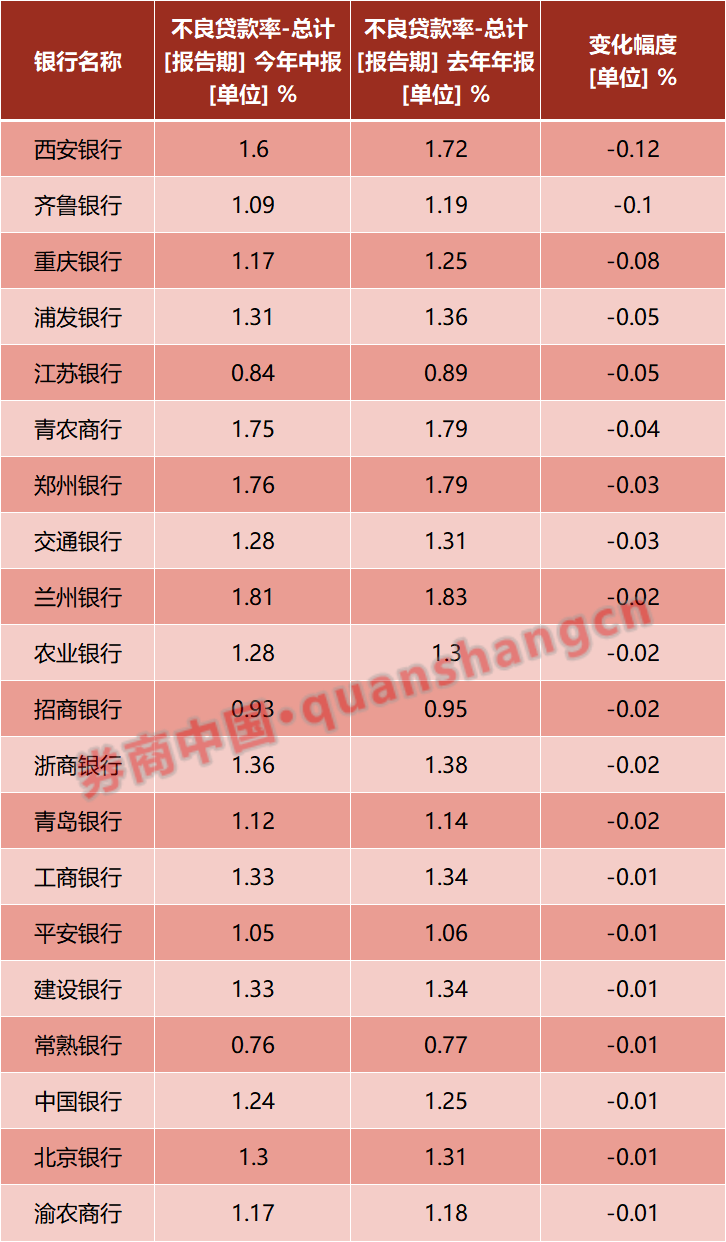
Core Viewpoint - The overall asset quality of the banking industry has remained stable and improved, with a decrease in non-performing loan (NPL) ratios for many listed banks, although risks in certain sectors, particularly corporate real estate and retail personal loans, have increased [1][2]. Group 1: Asset Quality Overview - As of mid-year, the overall asset quality of the banking industry is stable and shows further improvement, with 20 listed A-share banks reporting a decrease in NPL ratios compared to the beginning of the year [1][3]. - Among these banks, Xian Bank, Qilu Bank, and Chongqing Bank saw their NPL ratios decrease by 12, 10, and 8 basis points respectively, while 15 banks maintained their NPL ratios [3][5]. - Conversely, some banks, including Guiyang Bank and Minsheng Bank, reported an increase in their NPL ratios compared to the beginning of the year [3][5]. Group 2: Specific Bank Performance - Xian Bank's NPL ratio decreased to 1.60%, the largest decline among listed banks, while Qilu Bank and Chongqing Bank followed with ratios of 1.09% and 1.17% respectively [5]. - State-owned banks like Bank of Communications and Agricultural Bank of China also reported slight decreases in their NPL ratios, while Postal Savings Bank's ratio increased slightly to 0.92% [5]. - Notably, Guiyang Bank's NPL ratio rose from 1.58% to 1.70%, marking a significant increase [5]. Group 3: Sector-Specific Risks - The real estate sector continues to pose risks, with Qingnong Bank's real estate NPL ratio increasing significantly by 14.15 percentage points to 21.32% [7]. - Guiyang Bank also reported a rise in its real estate NPL ratio by 70 basis points to 1.75% [7]. - In retail lending, 8 out of 14 banks reported an increase in credit card NPL ratios, with Chongqing Bank's ratio rising to 4.19% [8][9]. Group 4: Management Responses - Bank executives have emphasized the importance of risk management, with many banks planning to enhance their risk control measures and digital risk management capabilities [10][12]. - Beijing Bank's president highlighted the need for increased provisioning to strengthen future development, while Industrial and Commercial Bank of China expects a slowdown in the deterioration of personal consumption loans [11][12]. - Other banks, such as Industrial Bank, are focusing on risk resolution in real estate and credit card sectors, indicating a shift from high incidence to a more controlled environment [12].
银行集体喊话!下半年风控不放松!
券商中国· 2025-09-07 23:32
Core Viewpoint - The overall asset quality of the banking industry has remained stable and improved, with a focus on risk management and control in the second half of the year [1][2]. Group 1: Asset Quality Overview - As of mid-year, the overall asset quality of the banking industry is stable and has further improved, with 20 A-share listed banks showing a decrease in non-performing loan (NPL) ratios compared to the beginning of the year [2][3]. - Among the listed banks, Xian Bank, Qilu Bank, and Chongqing Bank reported the most significant reductions in NPL ratios, with decreases of 12, 10, and 8 basis points, respectively [4][5]. - Conversely, some banks, including Guizhou Bank and Minsheng Bank, experienced increases in their NPL ratios compared to the beginning of the year [6]. Group 2: Sector-Specific Risks - There is a notable upward trend in NPL ratios in specific sectors, particularly in corporate real estate and retail personal loans [7][8]. - Qingnong Bank reported a significant increase in its real estate NPL ratio, rising by 14.15 percentage points to 21.32%, with real estate NPLs now comprising 61.54% of its total NPLs [8]. - Guizhou Bank also saw a rise in its real estate NPL ratio, which increased by 70 basis points to 1.75% [8]. Group 3: Retail Credit Concerns - In the retail credit sector, there has been an increase in NPL ratios for personal consumption loans and credit cards, with 8 out of 14 banks reporting higher NPL ratios for credit card receivables compared to the beginning of the year [9][10]. - Chongqing Bank's credit card NPL ratio increased by 1.15 percentage points to 4.19%, while Lanzhou Bank's rose by 1.06 percentage points to 2.85% [9]. - Among 12 banks disclosing personal consumption loan NPL ratios, 7 reported increases, with notable rises from China Merchants Bank and Lanzhou Bank [10]. Group 4: Risk Management Strategies - Banks are increasingly prioritizing risk management, with several executives emphasizing the need for enhanced risk control measures and digital risk management capabilities [11][12]. - Beijing Bank plans to strengthen its provisioning efforts and improve the management of new NPLs, while ICBC expects a slowdown in the deterioration of personal consumption loans due to supportive economic policies [11]. - Industry leaders, including those from Industrial Bank and China Merchants Bank, are focusing on risk mitigation in real estate and credit card sectors, indicating a shift from high incidence to a more controlled environment [12].



三湘银行上半年净亏2.41亿元,高管"换血"能否破解发展困局?
Guan Cha Zhe Wang· 2025-09-05 12:06
Core Viewpoint - Sanxiang Bank, the first private bank in Central China, is facing unprecedented development challenges, marked by a significant shift from profit to loss in its financial performance [1][5]. Financial Performance - In the first half of 2025, Sanxiang Bank reported a net loss of 241 million yuan, contrasting sharply with a net profit of 68 million yuan in the same period last year [1]. - The bank's total assets as of June 30, 2025, stood at 51.744 billion yuan, reflecting a slight decrease of 1.94% from the beginning of the year [1]. - Operating income for the period was only 651 million yuan, a substantial year-on-year decline of 28.78%, which directly contributed to the shift from profit to loss [1]. - The bank's net profit has been on a downward trend over the past three years, with figures of 353 million yuan in 2022, 329 million yuan in 2023, and 132 million yuan in 2024, indicating a more than 60% reduction over this period [1]. Asset Quality - The bank's asset quality has deteriorated, with the overdue rate reaching 4.27% by the end of 2024 and a non-performing loan rate of 1.75% in 2023 [1]. - The provision coverage ratio has remained below 170% since dropping from 140.56% in 2020, indicating insufficient risk buffer capacity [1]. Business Strategy and Structure - Sanxiang Bank has undergone frequent adjustments in its business structure and strategic positioning since its establishment in December 2016, leading to a lack of clarity in its strategic direction [2]. - Initially focused on corporate loans, the bank shifted towards personal loans starting in 2019, with personal loan balances peaking at 30.39 billion yuan in 2021, accounting for 81.07% of total loans [2]. - The internal structure of personal loans has also seen significant changes, with a shift from consumer loans to business loans and back, reflecting instability in risk management [2]. Risk Management - The bank's personal consumption loan business heavily relies on external partnerships, with 119.27 billion yuan of the 149.48 billion yuan in personal consumption loans coming from internet partnerships, representing nearly 80% [3]. - The management has acknowledged that the significant drop in profits is primarily due to increased credit risks associated with small and micro enterprises, which are the bank's main clientele [3]. Management Changes - In response to declining performance and rising risks, Sanxiang Bank underwent a major management overhaul in the first half of 2025, including the resignation of the former president and the appointment of a new president with a strong background in risk management [4][5]. - The new management team is seen as a critical factor in determining the bank's future development and ability to navigate current challenges [5]. Industry Context - The challenges faced by Sanxiang Bank are indicative of broader issues within the private banking sector, particularly as these institutions grapple with stricter regulations and increased market competition [5][6]. - The bank's immediate priorities include stabilizing business development, establishing a more robust risk management system, and optimizing its income structure to reduce reliance on interest income [6].
神州数码(000034.SZ):上半年计提1.6亿元,较去年同期下降30%
Ge Long Hui· 2025-09-03 12:00
Core Viewpoint - The company has optimized its business structure and focused on cost reduction and efficiency improvement, achieving revenue growth despite external market challenges [1] Financial Performance - In the first half of the year, the company maintained stable development in IT distribution and value-added services while focusing on strategic business as a new growth engine, resulting in revenue growth [1] - Research and development expenses increased by 11% to nearly 200 million yuan, reflecting a commitment to enhancing cloud services, software, and proprietary brand products [1] - Sales and management expenses grew by 3%, significantly lower than the revenue growth rate, indicating effective cost control [1] Risk Management - The company has placed a strong emphasis on risk management in response to declining performance capabilities in the external market, enhancing credit and asset impairment loss management [1] - The provision for impairment losses amounted to 160 million yuan, a decrease of 30% compared to the same period last year, showcasing improved risk management practices [1]

中信股份半年报:总资产超12万亿,金融子公司利润全面提升
2 1 Shi Ji Jing Ji Bao Dao· 2025-08-30 02:41
Core Viewpoint - CITIC Limited reported a robust mid-year performance with total assets exceeding 12.5 trillion RMB, revenue of 368.8 billion RMB, and net profit of 59.8 billion RMB, indicating steady growth across key metrics [1][3]. Financial Performance - As of June 30, 2025, CITIC Limited's total assets reached 12.5 trillion RMB, a 3.5% increase from the end of 2024, while total liabilities rose by 3.6% to 11.03 trillion RMB, maintaining a stable asset structure [3][4]. - The company reported a revenue of 368.76 billion RMB, a slight decrease of 1.6% compared to the previous year, while pre-tax profit increased by 5.9% to 76.01 billion RMB [4]. - Net profit was recorded at 59.85 billion RMB, up 5.5% year-on-year, although the net profit attributable to ordinary shareholders decreased by 2.8% to 31.23 billion RMB [4]. Shareholder Returns - The board proposed an interim dividend of 0.2 RMB per share, totaling 5.818 billion RMB, reflecting a 5.3% increase from the previous year [5][6]. - The actual dividend payout ratio for 2024 reached 27.5%, exceeding the planned ratio by 0.5 percentage points [6]. Financial Subsidiaries Performance - Financial subsidiaries showed comprehensive profit growth, with total financial service revenue reaching 139.77 billion RMB, a 2.0% increase from the previous year [5]. - The book value of financial assets increased by 5.0% to 3.714 trillion RMB, with financial assets accounting for 29.7% of total assets, up 0.4 percentage points [5]. Risk Management - The company emphasized the importance of risk control, implementing a management plan for the concentration limits of the comprehensive financial sector for 2025 [6]. - There was a significant reduction in regulatory penalties, with the number and amount of penalties decreasing by 30% and 80% respectively, indicating progress in compliance management [6].