
数字技术

Search documents
近20个国家和地区的近千家参展企业带来创新成果 上交会构建起国际技术合作网络
Jie Fang Ri Bao· 2025-06-12 01:59
Group 1 - The 11th China (Shanghai) International Technology Import and Export Fair has attracted nearly a thousand exhibitors from around 20 countries and regions, showcasing innovative achievements and building an international technology cooperation network [1] - The United Nations Industrial Development Organization emphasizes support for technology innovation and transfer, focusing on green transformation, digital technology, artificial intelligence, and South-South cooperation as priority areas [1] - Glasgow, as the overseas guest city, aims to strengthen cooperation with China in clean energy, particularly in offshore wind power, highlighting the fair's focus on green low-carbon and medical technology sectors [1] Group 2 - The Peru exhibition team is interested in collaborating in agriculture, manufacturing, irrigation, and mining technology, benefiting economically and socially from deep cooperation with China [2] - Shenzhen serves as the domestic guest city, with BGI showcasing its "GenSIRO-16" AI-based high-throughput gene testing solution, having established partnerships with over 3,000 overseas medical and research institutions [2] - Shanghai's technology import and export contract amount has seen an average annual growth of 8.6% since the 14th Five-Year Plan, with a projected amount of $21.33 billion in 2024, marking a 17.7% year-on-year increase and setting a historical record [2]
浙数文化(600633):游戏及IDC筑牢基本盘 多元业务开拓新增长极
Xin Lang Cai Jing· 2025-06-11 00:25
Core Viewpoint - The traditional print media has successfully transformed, driven by "digital culture + digital technology + data operation + innovation track" [1] Digital Culture - Bianfeng Network focuses on online games, particularly card games, and has established a strong game matrix through control or investment, with Bianfeng Doudizhu becoming the first card game app in China to exceed one million daily active users [2] - The company is actively expanding into the "millet economy" in response to the rise of new consumption, with an investment in Chaoka Qiangli in Hangzhou in March 2025, which is expected to drive growth in digital cultural business [2] Digital Technology & Data Operation - Fuchun Cloud IDC is operating steadily and advancing construction, with a focus on AI-driven computing power demand, which is expected to increase revenue and profit [2] - The "Communication Brain" media integration technology supports provincial promotion, and the business has expanded to multiple provinces and cities nationwide [2] - The Zhejiang Big Data Trading Center serves as a core node for data circulation, leveraging licensing, regional economic, data structure, and first-mover advantages, with policies driving rapid business development [2] Profit Forecast and Investment Recommendation - Supported by mature businesses like gaming and IDC, the company is expected to benefit from ongoing data-related policy implementations and improved profitability from the Communication Brain, alongside the millet economy layout, which is likely to open up growth space [3] - Projected revenues for 2025-2027 are 3.346 billion, 3.614 billion, and 3.879 billion yuan, with net profits of 666 million, 764 million, and 863 million yuan respectively [3] - The company is assigned a 30x PE for 2025, corresponding to a reasonable value of 15.73 yuan per share, with an initial "buy" rating [3]

数字时代儿童发展:以“四大支柱”筑牢成长根基
Zhong Guo Xin Wen Wang· 2025-06-09 15:32
Core Insights - The OECD report titled "How is Life for Children in the Digital Age?" highlights both the opportunities and risks associated with digital technology for children, emphasizing the need for a collective societal effort to build a supportive framework for children's adaptation to digital life [1][3]. Group 1: Opportunities Presented by Digital Technology - Digital technology offers diverse learning opportunities, with 84% of 15-year-old students utilizing it to acquire practical knowledge, and around 70% engaging in creating or editing personal digital content [1]. - A study published in 2024 indicates that educational digital apps, when used with parental guidance, significantly enhance children's literacy skills, even for preschoolers [2]. - Digital technology can improve children's social skills and mental well-being, with 40% of 11-15-year-olds in OECD member countries having online friends and frequently communicating with them [2]. Group 2: Framework for Protecting and Promoting Children's Development - The report advocates for a comprehensive policy framework built on four pillars to effectively protect and promote children's development in the digital age [3]. - Pillar one emphasizes the need for robust legal frameworks to hold digital service providers accountable for children's safety, including data privacy and protection from harmful content [3]. - Pillar two focuses on enhancing digital literacy in schools by integrating digital skills into the curriculum and providing ongoing training for teachers [4]. - Pillar three highlights the importance of parental involvement in creating a protective home environment, encouraging open dialogue about digital activities, and improving their own digital literacy [4]. - Pillar four stresses the necessity of including children's perspectives in policy-making and service design, particularly for disadvantaged groups [5][6].
任鸿斌:中国仲裁事业正处于前所未有的上升机遇期
2 1 Shi Ji Jing Ji Bao Dao· 2025-06-08 06:05
Core Viewpoint - Arbitration is increasingly important in resolving cross-border commercial disputes amid a changing international economic environment, providing efficient, flexible, and fair solutions [1][2]. Group 1: Current State of Arbitration in China - The China Maritime Arbitration Commission (CMAC) has seen significant growth, with over 60,000 arbitrators and cases involving parties from over 100 countries and regions [1]. - In 2024, CMAC ranked among the top international maritime arbitration institutions, with foreign-related cases accounting for 39% of total cases, a 55% year-on-year increase [1]. Group 2: Future Development and Strategic Initiatives - The Chinese arbitration sector is at a unique opportunity for growth, with new reforms and innovations being prioritized by the government [2]. - Key areas for development include leveraging digital technology and artificial intelligence to enhance arbitration processes, strengthening rule research to represent Chinese business interests internationally, and fostering communication platforms between business and legal communities [2]. Group 3: Practical Applications and Case Studies - CMAC released a collection of typical cases involving free trade zone enterprises, highlighting representative disputes in shipbuilding, chartering, multimodal transport, freight forwarding, and marine insurance [3]. - The case collection aims to summarize CMAC's unique practices in resolving maritime disputes and offers practical recommendations [3].
前五个月 中国海仲受理涉外案件占比增长近10%
Yang Guang Wang· 2025-06-08 00:57
Core Insights - The international influence of China's maritime arbitration has expanded, with a nearly 10% increase in foreign-related cases in the first five months of this year compared to the same period last year [1] - China is the world's largest ship-owning country and has the highest maritime connectivity, with leading indicators in fleet size, port infrastructure, and cargo throughput [1] - The China Maritime Arbitration Commission (CMAC) has maintained a leading position in international maritime arbitration, with foreign-related cases accounting for 39% of total cases last year, a 55% year-on-year increase [1] Group 1 - In the first five months of this year, the CMAC accepted 80 cases, with foreign-related cases making up 41.25% [1] - The cases involved 21 countries and regions, covering various types such as bill of lading transportation, time chartering, freight forwarding, and shipbuilding [1] - The arbitration mechanism is recognized for its professionalism, efficiency, flexibility, confidentiality, and broad international enforceability [1] Group 2 - The president of the China Council for the Promotion of International Trade emphasized the increasing instability and uncertainty in international business due to unilateralism and protectionism [2] - There is a pressing need for legal methods to help enterprises resolve disputes in a timely manner [2] - The CMAC aims to innovate and explore the application of digital technology and artificial intelligence in arbitration to enhance its international credibility and competitiveness [2]
科技赋能 让养老服务更智慧
Yang Shi Wang· 2025-06-07 09:12
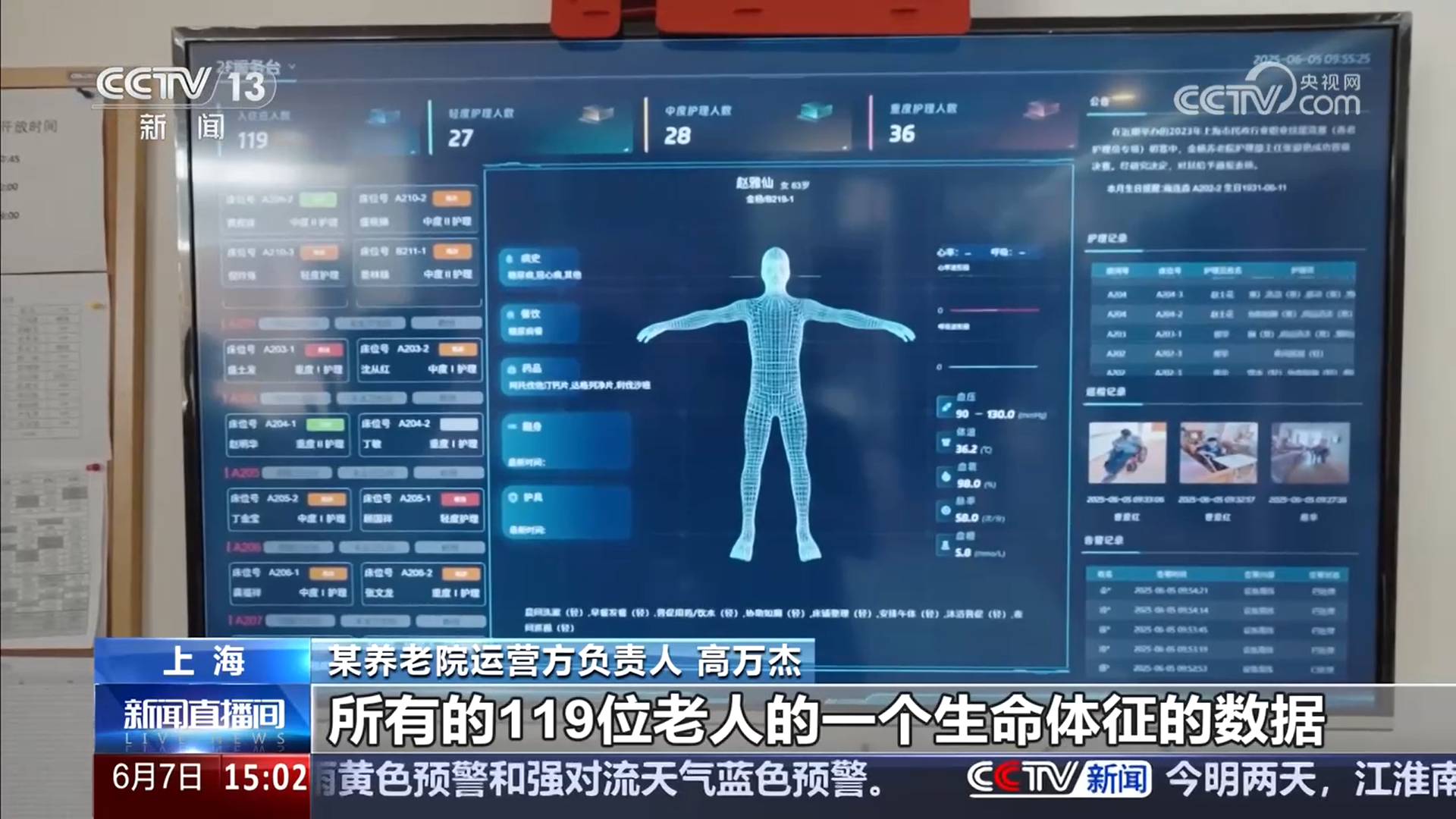
Core Viewpoint - The article highlights the increasing focus on elderly care services in China, particularly through the integration of technology such as artificial intelligence and robotics, as the country faces a significant aging population, projected to reach 220 million people aged 65 and above by the end of 2024 [1]. Group 1: Smart Elderly Care Models - Shanghai is implementing a "smart" elderly care model, aiming to establish at least 100 smart nursing homes by the end of 2025, with over 70 already built [1][2]. - Smart nursing homes utilize intelligent devices, such as smart mattresses that transmit health data to caregivers, enhancing the efficiency of care services [3][4]. - The introduction of smart technology allows caregivers to focus on services that cannot be replaced by technology, improving overall care quality [3]. Group 2: Integration of Healthcare Services - Some nursing homes in Shanghai are exploring the "nursing home + internet hospital" model, connecting elderly residents with quality medical resources through online consultations and remote diagnostics [4][6]. - This model allows for online appointment scheduling, remote medical consultations, and prescription deliveries directly to nursing homes [6]. Group 3: Home-Based Elderly Care Innovations - In Shaoxing, Zhejiang Province, a "smart home care service system" provides 24-hour health monitoring and emergency services for elderly residents at home [7]. - The system utilizes big data to create visual health profiles and sends alerts to family members and healthcare providers in case of abnormalities [9]. Group 4: Smart Dining Solutions - In Lanzhou, Gansu Province, smart dining solutions are being implemented in elderly canteens, featuring facial recognition payment systems and AI nutritionists [10][12]. - The integration of smart technology in meal preparation and service enhances the dining experience for elderly individuals, ensuring nutritional balance and operational efficiency [12]. Group 5: Comprehensive Elderly Service Platforms - A new service platform in Lanzhou consolidates various services such as medication delivery, appointment scheduling, and maintenance requests, simplifying the process for elderly users [13]. - The platform has expanded to multiple cities in Gansu, with over 80,000 elderly individuals registered to benefit from its services [13].

中国海事仲裁国际影响力进一步扩大
Xin Hua She· 2025-06-06 15:48
Core Viewpoint - The international influence of China's maritime arbitration is expanding, with a significant increase in the number of maritime and commercial cases handled by the China Maritime Arbitration Commission, reflecting its growing role in resolving international commercial disputes and maintaining economic stability [1][2]. Group 1: Maritime Arbitration Development - The China Maritime Arbitration Commission is a leader in maritime and commercial arbitration, having handled thousands of cases and developed temporary arbitration rules, contributing positively to the innovation of arbitration rules and system construction in China [2][3]. - In 2024, the number of maritime and commercial cases handled by the commission is expected to remain among the top in international maritime arbitration institutions, with foreign-related cases accounting for 39% of the total, a 55% year-on-year increase, involving 40 countries and regions [1][2]. Group 2: Policy and Institutional Support - The 20th National Congress of the Communist Party of China has made new deployments to improve international commercial arbitration and mediation systems, emphasizing the importance of maritime arbitration in connecting domestic and international shipping rules [3][4]. - The Ministry of Transport is accelerating the construction of a unified and open transportation market, with a focus on maritime arbitration system innovation as a key component [3]. Group 3: Technological Integration - There is a strong emphasis on leveraging digital technology, artificial intelligence, and big data in arbitration processes to enhance efficiency, transparency, and international competitiveness [3][4]. - The integration of technology in arbitration is seen as a way to reduce costs and improve service quality, thereby increasing the international credibility of arbitration services [3].
国家外汇管理局副局长李斌:重视科技赋能外汇管理,以科技提升外汇管理与服务水平
2 1 Shi Ji Jing Ji Bao Dao· 2025-06-05 13:04
Core Insights - The National Foreign Exchange Administration (NFA) is focusing on the integration of finance and technology to promote high-quality development and address external risks [1][2][3] - The NFA is implementing policies to facilitate cross-border financing for high-tech and specialized enterprises, enhancing the efficiency of capital utilization [1][2] - The NFA is leveraging digital technologies, including blockchain and big data, to improve foreign exchange management and services, thereby supporting the real economy [2][3] Group 1: Policy Initiatives - The NFA is promoting cross-border financing facilitation policies to support high-tech and "specialized, refined, unique" enterprises [1] - The NFA has expanded trade facilitation policies to benefit more specialized enterprises, improving capital efficiency [1] - The NFA is conducting pilot programs in cities like Beijing, Shanghai, and Tianjin to enhance foreign investment in scientific research [1] Group 2: Technological Integration - The NFA has established a cross-border financial service platform using blockchain technology, assisting over 100,000 enterprises in obtaining more than $410 billion in financing [2] - The NFA is optimizing business processes between itself and banks through digital technology, enhancing regulatory effectiveness [2] - The NFA is utilizing big data and AI to strengthen monitoring capabilities and combat illegal foreign exchange activities [2][3] Group 3: Future Outlook - The NFA emphasizes the mutual promotion of technology and finance as essential for achieving high-level technological self-reliance and supporting the real economy [3] - The NFA aims to enhance cross-border trade and investment facilitation for technology enterprises while expanding high-level institutional openness in the foreign exchange sector [3] - The NFA is committed to improving administrative efficiency and effectiveness through technological empowerment in foreign exchange management [3]
“全球欧元时刻”正在加速到来?
Sou Hu Cai Jing· 2025-06-05 04:14
Group 1: Core Perspectives on Euro Internationalization - The Euro has not significantly increased its global role despite being the second-largest currency since its inception in 1999, with its share in international currency usage remaining around 19%, still far behind the US dollar [1][2][3] - The Euro was created primarily for European integration rather than to compete with the dollar, and its internationalization lacks sufficient "hard" support compared to the dollar's backing from the US's economic, political, and military strength [3][4] - The Eurozone's economic performance has lagged behind the US and emerging economies since the 2009 Eurozone crisis, with its share of global GDP declining from 20% to 15% by 2023, which limits the Euro's global influence [4][6] Group 2: Challenges and Opportunities for Euro - The Euro's potential rise is hindered by the need for enhanced military strength and strategic autonomy, as reliance on US military power undermines trust in the Euro as a global currency [7][12] - The current international monetary environment presents opportunities for the Euro, as the dollar's dominance is being challenged by US economic policies and a decline in global trust towards the dollar [9][10][11] - To capitalize on these opportunities, the Eurozone must improve its economic vitality, enhance capital market attractiveness, and achieve political consensus among member states to elevate the Euro's international status [10][12]
强化技术支撑 发展数字经济
Jing Ji Ri Bao· 2025-06-04 22:03
Core Insights - A recent report by Renmin University of China's Global Public Opinion Research Center indicates that 86% of global respondents view China as advanced in digital technology, with 92.2% from developing countries and 75.2% from developed countries [1] - China's digital economy is projected to have a core industry value-added accounting for about 10% of GDP by 2024, with significant breakthroughs in integrated circuits, artificial intelligence, industrial software, and foundational software [1] - The establishment of six national digital economy innovation development pilot zones in provinces such as Hebei, Zhejiang, and Guangdong aims to explore new mechanisms for digital economy elements and resource allocation [1] Policy Framework - The State Council has released the "14th Five-Year Plan for Digital Economy Development," focusing on optimizing digital infrastructure, leveraging data elements, and promoting industrial digital transformation [2] - The Central Committee and State Council's 2023 "Overall Layout Plan for Digital China Construction" emphasizes accelerating digital technology innovation and deep integration with the real economy [2] - Local governments are also implementing action plans to promote high-quality digital economic development, creating a comprehensive policy environment for digital technology [2] Mechanism Improvement - Digital technology should be integrated into the national innovation system, with a comprehensive policy framework covering basic research, application development, and results transformation [3] - Establishing a data property rights system and a governance framework that balances security and efficiency is essential for facilitating data flow and transactions [3] - Reforming regulatory mechanisms to eliminate barriers to digital technology application and creating a supportive environment for new technologies and business models is crucial [3] Technical Advancement - Focus on key areas such as artificial intelligence algorithms, high-end chip design, and quantum information science to drive core technology breakthroughs [3] - Increase investment in basic research and promote deep integration of industry, academia, and research to build a comprehensive innovation system [3] - Strengthening the digital technology standard system and enhancing international influence in rule-making are vital for fostering a competitive digital technology ecosystem [3] Application Integration - Promote the penetration of digital technology across the entire value chain of the real economy, accelerating the transformation of manufacturing through intelligent upgrades [4] - Expand application scenarios in fields like bio-manufacturing, smart energy, and digital finance to cultivate new integrated business models [4] - Develop collaborative platforms across industries to facilitate technology sharing and efficient flow of resources, while exploring future industries like digital twins and the metaverse [4]