物联网

Search documents
中广核系股东转让股份!这家始创于1918年的称重企业,正备战IPO
Xin Lang Cai Jing· 2026-01-08 11:43
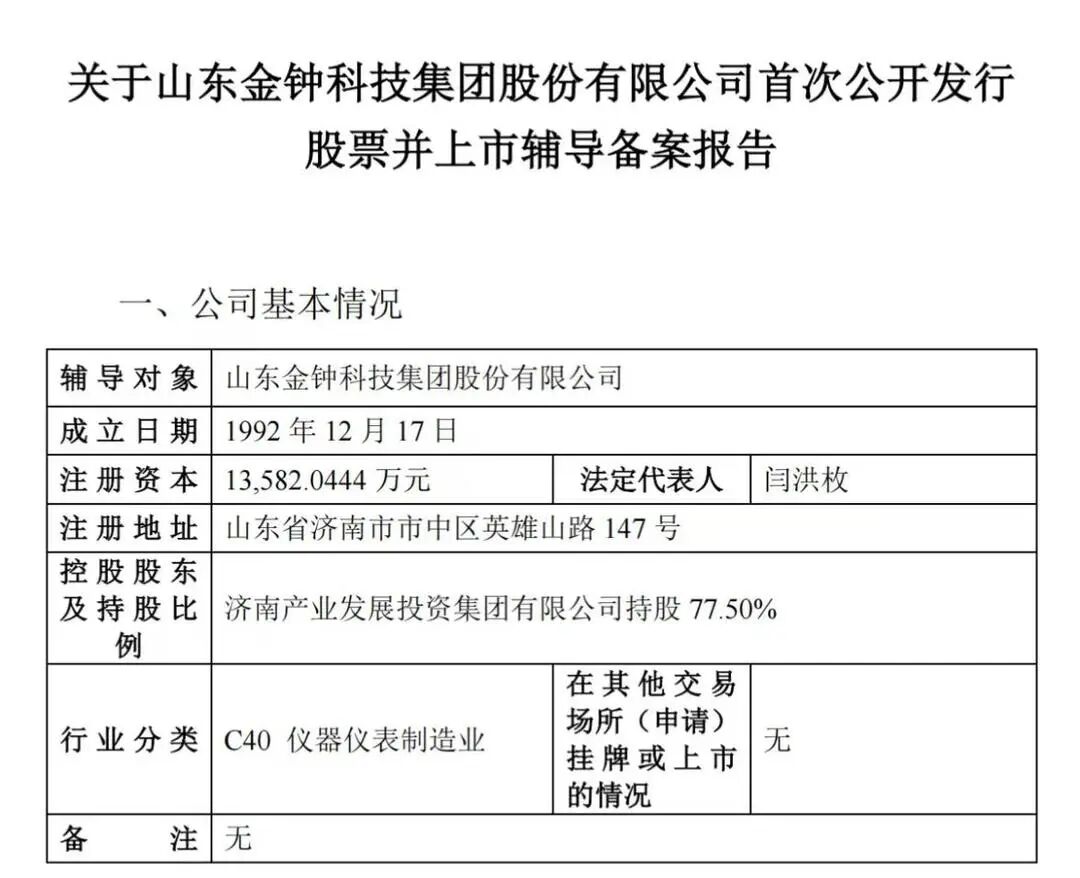
Core Viewpoint - Shandong Jinzong Technology Group Co., Ltd. is in the process of transferring 75,900 shares (0.55% of total equity) from Shenzhen Nuclear Power Industry Development Co., Ltd., with the project currently in the pre-disclosure stage [1][5]. Company Overview - Founded in 1918, Jinzong Technology is a pioneer in the weighing industry in China, having introduced Japanese Kubota technology in 1989 for mass production of weighing sensors and electronic scales [1][5]. - The company transitioned from a purely mechanical manufacturing enterprise to a high-tech information enterprise, focusing on weighing technology, IoT, and information technology [1][5]. - Jinzong Technology has a registered capital of 136 million yuan and operates three R&D centers covering core technologies such as mechanical, electronic, hydraulic, automation, and information technology [1][5]. Financial Performance - In 2023, Jinzong Technology reported revenues of 335 million yuan and a net profit of 24.66 million yuan [5][8]. - For the first nine months of 2024, the company achieved revenues of 302 million yuan and a net profit of 21.19 million yuan [5][8]. Shareholding Structure - The controlling shareholder of Jinzong Technology is Jinan Industrial Development Investment Group Co., Ltd., which holds 77.5% of the shares [2][6]. - Shenzhen Nuclear Power Industry Development Co., Ltd., the transferor, is a wholly state-owned enterprise controlled by China General Nuclear Power Group [3][8]. Upcoming IPO - Jinzong Technology has filed for guidance registration with the Shandong Securities Regulatory Bureau to prepare for its initial public offering (IPO) scheduled for December 17, 2025, with Guotai Junan Securities as the advisory institution [1][6].

北水动向|北水成交净卖出49.01亿 北水再度抛售港股ETF 全天净卖出盈富基金(02800)近63亿港元
智通财经网· 2026-01-08 10:01
Group 1 - The Hong Kong stock market experienced a net sell-off of 49.01 billion HKD from northbound capital on January 8, with the Shanghai-Hong Kong Stock Connect contributing a net sell of 39.68 billion HKD and the Shenzhen-Hong Kong Stock Connect a net sell of 9.33 billion HKD [1] - The stocks with the highest net buy from northbound capital included Xiaomi Group-W (01810), Tencent (00700), and SMIC (00981) [1] - The stocks with the highest net sell included the Tracker Fund of Hong Kong (02800), Hang Seng China Enterprises (02828), and Southern Hang Seng Technology (03033) [1] Group 2 - Alibaba-W (09988) saw a net buy of 3.5 billion HKD, while China Mobile (00941) faced a net sell of 7.32 billion HKD [7] - Xiaomi Group-W (01810) received a net buy of 10.71 billion HKD, driven by expected revenue growth from its electric vehicle business and steady growth in its IoT segment [4] - Tencent (00700) had a net buy of 8.63 billion HKD, with optimistic outlooks from analysts regarding its role in the AI technology sector [5] Group 3 - The Tracker Fund of Hong Kong (02800) experienced a significant net sell of 46.31 billion HKD, indicating a strong outflow of capital [2] - SMIC (00981) had a net buy of 5.63 billion HKD, while Hua Hong Semiconductor (01347) faced a net sell of 4.13 billion HKD, reflecting a divergence in the semiconductor sector [5] - Goldwind Technology (02208) received a net buy of 1.3 billion HKD, with potential positive catalysts from its stake in Blue Arrow Aerospace [5]






广州:大力发展低空经济和商业航天
Zheng Quan Shi Bao Wang· 2026-01-08 09:23
Core Viewpoint - Guangzhou's government has issued a plan to accelerate the development of an advanced manufacturing city, focusing on low-altitude economy and commercial aerospace from 2024 to 2035 [1] Group 1: Low-altitude Economy Development - The plan emphasizes the exploration of civil unmanned aerial vehicle (UAV) test zones and the development of new technologies, models, and business formats in the low-altitude sector [1] - Infrastructure construction for low-altitude operations will include hub-type takeoff and landing sites, vertical takeoff points, UAV test flight areas, automated maintenance hangars, and UAV takeoff cabinets [1] - The establishment of intelligent integrated infrastructure will create a network of facilities, airspace, flight routes, and services to support UAV development and manufacturing [1] Group 2: Industry Cultivation and Investment - The plan aims to enhance the cultivation of industries related to new materials, new energy, new processes, navigation, and smart transportation, focusing on key technologies in power systems, flight control systems, safety systems, and composite materials [1] - The Guangzhou Low-altitude Economic Application Demonstration Island will serve as a platform for applications such as "low-altitude + commuting," "low-altitude + tourism," and "low-altitude + emergency," promoting the development of supply chain clusters [1] Group 3: Commercial Aerospace Development - The initiative includes the establishment of a series of advanced launch vehicle industrial bases, focusing on low-cost, high-reliability launch vehicles, internet satellite constellations, and commercial aerospace applications [1] - Key breakthroughs are targeted in new high-thrust, reusable technologies to achieve repeatable and high-density launch capabilities [1] - The plan also involves the development of satellite communication and remote sensing ground terminal equipment, promoting collaboration with next-generation information technologies such as AI, big data, and 5G/6G [1]
2025年中国光模块市场需求分析 数据通信市场需求最大【组图】
Qian Zhan Wang· 2026-01-08 04:10
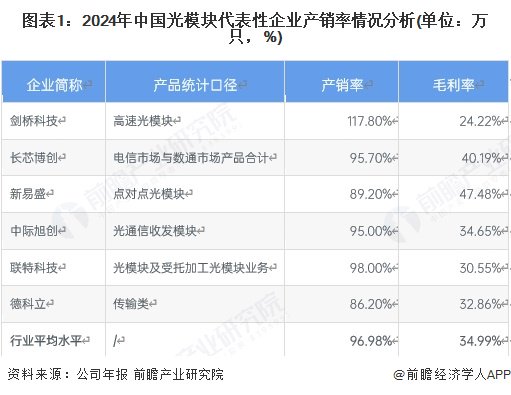
Core Insights - The report highlights the strong performance of China's optical module industry, with an average production and sales rate of 96.98% and an average gross profit margin of 34.99% for 2024, indicating overall good profitability [1] - The demand for optical modules in the telecommunications market is primarily driven by lower-speed modules, with significant growth in 5G base station construction projected for 2024 [2][4] - The data communication market is identified as the largest and fastest-growing segment for optical modules, fueled by increased data center traffic and evolving network architectures [7] Group 1: Optical Module Industry Overview - Major listed companies in the optical module industry include Guangxun Technology, Zhongji Xuchuang, Xinyi Sheng, Changxin Bochuang, Taicheng Guang, and others [1] - The average production and sales rate for representative optical module companies in China is projected to be 96.98% in 2024, with a gross profit margin of 34.99% [1] - Cambridge Technology has reported a production and sales rate exceeding 100% [1] Group 2: Telecommunications Market Demand - The telecommunications market is the origin of optical modules, with 5G transmission networks comprising front-haul, mid-haul, and back-haul segments [2] - In 2024, China is expected to build 874,000 new 5G base stations, bringing the total to 4.251 million by the end of the year [2] - The demand for optical modules is primarily for lower-speed modules, particularly in the front-haul subsystem, which has the highest demand due to its long-distance, high-density characteristics [2] Group 3: Capital Expenditure Trends - The capital expenditure of China's three major telecom operators is gradually shifting towards cloud computing and computing power networks as a second growth curve [4] - In 2023, the total fixed asset investment by major telecom companies and China Tower reached 420.5 billion yuan, with 5G investment accounting for 190.5 billion yuan, a year-on-year increase of 5.7% [4] - The overall market for optical modules is expected to show steady growth, supported by the expansion of fiber-to-the-home and the increase in 10G PON port numbers [4] Group 4: Data Communication Market Growth - The data communication market is currently the largest and fastest-growing market for optical modules, driven by significant increases in data center traffic and changes in network architecture [7] - By mid-2025, the total number of operational computing center racks in China is expected to reach 10.85 million standard racks [7] Group 5: Fixed Network Access Market - The "14th Five-Year" information and communication industry development plan aims to fully deploy gigabit optical fiber networks and accelerate the construction of gigabit cities [9] - By the end of 2025, the number of 10G PON ports is projected to grow from over 5 million at the end of 2021 to 12 million, with gigabit broadband users expected to increase nearly tenfold to 60 million [9] - The Ministry of Industry and Information Technology has initiated pilot projects for 10G optical networks to address key challenges and promote the development of a complete industrial chain [9]




先河环保跌2.08%,成交额3923.45万元,主力资金净流出422.53万元
Xin Lang Cai Jing· 2026-01-08 02:21
Group 1 - The core viewpoint of the news is that Xianhe Environmental Technology Co., Ltd. has experienced fluctuations in its stock price and trading volume, with a recent decline of 2.08% on January 8, 2023, and a total market capitalization of 5.8 billion yuan [1] - As of January 8, 2023, the stock price of Xianhe Environmental is reported at 10.81 yuan per share, with a trading volume of 39.23 million yuan and a turnover rate of 0.68% [1] - The company has seen a stock price increase of 4.34% year-to-date, with significant gains of 8.10% over the last five trading days, 21.32% over the last 20 days, and 57.12% over the last 60 days [1] Group 2 - Xianhe Environmental's main business includes the research, development, production, and sales of high-end environmental online monitoring instruments, with revenue composition being 62.82% from operation and consulting services, 32.93% from environmental monitoring systems, and 4.25% from other sources [1] - As of December 19, 2022, the number of shareholders of Xianhe Environmental has increased to 23,700, representing a 3.79% rise, while the average circulating shares per person decreased by 3.65% to 22,395 shares [2] - For the period from January to September 2025, Xianhe Environmental achieved an operating income of 628 million yuan, reflecting a year-on-year growth of 4.71%, and a net profit attributable to shareholders of 5.53 million yuan, with a year-on-year increase of 2.68% [2]

2026年中国高速铜缆行业政策、产业链、市场规模、竞争格局及发展趋势研判:市场规模不断扩张,国内企业 在全球市场中份额有望持续提升[图]
Chan Ye Xin Xi Wang· 2026-01-08 01:27
Core Viewpoint - The high-speed copper cable market is experiencing rapid expansion driven by the increasing demand for high data rates and low latency transmission, particularly in AI servers and data centers, with significant growth projected through 2026 [1][7]. High-Speed Copper Cable Industry Definition and Classification - High-speed copper cables utilize copper as a conductor to achieve ultra-high data rates (e.g., 400Gbps, 800Gbps, and 1.6Tbps) over short distances (typically less than 10 meters) [1][2]. - The industry is categorized into three main types: passive copper cables (DAC), active copper cables (ACC), and active electrical cables (AEC), with AEC showing greater potential for AI applications due to enhanced signal quality and longer transmission distances [2]. High-Speed Copper Cable Industry Development Status - The global high-speed communication cable market is expected to reach approximately $400 million by 2025, with the high-speed copper cable segment accounting for $190 million (47.5%) [1][7]. - By 2026, the market is projected to grow to $580 million, with high-speed copper cables estimated at $270 million (46.55%) [1][7]. High-Speed Copper Cable Industry Supply Chain - The upstream supply chain includes raw materials such as copper, plating materials, and insulation materials, while the midstream consists of manufacturers of high-speed copper cables, and the downstream involves connector manufacturers serving various applications [8]. High-Speed Copper Cable Industry Development Environment - Related Policies - The rapid development of digital communication and digitization has led to strong demand for high-speed copper cables, supported by government policies aimed at technological upgrades and market expansion [8]. High-Speed Copper Cable Industry Competitive Landscape - The global high-speed copper cable market is highly concentrated, with the top five companies holding 86.8% of the market share [11]. - Major domestic players include Zhaolong Interconnect, Xinya Electronics, and Wolong Materials, with Wolong Materials holding a 24.9% market share, ranking second globally [11][12]. High-Speed Copper Cable Industry Development Trends - The demand for high-speed copper cables is expected to grow due to the rise of cloud computing, big data, and AI technologies, necessitating higher capacity and reliability in data transmission [14]. - Technological innovation will drive the industry forward, with domestic companies increasing R&D investments to enhance cable performance and potentially lead in the global market [14].




研判2025!中国计量校准服务行业政策、产业链、发展现状、竞争格局和未来趋势分析:仪器仪表高端化,推动计量校准服务需求上升[图]
Chan Ye Xin Xi Wang· 2026-01-08 01:13
Core Insights - The metrology calibration service has become a crucial foundation for high-quality development across various industries, including high-end manufacturing, scientific research, environmental protection, and healthcare [1][9] - The Chinese metrology calibration service industry has experienced rapid growth, with a projected market size of 13.01 billion yuan in 2024, reflecting a year-on-year increase of 5.1% [1][9] - The industry is expected to expand further due to national policies and technological advancements, broadening its application scope and increasing market size [1][9] Industry Overview - Metrology calibration services involve determining the accuracy and reliability of measuring instruments by comparing their results with known standards, ensuring consistency and accuracy in measurements [3] - The calibration process includes three main steps: inspection, adjustment, and comparison [3] - The industry can be categorized into mandatory and non-mandatory calibration, with mandatory calibration requiring authorized institutions for inspection [4] Market Size and Growth - The metrology calibration service market in China is expected to reach 23.56 billion yuan in 2024, with a year-on-year growth of 6%, where calibration services account for 55.22% of the market [8] - The revenue of the instrument manufacturing industry in China is projected to reach 1,080.38 billion yuan in 2024, with a growth rate of 4.3% [7] Competitive Landscape - The metrology calibration service market is becoming increasingly competitive, with a fragmented landscape but the emergence of leading companies like Guodian Calibration and Tiansu Calibration, which leverage technical and financial advantages [9][10] - These leading firms have established national service networks and created barriers through laboratory layouts and certification [9] Industry Trends - The integration of AI, IoT, and blockchain technologies is driving the digital transformation of metrology calibration services, enhancing predictive maintenance and real-time data transmission [12] - Subscription models and predictive maintenance are becoming mainstream, allowing companies to reduce costs and improve service accessibility [13] - Industry consolidation is accelerating, with technologically advanced firms likely to acquire less innovative competitors, leading to increased market concentration [14]


上海睿联丰科技有限公司成立,注册资本300万人民币
Sou Hu Cai Jing· 2026-01-07 17:04
Core Viewpoint - Shanghai Ruilianfeng Technology Co., Ltd. has been established with a registered capital of 3 million RMB, fully owned by Shanghai Qidian Shengen Intelligent Technology Co., Ltd. [1] Company Information - The legal representative of Shanghai Ruilianfeng Technology Co., Ltd. is Ren Jia [1] - The company is registered with a capital of 3 million RMB [1] - The business scope includes technology services, development, consulting, and software development, among others [1] - The company is classified under the scientific research and technical service industry, specifically in technology promotion and application services [1] Shareholding Structure - Shanghai Qidian Shengen Intelligent Technology Co., Ltd. holds 100% of the shares in Shanghai Ruilianfeng Technology Co., Ltd. [1] Business Activities - The company engages in various activities including big data services, digital technology services, sales of IoT devices, and management consulting [1] - Additional sales activities include metal products, communication equipment, electronic products, construction materials, and agricultural products [1] Registration Details - The company is located at 2123 Pudong Avenue, Southwest Area, China (Shanghai) Pilot Free Trade Zone [1] - The business registration is valid until January 7, 2026, with no fixed term thereafter [1] - The registration authority is the Free Trade Zone Market Supervision Administration [1]
汇中股份与安富利续签战略合作协议 聚焦全球市场销售、定制化产品研发
Zheng Quan Shi Bao Wang· 2026-01-07 14:23
Group 1 - The core viewpoint of the news is that Huizhong Co., Ltd. has renewed its strategic cooperation agreement with Avnet Asia Pte Ltd., focusing on global market sales and joint product development, which is expected to support long-term growth in overseas sales [1] - The renewed agreement confirms the recognition of Huizhong's ultrasonic flow measurement products by overseas customers and aims to enhance the strategic development goals and planning for overseas markets [1] - The agreement includes a two-year exclusive agency for Australia and New Zealand starting from January 1, 2026, and emphasizes collaboration on customized product development and supply chain management improvements [1] Group 2 - Huizhong Co., Ltd. provides smart water supply and heating solutions, with products including ultrasonic water meters and related management systems, and has seen significant growth in overseas markets despite increasing competition [2] - In the first half of 2025, Huizhong's overseas revenue reached 73.5964 million yuan, a year-on-year increase of 19 times, with an overseas gross margin of 49.79%, up 11.08 percentage points [2] - The company has established partnerships with other firms, including a strategic cooperation agreement with Almaviva Bluebit to expand the global ultrasonic water meter market and plans to set up a wholly-owned subsidiary in Australia to enhance service capabilities [2] Group 3 - Huizhong Co., Ltd. is increasing the integration of technologies such as AI, IoT, big data, and digital twins with its ultrasonic measurement products, aiming for breakthroughs in measurement accuracy, product performance, and customization capabilities [3] - The company is optimizing its hardware products while expanding the application fields of ultrasonic measurement technology and actively developing "second curve" products based on core technologies [3]

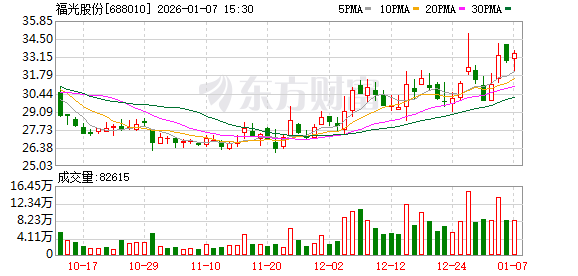
福光股份:产品包括激光、紫外、可见光、红外系列全光谱镜头及光电系统
Zheng Quan Ri Bao· 2026-01-07 12:38
Core Viewpoint - Fuguang Co., Ltd. is a high-tech enterprise specializing in the research and production of special and civilian optical lenses, optoelectronic systems, and optical components, positioning itself as a significant global manufacturer of optical lenses [2] Group 1: Company Overview - The company offers a range of products including laser, ultraviolet, visible light, and infrared lenses, categorized into "custom products" and "non-custom products" [2] - The "custom products" series includes special optical lenses and optoelectronic systems, which are widely used in major national space missions such as the Shenzhou series, Chang'e lunar exploration, and Tianwen-1, with core clients including the Chinese Academy of Sciences and various research institutes and enterprises [2] - The "non-custom products" series consists of security lenses, vehicle-mounted lenses, infrared lenses, machine vision lenses, and projection light machines, applicable in smart city initiatives, IoT, vehicle networking, intelligent manufacturing, and AR/VR fields [2]