跨境支付

Search documents
中科软股价上涨1.30% 公司披露跨境支付与医疗AI技术储备
Sou Hu Cai Jing· 2025-08-06 12:00
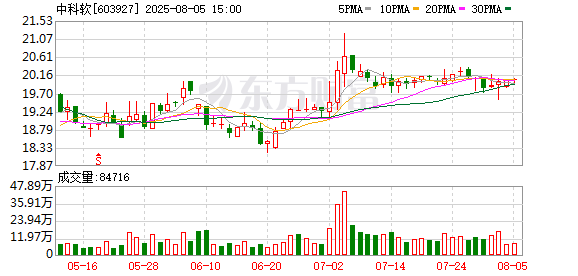
Core Viewpoint - Zhongke Soft's stock price has increased by 1.30% to 20.32 yuan, indicating positive market sentiment and trading activity [1] Company Overview - Zhongke Soft is a leading provider of industry application software and solutions in China, primarily serving sectors such as insurance, government, healthcare, and transportation [1] - The company has a strong foundation in software development, with business operations spanning financial technology and healthcare information technology [1] Recent Developments - The company disclosed on its investor interaction platform that it possesses relevant technical reserves for China's Cross-Border Interbank Payment System (CIPS) and has previously provided technical services for payment systems to regulatory authorities [1] - In the healthcare sector, Zhongke Soft has successfully implemented AI technology in various applications, including intelligent identification of tuberculosis and smart customer service for vaccine administration [1] Market Activity - As of August 6, data shows that the main capital outflow from Zhongke Soft amounted to 52.77 thousand yuan, with a cumulative net outflow of 3,507.72 thousand yuan over the past five days [1]

数码视讯涨1.19%,成交额2.71亿元,近5日主力净流入-1612.33万
Xin Lang Cai Jing· 2025-08-06 07:32
Core Viewpoint - The company, Digital Vision, is actively expanding its business in digital currency, cross-border payment, and blockchain technology, aiming to leverage these innovations for growth in various sectors including digital art and internet finance [2][3][7]. Group 1: Business Development - The subsidiary, Kuaishiting, is utilizing blockchain technology to enhance industry applications, particularly in the metaverse, by issuing digital collectibles that provide new rights and copyright verification for digital content [2]. - The company is developing digital currency application products and is pursuing market collaborations to support the adoption of digital currency payment scenarios [2]. - As of June 26, 2025, the payment subsidiary has obtained qualifications for cross-border RMB payment operations and holds various payment licenses, creating a diverse product system for multiple industry markets [2]. Group 2: Financial Performance - For the first quarter of 2025, Digital Vision reported revenue of 131 million, representing a year-on-year growth of 29.71%, and a net profit attributable to shareholders of 7.76 million, up 12.44% year-on-year [8]. - The company has distributed a total of 370 million in dividends since its A-share listing, with 42.83 million distributed over the past three years [9]. Group 3: Market Position and Trends - The company operates in the IT services sector, focusing on digital watermarking, cross-border payments, NFC concepts, digital currency, and data rights [8]. - The average trading cost of the stock is 5.72, with recent trading activity indicating a lack of strong accumulation, suggesting a potential trading range between resistance at 5.98 and support at 5.92 [6].

中科软:公司拥有中国跨境支付系统(CIPS)的相关技术储备
Mei Ri Jing Ji Xin Wen· 2025-08-05 14:11
中科软(603927.SH)8月5日在投资者互动平台表示,公司拥有中国跨境支付系统(CIPS)的相关技术 储备,曾为某监管机构提供支付系统CCPC及CIPS相关的技术服务。截至目前,相关业务占公司营业收 入比重很小。 (文章来源:每日经济新闻) 每经AI快讯,有投资者在投资者互动平台提问:你好,公司在跨境支付领域目前有没有具体落地的应 用场景? ...

ZY 8月十大金股
2025-08-05 03:19
Summary of Conference Call Notes Company and Industry Overview - **Industry**: Financial Technology, Semiconductor, Chemical, Military, Agriculture, and New Consumption - **Key Companies**: Tianyang Technology, Wentai Technology, Wanhu Chemical, Gaode Hongai, Muyuan Co., Ltd., Chuan Yi Co., Ltd., Lao Pu Gold, Li Gao Video, and Long Sheng. Key Points and Arguments Tianyang Technology - **Market Position**: Leading in card solutions, with financial services accounting for about one-third and fintech solutions for two-thirds of revenue [2] - **Revenue**: Total revenue for 2024 is projected at 1.76 billion, down 8% year-on-year, with net profit at 78 million, also showing a decline [2] - **Growth Opportunities**: Key business areas like corporate credit are expected to grow over the next three years [2][4] Wentai Technology - **Business Segments**: Divided into product integration and semiconductor businesses, with the latter showing revenue growth in the first half of the year [5][6] - **Market Trends**: The semiconductor segment's revenue is expected to grow, particularly in automotive applications, which account for over 60% of revenue [6][7] - **Future Projections**: Expected revenue decline in product integration but significant profit growth in semiconductors projected for 2025-2027 [8] Wanhu Chemical - **Market Dynamics**: TDI prices are expected to rise due to supply shortages caused by maintenance and accidents at production facilities [9][10] - **Price Trends**: Domestic TDI prices increased by 32% recently, indicating strong demand and supply constraints [10][11] - **Industry Outlook**: Anticipated simultaneous price increases for TDI and MDI, benefiting leading companies like Wanhu [11] Gaode Hongai - **Business Expansion**: Transitioning from a supplier to a comprehensive weapon system provider, with significant contracts signed recently [12][13] - **Financial Performance**: Expected rapid growth in revenue and profit due to increased orders and successful project deliveries [14] Muyuan Co., Ltd. - **Market Position**: Positioned well in the agricultural sector with a focus on cost advantages and stable profit margins [15][19] - **Price Stability**: Government policies are expected to stabilize pork prices, reducing downward pressure on prices [17][18] - **Future Projections**: Anticipated price increases for pork in the coming year, benefiting the company's profitability [18][20] Chuan Yi Co., Ltd. - **Industry Position**: A leading automation instrument company with significant growth potential in domestic and international markets [24][25] - **Market Trends**: Expected growth in demand due to infrastructure projects and a low industry base [24] Lao Pu Gold - **Financial Performance**: Significant revenue growth projected for the first half of the year, with expectations for continued strong performance [27][28] - **Market Outlook**: Anticipated strong demand and expansion in new store openings contributing to revenue growth [28] Li Gao Video - **Market Dynamics**: Stable performance in the supply chain, with growth in revenue and profit despite market pressures [30] - **Product Innovation**: Introduction of new products in response to regulatory changes, enhancing market competitiveness [30][31] Long Sheng - **Cost Management**: Decrease in raw material costs, particularly oil, is expected to improve profit margins [32][33] - **Market Conditions**: Positive outlook due to government policies aimed at stabilizing the economy and improving PPI [34][35] Additional Important Insights - **Overall Market Trends**: The conference highlighted a general trend of companies adapting to market changes and government policies, with a focus on innovation and cost management across various sectors. - **Investment Recommendations**: Analysts recommended several companies as "golden stocks" based on their market positions, growth potential, and financial performance. This summary encapsulates the key insights and projections discussed during the conference call, providing a comprehensive overview of the companies and industries involved.





信安世纪涨1.28%,成交额7364.77万元,近3日主力净流入-1610.20万
Xin Lang Cai Jing· 2025-08-04 08:10
Core Viewpoint - The company, Xinan Century, is a technology innovation-oriented provider of information security products and solutions, focusing on identity security, communication security, and data security in the context of increasing digitalization and cloud computing trends [3][8]. Company Overview - Xinan Century was established on August 31, 2001, and went public on April 21, 2021. The company is located in Haidian District, Beijing, and its main business involves using cryptographic technology to address information security issues [7]. - The company's revenue composition is 82.26% from information security products and 17.74% from services [8]. Business Segments - The company has developed a range of products from identity authentication technology, including electronic identity cards, which are relevant to the digital currency sector [2]. - Xinan Century's product lines include identity security, data security, communication security, mobile security, cloud security, and platform security, reflecting its comprehensive approach to information security [3]. Market Position and Recognition - The company has been recognized as a "specialized, refined, distinctive, and innovative" small giant enterprise, which is a prestigious title in China for small and medium-sized enterprises that excel in niche markets and possess strong innovation capabilities [3]. Financial Performance - For the first quarter of 2025, Xinan Century reported a revenue of 75.16 million yuan, representing a year-on-year growth of 6.44%. However, the net profit attributable to the parent company was a loss of 10.38 million yuan, although this reflects a significant improvement with a year-on-year decrease in losses of 65.13% [8]. Stock Performance - On August 4, 2025, Xinan Century's stock increased by 1.28%, with a trading volume of 73.65 million yuan and a turnover rate of 2.07%, bringing the total market capitalization to 3.768 billion yuan [1].

弘业期货:香港子公司持有香港证监会1、2、4、9类牌照
Jin Rong Jie· 2025-08-04 04:08
Core Viewpoint - The company is actively monitoring policy trends and market demands in the cross-border payment and fintech sectors, considering opportunities for upgrading its Hong Kong subsidiary's securities trading license to include virtual asset trading services [1] Group 1: Company Operations - The Hong Kong subsidiary, Hongye International Finance, currently holds licenses from the Hong Kong Securities and Futures Commission for categories 1, 2, 4, and 9, enabling it to support securities trading, futures trading, asset management, and investment consulting services [1]

青岛银行半年快报出炉:规模效益双增,发力区域特色金融
21世纪经济报道· 2025-08-01 11:01
Core Viewpoint - Qingdao Bank has demonstrated resilience in development with significant growth in asset scale, profit, and asset quality, positioning itself as a leading local bank in Shandong Province [1][3][5]. Group 1: Scale and Profitability Growth - As of June 2025, Qingdao Bank's total assets reached 743 billion yuan, a year-on-year increase of 7.69% [3]. - The total customer loans amounted to 368.4 billion yuan, growing by 8.14%, while customer deposits reached 466.1 billion yuan, with a growth rate of 7.9% [3]. - The bank achieved an operating income of 7.7 billion yuan, a year-on-year increase of 7.5%, and a net profit exceeding 3 billion yuan, reflecting a growth of 16.05% [3][5]. Group 2: Asset Quality Improvement - The non-performing loan ratio decreased to 1.12%, down by 0.02 percentage points from the previous year [5]. - The provision coverage ratio increased significantly by 11.48 percentage points to 252.8%, indicating enhanced risk management capabilities [5][6]. Group 3: Regional and Specialized Financial Development - Qingdao Bank has focused on regional economic development, launching the "Qingchuyublue" brand strategy with 14 specialized blue finance products, serving over 500 clients with a blue loan balance nearing 20 billion yuan [8]. - The bank has established a comprehensive financial service matrix for marine enterprises, integrating financial services with the marine economy [8]. Group 4: Technological and Green Finance Initiatives - The bank has developed a "Technology Finance + New Quality Productivity" model, enhancing its service mechanism for technology enterprises [9]. - In green finance, Qingdao Bank has implemented a project library and tools to drive significant growth in green credit, while also addressing financing challenges for small and micro enterprises [11]. Group 5: Internationalization and Cross-Border Payment Services - Qingdao Bank became the first local bank in Shandong to gain direct participation in the RMB Cross-Border Payment System (CIPS), facilitating efficient cross-border payment services [14]. - The bank's proprietary system allows for cross-border payment processing within 10 minutes, significantly reducing operational costs for enterprises [14]. Group 6: Recognition and Brand Value - Qingdao Bank has been recognized for its brand value, ranking on the "China's 500 Most Valuable Brands" list for nine consecutive years, with a brand value of 36.236 billion yuan [15].

跨境支付通“满月” 浙江累计结算超1.7亿元
Xin Hua Cai Jing· 2025-08-01 09:33
据介绍,跨境支付通主要应用于三方面跨境汇款业务场景,包括境内居民个人汇出至香港地区银行账户 的"南向便利化汇款业务",可选择人民币汇出、人民币或港币到账;香港居民个人汇入至内地银行账户 的"北向便利化汇款业务",可选择港币或人民币发起、人民币到账;个人与机构间"双向跨境人民币支 付业务",如留学缴费、公共事业缴费、就医、薪资和补贴发放等,可选择双边本币或双边人民币汇 款。 新华财经杭州8月1日电(记者吕昂)由中国人民银行和香港金融管理局共同推动的跨境支付通自6月22 日正式落地以来已"满月"。记者从中国人民银行浙江省分行获悉,该业务开通一个月来,浙江全省累计 办理跨境支付通业务超2.6万笔,总金额达到1.7亿元,惠及客户7533人。 跨境支付通实现了内地网上支付跨行清算系统与香港"转数快"系统的高效连接,和传统跨境汇款业务相 比,可实现"秒到账",且无需填写收款行地址和银行代码。目前浙江辖内已有中国银行、工商银行、建 设银行、农业银行、交通银行、招商银行6家试点银行成功落地跨境支付通业务。 2024年,浙江对港跨境人民币结算金额达12751亿元,其中个人结算金额为692亿元,直接参与结算的在 浙香港居民高达2 ...
凤凰网数字经济频道 8 月 1 日正式上线 打造全球数字经济传播新平台
Feng Huang Wang· 2025-08-01 06:59
Core Insights - The launch of the Phoenix News Digital Economy Channel on August 1, 2025, marks a significant step in the digital economy landscape, coinciding with the enactment of the Hong Kong Stablecoin Issuance and Regulation Ordinance, drawing widespread industry attention [1][2]. Group 1: Channel Features - The Digital Economy Channel features several core sections including "Industry Hotspots," "Industry Map," "Global Digital Economy News," "Digital Cities," "Digital Knowledge," and "Global Experts Speak," aimed at providing comprehensive insights into the digital economy [2]. - "Industry Hotspots" will track real-time developments in the digital industry, while "Industry Map" will offer resources for enterprise positioning within the complex digital ecosystem [2]. - The channel will utilize various formats such as articles, videos, live broadcasts, interviews, and interactive topics to create a content ecosystem that combines authority and broad dissemination [2]. Group 2: Expert Analysis - The inaugural focus of the channel is on the Hong Kong Stablecoin Issuance and Regulation Ordinance, featuring expert analyses from notable figures in the field, including Dr. Li Ming and Ye Kai, who will discuss the implications of the stablecoin legislation on RWA, Web3 innovation, cross-border payments, and financial infrastructure [3]. - These expert insights aim to help industry readers understand policy trends and seize development opportunities, providing valuable decision-making references for the sector [3]. Group 3: Future Development - The channel aims to become a global hub for digital economy dissemination, focusing on "Technological Innovation × Industry Integration × Global Governance" as its core development framework [4]. - It will create a collaborative service ecosystem, offering multinational regulatory bodies policy implementation insights and assisting multinational companies in navigating compliance paths and market opportunities [4]. - By connecting Hong Kong with the global digital economy market, the channel seeks to uncover global opportunities in areas such as RWA and cross-border payments, contributing to a balanced and innovative global digital asset ecosystem [4].
蚂蚁、京东等竞逐,香港稳定币牌照门槛堪比银行
3 6 Ke· 2025-08-01 01:18
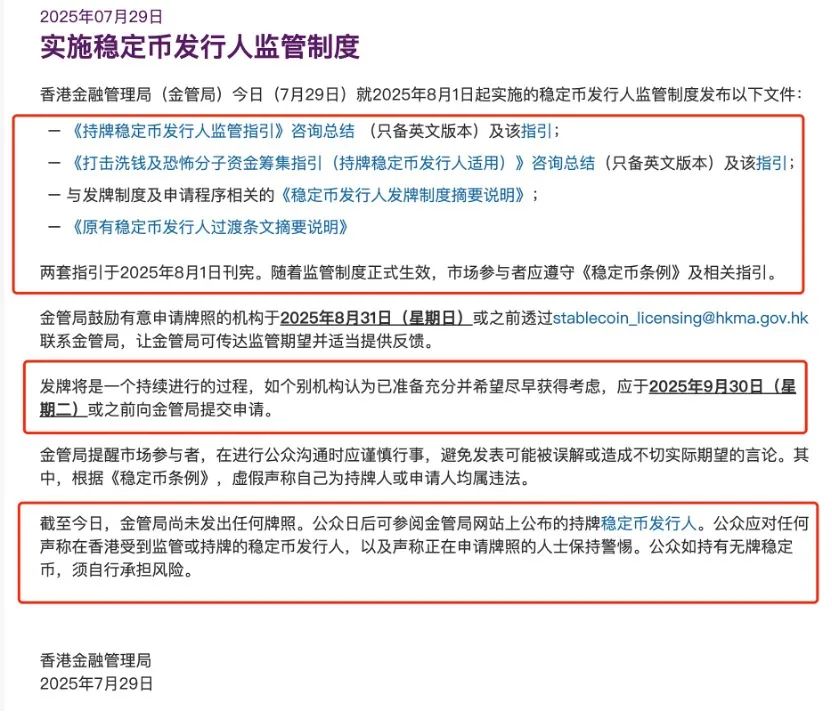
Core Points - Hong Kong's stablecoin licensing regulations will be implemented on August 1, with applications due by September 30, 2025, and the first batch of licenses expected to be very limited, possibly in single digits [1][4][9] - The licensing process will be ongoing, and institutions are encouraged to communicate with the Hong Kong Monetary Authority (HKMA) to understand regulatory expectations [4][10] - The requirements for stablecoin issuers are stringent, comparable to banking standards, including capital requirements, reserve asset backing, anti-money laundering (AML) compliance, and information disclosure [5][6][7] Licensing Timeline - The HKMA has outlined a timeline for the licensing process, with the first batch of licenses expected to be announced in early 2026 [4][9] - Institutions wishing to be considered in the first batch must submit their applications by September 30, 2025 [4][9] Issuer Requirements - Applicants must be registered corporations in Hong Kong with a minimum paid-up capital of HKD 25 million [5][6] - Reserve assets must fully back the stablecoins, including cash and high liquidity government bonds, with a requirement for 100% coverage [5][6] - Issuers must establish a redemption mechanism and comply with KYC/AML standards similar to those of banks in Hong Kong [6][7] Market Implications - The limited number of licenses and high entry barriers suggest that only a few well-prepared companies will succeed, with major players like Ant Group and JD.com being strong contenders [8][11][13] - The introduction of stablecoin regulations in Hong Kong is seen as a significant step towards integrating stablecoins into the traditional financial system, potentially transforming cross-border payments and trade settlements [12][13]