Workflow
人民币汇率
icon
Search documents
人民币市场汇价(11月28日)
Xin Hua Wang· 2025-11-28 02:02
Core Points - The People's Bank of China authorized the release of the market exchange rates for the Chinese Yuan against various currencies on November 28 [1] Group 1: Exchange Rates - The central parity rate of the Chinese Yuan against the US Dollar is 707.89 Yuan for 100 USD [2] - The central parity rate of the Chinese Yuan against the Euro is 820.78 Yuan for 100 EUR [2] - The central parity rate of the Chinese Yuan against the Japanese Yen is 4.5293 Yuan for 100 JPY [2] - The central parity rate of the Chinese Yuan against the Hong Kong Dollar is 90.99 Yuan for 100 HKD [2] - The central parity rate of the Chinese Yuan against the British Pound is 936.97 Yuan for 100 GBP [2] - The central parity rate of the Chinese Yuan against the Australian Dollar is 462.43 Yuan for 100 AUD [2] - The central parity rate of the Chinese Yuan against the New Zealand Dollar is 405.33 Yuan for 100 NZD [2] - The central parity rate of the Chinese Yuan against the Singapore Dollar is 545.89 Yuan for 100 SGD [2] - The central parity rate of the Chinese Yuan against the Swiss Franc is 879.71 Yuan for 100 CHF [2] - The central parity rate of the Chinese Yuan against the Canadian Dollar is 504.6 Yuan for 100 CAD [2] - The central parity rate of the Chinese Yuan against the Macanese Pataca is 113.29 MOP for 100 CNY [2] - The central parity rate of the Chinese Yuan against the Malaysian Ringgit is 58.344 MYR for 100 CNY [2] - The central parity rate of the Chinese Yuan against the Russian Ruble is 1101.35 RUB for 100 CNY [2] - The central parity rate of the Chinese Yuan against the South African Rand is 242.35 ZAR for 100 CNY [2] - The central parity rate of the Chinese Yuan against the South Korean Won is 20678 KRW for 100 CNY [2] - The central parity rate of the Chinese Yuan against the UAE Dirham is 51.897 AED for 100 CNY [2] - The central parity rate of the Chinese Yuan against the Saudi Riyal is 53.008 SAR for 100 CNY [2] - The central parity rate of the Chinese Yuan against the Hungarian Forint is 4646.31 HUF for 100 CNY [2] - The central parity rate of the Chinese Yuan against the Polish Zloty is 51.5 PLN for 100 CNY [2] - The central parity rate of the Chinese Yuan against the Danish Krone is 90.99 DKK for 100 CNY [2] - The central parity rate of the Chinese Yuan against the Swedish Krona is 133.85 SEK for 100 CNY [2] - The central parity rate of the Chinese Yuan against the Norwegian Krone is 143.56 NOK for 100 CNY [2] - The central parity rate of the Chinese Yuan against the Turkish Lira is 600.333 TRY for 100 CNY [2] - The central parity rate of the Chinese Yuan against the Mexican Peso is 259.18 MXN for 100 CNY [2] - The central parity rate of the Chinese Yuan against the Thai Baht is 455.26 THB for 100 CNY [2]
创一年新高!人民币兑美元汇率或有震荡
Sou Hu Cai Jing· 2025-11-27 23:16
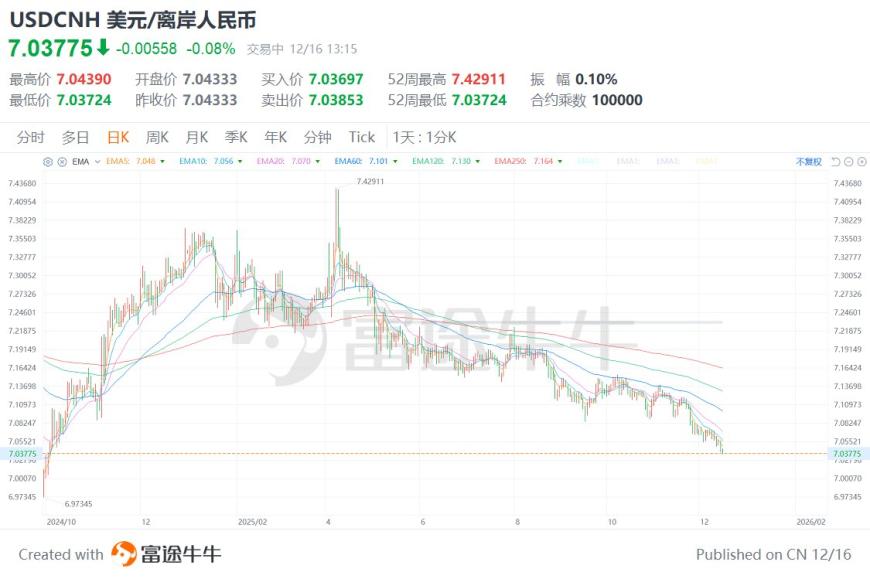
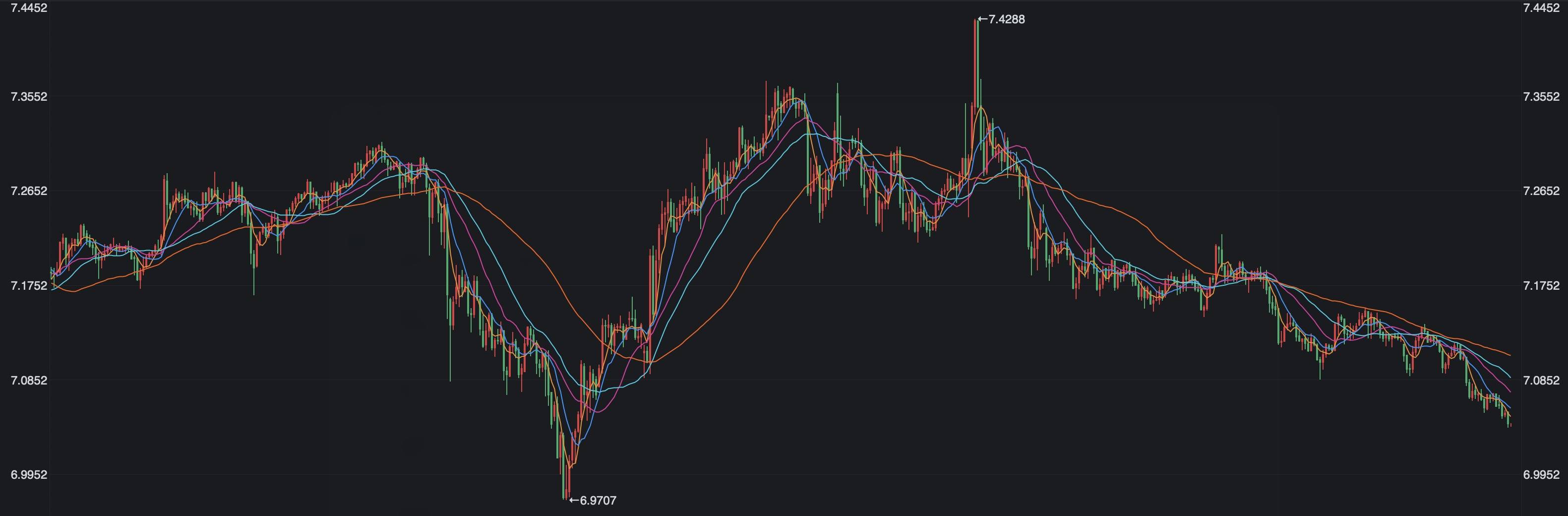
Core Viewpoint - The onshore and offshore RMB exchange rates have both surpassed the 7.08 mark, reaching their highest levels since mid-October of the previous year, indicating a strong performance of the RMB against the USD [1] Group 1: Exchange Rate Performance - As of November 27, the onshore RMB to USD rate was reported at 7.07990, while the offshore rate was at 7.07605 [1] - The RMB central parity rate was adjusted up by 17 basis points to 7.0779, with a year-to-date increase of over 1000 basis points [1] - The onshore RMB has appreciated nearly 3% against the USD this year, while the offshore RMB has appreciated approximately 3.5% [1] Group 2: Market Insights - The USD index has been fluctuating around the 100 mark, maintaining overall strength, yet the RMB has shown resilience, achieving a new high against a basket of currencies [1] - According to the State Administration of Foreign Exchange, in October, banks settled $214.2 billion and sold $196.5 billion in foreign exchange, with foreign income at $623.1 billion and payments at $571.9 billion [1] - Analysts predict that the RMB exchange rate will likely exhibit a stable trend, with minor fluctuations against the USD [1][2] Group 3: Future Outlook - Citic Securities' chief economist forecasts a moderate appreciation of the RMB exchange rate by 2026 [1] - Wealth research director Liu Youhua suggests that the RMB central parity has the potential to test the "7" mark in the future [1] - Dongfang Jincheng's chief macro analyst Wang Qing believes that the RMB exchange rate will primarily maintain stability, with relatively small fluctuations against the USD [1]
人民币狂拉,涨超1000基点,汇市大变局来袭
Sou Hu Cai Jing· 2025-11-27 16:38
Group 1 - The core viewpoint is that the Chinese Yuan has appreciated significantly, rising over 1000 basis points since the beginning of the year, influenced by both external and internal factors [1][7][15] - External factors include concerns over potential tariff increases by Trump, which initially created depreciation pressure on the Yuan, but the central bank managed to stabilize the market through its middle rate [3][5] - The outlook for the Yuan's appreciation is supported by expectations of continued interest rate cuts by the Federal Reserve, the diminishing impact of tariffs on the US economy, and concerns over the independence of the Federal Reserve [5][15] Group 2 - Domestic fundamentals are seen as supportive for the Yuan, with any strong growth-promoting policies likely to impact the exchange rate positively [7][9] - There is a backlog of demand for currency conversion, which is expected to be released as the Yuan appreciates, further supporting its upward trend [7][9] - On November 26, the Yuan broke the 7.08 mark, with the offshore rate at 7.07499 and the central bank's middle rate adjusted up by 30 basis points [11][13] Group 3 - The cumulative increase in the middle rate has exceeded 1000 basis points this year, marking significant milestones in the current market trend [13][15] - The market will continue to monitor the performance of the US dollar and the central bank's adjustments to the middle rate in the short term [13][15] - Long-term appreciation of the Yuan is possible if there are no major external changes, domestic growth efforts are effective, and demand for currency conversion continues to be released [15]
喜娜AI速递:今日财经热点要闻回顾|2025年11月27日
Sou Hu Cai Jing· 2025-11-27 11:15
Group 1: Federal Reserve and Economic Outlook - The Federal Reserve's Beige Book indicates little change in U.S. economic activity, with a further decline in consumer spending and increased risks of economic slowdown [2] - Market expectations for a 25 basis point rate cut in December have risen to 85%, following support from several Federal Reserve officials [2] - U.S. stock markets have seen four consecutive days of gains, while precious metal prices have increased and the U.S. dollar index has declined [2] Group 2: Lithium Carbonate Market - Lithium carbonate prices have surged over 60% in the past six months, with the main contract closing at 96,300 yuan/ton on November 26 [2] - The price rebound is attributed to the suspension of production at CATL's Yichun lithium mine and strong demand from the energy storage sector [2] - Despite rising prices, downstream companies are adopting a wait-and-see approach, leading to limited transactions in the spot market [2] Group 3: Consumption Promotion Measures - Six Chinese government departments have issued a plan to enhance the adaptability of supply and demand in consumer goods, aiming to establish three trillion-level consumption sectors by 2027 [2] - The plan includes 19 key tasks across five areas, such as expanding low-altitude consumption supply and promoting the launch of consumer goods [2] Group 4: Vanke's Bond Extension - Vanke is seeking to extend the maturity of its "22 Vanke MTN004" bond, with a principal repayment date set for December 15 and an outstanding balance of 2 billion yuan [3] - The company's stock and bond prices have both come under pressure, raising market concerns about its debt situation [3] Group 5: Longpan Technology's Major Contract - Longpan Technology's subsidiary has signed a supplementary agreement with three subsidiaries of Chuangneng New Energy, with a total sales amount exceeding 45 billion yuan for lithium iron phosphate materials [3] - The demand for lithium iron phosphate is expected to surge due to the growth in energy storage and electric vehicle sectors, leading to a favorable outlook for the industry [3] Group 6: Renminbi Exchange Rate - The Renminbi has strengthened against the U.S. dollar, with both offshore and onshore rates surpassing 7.09 on November 25, marking a year-to-date increase of approximately 1000 basis points [3] - Factors contributing to this strength include a recovering domestic economy, strong foreign trade performance, and a decline in the U.S. dollar [3] Group 7: Ideal Auto's Financial Performance - Ideal Auto reported a 36.2% year-on-year decline in revenue for Q3, totaling 27.4 billion yuan, and a net loss of 624 million yuan [5] - The company plans to implement several initiatives, including the introduction of new battery technology and a return to a startup management model [5] Group 8: Bitcoin Market Activity - Bitcoin has surpassed the $91,000 mark, with over 100,000 traders liquidated in the past 24 hours, totaling $277 million in liquidations [5] - Analysts suggest that long-term holders are taking profits, while some institutions predict a potential return to high levels by year-end, albeit with selling pressure [5]
国债期货日报-20251127
Nan Hua Qi Huo· 2025-11-27 10:33
Report Summary 1. Report Industry Investment Rating No relevant content provided. 2. Core View - The report suggests paying attention to the central bank's policy attitude. Given the weakening economic fundamentals, interest rates are expected to remain low for a certain period. Mid - term bottom positions should be held, and new long positions can be gradually established on dips, with price intervals widened [1][3]. 3. Summary by Relevant Catalogs 3.1.盘面点评 - On Thursday, Treasury bond futures fluctuated. TS closed up, TF and T closed down, and TL remained flat. The funding situation was loose, with DR001 around 1.31%. Open - market reverse repurchase was 356.4 billion yuan, with a net injection of 56.4 billion yuan [1]. 3.2.重要资讯 - The central parity rate of the RMB against the US dollar was raised by 17 basis points to 7.0779, reaching the highest level since October 14, 2024. China's industrial enterprise profits above designated size in October decreased by 5.5% year - on - year, while the manufacturing and power sectors had relatively rapid growth in the first 10 months. Vanke announced that it will hold a meeting to review matters related to bond extension [2]. 3.3.行情研判 - Today, Treasury bond futures showed weak fluctuations after a sharp decline, and the trading volume of the main contracts of each variety decreased significantly. In terms of data, industrial enterprise profits in October decreased year - on - year, and the cumulative growth rate of profits from January to October slowed down. The weakening economic fundamentals determine that interest rates need to remain low for a certain period. Operationally, mid - term bottom positions should be held, and new long positions can be gradually established on dips, with price intervals widened [3]. 3.4.国债期货日度数据 - **Price and price change**: TS2603 closed at 102.394, up 0.012; TF2603 closed at 105.78, down 0.005; T2603 closed at 107.905, down 0.05; TL2603 closed at 114.43, unchanged [4]. - **Position change**: TS contract positions decreased by 4,339 to 66,382; TF contract positions decreased by 15,019 to 146,639; T contract positions decreased by 27,648 to 237,119; TL contract positions decreased by 14,248 to 169,380 [4]. - **Base - spread change**: TS basis (CTD) increased by 0.0302 to - 0.0566; TF basis (CTD) increased by 0.1322 to 0.0093; T basis (CTD) increased by 0.1048 to 0.0632; TL basis (CTD) increased by 0.3829 to 0.6666 [4][5]. - **Trading volume change**: TS main contract trading volume decreased by 6,816 to 29,291; TF main contract trading volume decreased by 18,744 to 58,494; T main contract trading volume decreased by 34,131 to 75,691; TL main contract trading volume decreased by 40,220 to 99,298 [4][5].
人民币兑美元汇率升至13个月新高
Sou Hu Cai Jing· 2025-11-27 10:28
Core Viewpoint - The Chinese yuan has strengthened against the US dollar, reaching a 13-month high, driven by expectations of a potential interest rate cut by the Federal Reserve and a more stable outlook for Sino-US relations [2][3][5]. Exchange Rate Movement - Since November 21, the yuan has appreciated from around 7.11 to approximately 7.07 against the dollar, with the central bank's mid-point rate rising to 7.0779 on November 27, the highest since October 14, 2024 [2]. - On November 26, the offshore yuan broke below 7.07, indicating a significant strengthening of the currency [2][3]. Federal Reserve Influence - The market's expectation for a December interest rate cut by the Federal Reserve surged to over 70% following dovish comments from New York Fed President Williams, contributing to the dollar's decline [3]. - The dollar index fell below 100, trading around 99.6, reflecting a broader trend of weakening for the dollar [3]. Sino-US Relations - Optimism regarding the stability of Sino-US relations has contributed to the yuan's strength, as market participants perceive reduced external uncertainties for the Chinese economy [3][5]. Economic Fundamentals - Analysts suggest that previous counter-cyclical policies will support the Chinese economy, making it likely to achieve a GDP growth target of around 5% for the year, which in turn supports the yuan's exchange rate [5][6]. - The yuan's recent appreciation is primarily driven by market forces, with a closer alignment between the central bank's mid-point rate and market prices [5][6]. Corporate Demand for Currency Exchange - Increased corporate demand for currency exchange is seen as a key factor supporting the yuan's exchange rate, particularly as the fourth quarter is a seasonal peak for such demand [6]. Central Bank Actions - The People's Bank of China issued 450 billion yuan in central bank bills in Hong Kong to manage offshore liquidity, which is viewed as a stabilizing measure for the yuan's exchange rate [6]. - Some analysts believe that the central bank's actions are part of a broader strategy to promote the internationalization of the yuan [6]. Future Outlook - Looking ahead, if the Chinese government implements strong stimulus policies, the yuan could continue to appreciate, with predictions suggesting a potential exchange rate of 6.95 by the end of 2026 [7]. - The long-term outlook for the yuan remains positive, supported by domestic economic fundamentals and a favorable external environment [7].
经济“数”语|一文看懂:人民币持续走强,这次为何不太一样
Sou Hu Cai Jing· 2025-11-27 08:41
Core Viewpoint - The recent strengthening of the Chinese yuan against the US dollar has garnered significant market attention, with the yuan's mid-price rising to 7.0779, the highest since October 14, 2024, driven by expectations of a potential interest rate cut by the Federal Reserve in December [1][2]. Group 1: Reasons for Yuan Strengthening - The yuan's recent strength is attributed to two main factors: the continuous adjustment of the yuan's mid-price towards a stronger direction and the overall positive performance of the domestic economy, which has not fully matched the depreciation of the dollar [2][3]. - Increased demand for currency conversion (结汇) due to better-than-expected export performance and a recovering capital market has bolstered confidence in the yuan [2][3]. Group 2: Impacts of Yuan Strengthening - The appreciation of the yuan is expected to boost market confidence, particularly among foreign investors, making holding yuan-denominated assets more attractive and potentially leading to increased capital inflows into Chinese stock and bond markets [5][6]. - For foreign trade enterprises, the yuan's appreciation may pose challenges by making exports more expensive, while simultaneously reducing import costs for businesses reliant on imported goods [5][6]. Group 3: Future Outlook - The yuan is likely to maintain a strong position in the short term, influenced by the dollar's performance, the central bank's control over the mid-price, and domestic economic growth policies [7][8]. - While the yuan may experience fluctuations, a significant appreciation beyond 7.0 against the dollar before the end of the year is considered unlikely, with a stable dual-directional fluctuation expected through 2026 [8][9].
中间价年内涨约1000基点 人民币汇率创逾一年新高
Jing Ji Ri Bao· 2025-11-27 04:22
Core Viewpoint - The recent strengthening of the Renminbi (RMB) against the US dollar is attributed to China's economic recovery, strong foreign trade performance, and the weakening of the US dollar index, with the RMB reaching a new high against the dollar since last year [1][2]. Group 1: RMB Exchange Rate Performance - On November 25, both offshore and onshore RMB against the US dollar broke the 7.09 mark, reaching a high not seen in over a year [1]. - The People's Bank of China reported the RMB to USD central parity rate at 7.0796, an increase of 30 basis points from the previous trading day, with a year-to-date increase of approximately 1000 basis points [1]. - The three major RMB exchange rate indices have risen to their highest levels since early April, with the CFETS index at 98.22, the BIS index at 104.66, and the SDR index at 92.60 [1]. Group 2: Factors Influencing RMB Strength - Experts attribute the RMB's strong performance to its favorable fundamentals and capital flows relative to non-USD currencies, supported by a recovering domestic economy and robust foreign trade [1][2]. - The outlook for the RMB in 2026 is positive, driven by domestic economic recovery, accelerated technological innovation, stabilization of US-China trade relations, and potential further weakening of the US dollar due to credit issues and possible interest rate cuts by the Federal Reserve [2]. - The People's Bank of China emphasizes maintaining a managed floating exchange rate system based on market supply and demand, aiming for stability in the RMB exchange rate at a reasonable equilibrium level [2].
人民币汇率突破7.08创年内新高,多重因素推动升值走势
Sou Hu Cai Jing· 2025-11-27 03:55
Core Viewpoint - The recent appreciation of the Renminbi (RMB) against the US dollar is driven by multiple factors, including policy guidance, economic fundamentals, and external environment changes [1][2]. Group 1: Policy Guidance - The People's Bank of China (PBOC) has been signaling a stronger RMB through the continuous adjustment of the central parity rate, which was set at 7.0796 yuan per dollar, up by 30 basis points from the previous trading day [1]. - The current exchange rate regulation is aimed at promoting a stable environment for foreign trade enterprises, with the CFETS RMB exchange rate index showing moderate upward movement [1]. Group 2: Economic Fundamentals - The RMB's appreciation is supported by robust economic fundamentals, with exports exceeding expectations and a noticeable recovery in the capital markets since July [1]. - Increased demand for foreign exchange settlements from enterprises has boosted market confidence in the RMB, while cross-border capital flows remain stable and orderly [1]. Group 3: External Environment - The Federal Reserve has entered a rate-cutting cycle, with market expectations for another rate cut in December, contributing to a limited upward space for the US dollar index [1][2]. - Weakening US economic data, including slowing retail sales growth and signs of a softening labor market, have heightened concerns about the economic outlook, further supporting the RMB's strength [1]. Group 4: Seasonal Factors - Seasonal factors are also at play, as the fourth quarter typically sees a peak in foreign exchange settlements, maintaining high corporate settlement intentions [2]. - The ongoing trend of cross-border capital inflows provides additional momentum for the RMB's appreciation [2]. Group 5: Future Outlook - The RMB is expected to maintain a steady and strong trend, with limited volatility against the US dollar due to the Fed's rate cut expectations and significant depreciation of the dollar since the beginning of the year [2]. - The RMB's exchange rate is likely to remain stable, exhibiting a reverse fluctuation pattern with the US dollar, with relatively small amplitude [2].
银行间外汇市场交投总量平稳 日均成交量环比持续上升
Jin Rong Shi Bao· 2025-11-27 03:33
Group 1: Market Overview - In October, global financial markets experienced increased volatility due to multiple uncertainties, leading to heightened risk aversion among investors [1] - The average daily trading volume in China's interbank foreign exchange market reached $205.18 billion, showing a month-on-month increase of 6.72% and a year-on-year slight decline of 0.30% [2][3] Group 2: RMB Exchange Rate Trends - The RMB exchange rate rose to a new high for the year in early October but subsequently experienced fluctuations, with the lowest point reaching 7.1433 against the USD [2] - By the end of October, the onshore RMB exchange rate closed at 7.1135, appreciating by 0.07% compared to September [2] Group 3: Foreign Exchange Market Activity - The average daily trading volume for RMB in the foreign exchange market was $152.54 billion, reflecting a year-on-year decline of 5.72% but a month-on-month increase of 6.30% [2] - The foreign exchange market showed active trading in foreign currencies and foreign currency lending, with month-on-month increases exceeding 6% [2] Group 4: RMB Options Trading - RMB foreign exchange options trading remained stable in October, with an average daily transaction volume of $5.23 billion, marking a month-on-month decrease of 9.07% [3] - The implied volatility for RMB/USD options remained low, indicating stable market expectations for short-term RMB exchange rate movements [3] Group 5: Domestic and Offshore Exchange Rate Differences - The domestic foreign exchange differential gradually converged and turned positive by the end of October, with the average daily differential being -29 basis points [4] - As of October 20, the average daily net purchase of foreign exchange by institutions was $1.18 billion, indicating a shift in market sentiment towards net selling by the end of the month [4] Group 6: Market Sentiment and Behavior - The market's herd effect index in October was 61.89, slightly down from September, indicating a weaker herd effect compared to the historical average [5] Group 7: Swap Points and Interest Rate Differentials - Long-term swap points reached a nearly three-year high in October, driven by strong market buying pressure [6][7] - The one-year swap points at the end of October were -1287 basis points, an increase of 35 basis points from September, reflecting ongoing strong buying pressure in the swap market [7]