企业结汇需求

Search documents
人民币汇率开年走强 专家提醒切勿盲目“赌”方向
Shang Hai Zheng Quan Bao· 2026-02-24 17:49
Group 1 - The core viewpoint of the articles highlights the strong performance of the Renminbi (RMB) against the US dollar, attributed to multiple factors including improved external conditions and seasonal demand for currency exchange from enterprises [1][2] - As of February 24, 2026, the onshore and offshore RMB exchange rates were reported at 6.8817 and 6.8776 respectively, with cumulative appreciation of 1.53% and 1.41% since the beginning of the year [1] - Analysts suggest that the recent strength of the RMB is supported by a combination of market sentiment and enterprise demand for currency exchange, with a notable breakthrough of the 6.90 mark [1][2] Group 2 - External factors influencing the RMB include the new Federal Reserve Chair's proposed "rate cut + balance sheet reduction" policy, which introduces uncertainty into the dollar's trajectory [2] - There are concerns that the RMB's passive appreciation against the dollar may weaken in 2026 due to potential strengthening of the dollar amid tightening expectations [2] - Internally, the seasonal effects that boosted enterprise currency exchange demand are expected to diminish, leading to a potential slowdown in this demand [2][3] Group 3 - The People's Bank of China emphasizes maintaining a managed floating exchange rate system based on market supply and demand, aiming for basic stability of the RMB at a reasonable equilibrium level [3] - The central bank aims to use the exchange rate as a macroeconomic stabilizer and to prevent excessive fluctuations in the currency [3]
飙升1100点!三重因素助推人民币走强,偏强状态将延续?
2 1 Shi Ji Jing Ji Bao Dao· 2026-02-24 11:16
Core Viewpoint - The offshore RMB has surged against the USD, reaching a high of 6.8760, with the onshore RMB also showing significant gains, indicating a strong performance of RMB assets in the market [1][2]. Group 1: Factors Driving RMB Strength - External environment improvement is a key background for the RMB's strength, with a stabilization in China-US trade relations since November 2025 [4]. - The weakness of the USD has opened up appreciation space for non-USD currencies, influenced by the ongoing investigation into the Federal Reserve Chairman and the proposed monetary policies [4]. - Seasonal support from concentrated corporate foreign exchange settlement demand is contributing to the RMB's appreciation, particularly during the traditional settlement peak at year-end and early year [4]. Group 2: Market Sentiment and Future Outlook - The recent strong performance of the offshore RMB has led to heightened market sentiment, which is a significant factor in the RMB's upward trend [5]. - The RMB is expected to maintain a strong position leading up to and following the Spring Festival, supported by continued export growth and high corporate settlement demand [6]. - However, there are concerns about potential depreciation pressures throughout the year, with expectations that the RMB will fluctuate around a central range of 7.0 to 7.2 against the USD in 2026 [6].


多因素支撑人民币汇率走强 双向波动仍将是常态
Zhong Guo Zheng Quan Bao· 2025-12-28 22:17
Core Viewpoint - The recent strengthening of the Renminbi (RMB) against the US dollar is influenced by a weakening US dollar index, increased demand for currency settlement by enterprises at year-end, and the rising attractiveness of RMB assets [1][2][3]. External Factors - The US dollar index has weakened significantly, dropping 1.41% since December, primarily due to the Federal Reserve's 25 basis point interest rate cut, which has led to a general appreciation of non-USD currencies, including the RMB [2][3]. - The demand for currency settlement from export enterprises has increased, contributing to the seasonal strengthening of the RMB as companies are encouraged to settle in RMB due to its rising value [2][3]. Internal Factors - The attractiveness of RMB assets has increased, with foreign capital continuously flowing into China's capital markets and a growing scale of international investors holding Chinese government bonds, which enhances the buying power of the RMB [3]. Future Outlook - Experts predict that the RMB will experience two-way fluctuations in the future, as a sustained one-sided trend is deemed unsustainable. The potential for the US dollar index to rise again poses a risk to the RMB's strength [4]. - The current interest rate differential between domestic and foreign currencies remains significant, which could reduce the willingness of enterprises to settle in RMB if the appreciation trend slows down [4]. Recommendations for Enterprises - Companies, especially those engaged in foreign trade, are advised to adopt a risk-neutral approach and avoid speculating on one-sided RMB trends. They should focus on managing exchange rate risks effectively [6]. - Practical measures include optimizing commercial contracts to use RMB for pricing and settlement, and utilizing financial instruments such as forward foreign exchange contracts and swaps to hedge against long-term risks [6].
人民币汇率大幅升值,离岸人民币盘中升破7.0大关
Sou Hu Cai Jing· 2025-12-26 02:55
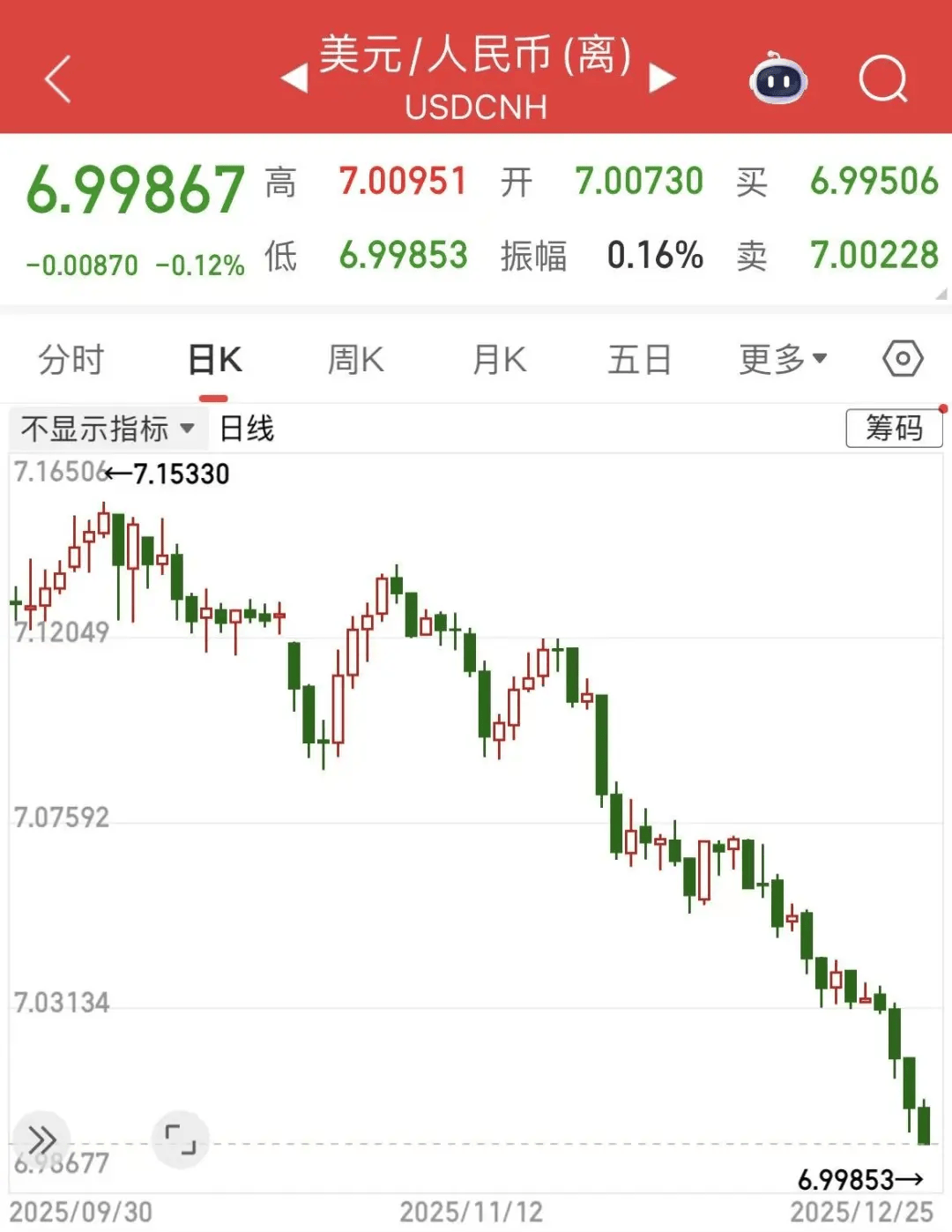
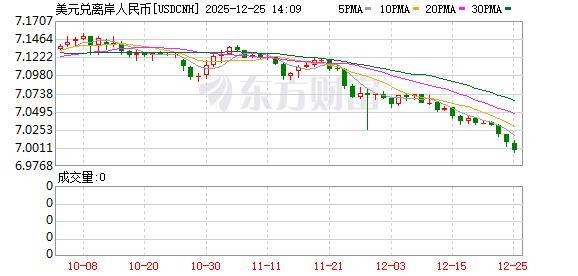
Core Viewpoint - The offshore RMB against the US dollar has broken the "7" mark for the first time since October 2024, reaching a high of 6.9985, marking a 15-month peak, while the onshore RMB also strengthened, nearing the "7" mark at 7.0066, a new high since September 2024 [2][4]. Group 1: Factors Driving RMB Appreciation - The appreciation of the RMB against the US dollar is driven by four main forces: a weakening US dollar index, a strong Chinese stock market increasing the attractiveness of RMB assets, rising demand for currency settlement from export companies, and the People's Bank of China's efforts to maintain stability in the RMB against a basket of currencies [2]. - The weakening of the US dollar index, particularly around the Federal Reserve's interest rate cut on December 11, has led to a general appreciation of non-USD currencies, including the RMB [4]. - Seasonal factors, such as increased currency settlement demand from enterprises as the year-end approaches, have also contributed to the RMB's strength [4]. Group 2: Implications for Capital Markets and Trade - The continuous appreciation of the RMB is expected to enhance the attractiveness of domestic capital markets to foreign investors, potentially increasing foreign exchange gains [4]. - For export companies, the recent RMB appreciation may reduce exchange profits, while import companies will benefit from lower costs [4]. - Experts recommend that foreign trade companies avoid betting on a one-sided RMB exchange rate trend and focus on their core business, utilizing foreign exchange derivatives to manage risks [4][6]. Group 3: Future Outlook - Experts anticipate that the RMB exchange rate will maintain a moderate appreciation trend through 2026, with a potential key level at 6.8 against the US dollar [5][6]. - The central bank's policy is expected to balance stability and flexibility, enhancing the resilience of the RMB exchange rate [5].
离岸人民币冲破7.0关键水平,三大因素带动后市
Sou Hu Cai Jing· 2025-12-25 15:45
Core Viewpoint - The recent strengthening of the Renminbi (RMB) is attributed to multiple factors, including expectations of interest rate cuts by the Federal Reserve, a weakening US dollar index, and increased demand for currency exchange from domestic enterprises as the year-end approaches [3][5]. Group 1: Factors Driving RMB Appreciation - Federal Reserve Rate Cut Expectations: The Federal Reserve is anticipated to cut rates by 25 basis points in December, with inflation cooling and signs of a slowing labor market, leading investors to bet on two potential rate cuts in 2026. The 10-year US Treasury yield has stabilized between 3.9% and 4.2% since September, reflecting market expectations for a shift towards a more accommodative monetary policy [3]. - Weakening US Dollar Index: The US dollar index has fallen to around 97.80, marking a 9.8% decline for the year, the worst annual performance since 2017, which has contributed to the appreciation of non-US currencies, including the RMB [3]. - Increased Corporate Currency Exchange Demand: As the year-end approaches, domestic foreign trade enterprises are increasing their currency exchange needs for financial settlements and cash flow, leading to a seasonal strengthening of the RMB. Although November's exchange rate did not show significant increases, the overall trade surplus for the year has prompted enterprises to exchange dollars for RMB earlier than usual [5]. Group 2: Implications of RMB Strengthening - Positive Impact on Domestic Capital Markets: The strengthening of the RMB is expected to benefit Chinese assets significantly, enhancing the attractiveness of RMB-denominated assets and potentially allowing for more accommodative monetary policy [5]. - Increased Cross-Border Investment Costs: The appreciation of the RMB may lead to higher currency exchange costs for cross-border investments, which could affect the final returns for investors in instruments like Hong Kong Stock Connect and mutual funds [5]. Group 3: Future Outlook - RMB Exchange Rate Projections: Analysts predict that the RMB will hover around the 7.0 mark against the US dollar through 2026, with potential appreciation towards the 6.7 to 6.8 range if the US dollar index remains weak [6][7]. - Policy Stability and Market Expectations: The central economic work conference emphasizes maintaining the RMB exchange rate's stability, aiming to guide market expectations and prevent one-sided trends in the currency market [6][7]. - Long-Term Trends: Analysts suggest that the RMB may decouple from the US dollar index in the future, with fundamental and policy support for the RMB's strength, while also noting that the underlying economic fundamentals will be crucial for sustained appreciation [7].
离岸人民币冲破7.0关键水平 三大因素带动后市
Xin Hua Cai Jing· 2025-12-25 14:00
Core Viewpoint - The Chinese yuan has strengthened significantly in December, with the offshore yuan surpassing the 7.0 mark against the US dollar for the first time since September 2024, indicating a trend of appreciation in the currency [1]. Factors Driving Yuan Appreciation - The recent appreciation of the yuan is attributed to three main factors: expectations of interest rate cuts by the Federal Reserve, a weakening US dollar index, and increased demand for currency conversion from domestic enterprises as the year-end approaches [3][6]. - Federal Reserve Rate Cut Expectations: The Fed is anticipated to cut rates by 25 basis points in December, with inflation cooling and signs of a slowing labor market, leading investors to bet on two potential rate cuts in 2026. The 10-year US Treasury yield has stabilized between 3.9% and 4.2% since September, reflecting market expectations for a shift towards a more accommodative monetary policy [3]. - Weakening US Dollar Index: The US dollar index has dropped to around 97.80, marking a 9.8% decline for the year, the worst annual performance since 2017, which has contributed to the appreciation of non-US currencies, including the yuan [3]. - Increased Corporate Currency Conversion Demand: As the year-end approaches, domestic foreign trade enterprises are increasing their demand for currency conversion to meet financial settlement and cash flow needs, leading to a seasonal strengthening of the yuan [6]. Implications for Domestic Capital Markets - The appreciation of the yuan is expected to have a positive impact on domestic capital markets, enhancing the attractiveness of yuan-denominated assets and potentially providing more room for monetary policy easing [6]. - Analysts suggest that the strengthening yuan indicates foreign investors' confidence in yuan assets, which could drive up asset prices [6]. Future Outlook - Looking ahead, the yuan's exchange rate is expected to fluctuate around the 7.0 mark, with predictions suggesting it may rise to the 6.7 to 6.8 range by the end of 2026 if the US dollar index remains weak [7]. - The central economic work conference emphasizes maintaining the yuan's stability at a reasonable level, indicating that rapid appreciation may prompt financial authorities to intervene to stabilize fluctuations [7]. - Analysts predict that the US dollar index may continue to weaken, potentially falling to 96 by the end of 2026, although the pace of decline may be more moderate compared to this year [7][8].
离岸人民币对美元升破7.0大关 有哪些直接影响?券商称“极大利好A股”
Sou Hu Cai Jing· 2025-12-25 07:22
Core Viewpoint - The offshore RMB has strengthened against the USD, breaking the 7.0 mark for the first time since September 2024, driven by a declining USD index and increased demand for currency exchange as the year-end approaches [2][3]. Group 1: Currency Exchange Dynamics - The offshore RMB reached a high of 6.9965 against the USD, while the onshore RMB was reported at 7.0062, marking a new high since September 27, 2024 [2]. - The People's Bank of China set the RMB/USD central parity rate at 7.0392, an increase of 79 basis points from the previous day's rate of 7.0471, indicating a strengthening trend [2]. - Analysts attribute the RMB's appreciation to two main factors: the USD index falling below 100 due to expectations of interest rate cuts by the Federal Reserve and increased corporate demand for currency exchange as the year-end approaches [2]. Group 2: Implications for Individuals and Investments - The appreciation of the RMB will lower costs for individuals needing to exchange currency for studying abroad or traveling, and it will enhance the cost-effectiveness of imported goods [4]. - Investment strategies should consider adjusting foreign exchange asset allocations to capitalize on current exchange rates, while maintaining caution towards USD-related financial products [4]. - Sectors benefiting from RMB appreciation, such as technology, should be prioritized for investment, while avoiding export-oriented assets sensitive to exchange rate fluctuations [4][3].
离岸人民币升破7关口,在岸汇率创9月底新高
Sou Hu Cai Jing· 2025-12-25 06:30
Group 1 - The offshore RMB against the US dollar has surpassed the "7" mark for the first time since October 2024, indicating a significant strengthening of the currency [1] - On the same day, the onshore RMB also rose above 7.01, reaching a new high since late September 2024 [1] - The People's Bank of China reported that the central parity rate for the RMB against the US dollar was set at 7.0392, an increase of 79 basis points from the previous trading day, marking a new high since October 2024 [1] Group 2 - Factors contributing to the recent strengthening of the RMB include reduced external pressures, enhanced internal resilience, precise policy adjustments, and a shift in market expectations [1] - The weakening of the US dollar index, driven by the Federal Reserve entering a rate-cutting phase, has led to a passive appreciation of major non-USD currencies, including the RMB [1] - The resilience of China's economic fundamentals, particularly the unexpected performance of exports and the attractiveness of the capital market, has provided internal support for the exchange rate [1] Group 3 - Seasonal increases in corporate demand for currency settlement towards the end of the year are also contributing to the strengthening of the RMB [1] - Analysts advise foreign trade enterprises to avoid betting on unilateral exchange rate trends and to utilize foreign exchange derivatives such as options and futures to manage exchange rate risks [1]
时隔15月,人民币升破7,三大推手曝光
21世纪经济报道· 2025-12-25 06:14
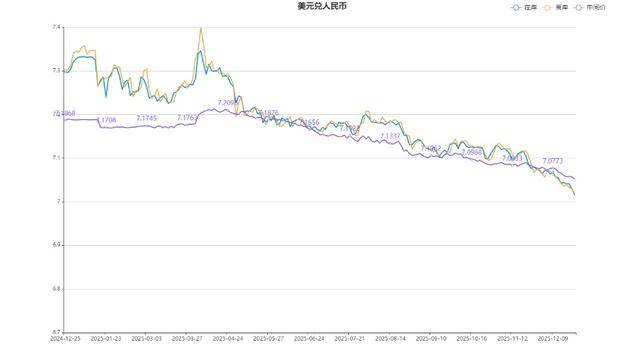
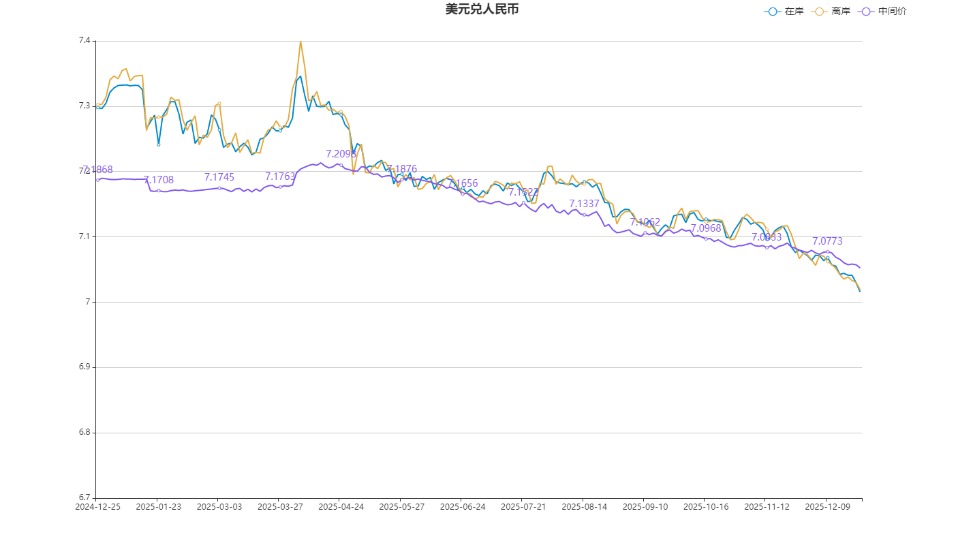
Core Viewpoint - The article discusses the recent strengthening of the offshore RMB against the USD, highlighting its significance as it broke the psychological barrier of 7.0, reaching a low of 6.99853 for the first time in 2024, with the onshore rate also rising to a new high of 7.0392 [1][4]. Group 1: RMB Exchange Rate Trends - In 2025, the RMB to USD exchange rate exhibited a "first decline, then rise, and fluctuating increase" pattern, starting the year around 7.27 and hitting a low of 7.42879 on April 8 due to the Fed's hawkish stance [2][3]. - A turning point occurred in the second half of the year as expectations of Fed rate cuts grew, leading to a decline in the USD index and a subsequent strengthening of the RMB, which broke the 7.1 mark on September 17 and accelerated its appreciation in December [4][5]. Group 2: Factors Driving RMB Strength - The primary driver of the RMB's recent strength is the weakening trend of the USD index, influenced by rising expectations of Fed rate cuts, which caused the USD index to fall below 100, benefiting non-USD currencies including the RMB [5]. - Seasonal demand for corporate currency settlement has also played a crucial role, as companies typically increase their settlement activities towards year-end, particularly when the RMB is appreciating, creating a cycle of "appreciation-settlement-further appreciation" [6]. - The central bank's liquidity management and expectations guidance have been significant, as it has not suppressed the RMB's appreciation and has adjusted counter-cyclical factors positively, indicating support for the current appreciation trend [7]. Group 3: Market Outlook - Market institutions express cautious optimism regarding the RMB's ability to maintain and effectively break the 7.0 barrier, with many predicting a continued appreciation in 2026 due to the structural weakness of the USD index and favorable economic conditions [8][9]. - Forecasts suggest that the RMB could reach levels between 6.7 and 6.8 by the end of 2026, with some analysts predicting the appreciation trend could extend into 2027, potentially reaching 6.20 to 6.30 [8][9].

人民币汇率,破7!
Sou Hu Cai Jing· 2025-12-25 04:49
Core Viewpoint - The recent appreciation of the Renminbi (RMB) against the US dollar is attributed to a combination of external pressures easing, internal resilience strengthening, precise policy adjustments, and a shift in market expectations [3]. Group 1: Factors Influencing RMB Appreciation - The direct driving force behind the current RMB appreciation is the changing environment of the US dollar, with market expectations that continued interest rate cuts by the Federal Reserve will suppress the long-term outlook for the dollar, providing external appreciation space for the RMB [4]. - Near the end of the year, increased demand for foreign exchange settlement by enterprises is contributing to the seasonal strengthening of the RMB, particularly as previous accumulated settlement demand may accelerate release following the recent RMB strength [4]. - The continuous appreciation of the RMB is expected to enhance the attractiveness of the domestic capital market to foreign capital, directly increasing foreign exchange earnings for investors [4]. Group 2: Future Outlook on RMB Exchange Rate - Experts predict that the RMB exchange rate will fluctuate around the 7 yuan mark, with a stable yet slightly strong operation expected, and the likelihood of rapid one-sided trends is low [4]. - The future decoupling of the RMB exchange rate from the US dollar index is anticipated to become a norm, with the RMB breaking the 7 yuan mark supported by both fundamental and policy factors [4]. - Looking ahead to 2026, the RMB is expected to maintain a moderate appreciation, influenced by a potentially weak US dollar index and a balanced approach to exchange rate policy by the central bank [5].