企业结汇

Search documents
美元没跌人民币却狂飙5600点!背后买家不是央行也非游资
Sou Hu Cai Jing· 2026-02-27 23:52
Core Viewpoint - The recent surge of the Chinese yuan against the US dollar, rising 5600 points, is primarily driven by export companies converting their accumulated dollars into yuan, rather than central bank intervention or speculative trading [1][4][6]. Group 1: Currency Movement - The onshore yuan has appreciated significantly, climbing from around 7.4 to 6.83 against the dollar, marking a notable increase over the past ten months [3][4]. - The US dollar index has remained stable within the 103-105 range, contradicting traditional expectations that a stable dollar would prevent a significant rise in the yuan [3][4]. Group 2: Export Companies' Role - Data from the State Administration of Foreign Exchange indicates that in January 2026, banks recorded a settlement of $286.3 billion and a sale of $206.5 billion, resulting in a settlement surplus of $79.8 billion, with export companies showing a high willingness to convert currencies [4][5]. - The surge in the yuan is attributed to the large-scale conversion of dollars by export companies, which have been holding onto dollars for three years due to high interest rates and concerns over yuan volatility [5][6]. Group 3: Economic Context - The domestic economy is recovering, increasing the attractiveness of yuan-denominated assets, while declining dollar interest rates have made holding dollars less profitable for companies [6][7]. - The need for yuan has intensified as factories resume operations post-holiday, creating a demand for local currency to pay wages and suppliers, prompting a collective move among exporters to convert dollars [6][7]. Group 4: Market Dynamics - The current currency dynamics reflect real economic activities rather than speculative maneuvers, with export companies' cash flows driving the demand for yuan [7]. - The central bank's policy of allowing market forces to dictate currency value has contributed to a stable environment for both consumers and exporters, benefiting the overall economy [7].


人民币破6.9,这波升值能持续多久?
Sou Hu Cai Jing· 2026-02-26 03:00
Core Viewpoint - The recent appreciation of the offshore RMB against the USD, surpassing the 6.9 mark, is attributed to both external and internal factors, with a weaker USD and a stronger domestic economic foundation being key contributors [1]. External Factors - The weakening of the USD has been a significant support factor, with the Federal Reserve having cut rates three times since 2025, totaling 75 basis points, and the USD index dropping by 9.41% last year [1]. - The USD fell to around 97 early this year, compounded by investigations into the Federal Reserve Chairman, which negatively impacted the USD's credibility [1]. Internal Factors - China's trade surplus reached a historical high of $1.19 trillion in 2025, indicating a robust inflow of USD, which strengthens the RMB [2]. - Companies have begun to convert their USD holdings into RMB, with bank customer foreign exchange settlement surpluses reaching $99.93 billion and $88.76 billion in December 2025 and January 2026, respectively, marking historical highs [2]. - Foreign exchange reserves increased from $3.2 trillion at the end of 2024 to $3.4 trillion in January 2026, remaining above $3.3 trillion for six consecutive months, signaling positive market sentiment [2]. - Improved Sino-US relations, particularly in tariff negotiations since November 2025, have reduced external uncertainties, contributing to a more stable exchange rate [2]. Future Outlook - Major institutions predict the RMB could appreciate to around 6.7 by the end of the year, indicating a potential 2.2% increase from the current level of 6.85 [2]. - The expectation of an additional 50 basis points cut by the Federal Reserve this year supports the outlook for a weaker USD, while the resilience of exports and continued foreign investment in RMB assets are also positive indicators [2]. Potential Challenges - The central bank aims to prevent rapid appreciation of the RMB to protect export-oriented businesses, with measures in place to keep the midpoint exchange rate slightly weaker since December [3]. - Seasonal factors may lead to a typical decline in RMB value during the February to March period, which is traditionally a low season for currency conversion [3]. - External risks remain, including potential inflation rebounds in the US that could delay rate cuts, or geopolitical tensions that might cause the USD to strengthen [3].
人民币暴走!6.88关口告破,外贸老板们春节睡得着吗?
Sou Hu Cai Jing· 2026-02-19 04:05
Core Viewpoint - The offshore RMB has surged past the 6.89 mark against the USD, reaching a low of 6.8825, marking a three-year high, driven primarily by corporate foreign exchange settlements rather than central bank intervention [1][3] Group 1: Market Dynamics - The RMB appreciated approximately 1.3% from the beginning of 2026 to February 11, while the USD index fell nearly 4%, indicating that the RMB's strength is partly due to the USD's weakness [5] - China's merchandise trade surplus reached a record high of $1.076 trillion in 2025, leading to a significant accumulation of USD by Chinese enterprises [5][7] - An estimated $1.1 trillion in pending foreign exchange settlements has built up over the past three years, with the Chinese New Year acting as a catalyst for a surge in corporate settlements [7] Group 2: Corporate Impact - The surge in RMB value has pressured profit margins for exporters, particularly in labor-intensive sectors like textiles, toys, and furniture, where even slight fluctuations in exchange rates can turn profits into losses [11][13] - Some companies are forced to lower prices to maintain orders, as the strong RMB diminishes their competitive pricing advantage in the global market [13] Group 3: Central Bank Response - The People's Bank of China (PBOC) has signaled that it will not allow excessive appreciation of the RMB while also preventing competitive devaluation, aiming for stability at a reasonable equilibrium [13][15] - The PBOC has a range of tools at its disposal to manage currency fluctuations, including adjusting foreign exchange reserve requirements and utilizing macro-prudential parameters for cross-border financing [15]
企业结汇意愿增加,是否影响银行间流动性?
Orient Securities· 2026-02-04 02:46
Investment Rating - The report maintains a "Positive" outlook for the banking sector in 2026 [5] Core Insights - The banking sector is expected to return to fundamental narratives in 2026, supported by policy financial tools and resilient asset expansion. The sector is still in a deposit repricing cycle, which is likely to stabilize net interest margins. Structural risks are anticipated to be supported by policy measures [3][32] - The report highlights two main investment themes: 1. High-quality small and medium-sized banks with confirmed fundamentals, including Nanjing Bank (601009, Buy), Ningbo Bank (002142, Buy), and Chongqing Rural Commercial Bank (601077, Buy) 2. State-owned large banks with stable fundamentals and good defensive value, including Bank of Communications (601328, Not Rated) and Industrial and Commercial Bank of China (601398, Not Rated) [3][32] Summary by Sections Impact of Corporate Foreign Exchange Settlement on Interbank Liquidity - Corporate foreign exchange settlement has increased due to the continuous appreciation of the RMB, with a record high of USD 99.9 billion in December 2025. The strong RMB trend is expected to maintain high settlement levels throughout 2026 [8][11] - The settlement process involves two stages: 1. Corporates settle with commercial banks, leading to a decrease in foreign currency deposits and a corresponding decrease in excess reserves. This results in an increase in RMB deposits and a need for banks to match more statutory reserves, which may reduce excess reserves [10][13] 2. If commercial banks settle with the central bank, it results in a decrease in foreign currency assets and an increase in excess reserves, thereby injecting liquidity into the market [10][13] Current Liquidity Conditions - Current liquidity is relatively loose, supported by the central bank's clear stance on maintaining liquidity and stable growth in deposits. Concerns about deposit disintermediation have not materialized, and the overall disintermediation pressure remains moderate [26][32] - The central bank has net injected CNY 1 trillion in medium- and long-term funds through various operations, indicating a proactive approach to liquidity management [15][32]





特朗普“悠悠球论”神助攻,美元创近四年新低,人民币升值动力拉满?
Jin Rong Jie· 2026-01-30 01:20
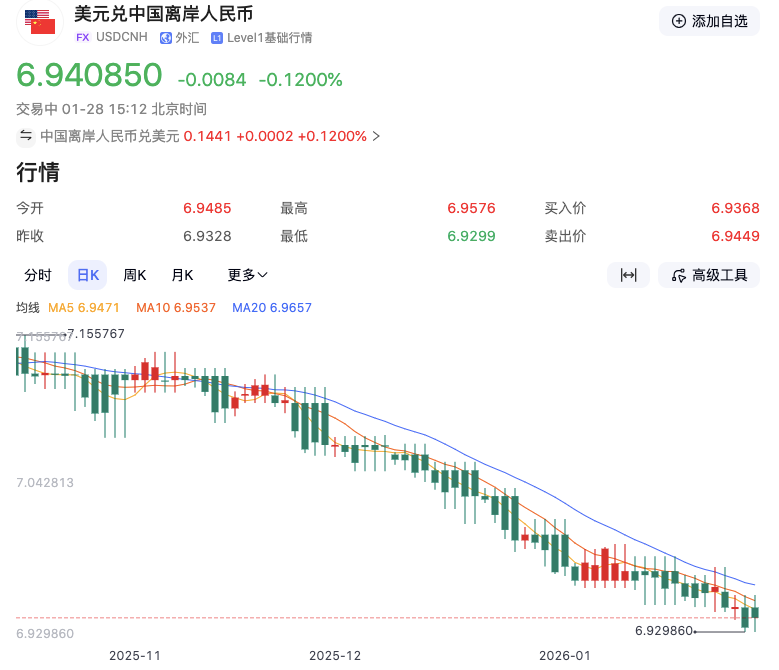
Core Viewpoint - The Chinese yuan has strengthened significantly against the US dollar, with the onshore and offshore yuan breaking the 7 mark, driven by multiple factors including policy guidance, seasonal factors, and the depreciation of the dollar [1][3]. Group 1: External Factors - The continuous weakening of the US dollar has provided ample space for the yuan's appreciation, becoming a core driver of its strength [4]. - The dollar index fell by 9% last year, marking its worst performance since 2017, influenced by former President Trump's comments on the dollar's volatility [4][5]. - The Federal Reserve's decision to maintain interest rates has led to expectations of future rate cuts, further weakening the dollar's appeal [6]. Group 2: Domestic Factors - The steady recovery of China's economic fundamentals and precise policy guidance have provided solid internal support for the yuan's exchange rate [7]. - China's GDP reached 140 trillion yuan in 2025, growing by 5.0% year-on-year, which has improved global market confidence in the yuan [7]. - Seasonal factors, such as year-end currency settlement peaks and proactive foreign exchange sales by export enterprises, have created a positive supply-demand cycle, driving the offshore yuan's appreciation [8]. Group 3: Market Dynamics - Increased demand for yuan due to enterprises accelerating their dollar sales to meet year-end financial obligations has further strengthened the yuan [8]. - In December 2025, banks recorded a net settlement of $99.93 billion, a new high, indicating strong corporate demand for yuan [8]. Group 4: Future Outlook - Analysts predict that the yuan will continue to exhibit a trend of stable appreciation and two-way fluctuations, with short-term upward momentum supported by ongoing corporate settlement demands and global capital flows into yuan assets [9]. - The long-term trajectory of the yuan will ultimately depend on the continuous improvement of China's economic fundamentals, with potential upward pressure on the yuan's international status [9].
升值结汇对流动性、PPI和市场的影响分析
ZHONGTAI SECURITIES· 2026-01-13 13:39
Group 1: Exchange Settlement Overview - The estimated "pending settlement" amount for enterprises is approximately $930 billion, accumulated from early 2022 to November 2025[1] - The willingness of export enterprises to settle foreign exchange is expected to improve in 2025 due to the RMB entering an appreciation cycle and strong performance of Chinese financial assets[1] - By the end of 2026, if 20% of the pending settlement is realized, it could lead to an increase in M1 by approximately 1.3 trillion RMB, contributing about 1.2 percentage points to M1 growth[1] Group 2: Impact on Liquidity and Market - Enterprise settlement essentially converts foreign exchange assets into RMB deposits, affecting the balance sheets of central banks, commercial banks, and enterprises[1] - The relationship between M1 growth and PPI typically shows that M1 growth leads PPI growth by 2-3 quarters, but the current M1 increase may have limited impact on PPI due to insufficient effective demand[1] - High-risk enterprises may channel some of the funds from settlements into the stock market, potentially providing incremental capital to the A-share market[1] Group 3: Risks and Considerations - Risks include domestic policy effectiveness falling short of expectations, potential data distortion from third-party sources, and the possibility of measurement deviations[1] - The analysis indicates that while M1 growth is expected, its direct influence on corporate profitability may be limited due to the different driving factors compared to previous cycles[1]
升值结汇对流动性、PPI和市场的影响分析
李迅雷金融与投资· 2026-01-13 12:44
Core Viewpoint - In recent years, Chinese export enterprises have shown a clear tendency to "hold foreign exchange without settling." Starting from early 2025, as the RMB enters an appreciation cycle and Chinese assets are revalued, the willingness of enterprises to settle foreign exchange is expected to rebound. The recent RMB exchange rate against the USD has broken through 7.0, and mainstream expectations suggest that the RMB will continue to appreciate, further stimulating enterprises' settlement sentiment and positively impacting liquidity and the market [2][3][12]. Group 1: Settlement Willingness and Scale - The "pending settlement" scale for enterprises is approximately $930 billion, with an expected increase in settlement willingness by 2025. From early 2022 to November 2025, export enterprises accumulated $930 billion in foreign exchange that has not been settled [3][7]. - The settlement rate, which measures the proportion of foreign exchange that enterprises actively convert to RMB, is a good indicator of their willingness to settle. A higher settlement rate indicates stronger willingness [8][10]. - Since early 2025, the settlement rate has improved significantly, rising from a low of 54.4% in February 2025 to a high of 71.2% in September 2025, indicating a shift from "holding foreign exchange" to "steady settlement" [10][11]. Group 2: Factors Influencing Settlement Willingness - Two main factors influence enterprises' willingness to settle: expectations regarding the RMB exchange rate and the comparative returns of holding different currencies. When enterprises expect the RMB to appreciate, they are more inclined to settle early to avoid exchange losses [11][13]. - The attractiveness of RMB assets has increased due to favorable developments in sectors like innovative pharmaceuticals and effective responses to trade tensions, which have boosted risk appetite and improved the performance of Chinese financial assets [13][14]. Group 3: Impact on Liquidity and Market - The settlement of foreign exchange essentially converts foreign assets into RMB deposits, impacting the balance sheets of the central bank, commercial banks, and enterprises. However, the effect on the base currency supply is minimal if commercial banks do not sell the foreign exchange to the central bank [15][20]. - If 20% of the pending settlement is realized by the end of 2026, it could lead to an increase in M1 by approximately 1.3 trillion RMB, contributing about 1.2 percentage points to M1 growth [24][27]. - The increase in M1 is expected to have limited impact on PPI due to insufficient effective demand, and some high-risk enterprises may channel funds into the stock market, providing incremental capital to A-shares [27][28][31].

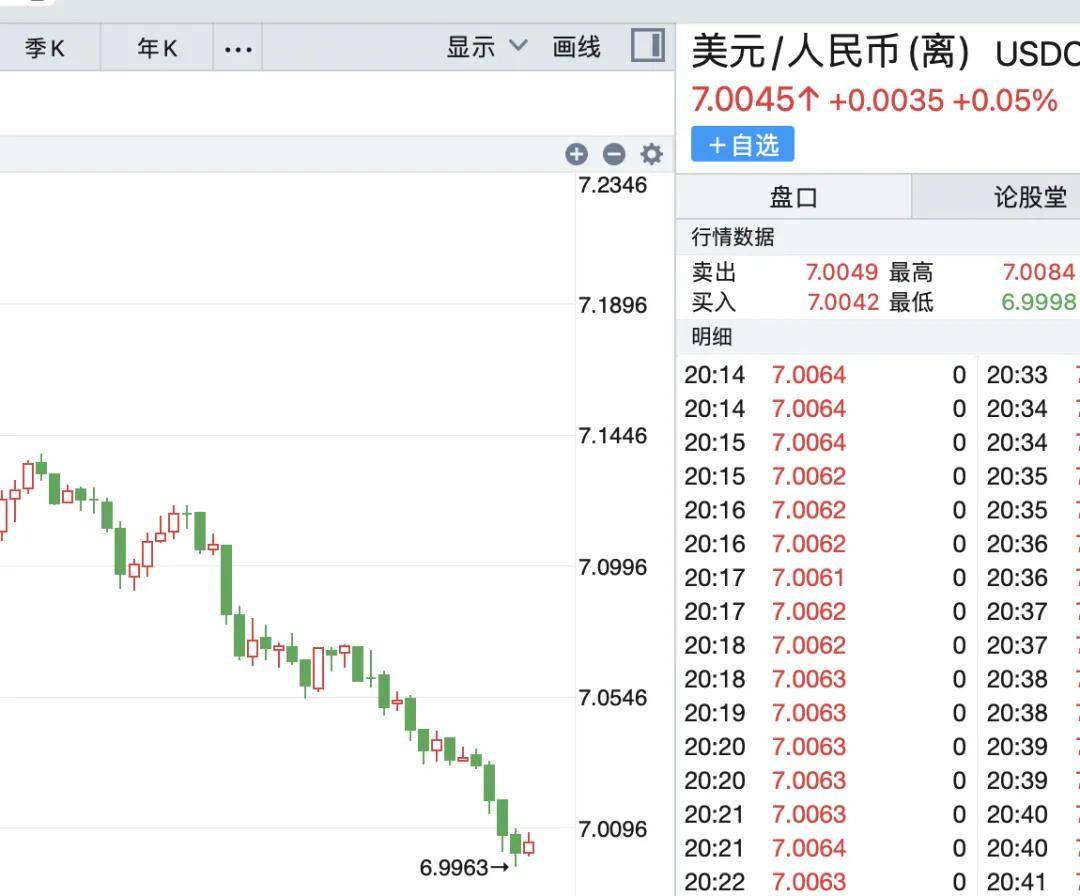
离岸人民币升破7.0关口
Sou Hu Cai Jing· 2025-12-31 08:37
Core Viewpoint - The offshore RMB has strengthened against the USD, breaking the 7.0 threshold for the first time since September 2024, primarily due to the Federal Reserve's interest rate cuts and other supportive factors [1]. Group 1: Currency Exchange Rate - On December 25, the offshore RMB to USD exchange rate was reported at 6.9999, with an intraday high of 6.9981 [1]. - The recent appreciation of the RMB is attributed to the Federal Reserve's decision to lower the federal funds rate target range to 3.5%-3.75% on December 10, marking the sixth rate cut of the year [1]. Group 2: Trade and Economic Factors - China's trade surplus exceeded 1 trillion USD for the first 11 months of the year, contributing to the RMB's strength [1]. - The end-of-year demand for corporate foreign exchange settlements and reduced currency intervention policies have also supported the RMB's appreciation [1]. Group 3: Market Reactions - The breaking of the 7.0 threshold has triggered a wave of foreign exchange settlements among export companies and cross-border e-commerce sellers, with many considering it an opportune time to settle before the Spring Festival [1]. - Large enterprises are utilizing foreign exchange hedging tools to mitigate currency risk [1]. Group 4: Future Predictions - Analysts predict that the RMB may continue to appreciate moderately, potentially reaching a level of 6.7 by the end of 2026 [1].

重返“6时代”:人民币升值的全球变量与家庭账单
Sou Hu Cai Jing· 2025-12-30 13:04
Core Insights - The offshore RMB has officially broken the "7" mark against the USD for the first time since October 2024, indicating a significant shift in the currency's trend [1][2] - The recent appreciation of the RMB is attributed to both external factors, such as the Federal Reserve's monetary policy shift, and strong internal economic fundamentals [3] External Factors - The Federal Reserve's recent interest rate cuts have led to a weakening of the USD, contributing to the RMB's rise [3] - The RMB's appreciation is also supported by China's economic resilience, with a notable trade surplus exceeding $1 trillion in the first eleven months of the year [4] Corporate Impact - Importing companies benefit from the RMB's appreciation, as it reduces procurement costs. For instance, a large manufacturing firm estimates saving 10 million RMB monthly due to favorable exchange rates [5] - Conversely, export-oriented companies face pressure on profit margins due to the stronger RMB, necessitating a reassessment of order feasibility [5] - Over 30 A-share companies have announced plans to engage in foreign exchange hedging to mitigate risks associated with currency fluctuations [5] Consumer Impact - The appreciation of the RMB has tangible benefits for consumers, particularly for families planning to study abroad, as it reduces the cost of tuition significantly [6] - Travel and shopping costs for overseas consumers are also decreasing, enhancing the affordability of international experiences [7] Policy Stance - Financial regulatory bodies emphasize maintaining the RMB's stability at a reasonable level, with recent meetings reinforcing the need for market resilience and preventing excessive fluctuations [8] Future Outlook - Market analysts express cautious optimism regarding the RMB's future, with expectations of continued strength in the short term [9] - Predictions for 2026 suggest a moderate appreciation trend, with estimates indicating the RMB could approach the 6.9 mark by year-end [9]
1美元=6.99人民币!人民币一度涨破“7”,对A股意味着什么?
Sou Hu Cai Jing· 2025-12-26 13:17
Group 1 - The offshore RMB against the USD recently broke the 7.0 mark, reaching a 15-month high, indicating a strong upward trend for the RMB in the near future [1] - The rise in the RMB is supported by China's strong manufacturing competitiveness and technological capabilities, highlighted by advancements in AI and robotics [2][3] - The narrowing of the interest rate differential between China and the US, with the Fed expected to cut rates more frequently than the PBOC, is contributing to reduced capital outflow pressure and a stronger RMB outlook [3] Group 2 - The appreciation of the RMB is expected to boost the A-share market, as foreign capital inflows are likely to increase, driving asset appreciation [5] - Historical trends show that the A-share market often rises alongside the RMB, with significant gains observed during previous RMB appreciation periods [5] - Foreign investment firms are optimistic about the A-share market, predicting continued growth in corporate earnings and stock performance in 2026 [5]