长期投资

Search documents
“股神”徐翔是一个怎么样的人?
Sou Hu Cai Jing· 2025-05-31 11:24
Group 1 - The article discusses the controversial yet significant figure of Xu Xiang, known for his unique investment style and long-term high returns, leaving a legendary mark in the investment community [2] - Xu Xiang's early life was characterized by hard work and a strong dedication to studying finance, which laid the foundation for his future success in the securities industry [5][6] - His investment firm, Zexi, was known for its aggressive trading style and strict performance standards, focusing on absolute returns while also considering relative performance [12][13] Group 2 - Xu Xiang's work ethic was highlighted by his dedication to studying the stock market for over 12 hours a day, demonstrating an intense focus that contributed to his investment success [8][9] - The firm Zexi employed a rigorous assessment method for its researchers, emphasizing the importance of stock recommendations that would yield immediate gains and maintaining strict stop-loss measures [13][14] - The article illustrates the concept of contrarian thinking in investing, where Xu Xiang often went against prevailing market sentiments, leading to successful outcomes [14][18] Group 3 - The case of Chongqing Brewery is presented as a classic example of Xu Xiang's investment strategy, where he capitalized on market misjudgments despite negative news, showcasing the psychological aspects of stock trading [17][18] - The narrative emphasizes the importance of resilience in the face of market volatility, as demonstrated by Zexi's ability to recover from significant losses due to unforeseen events [19]


平安获批设立私募基金 保险系证券私募再现新进展
Mei Ri Jing Ji Xin Wen· 2025-05-30 13:40
Group 1 - Ping An Asset Management has received official approval from the National Financial Regulatory Administration to establish Hengyi Holding (Shenzhen) Private Fund Management Co., Ltd. [1] - The first phase of Hengyi Holding's fund will have a scale of 30 billion yuan, focusing on "long-term investment and value investment" in high-quality listed companies that align with policy guidance and insurance capital allocation needs [2] - The registered capital of Hengyi Holding is 300 million yuan, and it will be located in Qianhai, Shenzhen [2] Group 2 - Several insurance companies have recently applied for or received approval to participate in long-term investment pilot programs [3] - The total balance of insurance funds in China reached 34.9 trillion yuan by the end of the first quarter of 2025, showing a year-on-year growth of 16.7% [4] - The proportion of stock allocation by insurance funds has increased, with life insurance companies reaching 8.4% and property insurance companies at 7.6%, marking recent highs [4] Group 3 - The trend of increasing stock allocation by insurance funds is a response to policy encouragement and aims to address investment bottlenecks [4] - High dividend stocks are expected to become a significant focus for insurance companies in the context of low interest rates, with an anticipated annual increase of 300 billion to 400 billion yuan in high dividend allocations over the next three years [4]

招银理财总裁助理董倩:将重心放在R3含权产品线,保持绝对收益基本盘
Cai Jing Wang· 2025-05-29 11:37
Core Viewpoint - The article emphasizes the importance of long-term investment and value investing in the capital market, particularly in light of new policies aimed at promoting long-term funds into the market [1] Group 1: Policy and Market Environment - The new "National Nine Articles" policy aims to significantly boost long-term capital inflow into the market, which is crucial for the healthy and stable development of the capital market [1] - The banking wealth management sector, with a scale of 30 trillion, is expected to inject substantial liquidity into the capital market, benefiting the real economy [1] Group 2: Company Strategy and Product Development - 招银理财 has established an independent equity investment department since 2019 and has been innovating in fee structures, such as launching the first equity product that does not charge management fees if the net value is below 1 [5] - The company has developed a multi-asset strategy brand called "全+福," which includes various strategies like value+, dividend+, and index+ to adapt to different market conditions [7] - 招银理财 aims to enhance its investment strategies and product functionalities, focusing on absolute return goals while also considering relative returns [5][7] Group 3: Investment Roles and Market Stability - 招银理财 plays multiple roles in the market, including being a long-term capital "introducer," a "stabilizer" for the capital market, and a "promoter" of industrial upgrades through participation in equity financing [6] - The company has reported that its PR3 and above equity products have reached over 200 billion, accounting for about one-third of the bank wealth management market [7] Group 4: Investment Trends and Future Outlook - The company sees "固收+" products as a key strategy for increasing equity investment, as they offer a balanced risk-return profile and are well-received by clients with lower risk tolerance [8] - 招银理财 is also focusing on enhancing investor education to improve confidence in equity products, employing a tiered educational approach tailored to different risk preferences [17] - The company anticipates that the proportion of equity assets in wealth management will gradually increase, with a more diversified asset allocation strategy in response to the low-interest-rate environment [20]

5·15专栏丨申万宏源证券开展5·15“投教进百校”活动—走进上海对外经贸大学
申万宏源证券上海北京西路营业部· 2025-05-29 02:24
Core Viewpoint - The article emphasizes the importance of financial education for university students, particularly in the context of preventing illegal investment activities and enhancing financial literacy among the youth [2][4]. Group 1: Financial Education Initiatives - The investment department organized a "financial education into universities" event at Shanghai University of International Business and Economics, engaging nearly 200 students in a financial literacy program [2]. - The initiative aims to integrate financial knowledge into the national education system, thereby improving the financial literacy and risk awareness of young people [2][5]. Group 2: Awareness of Illegal Activities - The department focuses on raising awareness about various illegal financial activities, including fraudulent stock recommendations, illegal fund transfers, and unauthorized trading services [4]. - Students are cautioned against schemes that promise insider information or expert recommendations, which often target inexperienced investors and can lead to financial losses [4]. Group 3: Risk Prevention and Personal Security - The article highlights the importance of verifying the legitimacy of investment consulting firms through regulatory websites and emphasizes the need for students to protect their personal information online [4]. - Students are encouraged to remain vigilant against suspicious investment offers and to consult regulatory bodies or their university when encountering potential scams [4]. Group 4: Long-term Investment Philosophy - The investment department commits to promoting rational, value-based, and long-term investment philosophies among students, contributing to a stable capital market [5]. - The article concludes with a call for students to adopt a proactive mindset in safeguarding national security and personal financial well-being [6].
精彩抢先看|秒懂金融·资管行业践行“三投资”理念优秀实践系列访谈之太平资产
第一财经· 2025-05-28 07:00
Core Viewpoint - The article emphasizes the promotion of the "Three Investment" philosophy in the asset management industry, aiming to encourage rational, value, and long-term investments, in line with the directives from the Central Financial Work Conference and the new "National Nine Articles" [1] Group 1 - The Shanghai Municipal Financial Committee and the Shanghai Stock Exchange are guiding the first exhibition of excellent practices in the asset management industry to promote the "Three Investment" philosophy [1] - The initiative aims to deepen investors' understanding of the asset management industry and its managers through interviews with outstanding asset management institutions [1] - The program will feature insights from various sectors of the asset management field, including public funds, bank wealth management, insurance asset management, trust companies, and securities asset management [1] Group 2 - The program invites executives from Taiping Asset Management to discuss how they leverage insurance capital advantages and innovate assessment mechanisms, upgrade risk control systems, and restructure investment research capabilities [1] - The discussion will focus on matching capital attributes with asset characteristics across cycles to support the stable development of China's capital market and the high-quality growth of the national economy [1]

每日市场观察-20250526
Caida Securities· 2025-05-26 13:40
Market Overview - The Shanghai and Shenzhen markets opened lower and experienced a downward trend, with the Shanghai Composite Index falling by 0.94% and the Shenzhen Component Index by 0.85% on May 23[2] - The ChiNext Index saw a decline of 1.18%, indicating a bearish sentiment in the market[2] Fund Flow - On May 23, the net outflow from the Shanghai Stock Exchange was 32.96 billion yuan, while the Shenzhen Stock Exchange saw a net outflow of 20.05 billion yuan[3][4] - The top three sectors for capital inflow were passenger vehicles, chemical pharmaceuticals, and automotive parts[4] Industry Trends - The online sales of digital products grew by 8.4% from January to April 2025, with smart robots and smart home systems increasing by 87.6% and 16% respectively[9] - The real estate market showed signs of stabilization in Q1 2025, with improved transaction metrics and a focus on high-quality land resources in first and second-tier cities[11] Investment Recommendations - Short-term focus should be on rotation opportunities in defensive sectors, while long-term investments should target technology sectors and industries supported by national policies[1] - Investors are encouraged to leverage short-term adjustments to identify suitable investment opportunities[1] Fund Dynamics - A total of 139 funds have ended their fundraising early this year, with equity funds making up over 50% of this total, reflecting a 10.5 percentage point increase from the previous year[13]
卡塔尔经济论坛第二天活动的要点回顾:科威特称“低配美股”需要自担风险
news flash· 2025-05-21 23:03
Group 1 - The Kuwait Investment Authority's Managing Director, Sheikh Saud Salim Abdulaziz Al Sabah, emphasizes a commitment to long-term investments in the U.S. but warns about the diminishing time for capital returns to investors [1] - Donald Trump Jr. defends the tariffs imposed by his father as a means to promote U.S. economic growth and hints at a potential future presidential run [1] - Former U.S. Treasury Secretary Steven Mnuchin expresses greater concern over the U.S. budget deficit than trade issues, urging for "fiscal repair" [1]
投资者保护工作路漫漫其修远兮
Zheng Quan Ri Bao· 2025-05-21 17:22
■择远 历时五天的第七届"5·15—5·19中小投资者保护宣传周"公益活动于5月19日圆满结束。 这是一场倡导理性投资、价值投资、长期投资,防范风险的金融知识普及的盛宴。五天的时间里,在北 京、深圳和上海,《证券日报》与投资者一起,聆听了资本市场各个参与主体的真知灼见,深切感受到 了他们对投资者保护工作的满腔热情。 保护投资者特别是中小投资者的合法权益,是资本市场工作政治性、人民性的集中体现,承载着万千投 资者的切身利益与美好期许。这在客观上就需要市场各方凝聚共识、共同努力,协同推进投资者保护工 作:不断健全投资者保护长效机制,合力培育成熟理性的投资文化,积极营造崇法守信的市场生态,切 实增强投资者对资本市场的信任和信心,提升投资者的获得感、安全感和参与感,推动资本市场高质量 发展。 这充分体现了保护投资者的鲜明导向,也是媒体必须积极践行的职责。唯有向投资者传递权威的声音、 普及更多的知识、倡导正确的投资理念,才能在投资者保护的道路上行稳致远,切实成为投资者保护的 引领者、推动者。我们是这么说的,也是这么做的。 作为"社会公器"的媒体必须要积极履行好社会责任。因为这是投资者了解政策、获取信息、形成预期的 重要 ...
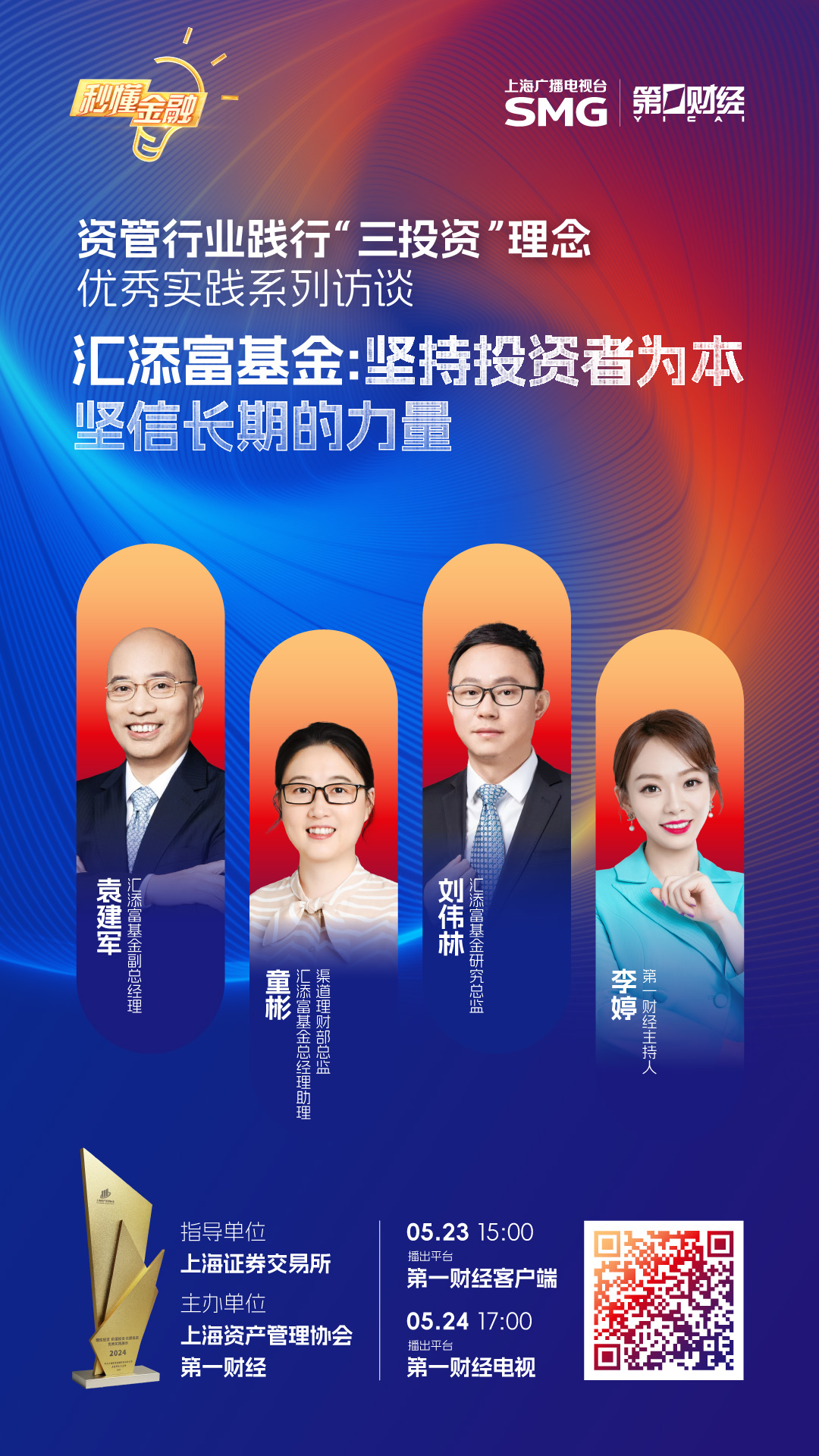
精彩抢先看|秒懂金融·资管行业践行“三投资”理念优秀实践系列访谈之汇添富基金
第一财经· 2025-05-21 09:44
Group 1 - The article emphasizes the importance of promoting the "Three Investment" philosophy in the asset management industry to encourage rational, value, and long-term investment practices [1] - The Shanghai Asset Management Association, in collaboration with the Shanghai Stock Exchange and other organizations, is conducting the first showcase of excellent practices in the asset management industry to advocate for this philosophy [1] - The program features interviews with representatives from various asset management sectors, including public funds, bank wealth management, insurance asset management, trust companies, and brokerage asset management, to share their experiences and insights on the "Three Investment" philosophy [1] Group 2 - The program will discuss how public funds can enhance investor returns and the shift from scale-oriented to return-oriented strategies, which will support the sustainable development of the industry [1] - The increasing number of ETF and index fund products raises questions about how investors should scientifically allocate their investments [1] - The program includes insights from senior executives at Huatai-PineBridge Fund, focusing on how they strengthen investor returns through standardized investment management and productized services [1]

精彩抢先看|秒懂金融·资管行业践行“三投资”理念优秀实践系列访谈之汇添富基金
Di Yi Cai Jing· 2025-05-21 07:13
Group 1 - The article emphasizes the implementation of the "Three Investment" philosophy to promote rational, value, and long-term investment strategies in the asset management industry [1] - The Shanghai Asset Management Association, in collaboration with the Shanghai Stock Exchange and First Financial, is organizing the first showcase of excellent practices in the asset management industry to advocate for the "Three Investment" concept [1] - The program will feature interviews with representatives from various asset management sectors, including public funds, bank wealth management, insurance asset management, trust companies, and securities asset management [1] Group 2 - The program aims to discuss how public funds can enhance investor returns and transition from a scale-oriented approach to a return-oriented approach, contributing to the sustainable development of the industry [1] - The increasing number of ETF and index fund products raises questions about how investors should scientifically allocate their investments [1] - Guests from Huatai-PineBridge Fund will share insights on how they strengthen investor returns through standardized investment management and productized services, contributing to the inflow of long-term capital into the market [1]