
人形机器人商业化

Search documents
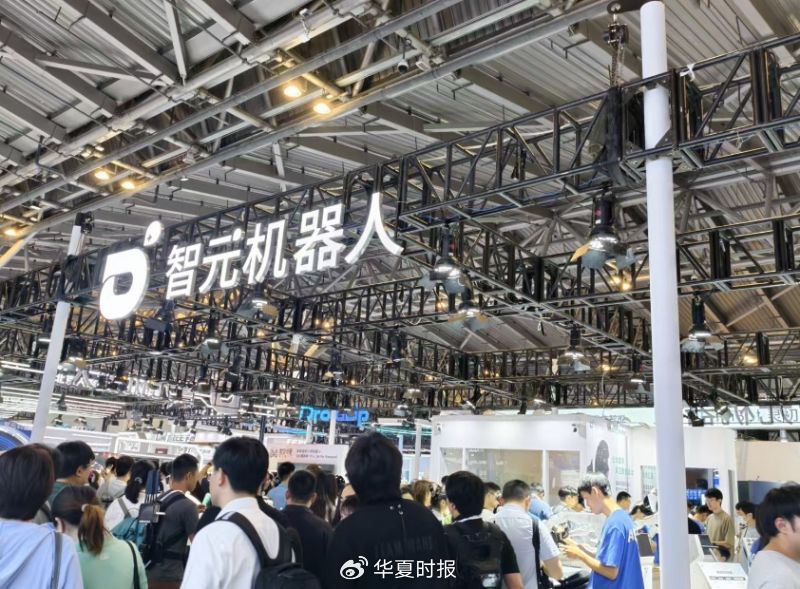
智元合伙人姚卯青:成本优化后服役两年可打平人力
Xin Lang Cai Jing· 2025-10-17 15:50
Core Insights - The lifecycle of humanoid robots is designed around a three-year metric, with the potential for cost parity with human labor after scaling production [2] - The company has become one of the leading humanoid robot manufacturers in China, recently announcing significant orders for its new industrial-grade interactive robot, the ZhiYuan Spirit G2 [2][5] - The company aims for overseas revenue to account for over 30% of total income by next year, reflecting its ambition to expand beyond domestic markets [2][7] Product Development - The ZhiYuan Spirit G2 features significant upgrades in hardware performance, control precision, and interactive intelligence compared to its predecessor, the G1, which has sold over 1,000 units [2][3] - The G2's design allows for enhanced flexibility and efficiency, enabling it to perform tasks that previously required multiple robots with just one [3] - The G2 is a wheeled humanoid robot, chosen for its advantages in stable environments, longer endurance, and lower manufacturing costs compared to bipedal robots [4] Commercialization Progress - The company has secured substantial framework orders, including a multi-million dollar contract with Longqi Technology and a significant order from Junsheng Electronics [5][6] - The humanoid robot industry is entering a commercialization phase, with several companies, including ZhiYuan, reporting considerable order volumes [5] - The company has seen a significant increase in delivery volumes, achieving thousands of units delivered from January to September this year [6] Cost Efficiency and Market Strategy - The company estimates that deploying a robot to replace two or three shifts of human workers can achieve cost parity or even greater economic efficiency [7] - Labor costs for human workers in certain regions can reach over 300,000 yuan for two years, making robots an attractive alternative, especially in overseas markets with higher labor costs [7] - The company is implementing a global strategy, including building a distribution network and local partnerships for design, production, and sales [8]

渤海证券研究所晨会纪要(2025.10.16)-20251016
BOHAI SECURITIES· 2025-10-16 02:58
Core Insights - The report indicates a significant recovery in the construction machinery sector, with excavator sales reaching 19,858 units in September, representing a year-on-year increase of 25.4% [2][3] - Loader sales also showed strong growth, with 10,530 units sold in September, marking a 30.5% year-on-year increase [2][3] - The average working hours for major construction machinery products in September was 78.1 hours, reflecting increased utilization [2] Industry News - The Ministry of Industry and Information Technology, along with five other departments, issued a "Work Plan for Stabilizing Growth in the Machinery Industry (2025-2026)", emphasizing the need to expand effective demand and enhance equipment updates [3] - The report highlights that downstream demand for construction machinery is expected to grow due to ongoing projects in hydropower and urban renewal, as well as reduced tariff disturbances in major global regions, enhancing the cost-performance advantage of domestic machinery [3] Company Announcements - Zongshen Power announced a profit forecast for the first three quarters of 2025, expecting a year-on-year increase in net profit of 70%-100% [2] - Inovance Technology reported a 40.19% year-on-year increase in revenue for the first three quarters of 2025 [2] Market Review - From October 8 to October 14, 2025, the CSI 300 Index fell by 2.19%, while the Shenwan Machinery Equipment Industry Index declined by 2.97%, underperforming the CSI 300 by 0.78 percentage points [2] - As of October 14, 2025, the price-to-earnings ratio (TTM) for the Shenwan Machinery Equipment Industry was 31.41 times, with a valuation premium of 135.85% relative to the CSI 300 [2] Future Outlook - The report maintains a "positive" rating for the industry, with a recommendation to continue monitoring investment opportunities in the supply chain, particularly in humanoid robotics, as the industry transitions from a technology race to a commercialization phase [3] - The report suggests that the ongoing large-scale equipment update policies will likely sustain the industry's recovery momentum [3]




软件与服务行业:FIGURE 03正式发布 人形机器人持续迭代
Xin Lang Cai Jing· 2025-10-14 00:32
Core Insights - Figure AI has launched its next-generation robot, Figure 03, capable of performing various household tasks such as serving tea, doing laundry, and folding clothes [1] Group 1: Product Features - Figure 03 features a redesigned sensor suite and hand system, enhancing its adaptability for a wider range of applications [2] - The visual system of Figure 03 includes a new camera architecture that doubles the frame rate, reduces latency to one-fourth, and expands the single-camera field of view by 60%, providing higher density and more stable perception data [2] - The hand system has been improved with softer, more adaptable materials, increasing contact area for better stability in grasping various objects, thus enhancing dexterity and tactile perception [2] Group 2: AI and Decision-Making - The Helix AI system enables Figure 03 to make autonomous decisions by integrating perception, language understanding, and learning control, allowing it to process natural language commands and execute complex actions without pre-set scripts [3] - The hardware upgrades of Figure 03 are designed to support the Helix system, creating a more precise sensory apparatus and flexible execution limbs [3] Group 3: Commercialization and Production - Figure 03 is designed for high-volume manufacturing, with a dedicated factory, BotQ, initially planned to produce 12,000 units annually, aiming for a cumulative production of 100,000 units over four years [4] - The company has implemented a vertical integration strategy for key components, significantly reducing unit manufacturing costs while ensuring quality and delivery standards [4] - The launch of Figure 03 is expected to accelerate commercialization and may serve as a model for domestic robot manufacturers [4] Group 4: Investment Opportunities - The release of Figure 03 indicates progress in commercialization, with potential for the robot to transition from the technology exploration phase to the commercial growth phase [4] - Investment opportunities may arise in sectors related to robotic operating systems and large-scale robot models [4]

马斯克全职回归,Optimus秀功夫,人形机器人量产来袭
Sou Hu Cai Jing· 2025-10-06 02:11
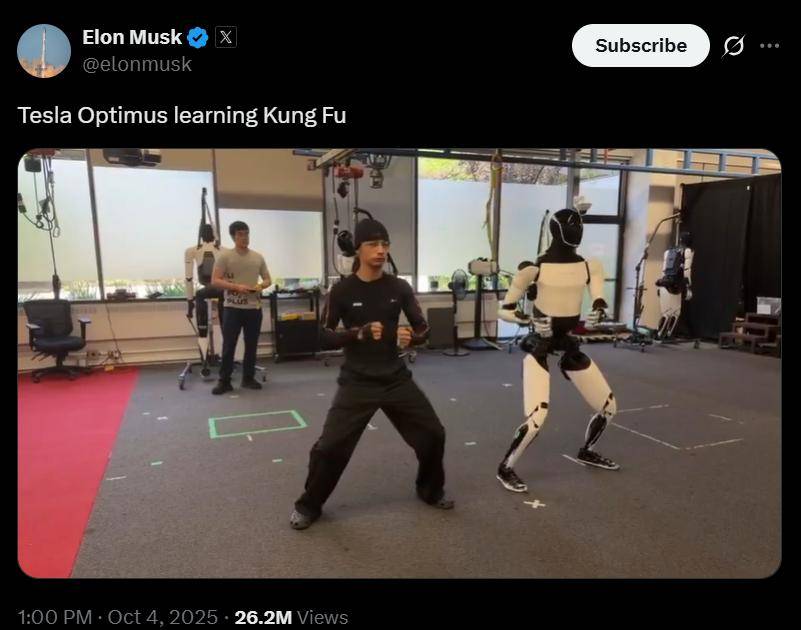
Core Insights - Elon Musk's return to full-time work at Tesla is generating significant momentum in the development of the Optimus robot, with a focus on human-like capabilities and mass production timelines [3][5][6] - The capital market is responding positively, with analysts noting a shift in Tesla's strategic focus towards humanoid robots, potentially positioning them alongside electric vehicles [5][6] Group 1: Product Development - The third generation of Optimus is set to be unveiled by the end of 2025, with mass production expected to start in 2026 and a target of one million units per year by 2030 [3][5] - The new version of Optimus will feature dexterous hands, which could significantly impact the joint module market, potentially leading to a 200x PE valuation [5] Group 2: Market Impact - Analysts from Huaxin Securities and Dongfang Securities have revised their reports, indicating that Musk's renewed focus has reversed the stagnation in R&D seen earlier in the year [5] - The humanoid robot sector is projected to be a $500 billion market, as per Tesla's own valuation goals, indicating a substantial new growth area for the company [5][6] Group 3: Broader Implications - Musk's ambitions extend beyond commercial success, aiming to redefine human-robot interactions, which could transform various sectors including manufacturing and service industries [6] - The recent demonstration of Optimus performing martial arts may mark the beginning of a new era in humanoid robot commercialization, akin to the impact of the Model S on the automotive industry [6]

人形机器人商业化进程持续加速,机器人ETF易方达(159530)规模迭创新高
Mei Ri Jing Ji Xin Wen· 2025-09-30 06:23
Group 1 - The robotics sector is maintaining an upward trend, with the National Securities Robotics Industry Index rising by 1.0% as of 13:48, and the E Fund Robotics ETF (159530) seeing a net subscription of 30 million shares during the trading session [1] - The E Fund Robotics ETF has experienced significant inflows this year, leading the growth among equity ETFs, with its latest scale surpassing 13 billion yuan, marking a historical high [1] - Leading robotics company UBTECH announced a new humanoid robot order worth 30 million yuan, bringing its total order amount close to 430 million yuan; Kepler Robotics has launched the K2 Bumblebee production video, indicating the start of commercial deliveries for the world's first commercially available hybrid humanoid robot, with orders amounting to several hundred million yuan [1] Group 2 - The commercialization process of humanoid robots is accelerating, with the core industry chain expected to benefit; the National Securities Robotics Industry Index focuses on the core segments of humanoid robots, with related stocks accounting for nearly 80% of the index [2] - The E Fund Robotics ETF ranks first in scale among all ETFs tracking this index, providing investors with a convenient way to invest in leading companies in the humanoid robotics industry [2]
基民懵了!这个火爆的板块年内涨超37% 主力却借道ETF狂抛逾400亿元
Mei Ri Jing Ji Xin Wen· 2025-09-20 05:54
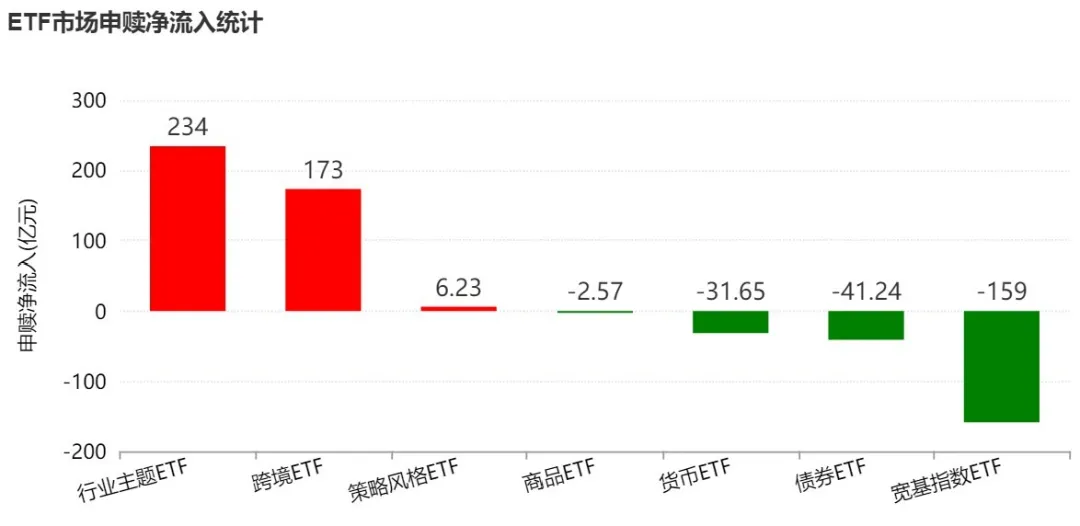
Market Overview - The stock indices showed mixed performance this week, with a total net inflow of approximately 25.3 billion yuan into stock ETFs and cross-border ETFs in the Shanghai and Shenzhen markets [1][3]. ETF Performance - Sector-themed ETFs such as those related to securities and robotics attracted significant capital, while chip-related ETFs faced substantial sell-offs [2][15]. - The total trading volume for the Shanghai and Shenzhen markets reached 12.45 trillion yuan, with the Shanghai Composite Index closing at 3820.09 points, down 1.3%, and the Shenzhen Component Index closing at 13070.86 points, up 1.14% [3]. Specific ETF Insights - The large-cap wide-based ETFs experienced a net outflow of 120.05 billion yuan, with the Kweichow Moutai 50 ETF seeing a net outflow of 43.18 billion yuan [7][10]. - The Kweichow Moutai 50 ETF's share count fell below 50 billion, with a year-to-date reduction of 39.528 billion shares and a net outflow of over 40 billion yuan [10]. Sector Analysis - In the sector-themed ETF space, 64 funds saw net inflows exceeding 100 million yuan, with securities ETFs, robotics ETFs, and brokerage ETFs leading the way with net inflows of 4.791 billion yuan, 2.758 billion yuan, and 2.289 billion yuan, respectively [13][14]. - Notably, the securities sector is viewed as having significant upside potential due to its relatively low year-to-date performance, suggesting a favorable entry point for investors [17][18]. Future Outlook - The market is expected to continue its upward trend, supported by easing monetary policy from the Federal Reserve and ongoing domestic growth initiatives [24]. - Upcoming listings of multiple ETFs tracking technology innovation bonds and other sectors are anticipated to attract additional capital [26].
基民懵了!这个火爆的板块年内涨超37%,主力却借道ETF狂抛逾400亿元
Sou Hu Cai Jing· 2025-09-20 04:47
Market Overview - The stock indices showed mixed performance this week, with a total net inflow of approximately 25.3 billion yuan into stock ETFs and cross-border ETFs in the Shanghai and Shenzhen markets [2][12] - The Shanghai Composite Index closed at 3820.09 points, down 1.3% for the week, while the Shenzhen Component Index rose 1.14% to 13070.86 points [2] ETF Performance - The major wide-based index ETFs experienced a total net outflow of 12.005 billion yuan, with the ChiNext index being the only one to see net inflow [5][8] - The Sci-Tech 50 ETF saw a significant net outflow of 4.318 billion yuan, with its total shares dropping below 50 billion [10][12] Sector Analysis - In sector-specific ETFs, securities and robotics ETFs attracted significant inflows, with net inflows of 4.791 billion yuan and 2.758 billion yuan respectively [13][18] - Conversely, chip-related ETFs faced substantial outflows, with the chip ETF experiencing a net outflow of 8.82 million yuan [16] Trading Activity - A total of 26 ETFs had trading volumes exceeding 10 billion yuan this week, indicating robust trading activity in the ETF market [22] - The Hong Kong Securities ETF recorded a trading volume of over 60 billion yuan, highlighting strong investor interest [24] Future Outlook - Analysts suggest that the current market conditions, including the Federal Reserve's interest rate cuts, may lead to increased liquidity and a potential recovery in domestic investments [12][24] - The humanoid robot industry is expected to see significant growth, with Tesla's recent order for 10,000 humanoid robots indicating a shift towards commercialization [21]
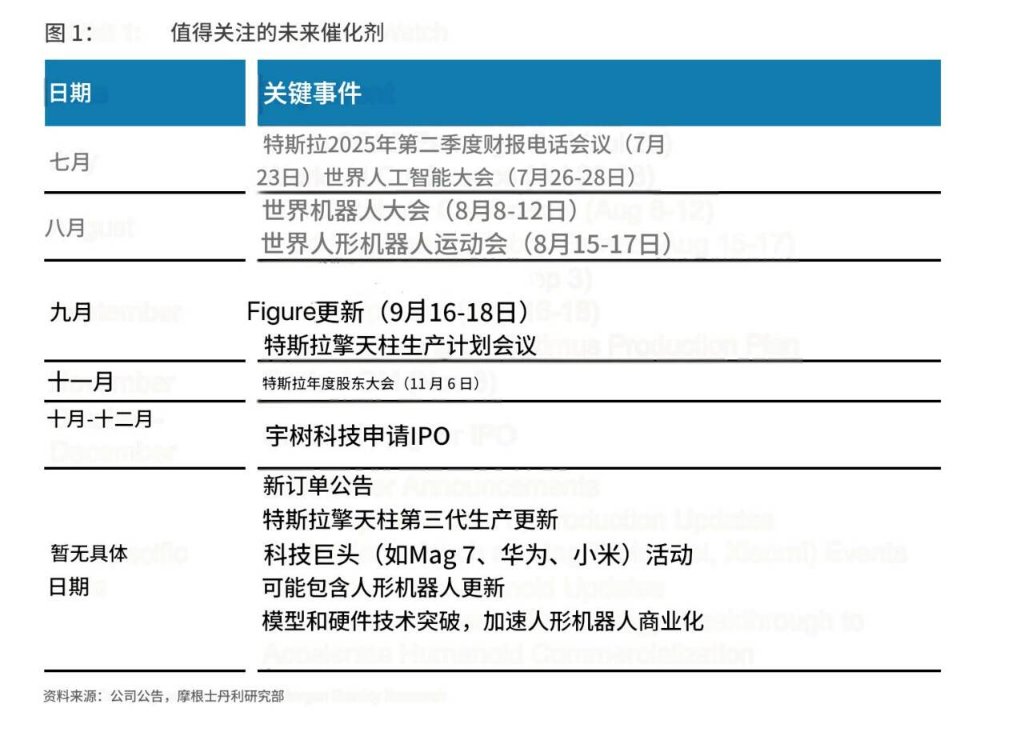
机器人连番暴涨,特斯拉和这张时刻表将是“接下来的关键”
Hua Er Jie Jian Wen· 2025-09-17 12:17
Core Insights - The recent surge in China's humanoid robot concept stocks is driven by Tesla's Optimus developments and advancements from global tech companies [1][3] - Since September 5, related industry stocks have averaged a 13.5% increase, significantly outperforming the MSCI China Index, which rose only 4.4% during the same period [3] - Major players like FigureAI are also contributing to market excitement with anticipated announcements, indicating a competitive landscape in the humanoid robotics sector [5] Industry Developments - Tesla's new incentive plan and production roadmap for humanoid robots were announced on September 5, leading to a series of positive market reactions [1][7] - The humanoid robot industry is experiencing a positive cycle of technological breakthroughs, confirmed orders, and capital catalysis, with expectations for significant developments in the next 2-3 months [1][5] - Chinese integrators have collectively signed contracts worth nearly 1 billion RMB, indicating a robust order flow and commercial viability in the sector [1][5] Market Performance - Stocks related to humanoid robot manufacturing have shown particularly strong performance, with an increase of 15.7% since September 5 [3] - The market is witnessing a growing interest in the commercial applications of humanoid robots, with key clients validating the return on investment (ROI) in manufacturing and logistics [5]
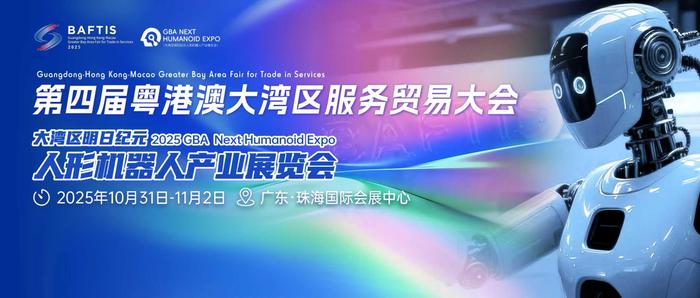
聚全球资源 促商业化落地——粤港澳大湾区明日纪元人形机器人产业展览会即将开幕
Guan Cha Zhe Wang· 2025-09-05 06:50
Core Insights - The 2025 Greater Bay Area Human-Robot Industry Exhibition is scheduled to take place from October 31 to November 2, 2025, at the Zhuhai International Convention and Exhibition Center, focusing on service trade and humanoid robots [2] - The event aims to connect technological innovation in humanoid robotics with commercial applications, addressing urgent industry needs [2][3] - The exhibition will feature participation from leading companies such as Tesla, Tianlian Robotics, and others, providing a platform for businesses to access the latest technology trends and expand their commercial networks [3] Government and Industry Collaboration - The Greater Bay Area Service Trade Fair is the only large-scale exhibition in the region focused on service trade, supported by the governments of Guangdong, Hong Kong, and Macau [2] - The event is expected to attract over 50 countries and regions, facilitating connections between Chinese enterprises and international markets, particularly in Southeast Asia and the Middle East [4] - Strategic partnerships with over 20 international organizations are being established to enhance global outreach and collaboration [4] Industry Applications and Opportunities - The exhibition will showcase various service industry applications, including public safety, medical rehabilitation, education services, and smart dining, emphasizing the role of humanoid robots in digital transformation [6] - A comprehensive approach will be taken to address industry pain points, allowing companies to engage with key suppliers across the robotics value chain [6] Key Activities and Networking - Five core activities will be organized to foster collaboration across the entire industry ecosystem, including forums, roundtable discussions, and training sessions [8] - These activities aim to bridge the gap between technology research, industry application, and capital investment, promoting innovation and market cooperation [8] Regional Development and Support - Zhuhai is positioned as a policy innovation hub within the Greater Bay Area, actively supporting the development of AI and robotics industries [10] - The local government has invested 1 billion yuan to establish an aviation robotics hub, providing comprehensive support from research and development to large-scale application [10] - The exhibition will serve as a vital opportunity for companies to understand the latest trends and opportunities in the Greater Bay Area [10]
中国人形机器人产业“大展宏图”
Zhong Guo Xin Wen Wang· 2025-09-05 02:10
Group 1 - The humanoid robot industry is experiencing a surge in large orders, with companies like UBTECH securing a 250 million yuan contract, marking the largest single contract in the global humanoid robot market [1] - Other companies, such as Zhiyuan Robotics and Yushu Technology, have also won significant contracts, indicating a growing trend in the commercialization of humanoid robots [1][2] - The industry is predicted to see annual shipment volumes double in the coming years, potentially reaching hundreds of thousands to millions of units within 2 to 3 years if technological breakthroughs occur [2] Group 2 - Significant capital is flowing into humanoid robot companies, with 87 financing events reported in the first half of 2025, amounting to approximately 10.9 billion yuan [3] - The capital market is increasingly favoring humanoid robots, with companies like Zhiyuan Robotics investing 2.1 billion yuan to acquire a listed company, and Yushu Technology starting its IPO process with a valuation of 12 billion yuan [4] - Morgan Stanley forecasts that the humanoid robot market could exceed 5 trillion USD by 2050, with a compound annual growth rate of over 50% [4] Group 3 - Humanoid robots are expanding their applications beyond being seen as "large toys," moving into diverse fields such as manufacturing, home services, logistics, and education [4] - Companies like Yushu Technology and UBTECH are developing humanoid robots capable of complex tasks, indicating a shift towards practical industrial applications [4] - The integration of advanced technologies such as AI and high-end manufacturing positions humanoid robots as a disruptive product in the tech landscape [4] Group 4 - China is establishing a competitive edge in the humanoid robot sector, with two-thirds of global robot patent applications originating from the country [5] - Over one-third of the top 100 global humanoid robot companies are based in China, supported by favorable policies and a robust industrial foundation [5] - The Chinese government has set ambitious goals for the humanoid robot industry, aiming for advanced global competitiveness by 2027 [5] Group 5 - The humanoid robot industry in China is poised to replicate the growth trajectory of the electric vehicle sector, driven by the convergence of technology, capital, and industry [6] - Each order, financing event, and patent application contributes to shaping the future landscape of the humanoid robot industry [6]