军事威胁

Search documents
美军两架B-52轰炸机接近委内瑞拉海岸
Yang Shi Xin Wen Ke Hu Duan· 2025-11-07 00:54
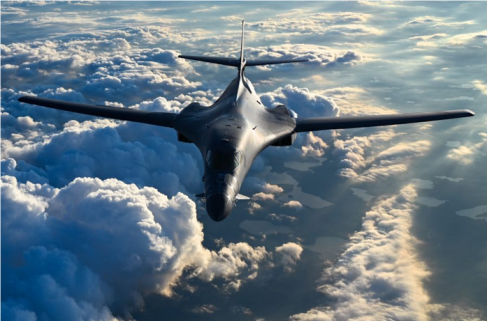
Core Viewpoint - The relationship between the United States and Venezuela is increasingly tense, highlighted by recent military activities near Venezuelan waters [1] Military Activities - Two U.S. Air Force B-52H strategic bombers approached the Venezuelan coast, flying within 70 kilometers of it [1] - The U.S. is intensifying its military presence in the Caribbean, with the USS Gerald R. Ford aircraft carrier recently passing through the Strait of Gibraltar towards the Caribbean [1] Political Context - Venezuelan President Maduro has accused the U.S. of attempting to use military threats for regime change in Venezuela and expanding its military influence in Latin America [1] - On October 23, flight tracking data indicated at least one U.S. B-1B bomber was near the Venezuelan coast, which was later denied by President Trump [1]
马杜罗嘲讽美方:我没在美国上过学 怎么会是独裁者
Xin Jing Bao· 2025-11-04 07:06
Core Viewpoint - Venezuelan President Maduro ridiculed U.S. accusations of him being a dictator, emphasizing his lack of elite education and military training, while accusing the U.S. of military threats and intentions to seize Venezuela's vast oil reserves [1] Group 1 - Maduro's speech was delivered on October 31 to the Caribbean Peace and Defense Council, where he questioned the legitimacy of the U.S. claims against him [1] - He highlighted the absence of formal education in prestigious institutions as a counterargument to the dictatorship label [1] - The U.S. has been accused of escalating military threats against Venezuela, with Trump recently making statements about potential ground attacks, although he denied any decisions have been made [1]
全线重挫!特朗普突发威胁,非洲石油大国资产遭遇猛烈抛售
Zheng Quan Shi Bao· 2025-11-03 22:33
Core Insights - Nigeria's assets have faced significant sell-offs following military threats from U.S. President Trump, leading to a sharp decline in both Nigerian dollar bonds and the naira's exchange rate against the dollar [1][2]. Group 1: Market Impact - All ten of Nigeria's dollar bonds experienced declines, with the 2047 bond seeing the largest drop of 0.6 cents per dollar, reaching 88.26 cents [2]. - The naira fell by 1.47% against the dollar, hitting a low of 1,424.59 naira per dollar, marking the largest daily drop since June [2]. Group 2: Political Context - Trump's military threats include the potential deployment of ground troops or airstrikes in Nigeria to address the "mass slaughter of Christians" [2][3]. - The U.S. Defense Secretary indicated that the Pentagon is preparing for possible actions in Nigeria following Trump's orders [3]. Group 3: Economic Relations - Trump has suggested halting all U.S. aid to Nigeria, which amounted to $1 billion in 2023, with a significant reduction in aid received since his administration began [4]. - Tariffs of 15% have been imposed on most goods imported from Nigeria, affecting trade valued at $400 million [5]. Group 4: Resource Overview - Nigeria is Africa's largest oil producer, with proven oil reserves of approximately 37 billion barrels, ranking second in Africa and eleventh globally [6]. - The country has 44 commercially viable mineral resources, including oil, natural gas, and various metals, making it an attractive destination for foreign investment [6]. Group 5: Security Situation - Nigeria faces complex security challenges, being ranked as the eighth most affected country by terrorism globally, with various militant groups operating within its borders [7]. - The motivations behind attacks in Nigeria vary, including religious conflicts and resource-based disputes between farmers and herders [7]. Group 6: Economic Outlook - Despite the current turmoil, Nigeria's stock market has seen a total return increase of approximately 65% in dollar terms this year, making it one of the best-performing emerging markets in Africa [6]. - Analysts suggest that potential military actions in northern Nigeria may not significantly impact the economy due to the already chaotic state of those regions [8].
“特朗普”突袭!深夜,全线重挫!
券商中国· 2025-11-03 15:30
Core Viewpoint - Nigeria's assets are experiencing significant sell-offs due to military threats from the U.S. President Trump, leading to declines in both dollar bonds and the naira currency [2][3]. Group 1: Market Impact - Following Trump's military threats, all tenors of Nigerian dollar bonds have dropped, with the 2047 bond experiencing the largest decline, falling to 88.26 cents on the dollar [3]. - The Nigerian naira depreciated by 1.47% against the dollar, reaching a low of 1424.59 naira per dollar, marking the largest daily drop since June [3]. Group 2: Political Context - Trump indicated the possibility of deploying ground troops or conducting airstrikes in Nigeria to address the "mass slaughter of Christians" [2][3]. - The U.S. Defense Secretary stated that the Pentagon is preparing for potential actions against Nigeria following Trump's orders [4]. Group 3: Economic Relations - Trump announced the potential cessation of all U.S. aid to Nigeria, which amounted to $1 billion in 2023, with a significant reduction in aid received since his administration began [5]. - The Trump administration has imposed a 15% tariff on most goods imported from Nigeria, affecting trade valued at $400 million [6]. Group 4: Resource and Investment Landscape - Nigeria is rich in natural resources, with proven oil reserves of approximately 37 billion barrels, making it Africa's largest oil producer and a member of OPEC [7]. - The Nigerian stock market has seen a total return increase of about 65% in dollar terms this year, making it one of the best-performing emerging markets in Africa [7]. Group 5: Security Situation - Nigeria faces a complex security landscape, being ranked as the eighth most affected country by terrorism globally, with various militant groups operating within its borders [8]. - The motivations behind attacks in Nigeria vary, including religious conflicts and resource scarcity disputes between farmers and herders [8].


刚刚!特朗普,突发威胁!
Zheng Quan Shi Bao Wang· 2025-11-03 02:06
Core Points - President Trump has issued military threats regarding Nigeria, claiming that U.S. forces may be deployed to prevent what he describes as the "mass slaughter of Nigerian Christians" [1][2][3] - Nigeria's Foreign Ministry has responded, stating that Trump's comments do not reflect the reality of the situation and emphasizing the country's commitment to combating terrorism and promoting religious harmony under President Tinubu's leadership [1][4] Summary by Sections Military Threats - Trump indicated the possibility of deploying U.S. troops or conducting airstrikes in Nigeria to address the alleged violence against Christians [2][3] - He has instructed the Pentagon to prepare for potential military actions and threatened to halt aid to Nigeria [2][3] Nigeria's Response - The Nigerian government has rejected Trump's claims, asserting that the country is dedicated to protecting the rights of all citizens and combating terrorism [4] - President Tinubu defended Nigeria's efforts to ensure religious freedom and cooperation with the U.S. government [4] Context of Violence - Nigeria faces threats from various extremist groups, including Boko Haram, which targets both Christians and Muslims [5] - The violence in Nigeria is driven by multiple factors, including religious motivations and resource competition among communities [5] Expert Opinions - Experts argue that the narrative of "Christian genocide" in Nigeria is overly simplistic and incorrect, highlighting that various groups, including Muslims, also face persecution [6] - There is a call for the U.S. to collaborate with Nigerian authorities rather than imposing military actions that could exacerbate the situation [6]
突发!美国,大举增兵!
Zheng Quan Shi Bao Wang· 2025-11-02 16:12
Group 1 - The U.S. Navy is increasing its military presence in the Caribbean, with the arrival of the "USS Gettysburg," a Ticonderoga-class guided missile cruiser, marking the second cruiser deployed in the region [1][2] - The "USS Iwo Jima," an amphibious assault ship, and the "USS Gravely," a destroyer, are positioned to strike targets within Venezuela, indicating a significant escalation in regional tensions [2][3] - The Pentagon is evaluating potential strike and blockade options as military deployments in the Caribbean reach their largest scale in over 30 years [3] Group 2 - Venezuelan President Maduro is reportedly seeking military assistance from Russia, including defense radar, aircraft maintenance services, and missiles, amid the U.S. military buildup [5][6] - Maduro's requests were formalized in a letter to President Putin, emphasizing the need to enhance Venezuela's air defense capabilities and repair previously purchased Russian aircraft [5] - Additionally, there are indications that Venezuela is coordinating with Iran for military equipment, including passive detection devices and drones [6]
英媒发现美军正在升级一处废弃海军基地,“可能想恐吓马杜罗”
Guan Cha Zhe Wang· 2025-11-02 14:59
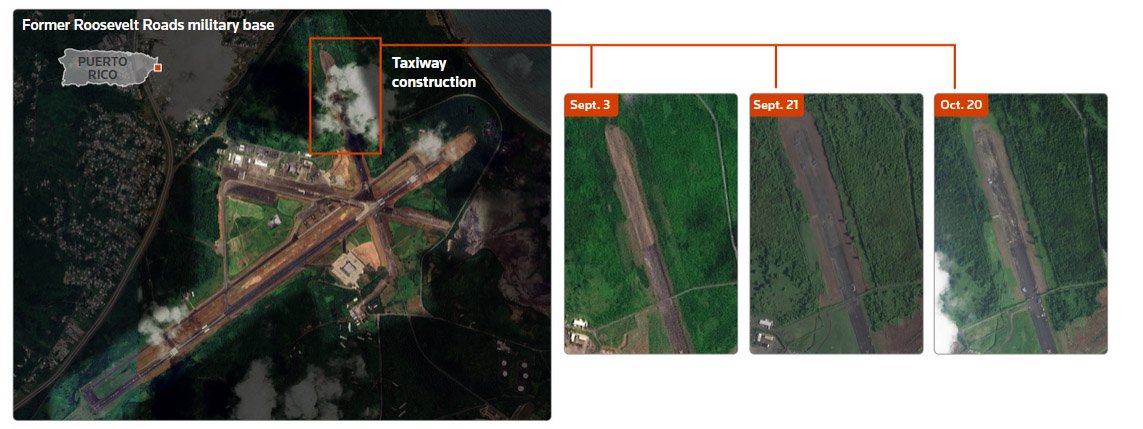
Core Viewpoint - The United States is significantly increasing its military activities in the Caribbean, particularly in response to ongoing tensions with Venezuela, indicating potential preparations for further actions against the Venezuelan government led by President Maduro [1][11]. Military Base Developments - The Roosevelt Roads Naval Base in Puerto Rico, which was closed in 2004, is undergoing renovations, including runway upgrades and the installation of portable air traffic support equipment, suggesting a readiness for increased military aircraft operations [2][4]. - Satellite images reveal the presence of tents near a decommissioned hangar at the base, indicating preparations for military personnel and operations [2][5]. Strategic Enhancements - The Rafael Hernandez Airport in Puerto Rico has seen the deployment of communication equipment and mobile air traffic control towers, enhancing the military's ability to coordinate increased flight operations in the region [6]. - The presence of MQ-9 drones and the construction of ammunition storage facilities at the airport suggest a dual purpose for operations: long-term anti-drug efforts and potential short-term actions against Venezuela [6]. Infrastructure Upgrades in the Virgin Islands - At Henry E. Rohlsen Airport on St. Croix, military upgrades are underway to accommodate more U.S. military aircraft, including the installation of new radar systems to improve surveillance capabilities [7][8]. Increased Military Presence - Since August, the U.S. has deployed at least 13 warships, 5 support vessels, and 1 nuclear submarine to the Caribbean, indicating a robust military presence aimed at intimidating the Venezuelan government [11]. - The MV Ocean Trader, associated with U.S. special forces, has been spotted in the region, capable of deploying troops and helicopters [11][13]. Air Operations and Intelligence - The deployment of the USS Gerald R. Ford aircraft carrier strike group to the region marks a significant escalation in U.S. military readiness, with increased aerial activities noted, including B-52 and B-1 bombers operating near Venezuelan airspace [13][15]. - Numerous reconnaissance flights and C-17 transport missions have been conducted to supply military resources to the Caribbean, indicating preparations for potential operations [15]. Political Context - The U.S. government has identified potential military targets within Venezuela, particularly those linked to drug trafficking, with discussions of possible airstrikes being considered [15][16]. - President Trump has hinted at military options against Venezuela, while Maduro has emphasized the country's defensive capabilities and sought support from Russia in response to U.S. threats [16][17].
美国加关税又甩锅中国!三艘航母驶向中国,特朗普为何如此焦虑?
Sou Hu Cai Jing· 2025-10-29 02:20
Core Viewpoint - The article discusses the recent statements made by Trump regarding tariffs on China, claiming they were "forced" upon him, which the author argues is a misrepresentation of the events leading to the trade tensions between the two countries [1][3]. Group 1: Trade Relations - The trade friction between the US and China has historically been initiated by the US, with tariffs imposed on Chinese goods starting in 2018 and continued pressure on Chinese high-tech companies in 2019 [3]. - Trump's assertion of being "forced" by China is seen as an inversion of reality, as the US has consistently taken the first step in escalating trade tensions [3]. Group 2: Military Presence - The deployment of three US aircraft carriers near China is interpreted as a show of force rather than a genuine military threat, with the carriers being outdated and not capable of effectively challenging China's military capabilities [5][11]. - The article suggests that the presence of these carriers serves more as a psychological deterrent rather than a real military strategy against China [5][11]. Group 3: US Strategy and Limitations - The US has struggled to find effective strategies to deal with China's rise, as traditional methods like economic sanctions and political pressure have proven ineffective [7][9]. - Trump's tariff strategy has not delivered the expected results, leading to significant economic pressure on the US itself, indicating that such measures are not sustainable in the long term [7][9]. Group 4: China's Position - China's growing economic and military strength has forced the US to reconsider its hegemonic policies, as the effectiveness of previous tactics has diminished [9]. - The article emphasizes that China is no longer a country that can be easily pressured or coerced, highlighting its determination to defend its national interests [9].

委内瑞拉暂停同特立尼达和多巴哥的天然气合作协议
Xin Hua She· 2025-10-28 13:17
Core Viewpoint - Venezuela has decided to suspend the advancement of its natural gas cooperation agreement with Trinidad and Tobago in response to Trinidad's support for U.S. anti-drug operations in the Caribbean [1] Group 1: Political Context - Venezuelan President Maduro announced the decision during a televised speech, indicating that the matter has been submitted to the Supreme Court and the National Assembly [1] - The U.S. military has increased its presence in the region, with the USS Gravely docking in Trinidad and Tobago for joint training exercises with the Trinidadian defense forces [1] Group 2: Historical Agreements - The energy cooperation agreement between Venezuela and Trinidad and Tobago was signed in 2015, covering joint development of gas fields and infrastructure, with a 10-year validity [1] - The agreement was automatically renewed for an additional five years in February of this year [1] Group 3: U.S. Military Actions - Since September, the U.S. government has claimed to have sunk 10 so-called "drug boats" off the coast of Venezuela and killed over 40 alleged drug traffickers [1] - Reports from the U.S. Drug Enforcement Administration indicate that Venezuela is not a major source of drugs entering the U.S. [1]
美媒:“距离仅约20英里”,美军B-1B轰炸机再度抵近委内瑞拉实施“攻击演示”
Huan Qiu Wang· 2025-10-28 05:35
Core Points - The article discusses the recent military flights of U.S. Air Force B-1B bombers near Venezuela as part of a "counter-narcotics operation" [1][3] - This marks the third such flight since October 15, with increasing proximity to Venezuelan shores [3] - The U.S. government claims to have sunk 10 "drug trafficking boats" and killed over 40 "drug traffickers" since September [4] Group 1 - Multiple B-1B bombers flew near Venezuela on October 27, showcasing U.S. military presence in the region [1][3] - The bombers took off from North Dakota and were tracked openly, indicating no attempt by the Pentagon to conceal the flights [3] - The B-1B bombers flew as close as 20 miles (approximately 32 kilometers) from the Venezuelan coast during this mission, the closest of the three recent flights [3] Group 2 - The U.S. military has conducted similar flights on October 15 and October 23, with B-52H bombers and F-35B fighters also involved [3] - The Venezuelan government has accused the U.S. of using military threats to instigate regime change and expand military presence in Latin America [4] - Reports indicate that Venezuela is not a major source of drugs entering the U.S., contradicting the U.S. government's narrative [4]