合规风控

Search documents
国信证券股东拟减持 券商转型格局加速分化
Jing Ji Guan Cha Wang· 2025-12-09 15:57
Group 1 - The core viewpoint of the articles highlights a significant transformation in the Chinese securities industry, marked by shareholder reductions and mergers and acquisitions among brokerage firms, indicating a structural adjustment during the "14th Five-Year Plan" period [2][4][5]. - Multiple brokerage firms, including Guosen Securities and Huaxi Securities, have announced shareholder reduction plans, reflecting diverse motivations such as asset allocation adjustments and operational funding needs [2][3]. - The market is currently experiencing relatively low valuations, with the securities sector's price-to-book ratio at approximately 1.36, indicating cautious expectations regarding short-term challenges but also highlighting long-term value potential [5][6]. Group 2 - The ongoing mergers and acquisitions, such as China International Capital Corporation's plan to absorb Dongxing Securities and Cinda Securities, represent a strategic path for enhancing competitiveness through consolidation [3][4]. - Regulatory encouragement for top brokerage firms to enhance their comprehensive strength through mergers contrasts with a more focused development path for smaller firms, which are urged to leverage their advantages in niche markets [6][7]. - The industry is facing multiple risks, including market volatility and regulatory challenges, necessitating a heightened focus on compliance and risk management as firms navigate the evolving landscape [7][8].




A股市场总体活跃 证券公司总资产达到14.5万亿元
Zhong Guo Jing Ji Wang· 2025-12-07 07:50
Core Viewpoint - The Chinese securities industry is focusing on enhancing compliance and risk management while transitioning from price competition to value competition, aiming to create internationally influential benchmark institutions and specialized service providers [1][2] Group 1: Compliance and Risk Management - The China Securities Regulatory Commission (CSRC) emphasizes the importance of safety and development as the industry's bottom line, urging institutions to strengthen compliance and risk awareness [1] - Institutions are required to improve corporate governance and employee management, clarify responsibilities, and prevent internal interference [1] - Key risks such as financing, margin trading, off-market activities, credit, liquidity, and compliance need to be monitored proactively [1] Group 2: Market Performance and Structural Optimization - The A-share market has been active this year, with market capitalization surpassing 100 trillion yuan since August, indicating reasonable quantitative growth and effective qualitative improvement [2] - Total assets of securities companies have reached 14.5 trillion yuan, with net assets around 3.3 trillion yuan, reflecting growth rates of over 60% and 40% respectively over the past four years [2] - The industry structure is continuously optimizing, with notable cases like the merger of Guotai Junan and Haitong Securities demonstrating initial success in achieving synergies [2] Group 3: Institutional Development and Market Opening - Smaller institutions are focusing on niche markets and achieving breakthroughs, while foreign institutions are accelerating their domestic business expansion [2] - The capital market is further opening up, with 11 foreign wholly-owned or controlling companies currently operating in China [2]
吴清的一次重要讲话!明确这些改革方向 十大重点梳理
Zhong Jin Zai Xian· 2025-12-07 02:40
Core Viewpoint - The speech by Wu Qing, Chairman of the China Securities Regulatory Commission (CSRC), emphasizes the responsibility of the financial sector in national development and outlines a path for the high-quality development of the securities industry, focusing on the concept of "functionality" as a key approach [2][4]. Group 1: Regulatory Policies - The CSRC will implement differentiated supervision, easing capital and leverage restrictions for high-quality institutions while optimizing risk control indicators to enhance capital utilization efficiency [4][10]. - The regulatory approach will vary for different types of institutions: easing restrictions for high-quality firms, guiding smaller firms to focus on niche markets, and supporting foreign institutions in integrating into the Chinese capital market [10][11]. Group 2: Industry Responsibilities - The securities industry must strengthen its mission in four areas: serving the real economy, optimizing asset allocation for residents, contributing to the construction of a financial power, and promoting high-level institutional openness [5]. - Firms are encouraged to align their services with diverse investor needs, focusing on long-term and value investments [5]. Group 3: Market Fundamentals - Investor confidence and market resilience have improved, with the total market capitalization of A-shares exceeding 100 trillion yuan, reflecting both quantitative growth and qualitative enhancement [6]. - The total assets of 107 securities firms reached 14.5 trillion yuan, with net assets growing over 40% in four years [6]. Group 4: Mergers and Acquisitions - The mergers among leading brokerages, such as the merger of Guotai Junan and Haitong, have shown initial success, indicating a shift towards differentiated development among smaller firms [7][9]. Group 5: Reputation Management - The industry must prioritize reputation management and cultural development, addressing past issues of misconduct and enhancing public trust through effective communication and storytelling [12]. Group 6: Investor Protection - There is a strong emphasis on binding the interests of securities firms with those of investors, promoting a core evaluation system centered on investor returns [13]. Group 7: Internationalization and Cross-Border Finance - The industry is encouraged to enhance its cross-border financial services and to leverage international experiences to better integrate into the global market [14]. Group 8: Compliance and Risk Management - The importance of compliance and risk management is highlighted, with a focus on preventing illegal arbitrage and maintaining market order [15][17]. Group 9: Financial Technology Innovation - The industry is urged to embrace financial technology innovations while ensuring that regulatory frameworks are in place to manage associated risks [18]. Group 10: Risk Resilience - The industry must enhance its risk management capabilities to navigate complex challenges, ensuring the stability of the financial system [19].
中国证监会:证券公司和投资机构要与投资者共进共赢
Sou Hu Cai Jing· 2025-12-07 01:47
Core Viewpoint - The Chinese securities industry is urged to provide a wider range of investment products that are beneficial for long-term and value investing, aiming for a win-win situation with investors [1][3]. Group 1: Market Development and Investor Confidence - The total market capitalization of A-shares has surpassed 100 trillion yuan since August, indicating reasonable growth in quantity and effective improvement in quality [5]. - Investor confidence and expectations have significantly improved, enhancing market resilience and risk management capabilities [5]. Group 2: Regulatory Focus and Risk Management - The securities industry has made significant progress in compliance and risk control, but new issues and risks have emerged that require attention [7]. - There is a strong emphasis on preventing illegal trading and maintaining market order, particularly in areas such as margin trading and off-exchange business [7][9]. - Regulatory measures will be strictly enforced against problematic brokerages, with a focus on compliance and risk awareness [10]. Group 3: Tailored Regulatory Approaches - The industry is encouraged to adopt differentiated regulatory measures for small and foreign brokerages, promoting specialized development while ensuring strict oversight of problematic firms [10]. - There is a call for enhancing transaction management and improving the fairness of trading services for different types of investors, particularly protecting the rights of small investors [9].
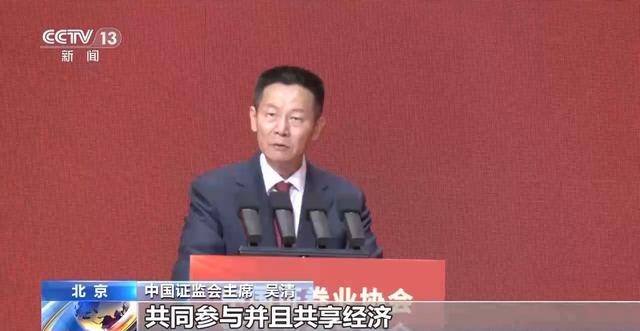
吴清:严防非法交易与市场秩序扰乱行为
Feng Huang Wang· 2025-12-06 08:04
Core Viewpoint - The Chairman of the China Securities Regulatory Commission, Wu Qing, emphasized that safety development is the industry's bottom line, urging institutions to strengthen compliance and risk management awareness [1] Group 1: Compliance and Governance - Institutions need to enhance compliance risk awareness and establish rigid requirements for corporate governance and employee management [1] - Clear delineation of responsibilities and authority is necessary to prevent internal interference [1] Group 2: Risk Management - There is a focus on managing related party transactions and compliance education to improve fairness in trading services [1] - The industry must be vigilant against illegal trading and disruptions to market order [1] - Key risk areas include margin financing, over-the-counter business, credit, liquidity, and compliance [1] Group 3: Industry Adaptation - The industry should strengthen analysis of new business models and respond promptly to market concerns [1]
治理新范式?国泰基金人事布局新落子:首席信息官倪蓥转任督察长
Xin Lang Ji Jin· 2025-12-02 02:11
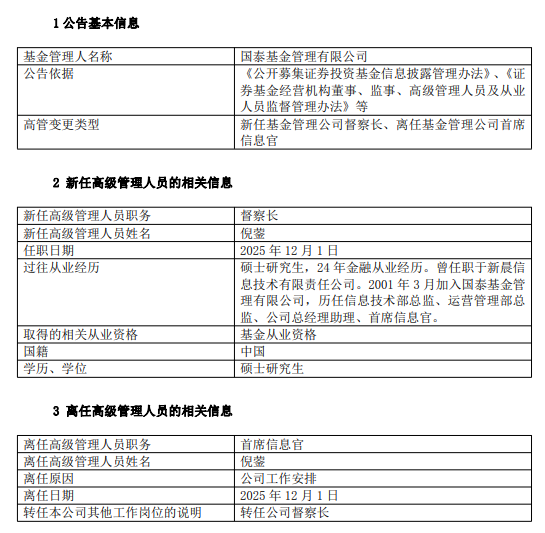
12月2日,国泰基金发布高级管理人员变更公告,公司首席信息官倪蓥因工作安排转任公司督察长,任 职日期为2025年12月1日。这一人事变动标志着这家资产管理规模突破8200亿元的老牌公募基金,正在 其内部治理与战略布局上落下关键一子。 值得注意的是,倪蓥对于投资者教育曾有过独到见解,她提出:"投教实际上也是一个教学相长的过 程。与其说是教育,我们更认为是一种服务或者是陪伴。"这种以"服务与陪伴"为核心的理念,恰恰与 督察长职责中保护投资者合法权益、构建信任的内核高度契合。从"技术基建者"到"合规守门人",倪蓥 的转型兼具专业基础与理念衔接的优势。 此次调整填补了公司督察长岗位历时半年的空缺。此前,在2025年5月29日,任期超过六年的督察长刘 国华退休离任,此后该职务一直由公司总经理代行职责。倪蓥的履新,或为国泰基金完善公司治理、强 化合规与风险管理体系带来了新的专业力量。 | 基金管理人名称 | 国泰基金管理有限公司 | | --- | --- | | 公告依据 | 《公开募集证券投资基金信息披露管理办法》、《证 券基金经营机构董事、监事、高级管理人员及从业 | | | 人员监督管理办法》等 | | 高管变更 ...
2025量化行业高质量发展大会将汇聚顶尖量化机构、科技领军企业及权威学者,围绕 AI 技术应用、GPU 算力升级、合规风控等前沿议题展开深度对话,为推动量化行业高质量发展贡献智慧力量
Zhong Guo Zheng Quan Bao· 2025-11-28 12:00
金融科技.量化机构金牛奖,明日揭晓!由中国证券报主办,华鑫证券、西岸集团联合承办,深圳数据 经济研究院提供独家学术支持的2025量化行业高质量发展大会暨金融科技.量化机构金牛奖颁奖典礼, 将于11月28日在上海徐汇西岸举行。 ...
财通基金:紧扣投资者获得感 以更匹配的合规风控助力高质量发展
Shang Hai Zheng Quan Bao· 2025-11-09 11:11
Core Viewpoint - The China Securities Regulatory Commission has released a draft guideline and operational details for the performance comparison benchmarks of publicly offered securities investment funds, emphasizing higher quality development in the public fund industry [1][2]. Group 1: Regulatory Changes - The new guidelines and operational details propose five specific requirements: comprehensive process control mechanisms, elevated decision-making levels for benchmark selection, independent departmental responsibility, enhanced compliance management, and linking performance compensation to benchmark performance [2]. - The new regulations serve as both a "yardstick" and a hard constraint for fund managers, encouraging prudent benchmark setting and comprehensive risk control [2]. Group 2: Industry Development - The public fund industry is entering a new phase of high-quality development, shifting focus from traditional scale competition to comprehensive governance, research capabilities, and compliance risk control [2]. - Compliance and risk control are viewed as core competitive advantages, particularly in a rapidly evolving market, with a strong emphasis on building long-term trust and brand value [2]. Group 3: Company Strategy - The company has achieved significant excess returns in its products by leveraging the recent structural market trends, indicating a successful differentiation strategy [3]. - The company aims to become a first-class asset management firm by focusing on distinctive, diversified development and customer trust, emphasizing sustainable talent development, high-recognition product systems, and a customer-centric approach [3]. - The company has launched a service brand "With Finance" and conducted over 150 customer service activities this year to systematically implement its customer-centric service philosophy [3].
海富通基金第三次因“老鼠仓”遭罚,年内多只产品清盘,新任董事长谢乐斌如何破局?
Feng Huang Wang Cai Jing· 2025-11-03 15:09
Core Viewpoint - Hai Fu Tong Fund has faced significant scrutiny due to repeated "mouse warehouse" incidents, with the latest case resulting in a fine of 500,000 yuan for fund manager Yang Ningjia, highlighting serious compliance and risk management issues within the company [1][2]. Group 1: Compliance Issues - The recent incident marks the third time Hai Fu Tong Fund has been penalized for "mouse warehouse" activities, which severely impacts the company's reputation and investor trust [2][6]. - Yang Ningjia, the implicated fund manager, utilized non-public information to guide external accounts in synchronized trading, a clear violation of regulations [3][5]. Group 2: Fund Performance - Under Yang Ningjia's management, several funds experienced poor performance, with the largest fund, Hai Fu Tong Electronic Information Media Industry Stock, showing a return decline of over 40%, ranking at the bottom of its peers [3][4]. - The company has seen a wave of fund liquidations, with seven products being closed this year, indicating a crisis of confidence among investors [8][10]. Group 3: Leadership and Future Challenges - The newly appointed chairman, Xie Lebin, faces the dual challenge of addressing compliance failures and managing the fallout from the fund liquidations [7][12]. - Xie Lebin, recognized as a risk management expert, is expected to implement measures to restore the company's brand and regain investor trust [7][12].

公募行业展现高质量发展新气象
中国基金报· 2025-10-26 12:57
Core Viewpoint - The implementation of the "Action Plan for Promoting High-Quality Development of Public Funds" marks a significant shift in China's public fund industry from a focus on scale to a focus on quality, emphasizing the need for systematic transformation in operational models and investment philosophies [2][4][24]. Transition from "Scale" to "Quality" - The core value of the "Action Plan" is to drive a fundamental ecological transformation in the public fund industry, shifting the focus from scale-driven growth to quality-oriented development [4][25]. - This transformation encourages a positive cycle between scale and performance, where funds with strong performance are more likely to attract investment, thus avoiding the vicious cycle of "scale expansion leading to performance decline" [4][5]. Upgrade of Research and Investment Capabilities - Enhancing core research and investment capabilities is fundamental to achieving high-quality development, with a shift from individual-driven to system-driven investment research [7][9]. - Fund companies are exploring unique paths for upgrading their research systems, with trends towards integrated and team-based approaches [8][9]. - The integration of technology, such as AI and big data, is becoming a key accelerator for enhancing research capabilities [9][10]. Enhancing Investor Experience - The "Action Plan" emphasizes better meeting residents' wealth management needs and enhancing investor satisfaction through fee reductions, product innovation, and investor education [11][12]. - Fee reforms have led to a decrease in management fees across various fund categories, fundamentally changing the competitive landscape of the industry [11][14]. - Fund companies are actively controlling the scale of new products to prioritize investor interests and improve the investment experience [12][14]. Product Innovation and Compliance - The public fund industry is actively promoting product innovation, shifting from supply-driven to demand-led product development [14][15]. - Fund companies are focusing on creating clear product positioning and competitive product lines, including the introduction of floating fee rate products [17][18]. - Compliance and risk management are critical to supporting the industry's transformation, with companies enhancing their compliance frameworks and risk control measures [20][22]. Challenges and Industry Restructuring - The transition to high-quality development faces internal challenges, such as entrenched performance evaluation systems and the need for deeper research capabilities [25][26]. - External challenges include the existing sales channel models that favor high-commission products, which may conflict with the industry's shift towards long-term investment strategies [26][27]. - The high-quality development wave is expected to reshape the competitive landscape, with a focus on value competition rather than scale [27][28]. Future Outlook - Over the next three to five years, the public fund industry is expected to prioritize high-quality development, with a focus on value competition and the emergence of firms with core capabilities [28][29]. - Companies that can provide comprehensive services and enhance investor engagement will likely gain a competitive edge in the evolving market [29].