国产GPU

Search documents
壁仞科技凭啥成为港股“国产GPU第一股”?
Sou Hu Cai Jing· 2026-01-02 07:23
Core Viewpoint - Biren Technology has successfully listed on the Hong Kong Stock Exchange, becoming the first domestic GPU stock and marking a significant milestone in China's computing landscape [2][5]. Company Overview - Founded in 2019 by Zhang Wen, former president of SenseTime, Biren Technology focuses on GPU technology and has filed over 1,500 patents globally, ranking first among Chinese general GPU companies [3][4]. - The company has raised over 5 billion HKD through its IPO, with 85% of the net proceeds allocated for R&D to advance next-generation products and solutions [5]. Financial Performance - Biren Technology reported revenues of 49,900 CNY in 2022, 62.03 million CNY in 2023, and projected 337 million CNY in 2024, with significant losses totaling 6.357 billion CNY over three and a half years [3][4]. - The company holds 24 binding orders valued at approximately 822 million CNY, along with framework sales agreements worth 1.241 billion CNY, indicating a solid foundation for future growth [3]. Market Position and Strategy - Biren Technology currently holds a market share of 0.16% in the Chinese smart computing chip market and 0.20% in the GPGPU market, with expectations to capture about 0.2% of the market by 2025 [6]. - The company aims to enhance its full-stack capabilities, focusing on high-performance general GPUs and supporting AI, cloud computing, and big data applications [6]. Industry Context - The demand for domestic AI chips is surging, with ByteDance planning to procure over 40 billion CNY worth of domestic AI chips by 2026, creating significant opportunities for companies like Biren Technology [6]. - Despite the growth potential, there remains a substantial gap between domestic GPU manufacturers and industry leader NVIDIA, which reported revenues of 130.5 billion USD in 2025, highlighting the challenges ahead for local firms [7].


港股“国产GPU第一股”来了!壁仞科技股价涨超80%,一手赚3220港元,前商汤科技总裁张文身家超133亿元
Jin Rong Jie· 2026-01-02 06:21
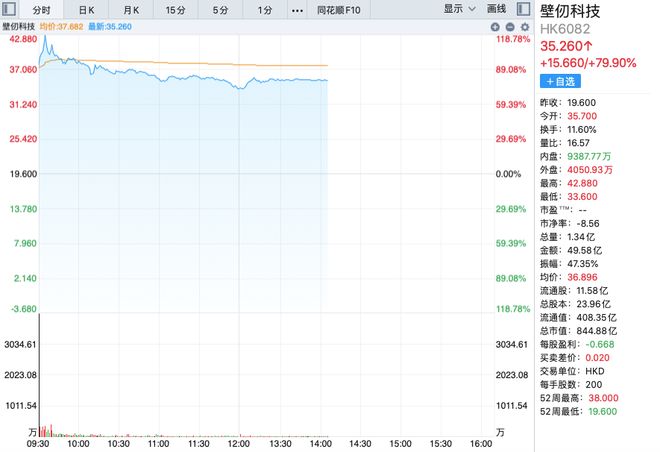
Group 1 - The core viewpoint of the article highlights the successful debut of Birran Technology as the first domestic GPU company listed on the Hong Kong Stock Exchange, with its stock price surging significantly on the first day of trading [1][3][4] - Birran Technology opened at HKD 35.7 per share, an 82% increase from the issue price of HKD 19.6, and reached a peak of HKD 42.88, pushing its market capitalization beyond HKD 100 billion [1][3] - The company has garnered substantial attention due to the booming AI sector, with significant interest from investors leading to over 2300 times oversubscription during its IPO [4] Group 2 - Birran Technology focuses on developing high-performance general-purpose GPUs, primarily through its self-developed Birli series GPU products, aiming to create a domestic intelligent computing industry ecosystem [4] - The company was founded in 2019 by Zhang Wen, who has an extensive background in technology and finance, including leadership roles at SenseTime and other firms [4] - Prior to its IPO, Birran Technology completed 10 rounds of financing, raising over RMB 5 billion, with investments from various institutional investors including Shanghai Guotou and IDG Capital [3][4] Group 3 - Other AI chip companies are also preparing to enter the capital market, with notable upcoming listings such as Tian Shu Zhi Xin on January 8 and Baidu's Kunlun Chip, which has submitted a listing application [5]
“港股GPU第一股” 上市首日大涨!市值破千亿港元
Shang Hai Zheng Quan Bao· 2026-01-02 04:34
Market Overview - The Hong Kong stock market opened positively on January 2, 2026, with the Hang Seng Index rising by 2.18% to 26,189.79 points, the Hang Seng China Enterprises Index increasing by 2.26% to 9,115.17 points, and the Hang Seng Tech Index climbing by 3.38% to 5,702.56 points [2] - Sectors such as semiconductors, software services, insurance, and telecommunications led the gains, while the food and beverage sector experienced a decline [2] Company Highlights - Wallen Technology, known as the "first GPU stock in Hong Kong," was listed on the Hong Kong Stock Exchange on January 2, 2026, and saw its market value exceed HKD 100 billion shortly after opening, with an initial surge of over 118% [4][5] - The stock closed at HKD 33.88 per share, reflecting a 72.86% increase, with a total market capitalization of HKD 811.8 billion and a trading volume exceeding HKD 4.6 billion [6][7] - Wallen Technology's IPO price was set at HKD 19.6 per share, with 285 million shares issued, raising approximately HKD 5.58 billion [6] Financial Performance - Wallen Technology reported revenues of RMB 499,000 in 2022, RMB 62.03 million in 2023, and projected revenues of RMB 336.8 million in 2024, with significant losses recorded each year [9][10] - The company has accumulated over RMB 5 billion in funding through 10 financing rounds prior to the IPO, with investments from various state-owned and private equity firms [11] Industry Trends - The semiconductor sector showed strong performance on the same day, with stocks like Hua Hong Semiconductor rising nearly 10% and SMIC and Jingmen Semiconductor increasing by nearly 5% [12][13] - The overall semiconductor index rose by 1.62%, indicating a positive trend in the industry [14]
港股异动 现涨超4% 已向阿里发行2.5亿美元可转债 双方合作有望进一步深化
Zhi Tong Cai Jing· 2026-01-02 03:38
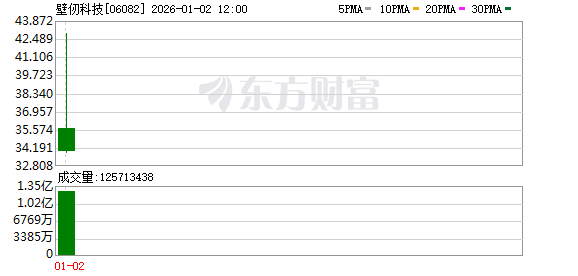
Group 1 - Meitu Company (01357) shares increased by over 4%, currently at 7.33 HKD with a trading volume of 55.43 million HKD [1] - On December 31, Meitu announced the issuance of 250 million USD convertible bonds to Alibaba [1] - If all convertible bonds are converted, Alibaba will hold 6.82% of Meitu's shares, becoming its third-largest shareholder [1] Group 2 - Morgan Stanley released a report indicating that the collaboration between Meitu and Alibaba is expected to deepen, particularly in the e-commerce design sector, creating strong synergies [1] - The China Securities Regulatory Commission reported that Suiyuan Technology, one of China's leading GPU companies, has completed its IPO counseling, marking a significant step in its listing process [1] - Tencent is the largest shareholder of Suiyuan Technology, having participated in multiple funding rounds, while Meitu is the fourteenth largest shareholder [1]

美图公司早盘涨超5% 已向阿里发行2.5亿美元可转债
Xin Lang Cai Jing· 2026-01-02 03:17
Core Viewpoint - Meitu Company (01357) has issued $250 million convertible bonds to Alibaba, which, if fully converted, will result in Alibaba holding 6.82% of Meitu's shares, making it the third-largest shareholder [1][5]. Group 1: Meitu Company - Meitu's stock price increased by 5.14%, currently trading at HKD 7.36, with a trading volume of HKD 64.89 million [1][5]. - Morgan Stanley released a report indicating that the collaboration between Meitu and Alibaba is expected to deepen, particularly in the e-commerce design sector, creating strong synergies [1][5]. Group 2: Industry Context - The China Securities Regulatory Commission announced that Suiyuan Technology, one of the domestic GPU "four dragons," has completed its IPO counseling, marking a significant step in its listing process [1][5]. - Tencent is the largest shareholder of Suiyuan Technology and has participated in multiple rounds of financing for the company [1][5]. - Meitu is the fourteenth largest shareholder of Suiyuan Technology, while the National Fund Phase II is the fifth largest shareholder [1][5].
开盘涨超100%,一笔直投让上海国资赢麻了
Xin Lang Cai Jing· 2026-01-02 02:45
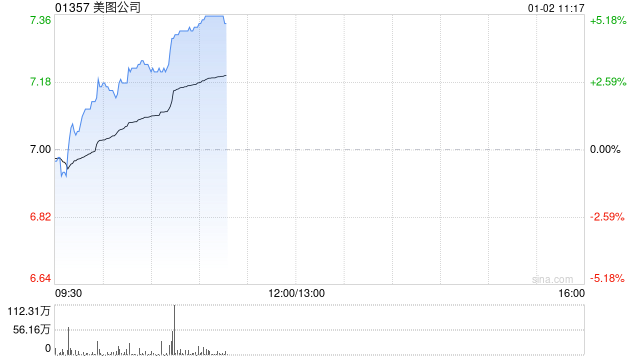
Group 1 - Wallan Technology (06082.HK) has officially listed on the Hong Kong Stock Exchange, becoming the first general-purpose AI chip company to go public in 2025, with an opening price increase of over 100% and a market capitalization exceeding HKD 94 billion [1] - Founded in 2019 by a team of former AMD and NVIDIA chip architects, Wallan Technology has launched several high-performance GPUs, including BR100, BR104, BR106, and BR166, and has become a key player in China's AI infrastructure [1] - The investment from Shanghai State-owned Capital, which holds a 3.7853% stake in Wallan through Shanghai Lingang Economic Development Group, signifies a strategic move in the AI computing power sector [2] Group 2 - The Shanghai Guotou Pioneer AI Industry Fund made a direct investment in Wallan Technology, marking its first direct investment project, which breaks from the traditional indirect investment model [3] - This investment not only provides financial support but also enhances Wallan's capabilities in technology development, industry connections, and ecosystem collaboration [4] - Wallan's R&D expenses reached CNY 572 million in the first half of 2025, accounting for 79.1% of total operating expenses, highlighting the ongoing need for funding in its expansion and development efforts [4] Group 3 - The collaboration between Wallan Technology and Shanghai State-owned Capital has opened pathways for market entry, customer integration, and supply chain collaboration, enhancing the company's market recognition and stability [5] - Wallan's success is part of a broader ecosystem in Shanghai, which includes multiple GPU and computing power chip companies, forming a dense entrepreneurial matrix [8] - Shanghai has emerged as a capital hub for the domestic GPU sector, with leading companies collectively raising over CNY 20 billion, indicating strong investor interest and confidence in the industry [9] Group 4 - The Shanghai government has set ambitious goals for the AI computing cloud industry, aiming for a scale of CNY 200 billion by 2027, with a focus on building large-scale computing clusters and a unified scheduling platform [12] - Wallan's IPO is seen as a significant milestone for the domestic computing power ecosystem, marking the beginning of a new phase in the development of China's AI infrastructure [12] - The strategic investment and support from Shanghai State-owned Capital are crucial for fostering a sustainable and competitive environment for hard-tech companies like Wallan Technology [11]
观察 | 壁仞上市,态度分裂:普通人该不该打新?
未可知人工智能研究院· 2025-12-31 04:03
Group 1 - The core viewpoint is that Wallran Technology is a "capital + technology" dual-driven company, with the founder's capital operation ability being a hidden advantage [56] - Wallran has raised over 9 billion RMB in financing over five years, with significant backing from top-tier VCs [7] - The company has a strong team led by founder Zhang Wen, who has successfully recruited talent from major companies like AMD and NVIDIA [9][11] Group 2 - Wallran's financial losses appear alarming, with over 6 billion RMB in losses over three and a half years, but excluding redemption liabilities, the actual loss is around 3.7 billion RMB [17][22][23] - The adjusted net loss is narrowing year by year, indicating improving cash generation capabilities [26][30] - Wallran's revenue for 2024 is projected at 337 million RMB, with a gross margin of 53% and a backlog of over 1.2 billion RMB in orders [28] Group 3 - The current market environment presents a golden opportunity for domestic GPUs, especially after the U.S. restrictions on NVIDIA products [31][32] - Wallran's BR100 chip claims to have peak performance exceeding NVIDIA's A100, and the upcoming BR166 is expected to double the performance of BR106 [36][39] - Investing in domestic GPUs is not just about current competition with NVIDIA but about the necessity of a self-sufficient computing supply chain in China [40][41] Group 4 - For ordinary investors, it is advised to remain calm regarding the initial price surge on Wallran's listing day and to consider the differences in positioning among the four major GPU companies [43][44] - Wallran is currently valued at approximately 16 billion RMB, which is relatively inexpensive compared to its peers, but investors should assess liquidity and market sentiment post-listing [45] - The significance of Wallran's listing extends beyond mere investment; it reflects a broader trend where computing power is becoming essential for AI-related businesses [52][54]

国产GPU加速奔赴资本市场,天数智芯募资37亿即将登陆港股
Xin Lang Cai Jing· 2025-12-30 03:06
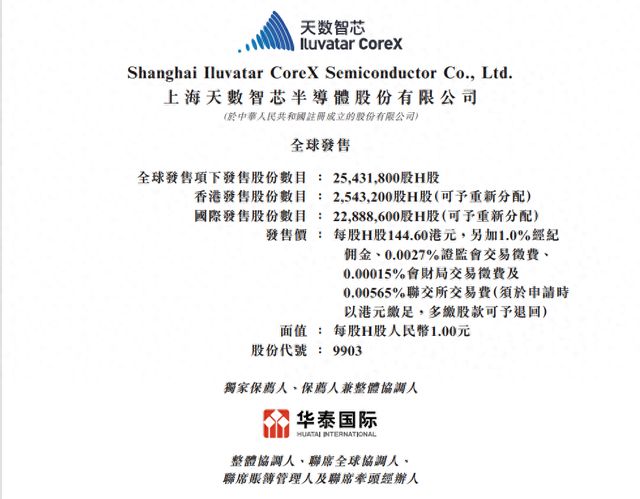
Group 1 - The core point of the article is that domestic GPU company TianShu ZhiXin is accelerating its entry into the capital market with an IPO in Hong Kong, aiming to raise approximately 3.7 billion HKD [1][5] - TianShu ZhiXin's IPO will involve a global offering of 25.43 million shares, with a public offering in Hong Kong accounting for 10% of the total [1][3] - The company has achieved a cumulative shipment of 52,000 units and serves over 290 clients across various sectors, including finance, healthcare, and transportation [3][5] Group 2 - The financial data indicates a compound annual growth rate (CAGR) of 68.8% from 2022 to 2024, with a revenue of 324 million CNY in the first half of 2025, representing a year-on-year growth of 64.2% [3][4] - The IPO has garnered significant interest from institutional investors, with 18 cornerstone investors agreeing to subscribe for shares worth a total of 1.583 billion HKD [3][5] - Approximately 80% of the net proceeds from the IPO are expected to be used for research and development of products and solutions, including general-purpose GPU chips and AI computing solutions [4]
看2026|摩尔线程周苑:让国产算力从“可用”走向“好用”
Xin Jing Bao· 2025-12-29 09:16
Core Viewpoint - The enthusiasm in China's capital market is being fueled by the rise of "domestic GPUs," with companies like Moore Threads making significant strides in the industry and contributing to a broader transformation driven by autonomous computing [2] Group 1: Industry Trends and Developments - The central economic work conference for 2026 emphasizes "innovation-driven" growth and the cultivation of new economic drivers, particularly in the context of AI and domestic chip development [2] - The GPU industry is transitioning from "single-point breakthroughs" to "systematic challenges and ecosystem building," indicating progress in overcoming critical technological barriers [5][6] - The first MUSA Developer Conference (MDC 2025) highlighted the importance of building a developer ecosystem around the MUSA architecture, which aims to compete with NVIDIA's CUDA [5] Group 2: Company Strategy and Positioning - Moore Threads aims to enhance its core competitiveness through a strategy centered on a full-function GPU and the MUSA architecture, focusing on comprehensive computing capabilities from cloud to edge [6] - The company plans to increase R&D investment and foster collaboration between academia and industry to accelerate the development of the domestic GPU sector [6][7] - The recent release of the "Huagang" architecture, which boasts a tenfold performance improvement over previous generations, exemplifies the company's commitment to technological advancement [6] Group 3: Policy and Market Opportunities - The central government's focus on "AI+" and the promotion of core technology independence presents significant strategic opportunities for companies like Moore Threads [8][10] - The concept of "new momentum" in the intelligent computing sector includes building a self-sufficient technology base, integrating AI into various industries, and fostering a collaborative ecosystem centered around developers [10] Group 4: Regional Development and Ecosystem - The national strategy for regional integration is seen as a way to maximize resource advantages and create unprecedented collaborative opportunities for the domestic computing industry [11] - Moore Threads aims to position itself as a foundational player in Beijing's integrated circuit industry, leveraging the city's rich resources and supportive policies [12][14] - The company advocates for enhancing the resilience of the integrated circuit supply chain and promoting collaborative innovation across the Beijing-Tianjin-Hebei region [16][18]

摩尔线程周苑:扩大北京新一代信息技术产业集群优势
Xin Jing Bao· 2025-12-29 08:52
Core Viewpoint - The article discusses the upcoming five-year plan for China's economy, emphasizing the importance of innovation and the development of new driving forces, particularly in the context of the domestic GPU industry and its role in the broader economic landscape [1][3][7]. Group 1: Economic Context and Policy Direction - The Central Economic Work Conference highlighted the need for steady progress and quality improvement in economic work for 2026, focusing on stabilizing employment, enterprises, markets, and expectations [1]. - The conference outlined eight key tasks for 2026, including the acceleration of innovation-driven development and the cultivation of new economic drivers [3][7]. Group 2: GPU Industry and Company Strategy - The domestic GPU industry is experiencing a transformation, with companies like Moer Thread making significant strides, as evidenced by its recent listing on the STAR Market [3]. - Moer Thread aims to establish a comprehensive computing power platform through its MUSA architecture, focusing on full-stack development and continuous innovation [5][6]. - The company emphasizes the importance of building a developer ecosystem, which is crucial for the competitive landscape of the GPU industry [4][6]. Group 3: Technological and Ecological Development - Moer Thread's strategy includes a commitment to open-source innovation and empowering developers, which is seen as essential for creating a robust AI ecosystem [6][8]. - The company is expanding its product offerings from data centers to edge and endpoint solutions, thereby broadening its market reach and validating its technology in real-world applications [6][9]. Group 4: Regional Development and Industry Positioning - Moer Thread positions itself as a key player in Beijing's integrated circuit industry, benefiting from the city's rich resources and supportive policies [9][10]. - The company advocates for enhanced collaboration across the entire supply chain and the establishment of a resilient integrated circuit industry in Beijing [11].