
技术赋能

Search documents
京东物流(02618.HK)中期业绩:总收入达985.3亿元,同比增长14.1%,净利润33.4亿元,营收、净利润额均超市场预期
Ge Long Hui· 2025-08-14 09:45
Core Viewpoint - JD Logistics reported a total revenue of 98.53 billion yuan for the first half of 2025, reflecting a year-on-year growth of 14.1% [1] Financial Performance - The adjusted net profit for JD Logistics reached 3.34 billion yuan in the first half of 2025, exceeding market expectations [1] - The revenue growth and net profit figures surpassed market forecasts, indicating strong financial performance [1] Operational Efficiency - The company enhanced resource utilization efficiency and reduced logistics costs through technology empowerment, network layout optimization, and refined management [1] - In the second quarter, integrated supply chain revenue grew by 26.3%, leading the industry [1]
京东物流中期业绩:总收入达985.3亿元,同比增长14.1%,净利润33.4亿元,营收、营收增长、净利润额均超市场预期
Zhong Jin Zai Xian· 2025-08-14 09:39
Core Viewpoint - JD Logistics reported a total revenue of 98.53 billion yuan for the first half of 2025, reflecting a year-on-year growth of 14.1% [1] Group 1: Financial Performance - As of June 30, JD Logistics achieved an adjusted net profit of 3.34 billion yuan, exceeding market expectations [1] - The revenue growth and net profit figures surpassed market forecasts, indicating strong financial performance [1] Group 2: Operational Efficiency - The company enhanced resource utilization efficiency and reduced logistics costs through technology empowerment, network layout optimization, and refined management [1] - Integrated supply chain revenue in the second quarter grew by 26.3%, leading the industry [1]
比亚迪 | 技术赋能+强化营销 构筑高端品牌溢价【民生汽车 崔琰团队】
汽车琰究· 2025-08-10 12:43
Core Viewpoint - The article emphasizes the strategic initiatives of BYD in enhancing its high-end automotive brand image through technological advancements and experiential marketing, particularly with the launch of a professional all-terrain racetrack in Zhengzhou and the introduction of high-performance models [2][4][22]. Group 1: Investment and Experience Initiatives - The company has invested 5 billion yuan to create the world's first professional all-terrain racetrack, which will serve as a hub for user interaction and brand showcasing [2][8]. - The racetrack features various testing environments where high-end models like Tengshi N9, Tengshi Z9GT, and Yangwang U8 demonstrated their capabilities, enhancing consumer perception of technological value [3][22]. Group 2: Brand Management and Leadership Changes - A management reshuffle was announced for the Tengshi brand, with a focus on strengthening brand system construction and overcoming high-end market challenges [4][25]. - The new leadership aims to enhance service upgrades and user experience, addressing the brand's shortcomings in high-end service ecosystems [4][25]. Group 3: Technological Empowerment and Market Strategy - The company is leveraging advanced technologies such as Yun Nian, Yi Si Fang, and DM-O platforms to drive high-end brand development, aiming to build brand premium through technological empowerment [5][32]. - The article outlines a three-pronged approach to high-end branding with Tengshi, Fangchengbao, and Yangwang, focusing on technological innovation and marketing strategies to enhance brand recognition and market penetration [5][32]. Group 4: Financial Projections - Revenue projections for 2025-2027 are estimated at 99.08 billion yuan, 118.90 billion yuan, and 139.70 billion yuan, respectively, with net profits expected to reach 5.52 billion yuan, 6.58 billion yuan, and 7.53 billion yuan [6][7]. - The earnings per share (EPS) are projected to be 6.05 yuan, 7.22 yuan, and 8.26 yuan for the respective years, indicating a positive growth trajectory [6][7].



上半年增加值119亿元 浙江嘉兴时尚产业“硬核”突围
Zhong Guo Xin Wen Wang· 2025-08-07 16:36
Core Insights - The fashion industry in Jiaxing is projected to achieve an industrial added value of 11.9 billion RMB in the first half of 2025, indicating a robust development trend [1] - Jiaxing's fashion sector is transitioning from "scale expansion" to "value creation" driven by sustainable innovation, technological empowerment, and digital transformation [1] Industry Development - Jiaxing has a strong foundation in the fashion industry, featuring well-known markets such as Tongxiang's wool sweater market, Haining Leather City, and Pinghu's China Garment City [1] - The city has formed a new pattern of industrial agglomeration with core areas in Haining, Tongxiang, Pinghu, and Xiuzhou, characterized by complementary and interlinked development [2] Technological Advancements - Traditional industries in Jiaxing are undergoing transformation through technology, with companies investing in research and development of high-quality natural fiber yarns and functional ecological textiles [3] - The integration of industrial big data, 5G, and artificial intelligence is enhancing capabilities across design, production, and marketing in the fashion textile sector [4] Value Creation - Jiaxing's textile and apparel industry is focusing on cultural confidence and ecological coexistence, with companies launching products that blend traditional cultural elements with modern design [5] - The shift from "selling products" to "selling culture" is evident, as companies emphasize brand positioning and cultural heritage in their offerings [6] - In 2025, seven silk projects in Jiaxing secured 35.8% of the total central foreign trade funds allocated to Zhejiang Province, ranking first in the province [6]
半年报预告(二)!中免少赚6.4亿仍称王,华夏航空赚2亿成黑马
Sou Hu Cai Jing· 2025-08-07 06:01
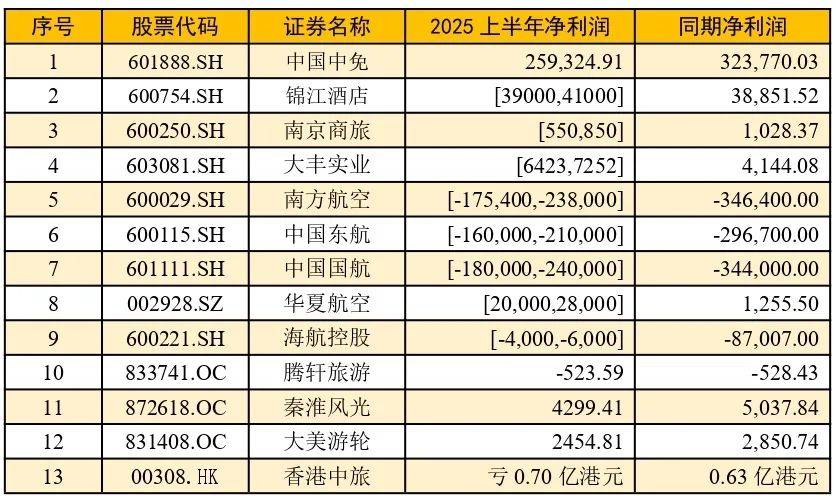
Core Viewpoint - The tourism industry is experiencing a shift from growth to efficiency, where companies must enhance cost, structure, and scenario effectiveness to convert competitors' declines into their own gains [1] Duty-Free Industry - China Duty Free Group (中国中免) reported a net profit of 259,324.91 thousand yuan for the first half of 2025, a significant decrease of 6.4% from 323,770.03 thousand yuan in the same period last year [7] - The decline is attributed to pressures on Hainan's offshore duty-free sales, outbound consumption diversion, and intensified market competition [7] - Despite challenges, China Duty Free's market share increased by nearly 1 percentage point year-on-year, and inventory turnover improved by 10% [7] Hotel Industry - Jin Jiang Hotels (锦江酒店) expects a net profit of 39,000 to 41,000 thousand yuan for the first half of 2025, showing slight growth from 38,851.52 thousand yuan year-on-year [10] - The growth is driven by a light-asset operation model that effectively reduced cost pressures, despite the absence of similar revenue items as in the previous year [10] - In contrast, Nanjing Tourism (南京商旅) anticipates a net profit of 550 to 850 thousand yuan, a notable decline from 1,028.37 thousand yuan, primarily due to underperformance in its tourism service segments [10] Airline Industry - Major state-owned airlines, including China Southern Airlines, China Eastern Airlines, and Air China, are projected to incur losses ranging from 175,400 thousand to 240,000 thousand yuan, 160,000 thousand to 210,000 thousand yuan, and 180,000 thousand to 240,000 thousand yuan respectively, although losses are narrowing compared to the previous year [11] - The losses are attributed to imbalances in market supply, a downward shift in customer demographics, competition from high-speed rail, and uncertainties in the international environment [11] - Conversely, Huaxia Airlines (华夏航空) expects a profit of 20,000 to 28,000 thousand yuan, a significant increase from 1,255.50 thousand yuan, benefiting from improved demand in civil aviation and optimized route structures [11] Regional Tourism - Qinhuai Scenic Area (秦淮风光) reported a net profit of 4,299.41 thousand yuan, down from 5,037.84 thousand yuan, due to decreased consumer spending and visitor numbers [14] - Daming Cruises (大美游轮) achieved a net profit of 2,454.81 thousand yuan, slightly down from 2,850.74 thousand yuan, with operational metrics showing stable performance despite minor declines in average ticket prices and hotel occupancy rates [15] - Tengxuan Tourism (腾轩旅游) reported a loss of 523.59 thousand yuan, nearly unchanged from the previous year's loss, impacted by reduced income from air freight and domestic ticket commissions [15] Hong Kong Tourism - Hong Kong China Travel Service (香港中旅) reported a loss of 0.70 billion HKD, a reversal from a profit of 0.63 billion HKD, primarily due to investment property impairments [16] - Despite a 12% increase in total visitors to Hong Kong, the company faces challenges from reduced group tours and rising operational costs [16] Cultural and Sports Equipment - Dafen Industrial (大丰实业) expects a net profit of 6,423 to 7,252 thousand yuan, a significant increase from 4,144.08 thousand yuan, driven by strong demand for technology solutions in cultural and tourism sectors [17]



大行评级丨花旗:予汇通达网络“买入”评级(目标价23港元),战略调整+政策受益等背景下具63%潜在上行空间
Ge Long Hui· 2025-08-01 02:34
Group 1 - The core viewpoint of the article is that Citigroup maintains a "Buy" rating for HuTongDa Network (9878.HK) with a target price of HKD 23.0, indicating significant upside potential from the current stock price of HKD 14.1, reflecting a 63.1% increase [1][2][3] - The company is expected to achieve steady revenue growth in 2025, driven by improved profitability and strategic adjustments made last year, which included reducing low-margin business operations [1] - Citigroup highlights that the company will benefit from government subsidies and the growth of its high-margin proprietary brand products, which will enhance overall profitability [1] Group 2 - The company is recognized as a "connector" in the lower-tier market, with its strategic adjustments leading to a re-evaluation of its value, indicating long-term growth potential [2] - The integration of mainstream large language models (LLM) into the company's service offerings, along with the launch of AI+SaaS tools, is expected to improve product usability and customer penetration, creating new growth engines through technology [1] - HuTongDa Network has been ranked among the top ten in the "2025 China Online Retail TOP 100," further solidifying its market position [3]
汇通达网络(9878.HK)获花旗“买入”评级(目标价23港元),战略调整+政策受益等背景下具63%潜在上行空间
Ge Long Hui· 2025-08-01 01:12
Core Viewpoint - Citi's report on HuTongDa Network (9878.HK) highlights a clear path for improving profitability and benefits from policy incentives, maintaining a "Buy" rating with a target price of HKD 23.0, indicating significant upside potential from the current stock price [1][2] Financial Performance - The company is expected to achieve steady revenue growth in 2025, driven by improved profitability [1] - Following strategic adjustments to reduce low-margin business, the company anticipates a substantial increase in profit margins for the year [1] Business Segments - The company effectively assists member stores in completing national subsidy qualification applications, which will boost revenue [1] - High-margin proprietary brand products are expected to significantly enhance overall profitability [1] Technological Integration - The company integrates mainstream large models (LLM) to launch AI+SaaS tools, improving product usability and customer penetration [1] - This technological enhancement aims to increase user stickiness and explore new growth engines for profit conversion [1] Market Recognition - Institutional recognition of HuTongDa Network's long-term growth potential is reflected in the acknowledgment of the "policy dividends + model upgrades + technological empowerment" logic [2] - The company's role as a "connector" in the lower-tier market is becoming increasingly clear, marking the beginning of its value reassessment journey post-strategic adjustments [2]
多维推进“微短剧+文旅”深度融合
Xiao Fei Ri Bao Wang· 2025-07-31 02:52
Core Viewpoint - The integration of "micro short dramas + cultural tourism" is emerging as a new engine for breaking through challenges in the cultural tourism industry, providing immersive experiences for consumers through fragmented storytelling and social dissemination [1][2]. Policy Guidance - The National Radio and Television Administration has launched the "Travel with Micro Short Dramas" initiative to promote deep integration of micro short drama content with cultural tourism resources, with over 20 provinces actively supporting this initiative [2]. - The initiative has already produced multiple high-quality works that transform intangible cultural heritage, landmark scenery, and folk customs into engaging narratives for younger audiences [2]. Content Practice - Diverse micro short dramas are becoming the "business cards" of cultural tourism, showcasing local delicacies and cultural stories, such as "My Journey Has Wind," "Summer in Sanjing Hutong," and "Scenic Hunter: Chaka Salt Lake" [3]. - These dramas not only highlight regional culture but also enhance the viewer's connection to the local heritage and experiences [3]. Market Dynamics - As of December 2024, the user base for micro short dramas in China is projected to reach 662 million, with a market size of 50.4 billion yuan [6]. - The filming of micro short dramas has significantly boosted local economies, as seen in Yantai, where filming generated over 5 million yuan in local consumption [6]. - In Zhejiang, a competition for outstanding works related to cultural tourism received 120 submissions, indicating strong industry engagement [6]. Extension of Micro Short Dramas in Cultural Tourism - Scenic spots are leveraging the exposure from film and television to create immersive experiences, as demonstrated by the Red Leaf Persimmon Rock Tourism Area in Shandong, which attracted 1.6 million visitors in 2024 [7]. - The integration of micro short dramas into tourism is enhancing the appeal of destinations, making travel more engaging for younger audiences [7]. Technological Empowerment - The micro short drama industry is being driven by technological innovations, with a focus on high-quality content development [8]. - Advanced technologies like XR and AI are reshaping the integration of micro short dramas with cultural tourism, enhancing viewer immersion and storytelling [9]. - The industry is moving towards content premiumization, utilizing data analytics to refine scripts and enhance production quality, thereby increasing user engagement [9].

微软全球裁员9000人,外媒称Xbox增长放缓或成导火索
Huan Qiu Wang· 2025-07-04 03:17
Group 1 - Microsoft announced a large-scale layoff plan, cutting 9,000 jobs globally, with 830 employees affected at its Washington headquarters [1][3] - The layoffs will impact multiple departments, including game design, audio engineering, and hardware development, reflecting the company's deeper considerations in business adjustments and cost control [1][3] - Despite a 13% overall revenue growth reported in Q1 2025, Xbox content and services revenue grew only 8%, indicating a slowdown in the gaming business, which may have triggered the layoffs [3][4] Group 2 - Microsoft emphasized that the layoffs aim to "eliminate redundancies and encourage employees to adopt new technologies," aligning with CEO Satya Nadella's "technology empowerment" strategy [3][4] - The company has not yet provided a specific technology transformation roadmap, raising questions about whether the layoffs will indeed enhance efficiency [3][4] - This is not the first large-scale layoff for Microsoft in 2023, as it previously announced a reduction of approximately 6,000 employees in May, accounting for about 3% of its total workforce [4][5]


强产业、助销售!茂南羊角镇驻镇帮镇扶村工作队超给“荔”
Nan Fang Nong Cun Bao· 2025-07-02 10:00
Core Viewpoint - The article highlights the successful implementation of a three-pronged strategy involving consumption assistance, technological empowerment, and brand development to modernize the lychee industry in Maonan District, particularly in Yangjiao Town, contributing to rural revitalization and economic growth [6][7][8]. Group 1: Lychee Production and Yield - In 2025, Yangjiao Town is expected to harvest 34,500 acres of lychee, with 468 ancient lychee trees yielding a significant output [3][4]. - The total lychee production in the town is approximately 13,500 tons, accounting for 51% of the lychee output in Maonan District [4]. Group 2: Technological Empowerment - The local work team has implemented smart management for 343 ancient lychee trees, utilizing pest control systems and a 5G irrigation system to enhance fruit-bearing rates [15][16]. - The team plans to continue providing standardized production training and protective development guidance for lychee farmers to improve quality and efficiency [18][19]. Group 3: Sales and Marketing Initiatives - The work team has collaborated with local government to create customized procurement plans for lychee, promoting a "purchase instead of assistance" model [24]. - Agreements have been signed with various organizations to include Yangjiao lychee in employee welfare purchasing systems, significantly expanding the consumer base [25][26]. - The sales initiatives have generated over 388,500 yuan in revenue, alleviating sales pressure on farmers and effectively increasing their income [29].
