权益资产配置

Search documents
中国人寿(601628):2025年中报点评:银保驱动增长,增配权益资产
Changjiang Securities· 2025-09-01 14:42
Investment Rating - The report maintains a "Buy" rating for China Life Insurance [2][8]. Core Views - The report suggests that with the increase in equity allocation, the long-term interest spread in the industry is expected to improve. The demand on the liability side remains robust, and the market is concentrated, indicating a positive outlook for the industry's long-term profitability and valuation re-evaluation. In the short term, the asset side presents the main challenges for the industry. As a pure life insurance company, China Life is positioned in the first tier of the industry in terms of sensitivity and elasticity, making it a quality beta asset for allocation. The current valuation stands at 0.78 times PEV [2][12]. Summary by Sections Financial Performance - In the first half of 2025, China Life achieved a net profit attributable to shareholders of 40.93 billion yuan, representing a year-on-year increase of 6.9%. The comparable new business value was 28.55 billion yuan, up 20.3% year-on-year [6][12]. Investment Strategy - The company has increased its equity allocation by 1.12 percentage points to 8.7% and its fund allocation by 0.28 percentage points to 4.92%, reflecting a commitment to long-term capital market responsibilities [12]. New Business Growth - The new business value for the first half of 2025 was 28.55 billion yuan, with a year-on-year growth of 20.3%. The improvement in value rate was a significant factor, with new single premiums slightly increasing by 0.6% year-on-year [12]. Individual Insurance and Bancassurance - The individual insurance long-term new single premium was 64.25 billion yuan, down 24.2% year-on-year, primarily due to the transformation of dividend insurance. The bancassurance long-term new single premium reached 35.67 billion yuan, a strong increase of 112.4% year-on-year, indicating a significant trend of "deposit migration" [12].

五险企半年净赚1782亿、拟发红包293亿 计划增配权益资产
2 1 Shi Ji Jing Ji Bao Dao· 2025-09-01 12:38
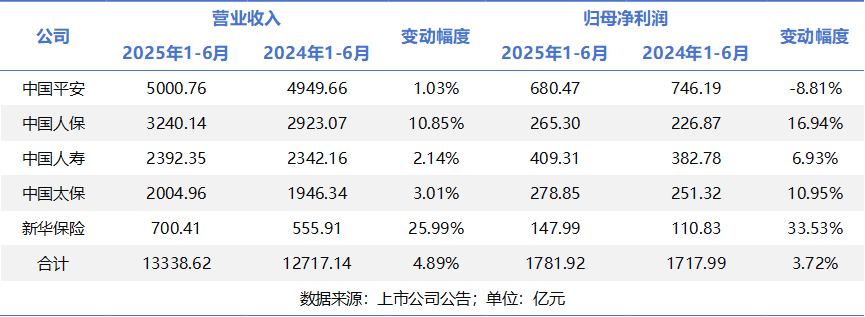
Core Viewpoint - The five major A-share listed insurance companies in China reported their 2025 mid-year results, showing a combined revenue of 1.33 trillion yuan, a year-on-year increase of 4.89%, and a net profit attributable to shareholders of 178.19 billion yuan, up 3.72% year-on-year. However, there was a divergence in net profit performance, with four companies reporting increases and one reporting a decrease [1][4]. Revenue Summary - The five insurance companies achieved a total revenue of 1.33 trillion yuan in the first half of 2025, reflecting a growth of 4.89% compared to the same period in 2024 [3]. - China Ping An led with a revenue of 500.08 billion yuan, a growth of 1.03% year-on-year [5]. - China Pacific Insurance and China Life both exceeded 200 billion yuan in revenue, with growth rates of 3.01% and 2.14%, respectively [5]. - New China Life Insurance reported the fastest revenue growth at 25.99%, reaching 70.04 billion yuan [5]. Net Profit Summary - The total net profit attributable to shareholders for the five companies was 178.19 billion yuan, marking a year-on-year increase of 3.72% [4]. - China Ping An's net profit was 68.05 billion yuan, but it experienced a decline of 8.81% [5][6]. - China Life reported a net profit of 40.93 billion yuan, up 6.93% year-on-year [6]. - New China Life achieved a net profit of 14.80 billion yuan, with the highest growth rate of 33.53% [7]. Investment Strategy - In response to a low-interest-rate environment, all five companies indicated plans to steadily increase their equity asset allocations, focusing on high-dividend value stocks and growth industries to enhance long-term returns [1][8]. - China Life has increased its equity asset allocation by over 150 billion yuan in the first half of 2025 [10]. - China Pacific Insurance aims to increase its public market equity assets and alternative asset allocations to improve long-term investment returns [12]. Dividend Plans - Four of the five companies have announced mid-term dividend plans, with a total proposed payout of approximately 29.34 billion yuan [2][14]. - China Ping An plans to distribute 0.95 yuan per share, totaling 17.20 billion yuan, an increase of 2.2% year-on-year [15][17]. - China Life intends to distribute 0.238 yuan per share, amounting to 6.73 billion yuan [18]. - New China Life plans to distribute 0.67 yuan per share, totaling approximately 2.09 billion yuan, with a payout ratio of 14.1% of its net profit [18].



二季度以来险资调研超1200次 医药、制造等行业上市公司成热门
Zheng Quan Ri Bao· 2025-09-01 02:33
Core Viewpoint - The insurance sector is increasingly shifting towards equity asset allocation in response to declining interest rates and a scarcity of risk-free investment assets, with a notable rise in the number of company surveys conducted by insurance institutions. Group 1: Investment Trends - Since the second quarter, insurance institutions have conducted 1,220 company surveys, a 31.3% increase from the first quarter's 929 surveys [1] - In the first four months of this year, insurance capital invested approximately 2.67 trillion yuan in stocks and securities investment funds, accounting for 13.60% of the total insurance fund utilization, marking a four-year high [1] - The top surveyed companies by insurance institutions include Mindray Medical, which received 52 surveys, followed by Antarctic E-commerce with 19 surveys [1][2] Group 2: Sector Performance - The medical sector, particularly Mindray Medical, is a focal point for insurance institutions, with significant attention on the impact of the pandemic on its global sales network and product lines [2] - From April 1 to June 19, 2023, the stock price performance of surveyed companies showed Mindray Medical increased by 13.1%, while Antarctic E-commerce surged by 83.5% [2] Group 3: Shareholding and Investment Strategy - As of now, there have been 16 cases of insurance capital acquiring stakes in listed companies this year, primarily involving large and medium-sized insurance firms [3] - The purpose of these acquisitions has shifted towards financial investment, aiming for long-term stable returns, with a preference for bank stocks and H-shares [3] - The overall proportion of equity investments by insurance capital is expected to continue rising, reflecting a broader industry trend towards increased equity investment [3]


1.8万亿!A股五大险企股票资产增超28% 关注这些投资机会
Zheng Quan Shi Bao Wang· 2025-09-01 00:29
Core Insights - The investment trends of listed insurance companies are gaining attention as they significantly increase their equity asset allocations, reflecting a positive outlook on the A-share market [1][2][3] Group 1: Investment Trends - As of the end of Q2 2025, five A-share listed insurance companies held over 1.8 trillion yuan in stock assets, an increase of over 400 billion yuan, representing a growth rate of 28.7% compared to the end of the previous year [1][2] - The equity asset allocation ratios for major insurance companies have increased, with China Life, Ping An, China Pacific, and China Property & Casualty reaching 13.6%, 12.6%, 11.8%, and 10.7% respectively, marking an increase of 0.9 to 2.7 percentage points from the previous year [2][3] - New China Life has the highest stock allocation ratio among listed insurers at 18.6%, despite a slight decrease of 0.2 percentage points from the previous year [2] Group 2: Investment Performance - The investment income of several listed insurance companies has significantly increased due to the recovery of the capital market, contributing to net profit growth [4][5] - In H1 2025, China Life reported total investment income of 127.5 billion yuan, a year-on-year increase of 4.2%, while China Property & Casualty and New China Life saw increases of 42.7% and 43.3% respectively [4] - New China Life's net profit grew by 33.5% in H1 2025, attributed to substantial investment performance improvements, with total investment income reaching 453 billion yuan, an increase of approximately 137 billion yuan [5] Group 3: Future Outlook - Insurance companies are optimistic about the equity market's future, with strategies focusing on enhancing equity asset allocations and optimizing investment structures [6][7] - The management of China Ping An expressed confidence in the stability and potential of the domestic equity market, highlighting opportunities in emerging industries such as artificial intelligence and advanced manufacturing [6] - China Pacific's management emphasized a balanced asset allocation strategy, combining long-term bonds with innovative high-quality assets to improve long-term investment returns [7]
1.8万亿!A股五大险企,股票资产增超28%,关注这些投资机会
券商中国· 2025-08-31 14:44
Core Viewpoint - The investment trends of listed insurance companies are gaining attention as they significantly increase their equity asset allocations, reflecting a positive outlook on the capital market and a strategic shift towards long-term investments [1][2][4]. Group 1: Investment Trends - As of the end of Q2 2025, five A-share listed insurance companies held over 1.8 trillion yuan in stock assets, an increase of over 400 billion yuan, representing a growth rate of 28.7% compared to the previous year [2][3]. - The proportion of equity assets has risen, with stock and fund allocations for major insurers like China Life, Ping An, and China Pacific reaching 13.6%, 12.6%, and 11.8% respectively, marking increases of 0.9 to 2.7 percentage points from the previous year [3][4]. - New China Life has notably increased its equity asset allocation, with its stock allocation rising from 7.9% to 11.1% over the past year, reflecting a strategic shift towards equities [4]. Group 2: Investment Returns - The recovery of the capital market has led to significant increases in investment returns for several listed insurance companies. For instance, China Life reported total investment income of 127.5 billion yuan, a year-on-year increase of 4.2% [5][6]. - China Pacific achieved a total investment income of 414.78 billion yuan, up 42.7% year-on-year, while New China Life's investment income rose by 43.3% to 452.88 billion yuan [5][6]. - China Pacific's net profit for the first half of 2025 reached 358.88 billion yuan, a 17.8% increase, driven by a substantial rise in investment income [7][8]. Group 3: Market Outlook and Strategy - The outlook for equity investments remains positive, with industry leaders emphasizing the stability and potential of the domestic equity market. Factors such as government support for capital markets and emerging industries are seen as key drivers [9][10]. - Companies are adopting flexible asset allocation strategies, focusing on sectors like technology, advanced manufacturing, and new consumption, while maintaining a cautious approach to risk management [10][11]. - The emphasis is on increasing allocations to long-term bonds and innovative assets, while also expanding equity investments in the public market and alternative assets to enhance long-term returns [11].

上市险企权益资产配置 一手抓股息一手抓成长
Zhong Guo Zheng Quan Bao· 2025-08-29 20:14
Core Viewpoint - The five major listed insurance companies in A-shares have all released their semi-annual performance reports, showing a significant impact from the investment side, particularly in the context of a low interest rate environment, which has pressured fixed-income asset returns and led to a strategic shift towards equity investments, especially high-dividend assets [1][2][4]. Investment Asset Growth - All five major insurance companies reported growth in investment assets compared to the beginning of the year, with increases ranging from 5.1% to 8.2%. A significant portion of this growth came from A-share investments, with China Pacific Insurance reporting a 26.1% increase in A-share investment assets [2][3]. Impact of Low Interest Rates - The pressure on fixed-income asset returns has accelerated the search for alternative assets among insurance companies. For instance, China Pacific Insurance reported a total investment yield of 2.3%, down 0.4 percentage points year-on-year, primarily due to declines in the fair value of fixed-income assets [3][4]. Diversification into Equity Assets - In response to the low interest rate environment, insurance companies are increasingly diversifying their asset allocations to include more equity assets, particularly high-dividend stocks, which are seen as stabilizing factors for overall investment returns [4][5]. Focus on Growth Stocks - The insurance companies are not only focusing on stable cash flows from their investments but are also looking to capture excess returns by identifying growth-oriented targets. This dual approach aims to balance stability and growth potential in their investment strategies [6][7]. Strategic Investment Areas - Companies like China Life and China Insurance are emphasizing the optimization of their equity allocation structures, focusing on sectors such as technology innovation, advanced manufacturing, and new consumption, which align with national strategic directions [7].


时报观察丨加快权益资产配置 险资“长钱长投”效应显现
Zheng Quan Shi Bao· 2025-08-29 00:27
Core Insights - The investment trends of listed insurance companies are a focal point for the market, with stock assets exceeding 1.8 trillion yuan as of June 30, marking an increase of over 400 billion yuan and a growth rate of 28.7% compared to the end of the previous year [1] - The combined stock and fund holdings of major insurance companies have also shown rapid growth, with China Life, Ping An, China Pacific Insurance, and China Property & Casualty Insurance having stock and fund allocation ratios of 13.6%, 12.6%, 11.8%, and 10.7% respectively, reflecting increases of 0.9 to 2.7 percentage points [1] - The proactive entry of insurance capital into the market is driven by two main factors: the low interest rate environment and new accounting standards necessitating increased equity asset allocation, along with policies that facilitate long-term investments [1][2] Industry Overview - As of the end of June, the total market value of stocks held by life insurance companies reached 2.87 trillion yuan, an increase of 605.2 billion yuan, representing a growth rate of 26.69%, significantly outpacing the 8.85% growth in total fund utilization [1] - The central government's push for long-term funds to enter the market, initiated in September of last year, has led to effective policies that have removed barriers for insurance capital, promoting a stable investment environment [2] - The active participation of insurance capital is expected to enhance its role as a market stabilizer and guide the market towards a trend of long-term and value investing, contributing to the healthy development of the capital market [2]
时报观察丨加快权益资产配置 险资“长钱长投”效应显现
证券时报· 2025-08-28 23:59
Group 1 - The core viewpoint of the article highlights the significant increase in stock investments by listed insurance companies in China, with a total stock asset amount exceeding 1.8 trillion yuan as of June 30, marking an increase of over 400 billion yuan and a growth rate of 28.7% compared to the end of the previous year [1] - The combined amount of stocks and funds held by listed insurance companies has also shown rapid growth, with specific allocation ratios for major companies such as China Life, Ping An, China Pacific Insurance, and China People’s Insurance reaching 13.6%, 12.6%, 11.8%, and 10.7% respectively, reflecting an increase of 0.9 to 2.7 percentage points [1] - The increase in equity asset allocation by insurance companies is driven by two main factors: the low interest rate environment and new accounting standards, creating a real demand for increasing equity asset allocation [1] Group 2 - The policies introduced since last September, including the Central Political Bureau's call to guide long-term funds into the market, have effectively addressed the barriers to insurance capital entering the market, leading to a significant increase in investments [2] - The active participation of insurance capital in the market is expected to enhance its role as a stabilizer and ballast, promoting a trend towards long-term and value investing, which in turn supports the stable and healthy development of the capital market [2] - In the long term, the combination of a low interest rate environment and policies encouraging insurance and other long-term funds to enter the market is likely to lead to a continued increase in equity asset allocation by insurance companies [2]

时报观察 加快权益资产配置 险资“长钱长投”效应显现
Zheng Quan Shi Bao· 2025-08-28 17:58
上市险企的投资动向历来是市场关注焦点。截至6月30日,五家A股上市险企持有的股票资产金额超1.8 万亿元,较上年末增超4000亿元,增幅达28.7%,远超投资资产增幅,入市明显提速。 去年9月中央政治局会议提出"大力引导中长期资金入市"要求,《关于推动中长期资金入市的指导意 见》等政策相继落地,打通保险资金入市堵点成效显著,稳步入市成为险企投资布局时的共同选择。 险资积极入市,得以更大程度发挥市场稳定器和压舱石作用,并引导市场逐步形成长期投资、价值投资 之风,助推资本市场平稳健康发展。反过来,资本市场稳步向好,也让保险公司受益,两者呈现出良性 互动的局面。长期来看,在低利率环境和政策鼓励保险等中长期资金入市的背景下,保险公司对权益资 产的配置有望持续提升。 (文章来源:证券时报) 上市险企持有的股票和基金合计金额亦呈现较快增长。截至6月30日,中国人寿、中国平安、中国太 保、中国人保的股票和基金配置比例分别达13.6%、12.6%、11.8%和10.7%,上升区间为0.9个至2.7个百 分点。新华保险股票和基金配置比例虽较上年末减少0.2个百分点,但仍处历史和行业高位,达到 18.6%。 险资积极入市主要有两 ...
险资股票仓位激增,重仓368股,偏爱银行、运营商
2 1 Shi Ji Jing Ji Bao Dao· 2025-08-28 13:46
Core Insights - Insurance capital is increasingly focusing on high-dividend stocks to secure stable returns and mitigate the impact of declining bond yields [2][6][10] - As of August 27, 368 stocks are heavily held by insurance capital, with significant investments in non-bank financials, banks, telecommunications, and utilities [2][5] - Insurance funds have shown a notable increase in equity investments, with 79 new stock positions and 124 increased holdings in Q2 2025 [2][5] Investment Trends - The top holdings include China Life Insurance's stake in China Life, valued at 795.93 billion yuan, and Ping An's stake in Ping An Bank, valued at 135.73 billion yuan [4][5] - Telecommunications companies, particularly China Unicom, China Telecom, and China Mobile, have become key targets for insurance capital in Q2 2025 [4][5] - The most popular stock among insurance funds is Shenhuo Co., with four insurance institutions holding a combined 104 million shares [4] Sector Allocation - The insurance sector's top three holdings by market value are in non-bank financials (796.21 billion yuan), banks (224.57 billion yuan), and telecommunications (33.64 billion yuan) [5] - Insurance capital has increased its holdings in stocks significantly, with a net increase of 640.6 billion yuan in equity investments in the first half of 2025 [9] Policy Influence - Recent policy initiatives have encouraged insurance capital to invest more in the stock market, with a target for large state-owned insurance companies to allocate 30% of new premiums to A-shares starting in 2025 [6][10] - The insurance industry is adjusting its investment strategies to enhance long-term returns, driven by the need for better asset-liability matching [6][7] Future Outlook - Insurance capital is expected to continue increasing its equity investments, with a focus on stable, high-dividend stocks and sectors aligned with national strategic directions, such as green energy and high-end manufacturing [10][11] - The potential for significant incremental capital from insurance funds is anticipated, contributing to the stability of the capital market [11][12]