
消费者价格指数(CPI)

Search documents
Two Measures of Inflation: September 2025
Etftrends· 2025-12-08 17:19
Core Insights - Inflation remains a significant concern, with the core PCE at 2.8% and core CPI at 3.0%, both above the Federal Reserve's 2% target [1][2] Inflation Measures - The Federal Reserve primarily uses the PCE Price Index as its inflation gauge, emphasizing core inflation which excludes volatile food and energy prices [2][3] - Core inflation measures are essential for identifying inflation trends, as they exclude items with dramatic price fluctuations [3] Federal Reserve Actions - The Federal Reserve recently cut the federal funds rate by 25 basis points to a range of 4.00%-4.25%, marking the first rate cut of the year, with expectations for two more cuts by year-end [3][4] - The upcoming Fed meeting is anticipated to result in another 25 basis point rate cut, with an 87% likelihood according to the CME FedWatch Tool [4] Comparison of Inflation Metrics - Core PCE is preferred over core CPI due to its lower volatility, making it a more reliable indicator for the Fed's dual mandate of price stability and maximum employment [5][6] - The historical stability of core PCE has raised questions about the effectiveness of the Fed's monetary policy, especially given the disinflationary trend prior to 2022 [6]


特朗普,最新签署!
Zheng Quan Shi Bao· 2025-12-08 01:08
Group 1 - The core point of the article is the establishment of food supply chain security task forces by the U.S. government to investigate price monopolies and anti-competitive behaviors, particularly focusing on foreign-controlled companies [1] - The task forces are empowered to take enforcement actions and develop new rules to combat anti-competitive practices, with a report on their progress due one year after the executive order [1] - The U.S. consumer price index (CPI) has shown a rising trend, increasing from 2.3% in April to 3% in September, with significant price hikes in beef, coffee, and tea, all exceeding 10% year-on-year [1] Group 2 - Moody's report indicates that American households now need to spend an additional $208 per month to purchase the same goods and services as in September of the previous year [1] - President Trump has called for an investigation into major U.S. meat processing companies, accusing foreign-controlled firms of potential collusion and price manipulation leading to increased beef prices [1]
特朗普称美国生活成本危机是“骗局”,但数据显示民众正涌向一元店
Di Yi Cai Jing· 2025-12-05 08:45
Group 1: Economic Context - The business of dollar stores in the U.S. is thriving, attracting consumers from various income levels as they cope with rising living costs [1] - Recent data shows that inflation pressures remain significant in the U.S., with the Consumer Price Index (CPI) rising by 0.3% in September, leading to an annual inflation rate increase from 2.9% to 3% [4] - Moody's data indicates that American households are spending an additional $208 per month on the same goods and services compared to the previous year, and $1,043 more than in early 2021 [5] Group 2: Dollar Store Performance - Dollar General reported a 2.5% increase in same-store sales for the third quarter, while Dollar Tree saw a 4.2% increase [8] - Dollar Tree's sales are primarily driven by items priced at $2 or below, with 85% of their sales coming from these lower-priced goods [8] - Dollar General's CEO noted that the growth in sales is attributed to a broad customer base, with a significant increase in high-income households shopping at their stores [8] Group 3: Consumer Behavior Trends - High-income families are increasingly shopping at dollar stores, with 60% of new customers coming from households earning over $100,000 annually [9] - Low-income families are relying more on dollar stores, with their average spending growth rate exceeding that of wealthier families [9] - Kroger's CEO highlighted the spending differences among income groups, noting that high-income spending remains strong while middle-income customers are feeling more pressure [9]

金价,大跌!原因找到了
Sou Hu Cai Jing· 2025-12-03 08:56
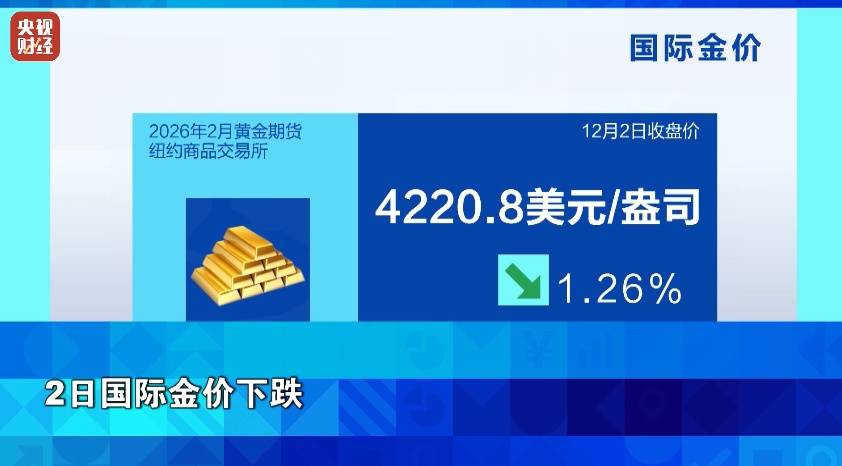
Group 1 - The market is focusing on the prospects of the Federal Reserve's interest rate cuts, with investor concerns about global financial market liquidity tightening easing [1] - Major U.S. stock indices closed higher, with the Dow Jones up 0.39%, S&P 500 up 0.25%, and Nasdaq up 0.59% [1] - Boeing executives indicated plans to gradually increase production, expecting to achieve positive cash flow of billions of dollars by 2026, which led to a 10.15% surge in Boeing's stock price [1] Group 2 - Gold prices fell over 1.2% as investors took profits ahead of key U.S. inflation data, with February gold futures closing at $4220.8 per ounce, down 1.26% [3] - European stock indices showed mixed results, with the Eurozone's November CPI rising 2.2%, slightly above expectations, influencing cautious trading [7] - The German stock market rose by 0.51%, while the UK and French markets saw slight declines of 0.01% and 0.28%, respectively [7] Group 3 - International oil prices declined due to expectations of a supply surplus in the global crude oil market, with January light crude futures closing at $58.64 per barrel, down 1.15% [9] - February Brent crude futures also fell, closing at $62.45 per barrel, down 1.14% [9]

波黑2025年10月CPI同比攀升4.3%
Shang Wu Bu Wang Zhan· 2025-11-29 04:41
Core Insights - The Consumer Price Index (CPI) in Bosnia and Herzegovina increased by 0.4% month-on-month and 4.3% year-on-year as of October 2025 [1] Group 1: Month-on-Month Changes - Significant increase in housing and utilities costs by 2.0%, marking the highest monthly increase [1] - Clothing and footwear prices rose by 0.9%, while transportation costs increased by 0.5% [1] - Moderate increases were observed in several categories including alcoholic beverages and tobacco (+0.1%), furniture and appliances (+0.3%), medical services (+0.2%), education (+0.1%), and dining and hotels (+0.2%) [1] - Slight declines were noted in cultural and entertainment services (-0.1%) and other goods and services (-0.2%) [1] Group 2: Year-on-Year Changes - The most significant year-on-year increases were in food and non-alcoholic beverages (+6.9%), dining and hotels (+7.8%), medical services (+5.5%), and housing and utilities (+5.2%) [1] - The only category that experienced a decline was clothing and footwear, which decreased by 8.2% [1]
澳大利亚10月CPI同比上涨3.8% 超出预期
Zhong Guo Xin Wen Wang· 2025-11-26 06:08
Core Viewpoint - Australia's Consumer Price Index (CPI) for October increased by 3.8% year-on-year, surpassing the market expectation of 3.6% and the previous month's increase of 3.6% [1] Group 1: Inflation Data - The primary driver for the CPI increase was housing prices, which rose by 5.9%, reflecting higher costs in electricity, rent, and new housing [1] - The trimmed mean inflation rate, a key indicator monitored by the Reserve Bank of Australia (RBA), rose from 3.2% in September to 3.3% in October, exceeding the RBA's target range of 2% to 3% [1] Group 2: Implications for Monetary Policy - The latest inflation data reduces the likelihood of interest rate cuts by the RBA this year and raises concerns about potential interest rate hikes [1] - This release marks the first complete monthly CPI report from the Australian Bureau of Statistics, transitioning from quarterly to monthly measurements for a more timely assessment of inflation changes [1] Group 3: Significance of the Data Release - The Australian statistician highlighted that the complete monthly CPI represents a significant improvement in measuring key economic data, providing more comprehensive and accurate information for policy decision-making [1]
Core wholesale prices rose less than expected in September; retail sales gain
CNBC· 2025-11-25 14:00
Group 1 - Core wholesale prices rose 0.3% in September, aligning with Dow Jones consensus estimates, indicating potential cooling in pipeline inflation pressures [1] - Excluding food and energy, the index increased by 0.1%, which is below the 0.2% estimate, while both core and headline PPI had decreased by 0.1% in August [2] - Headline PPI increased by 2.9% year-over-year, while core PPI rose by 2.6% [2] Group 2 - Goods prices drove the PPI increase, rising 0.9% month-over-month, marking the largest jump since February 2024, while services prices remained flat [2] - Final-demand energy prices surged by 3.5% for the month, with gasoline prices contributing significantly due to an 11.8% increase [3] - Transportation and warehousing prices rose by 0.8%, and airline passenger fees surged by 4% [3] Group 3 - Retail sales increased by 0.2% in September, slightly below the 0.3% forecast, while sales excluding autos rose by 0.3%, meeting estimates [4] - Miscellaneous retailers experienced a 2.9% increase, while gas stations saw a 2% rise due to higher prices; however, sporting goods and online sales declined by 2.5% and 0.7%, respectively [5] - Retail sales, adjusted for seasonality but not inflation, increased by 4.3% year-over-year, surpassing the 3% CPI rate for the month [5]

KG: September PPI & Retail Sales Prominent, DELL & DE Key Earnings This Week
Youtube· 2025-11-24 16:30
Economic Indicators - Retail sales for September are expected to show a month-over-month increase of 0.4%, indicating a healthy consumer environment, while core retail sales are estimated at 0.3% [3][4] - The Producer Price Index (PPI) is anticipated to show a headline CPI of 0.3% and core CPI of 0.2%, which would be a positive sign for inflation trends [4][5] Market Activity - The trading volume in E-Mini S&P 500 futures is low, with over 500,000 contracts traded, suggesting a light trading week due to the holiday [6][8] - Volatility is expected to remain elevated, with the S&P 500 testing the 20-week moving average and potential resistance at the 50-day moving average of 5,712 [7] Company Earnings - Key earnings reports to watch include Alibaba, which is expected to report soon, and Dell, which will report on Wednesday amid discussions about high memory prices [9][10] - Deere & Company is also highlighted, with recent trends showing a potential bullish crossover in its MACD, indicating a possible catch-up trade against its peer Caterpillar [12][13] Geopolitical Factors - Ongoing peace talks between Russia and Ukraine are affecting commodity prices, particularly crude oil, which saw a recent decline but is now trading flat [17][20] - The EU's concerns about concessions to Russia in the peace deal could impact energy markets, with low inventory levels in the U.S. for diesel and gasoline [20][21]


美国10月CPI报告取消发布 11月报告于12月18日发布
Sou Hu Cai Jing· 2025-11-21 19:50
Core Insights - The U.S. Bureau of Labor Statistics has canceled the October Consumer Price Index (CPI) report due to the government shutdown, which hindered the collection of certain data [1] - The agency can access most of the non-survey data for the month and will attempt to include the October figures in the November CPI report, but the November report will not reflect the missing October data in its month-over-month percentage changes [1] - The November CPI report is now scheduled for release on December 18, which is after the Federal Reserve's interest rate meeting on December 11, limiting the information available to Fed officials prior to their decision [1] Summary by Categories Economic Impact - The cancellation of the October CPI report may lead to uncertainty in economic indicators, affecting market expectations and monetary policy decisions [1] Federal Reserve Considerations - The timing of the November CPI report release, post the Federal Reserve's meeting, means that key economic data will not be available for decision-making, potentially impacting interest rate strategies [1] Data Collection Challenges - The government shutdown has created significant challenges in data collection, which may affect the reliability of economic reports during this period [1]
【环球财经】美国免除部分农产品“对等关税” 媒体称迫于物价上涨压力
Xin Hua She· 2025-11-15 07:56
Core Viewpoint - The U.S. government has eliminated certain "reciprocal tariffs" on agricultural products, responding to domestic demand and trade negotiations with partners [1] Group 1: Tariff Adjustments - The agricultural products exempted from "reciprocal tariffs" include coffee, tea, tropical fruits and juices, cocoa, spices, bananas, citrus fruits, tomatoes, beef, and some fertilizer products [1] - The adjustment in tariffs is influenced by the progress of negotiations with trade partners and the current demand and production capacity for certain products in the U.S. [1] Group 2: Economic Context - Rising inflation pressures have been a significant factor prompting the government to adjust tariffs, with recent electoral losses for the Republican Party indicating voter dissatisfaction with rising prices [1] - The U.S. Labor Department reported that the Consumer Price Index (CPI) has increased from 2.3% in April to 3% in September, with beef, coffee, and tea prices rising over 10% year-on-year in September [1]
