Mini LED

Search documents
TCL反内卷成功了
Sou Hu Cai Jing· 2025-07-25 13:26
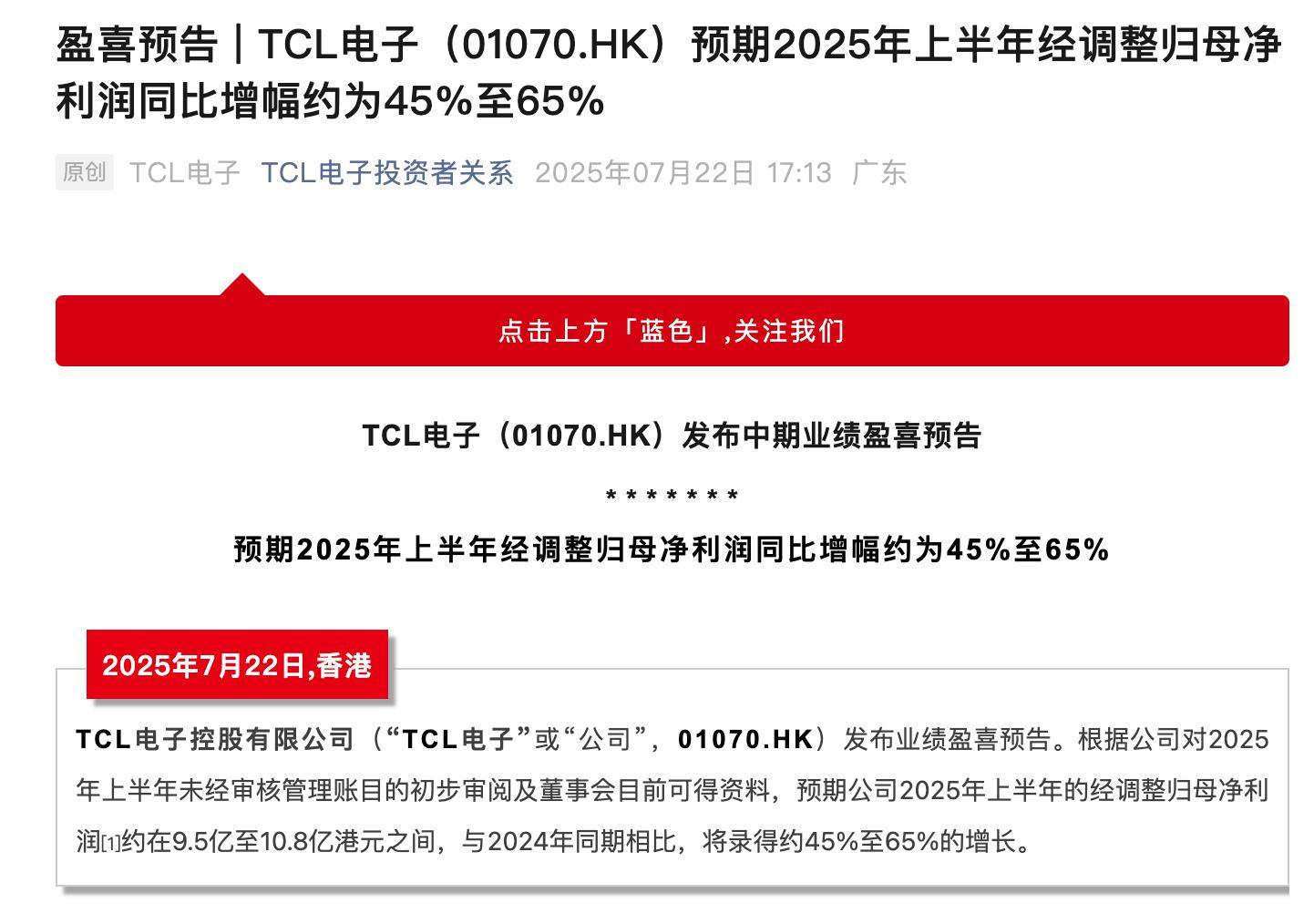
Core Viewpoint - TCL Electronics has reported a significant increase in adjusted net profit for the first half of the year, projecting between 9.5 billion to 10.8 billion HKD, representing a year-on-year growth of approximately 45% to 65% amidst a challenging consumer electronics market [1][4] Group 1: Financial Performance - TCL's expected net profit growth is attributed to its strategic focus on high-end Mini LED technology, which has driven both revenue and market share increases [1][4] - The company has achieved a global TV shipment growth of 7.6% and a 10.2% increase in brand shipments within China, outperforming the overall market [5] - Mini LED TVs have seen a remarkable 176.1% year-on-year growth in shipments, solidifying TCL's position as the global leader in this segment [5][10] Group 2: Market Trends - The trend towards larger screen sizes is evident, with 75-inch and above products now accounting for 40% of sales, a 5 percentage point increase from the previous year [6] - TCL's global shipment of TVs sized 65 inches and above has increased by 29.7%, indicating a strong consumer preference for larger displays [6][8] Group 3: Technological Innovation - TCL has positioned itself as a leader in Mini LED technology, having launched the world's first mass-produced Mini LED TV in 2019 and continuously innovating in this space [10][14] - The company has developed advanced technologies such as "万象分区" (thousand-zone partitioning) and "极影无黑边" (extreme edge without black), enhancing the visual quality of its products [11][14] Group 4: Global Strategy - TCL has established a global supply chain with 46 R&D centers and 38 manufacturing bases, allowing it to mitigate risks associated with tariffs and market fluctuations [9][18] - The company's marketing strategy includes localizing production in various countries, which helps to avoid geopolitical supply chain risks and enhances brand presence [18][20] Group 5: Competitive Advantage - TCL's vertical integration in the display industry, particularly through its subsidiary Huaxing Optoelectronics, allows for cost advantages and improved product quality [14][17] - The company's commitment to innovation and substantial R&D investment, projected at over 14 billion CNY for 2024, positions it well for future growth [16]

兆驰股份(002429):MINILED高附加值产品放量+越南基地自动化更新扩产增效 公司业绩向上的拐点逐步清晰
Xin Lang Cai Jing· 2025-07-24 10:29
Group 1 - The core viewpoint is that the company is positioned to benefit from high-value product growth and efficiency improvements in its Vietnam production base, leading to a potential profit turnaround by 2026 [1] - The company is a leader in the TV ODM and LED industries, with a comprehensive layout in the LED supply chain and expansion into optical communication [1][2] - The company's LED business is expected to see a continuous optimization of product structure, driven by the high demand for Mini LED products, which will enhance the sales of high-value chips, packaging modules, and direct display products [1][2] Group 2 - The LED business includes chips, packaging & modules, and direct display segments, all of which are in a leading industry position [2] - The Mini LED chip shipment ratio is expected to increase, contributing to higher profit margins [2] - The company is expanding its Vietnam production capacity from 5 million units per year to over 8 million units, which will support orders from North America and other overseas markets [2] Group 3 - The company is constructing a comprehensive optical communication platform, targeting a market size of 147.3 billion in China by 2024 [3] - The company plans to invest 1 billion in related projects and has begun supplying optical modules to leading manufacturers, with expected shipments of 100 million BOSA devices [3] - The company aims to replicate its success in the LED sector within the optical communication market through cost advantages and vertical integration [3]

TCL电子、晶合集成披露2025上半年业绩预告
WitsView睿智显示· 2025-07-23 08:12
Core Viewpoint - Both TCL Electronics and Crystal Integrated are expected to report significant profit growth for the first half of 2025, driven by advancements in technology and market strategies [1][8]. TCL Electronics - For the first half of 2025, TCL Electronics anticipates a net profit of approximately HKD 9.5 billion to HKD 10.8 billion, representing a year-on-year growth of about 45% to 65% [2]. - The substantial profit increase is attributed to two main factors: 1. Increased investment in high-end display technologies like Mini LED and artificial intelligence, enhancing product competitiveness and supporting a global mid-to-high-end strategy [3]. 2. Digital transformation initiatives that improve operational efficiency in manufacturing and logistics, alongside a reduction in overall expense ratios [3]. - TCL's TV sales data for the first half of 2025 shows strong performance in large-size TVs, with global shipments of 65 inches and above increasing by 29.7%, and 75 inches and above also growing by 29.7% [4]. - The average size of TCL TVs shipped globally increased by 1.5 inches to 53.4 inches, with Mini LED TV shipments reaching 1.37 million units, a 6.6 percentage point increase to 10.8% of total shipments [4]. - In international markets, TCL TV shipments grew by 8.7%, with significant increases in large-size products, particularly in Europe and emerging markets [6]. - In North America, despite an overall shipment decline of 7.3%, large-size TV shipments saw a notable increase, with 65 inches and above growing by 60.5% [7]. - In China, TCL TV shipments increased by 3.5%, with Mini LED TV shipments benefiting from government policies, showing a year-on-year increase of 154.2% [7]. Crystal Integrated - For the first half of 2025, Crystal Integrated expects revenue between CNY 5.07 billion and CNY 5.32 billion, reflecting a year-on-year growth of 15.29% to 20.97% [8]. - The anticipated net profit is projected to be between CNY 260 million and CNY 390 million, indicating a growth of 39.04% to 108.55% [8]. - The growth is attributed to: 1. Increased product sales and high capacity utilization due to the recovering industry environment [9]. 2. Strengthening of the company's position in display driver ICs (DDIC) and the rise of CMOS image sensors (CIS) as a key product [9]. 3. A 15% increase in R&D investment, leading to the mass production of advanced chips, including 40nm high-voltage OLED display driver chips [9].


聚灿光电(300708):产销两旺推动业绩稳增长,红黄光产能快速释放
Hua Yuan Zheng Quan· 2025-07-23 07:06
Investment Rating - The investment rating for the company is "Buy" (maintained) [5] Core Views - The company's performance is driven by strong production and sales, with rapid capacity release in red and yellow light segments [5] - The company has successfully transformed into a full-color LED chip supplier, optimizing its product structure and improving profit levels [6] Financial Summary - The company achieved a revenue of 1.594 billion yuan in the first half of 2025, representing a year-on-year growth of 19.51% [6] - The net profit attributable to the parent company for the same period was 117 million yuan, with a year-on-year increase of 3.43% [6] - The gross margin for the main business in the first half of 2025 was 26.15%, an increase of 0.65 percentage points year-on-year [6] - The company expects net profits of 314 million yuan, 349 million yuan, and 405 million yuan for 2025, 2026, and 2027 respectively, with corresponding year-on-year growth rates of 60.31%, 11.25%, and 16.07% [5][6] Market Performance - The company has maintained strong production and sales, achieving historical highs in key performance indicators for the first half of 2025 [6] - The production capacity utilization rate reached 96.60% in the first half of 2025 [6] - The company is focusing on high-value-added businesses, with significant breakthroughs in high-end products [6] Growth Drivers - The company is advancing its "annual production of 2.4 million red and yellow light epitaxial wafers and chip projects," enhancing the synergy of red and yellow light with blue and green light chips [6] - The company is capitalizing on the rapid rise of markets such as small-pitch displays and full-color screens [6]
刚刚,利好来了!上海,重磅发布!
券商中国· 2025-07-22 11:50
Core Viewpoint - The article highlights the strategic development of the next-generation display industry in Shanghai, focusing on technologies such as Micro LED, silicon-based OLED, and flexible displays, which are essential for the metaverse and high-definition visual experiences [1][3][4]. Group 1: Action Plan Overview - The Shanghai Municipal Economic and Information Commission released the "Action Plan for High-Quality Development of the Next-Generation Display Industry (2026-2030)", aiming to cultivate over three leading domestic enterprises in key technologies [1][4]. - The plan emphasizes the construction of a comprehensive "1+2+3+4" industry system, targeting a complete industrial chain and ecosystem by 2028, with international competitiveness by 2030 [4]. Group 2: Smart Glasses Development - The action plan encourages the development of smart glasses production capabilities, including the establishment of intelligent and automated production lines [2][4]. - It aims to foster AI+AR and AI+MR glasses, focusing on lightweight, low power consumption, high resolution, and wide field of view technologies [4]. Group 3: Next-Generation Display Applications - The plan explores innovative applications of next-generation display technologies in various sectors, including automotive displays, holographic displays, and electronic paper displays [5]. - It aims to enhance product innovation in car displays, such as instrument panels and head-up displays (HUD) [5]. Group 4: Micro LED and Silicon-based OLED Technologies - The initiative supports the mass production of full-color Micro LED micro-displays, targeting breakthroughs in low-power CMOS backplanes and high PPI Micro LED arrays [6]. - It also focuses on advancing silicon-based OLED technology for ultra-high resolution displays, addressing issues like color reproduction and latency [6]. Group 5: Market Outlook for AI Glasses and Mini LED - Global sales of AI smart glasses are projected to reach 550,000 units in Q1 2025, with significant contributions from brands like Ray-Ban Meta and Xiaomi [8]. - The Mini LED backlight module market is expected to grow to 15.6 billion yuan by 2028, with a CAGR of 29% from 2024 to 2028, indicating strong growth potential in the display technology sector [10].

诺瓦星云(301589) - 2025年7月18日投资者关系活动记录表
2025-07-18 08:14
Group 1: Market Growth and Trends - The global LED display market is projected to reach $79.71 billion by 2025 and $102.36 billion by 2028, with a compound annual growth rate (CAGR) of 7% from 2023 to 2028 [2] - The Mini LED market is expected to grow significantly, with a projected market size of $33 billion by 2028 and a CAGR of approximately 40% from 2024 to 2028 [2] - The transition from 2K to 4K and the emergence of 8K video technology indicates substantial growth potential in the video processing equipment industry [3] Group 2: Revenue and International Expansion - The company's overseas revenue grew by 32.03% year-on-year in 2024, accounting for 19.10% of total revenue, with stable growth in Europe and North America, and rapid growth in Southeast Asia and Latin America [3] - The company plans to increase its international market efforts, including expanding its workforce and participating in overseas exhibitions to enhance global influence [3] Group 3: Competitive Landscape and Intellectual Property - The video image display control industry has high barriers to entry, with few manufacturers achieving large-scale sales in the domestic market [3] - As of the end of 2024, the company holds 27 patents (22 invention patents) and 238 software copyrights, with a total of 1,177 domestic patents [3] Group 4: Profit Margins and Sales Structure - The disparity in gross margins between domestic and international sales is attributed to higher quality and performance requirements from foreign clients, leading to higher-priced product sales [4] - The sales structure differs, with a higher proportion of video processing systems and sending cards sold internationally, contributing to higher gross margins abroad [4] Group 5: Production and Supply Chain Management - The company employs a combination of external processing and internal production, focusing on efficiency and resource optimization [5] - To mitigate supply chain risks, the company collaborates with multiple international and domestic suppliers and establishes annual cooperation agreements with key suppliers [7]
家电板块25Q2业绩前瞻
2025-07-14 00:36
Summary of Key Points from the Conference Call Industry Overview - The home appliance sector is expected to show strong performance in Q2 2025, with leading brands like Midea, Haier, and Gree projected to achieve double-digit growth due to stable profitability and market share gains. In contrast, second-tier brands may experience single-digit declines or marginal growth [1][3][4]. Key Insights and Arguments White Goods and Components - The white goods and components sector is anticipated to demonstrate robust operational resilience, with leading companies expected to achieve over 10% year-on-year growth. In contrast, second-tier white goods companies are likely to see weak performance, with revenue and earnings projected to decline slightly or grow marginally [4]. - Midea Group is recommended as a top pick, with expected revenue and earnings growth of over 15%. Haier is also expected to achieve double-digit growth due to strong domestic air conditioning performance and stable overseas business [4]. Home Appliance Performance - The overall performance of the home appliance industry in Q2 2025 is promising, with strong domestic demand driven by national subsidy policies. The air conditioning market saw a 36% increase in online retail volume, with Midea and Haier gaining market share [5]. - The kitchen small appliance sector is recovering, with a 25% growth during the 618 shopping festival, driven by improved average prices and sales volume [10]. Cleaning Appliances - The cleaning appliance sector is benefiting from national subsidy policies and global market share gains. Companies like Ecovacs and Roborock are experiencing strong revenue growth, while the price increase by a competitor has led to a decline in market share for others, providing growth opportunities for leading brands [1][6]. Black Goods - The black goods sector is stable, with an increase in Mini LED penetration driving price increases. TCL Electronics and Hisense are expected to see revenue and performance growth due to product structure optimization and overseas market expansion [1][13][15]. Export Manufacturing - Export manufacturing companies like Ousheng Electric and Lek Electric are expected to gradually recover their performance in Q3 and Q4 2025, benefiting from well-established production capacity in Southeast Asia [12]. Additional Important Insights - The air conditioning market remains competitive, but leading companies are managing costs effectively without sacrificing profit margins. The small appliance sector is seeing improved profitability due to capacity clearing and marginal improvements in traffic costs [2]. - The kitchen appliance sector is facing pressure from real estate completion demands, but national subsidy policies are providing support. Traditional products are stable, while integrated stoves are experiencing significant declines [17][19]. - Companies like Bull Group are facing growth pressures due to a weak macro environment, although their new energy and overseas business segments are growing rapidly [21]. - Ecovacs is projected to achieve a net profit of 485 to 515 million yuan in Q2, representing a year-on-year growth of 56% to 66%, driven by strong domestic market performance and international sales [7][8]. This summary encapsulates the key points from the conference call, highlighting the performance expectations and strategic insights across various segments of the home appliance industry.





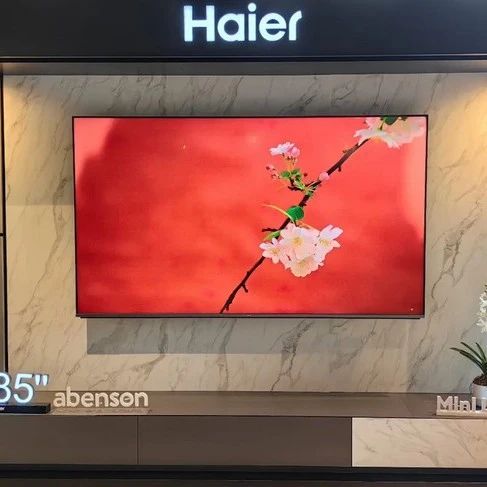
海尔在菲律宾发布Mini LED高端电视
WitsView睿智显示· 2025-07-02 03:17
Core Viewpoint - Haier Philippines launched a new Mini LED TV series in collaboration with local retailer Abenson, showcasing advanced display technology and enhanced audio features [1]. Group 1: Product Features - The new Mini LED TV series utilizes micron-level Mini LED backlight technology, with evenly distributed light beads on the back panel, allowing for more local dimming zones, which improves brightness and contrast [3]. - The TVs support HDR10 and Dolby Vision, resulting in finer picture quality [3]. Group 2: Audio Experience - Haier partnered with audio brand KEF to equip the TVs with Dolby Atmos and dbx-TV technology, providing a more immersive surround sound experience [4].
预期2025年车用LED与车灯市场产值将分别成长至34.51亿美元与357.29亿美元 | 最新报告
TrendForce集邦· 2025-06-30 03:54
Core Viewpoint - The global automotive LED market is expected to face significant price pressure in 2025 due to ongoing economic uncertainties, but a recovery in automotive production is anticipated in the second half of 2025, leading to projected market values of $3.451 billion for automotive LEDs and $35.729 billion for automotive lighting by 2025 [1]. Group 1: Automotive Lighting Trends - Automotive lighting is shifting towards personalization, communication displays, driver assistance, and safety upgrades [3]. - Adaptive headlights (ADB) enhance nighttime visibility and reaction time to obstacles, with a projected market penetration rate of 21.6% by 2029 despite current economic uncertainties [5][6]. - The introduction of Micro/Mini LED technology in adaptive headlights is expected to improve safety through flexible pixel control, with manufacturers like Volkswagen and Tesla adopting these technologies [5][6]. Group 2: Tail Light Innovations - The trend in automotive lighting includes personalized and communication displays, with Mini LED tail lights being integrated into various vehicle models [7]. - Ams OSRAM's ALIYOS technology allows for flexible Mini LED arrangements, enabling dynamic visual effects for design and information display [7]. Group 3: Decorative Lighting Market - The decorative lighting segment, including ambient lights and grille lamps, is projected to reach $311 million by 2029, with a compound annual growth rate of 28% from 2024 to 2029 [8]. - Intelligent ambient lighting, featuring built-in ICs for RGB LEDs, is expected to see a high growth rate of 69% [8]. Group 4: Mini LED Display Trends - Mini LED technology is being adopted by major automotive manufacturers, enhancing display quality with features like HDR and local dimming [10]. - Companies such as NIO, General Motors, and Ford are expected to implement Mini LED displays in their vehicles by 2024, with further expansions planned through 2029 [10]. Group 5: Market Size and Revenue Performance - The global automotive lighting market is projected to slightly decline to $34.658 billion in 2024 due to pricing pressures and inventory adjustments, despite a rise in electric vehicle sales [12]. - The top ten automotive lighting manufacturers for 2024 include Koito, Valeo, and Forvia Hella, among others [12]. Group 6: LED Manufacturer Revenue - The leading automotive LED manufacturers for 2024 are ams OSRAM, Nichia, and Lumileds, with ams OSRAM being favored for high-end and electric vehicles due to its product quality [14]. - The revenue of Everlight is expected to grow by over 40% in 2024, driven by demand in China, Europe, and South Korea [14].
显示器行业报告 | 项目案例
QYResearch· 2025-06-17 09:38
Core Insights - The display industry is a crucial part of the electronic information sector, encompassing upstream raw materials, midstream panel manufacturing, and downstream terminal applications [1] - The global display market is projected to reach $134.7 billion in 2024 and $172.1 billion by 2030, indicating significant growth potential [2][5] Market Size and Projections - According to QYResearch, the global display market size is expected to grow from $134.7 billion in 2024 to $172.1 billion by 2030, with a notable increase in AMOLED market share to 52.94% by 2030 [2][3] - The detailed revenue projections for various segments are as follows: - Global market: $792 billion in 2024, peaking at $1721 billion in 2030 - LCD (large size): $702 billion in 2024, declining to $689 billion by 2030 - AMOLED (large size): $80 million in 2024, increasing to $231 million by 2030 [3][6] Key Players in LCD and OLED - Major LCD manufacturers include: - BOE (China): Known for large-screen production - TCL Huaxing (China): Specializes in gaming screens - Innolux (Taiwan): Focuses on automotive displays - LG Display (South Korea): Renowned for IPS Nano Color technology - Sharp (Japan): Produces IGZO panels [11] - Key OLED manufacturers are: - Samsung Display (South Korea): Dominates rigid OLED market - LG Display (South Korea): Known for WOLED TVs - BOE (China): Rapidly advancing in foldable screens - Visionox (China): Innovating in under-display camera technology - Tianma (China): Focused on automotive OLED displays [16][18] Industry Trends - The OLED industry is at a cyclical low but is expected to enter a new growth phase soon, driven by advancements in technology and increasing demand [19] - The outdoor television market is expanding, particularly in North America, as consumer interest in outdoor entertainment rises [23] Research and Reports - QYResearch provides comprehensive market research reports covering various aspects of the display industry, including market size, growth potential, and competitive analysis [26][27]