
区域协调发展

Search documents
习近平主持召开部分省区市“十五五”时期经济社会发展座谈会
Xin Hua She· 2025-04-30 08:49
Core Points - The meeting emphasized the importance of formulating and implementing the 14th and 15th Five-Year Plans as a key experience in governance and a political advantage of socialism with Chinese characteristics [2][3] - The focus for the 15th Five-Year Plan should be on achieving national modernization goals, addressing key factors, and ensuring alignment with overall objectives [2][3] - There is a strong emphasis on adapting to international developments and optimizing economic layout while maintaining stability in employment, enterprises, and market expectations [2][3] - The development of new productive forces should be prioritized, with a focus on technological innovation and the transformation of traditional industries [3] - The plan aims to promote common prosperity and improve people's livelihoods through effective regional development strategies and policies [3][4] Summary by Sections Economic and Social Development Planning - The meeting highlighted the need for accurate understanding of the requirements for the 15th Five-Year Plan, focusing on national strength and modernization goals [2] - It called for a comprehensive approach to planning that considers both development and security, ensuring a balance between high-quality development and safety [2][3] Technological and Industrial Development - Emphasis was placed on enhancing the national innovation system and fostering various innovation entities to boost original innovation capabilities [3] - The plan includes a commitment to upgrading traditional industries and developing emerging sectors while preparing for future industries [3] Social Welfare and Common Prosperity - The importance of ensuring that development benefits all citizens was stressed, with a focus on improving living standards and addressing urgent public concerns [3][4] - The plan aims to implement policies that promote equitable access to resources and services, enhancing the quality of life for urban and rural populations [3]
促进互联互通和差异化发展 畅通区域循环
申万宏源研究· 2025-04-29 01:57
杨成长 龚 芳 邹 威 区域市场是组成全国统一大市场的基本单元,区域循环通过打破地理边界与行政藩篱,借 助基础设施的互联互通、跨区域规则的互认以及市场标准的衔接来推动要素自由流动和产业分 工协作,从而降低市场交易成本,畅通国内大循环 进一步消除各类区域隐形壁垒,完善对地方政府政绩的考核方式,引导区域之间形成良性 竞争生态 以城市群为载体,加快形成城市群内跨行政区域的常态化监管协调机制,着力解决区域基 础设施建设标准不一致的难题,以基础设施的高效连通推进区域一体化发展迈上新台阶 加快构建和完善不同区域间的利益补偿机制,缩小区域差异,推进区域协调平衡发展 消除区域壁垒、畅通区域循环是激发区域市场活力和推进全国统一大市场建设的重要内 容。 畅通区域循环包含区域良性竞争、区域有效合作和区域差异化发展三个层次的内涵,良性 的区域竞争是激发区域主体发展活力的重要抓手,区域之间的有效合作是实现区域互联互通的 有效举措,引导区域发掘差异化比较优势是实现区域协调发展的关键所在。在畅通国民经济循 环和新型产业循环的基础上,本文从地理视角出发,重点聚焦区域发展中的隐形壁垒、无效内 卷及协调发展难题,为推进全国统一大市场建设,全面释 ...
以大担当实现大作为
Jing Ji Ri Bao· 2025-04-28 22:13
Core Viewpoint - The economic primacy of provincial capitals is a significant topic of discussion, emphasizing the need for tailored development strategies rather than relying solely on a single economic indicator [1][2]. Group 1: Economic Development Strategies - Provinces are increasingly supporting the high-quality development of their capitals, with Ningxia implementing a "strong capital" strategy to enhance regional competitiveness and ecological protection [2]. - Continuous improvement in the economic quality and reasonable growth of provincial capitals requires a dual approach of scaling up and strategic direction, focusing on reform and innovation rather than merely increasing size [3]. Group 2: Challenges and Opportunities - Western provinces face challenges such as weak development foundations and economic structures, necessitating strong economic platforms in provincial capitals to compete nationally and globally [1]. - Provincial capitals should adopt a broader perspective, balancing short-term tasks with long-term goals, and contribute to regional coordination while avoiding negative effects like resource siphoning [3].
南粤之窗丨“共享机场”织起湾区“新跑道”
Yang Shi Xin Wen Ke Hu Duan· 2025-04-28 07:08
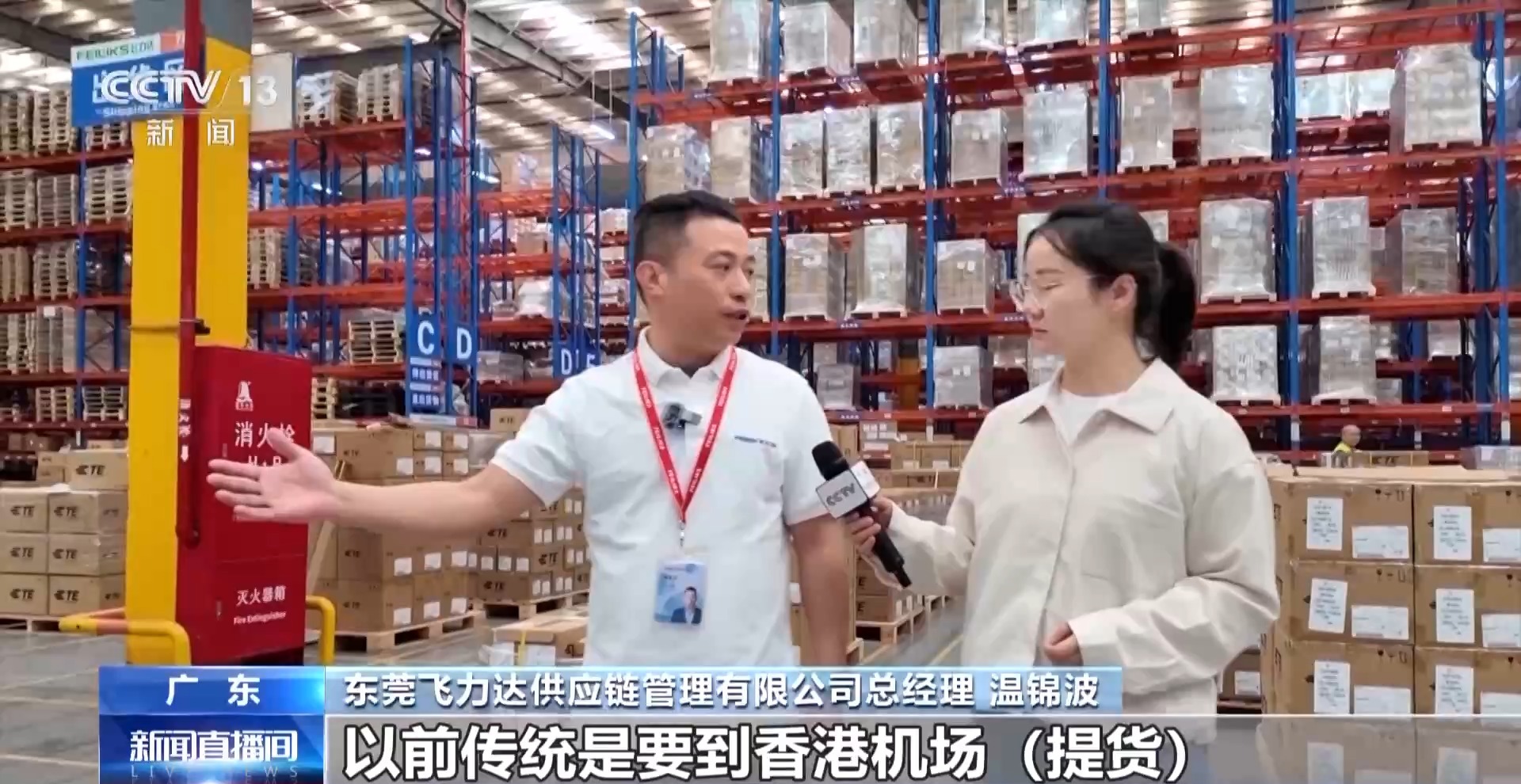
Core Viewpoint - The "shared airport" model in the Guangdong-Hong Kong-Macao Greater Bay Area is enhancing logistics efficiency and reducing costs for both cargo and passenger transport, demonstrating a successful collaboration across regions and sectors [3][27]. Group 1: Cargo Transport Innovations - The "Dongguan-Hong Kong International Airport Center" has transported 24,000 tons of goods over two years, valued at 24 billion yuan, reaching 48 countries [15]. - The new logistics model allows goods to be processed directly in Dongguan, eliminating the need for traditional customs procedures at Hong Kong airport, thus saving time and costs [4][6]. - The cost per kilogram of goods has decreased from 3.47 yuan to 2.47 yuan, representing a 30% reduction in logistics costs [15]. Group 2: Passenger Transport Enhancements - The "Jing Zhu Gang Fei" project allows passengers to complete customs checks at the Hong Kong-Zhuhai-Macao Bridge without needing to go through Hong Kong immigration, improving travel efficiency [18][20]. - The collaboration between Zhuhai Airport and Hong Kong International Airport aims to leverage each airport's strengths, enhancing domestic and international flight coverage [20][22]. Group 3: Infrastructure Development - The new Guangzhou Airport is being constructed in a location with ample land resources, optimizing the aviation transport network in the Greater Bay Area [26]. - A new smart logistics park is being developed to facilitate the transport of various goods to Hong Kong airport, building on the operational experience of the airport center [28][30]. - The Hong Kong Airport Authority has invested approximately 4.3 billion yuan to acquire a 35% stake in Zhuhai Airport, indicating a shift towards more integrated management and collaboration [33].

促进互联互通和差异化发展 畅通区域循环
Shang Hai Zheng Quan Bao· 2025-04-27 18:58
□ 进一步消除各类区域隐形壁垒,完善对地方政府政绩的考核方式,引导区域之间形成良性竞争生态 □ 以城市群为载体,加快形成城市群内跨行政区域的常态化监管协调机制,着力解决区域基础设施建设 标准不一致的难题,以基础设施的高效连通推进区域一体化发展迈上新台阶 □ 杨成长龚芳邹威 □ 加快构建和完善不同区域间的利益补偿机制,缩小区域差异,推进区域协调平衡发展 □ 区域市场是组成全国统一大市场的基本单元,区域循环通过打破地理边界与行政藩篱,借助基础设施 的互联互通、跨区域规则的互认以及市场标准的衔接来推动要素自由流动和产业分工协作,从而降低市 场交易成本,畅通国内大循环 畅通区域循环包含区域良性竞争、区域有效合作和区域差异化发展三个层次的内涵,良性的区域竞争是 激发区域主体发展活力的重要抓手,区域之间的有效合作是实现区域互联互通的有效举措,引导区域发 掘差异化比较优势是实现区域协调发展的关键所在。在畅通国民经济循环和新型产业循环的基础上,本 文从地理视角出发,重点聚焦区域发展中的隐形壁垒、无效内卷及协调发展难题,为推进全国统一大市 场建设,全面释放内需市场潜力提供区域视角的参考。 一、区域协调发展是推进全国统一大市场建 ...
鲁甘协作掀产业投资高潮 签约70个项目带动百亿投资
Jing Ji Guan Cha Wang· 2025-04-24 09:52
Core Viewpoint - The fifth "Shandong Enterprises Entering Gansu" investment promotion conference aims to enhance regional cooperation and economic development through industrial empowerment and collaboration between Shandong and Gansu provinces [1][2]. Group 1: Event Overview - The event was held on April 23 in Linxia, Gansu, focusing on promoting consumption, employment, and rural development [1]. - Over 300 enterprises from various sectors including energy, technology, agriculture, culture, tourism, and pharmaceuticals participated, marking a record high in both the number of participating companies and investment scale [1]. Group 2: Investment Growth - The investment amount from signed projects during the "Shandong Enterprises Entering Gansu" initiative increased from 4.1 billion yuan in 2021 to 10.6 billion yuan in 2025 [2]. - A total of 460 enterprises have been guided to establish operations in Gansu, contributing to the development of 37 industrial parks and over 30 distinctive industries [2]. Group 3: Collaborative Framework - The conference adopted a "1+3" model, featuring a main venue and three parallel forums focusing on high-quality development of agricultural industries, employment promotion, and cooperation between state-owned enterprises [2]. - The event aims to build a broader cooperation platform for industrial development and employment promotion between Shandong and Gansu [2].
“集中精力”做自己 155项试点任务提速加力高水平开放
Yang Shi Wang· 2025-04-21 22:00
Core Viewpoint - The Chinese government is accelerating the expansion of service industry openness amid rising unilateralism and protectionism globally, with a focus on enhancing its own economic stability and providing certainty to the world [8]. Group 1: Service Industry Expansion - The State Council announced a comprehensive pilot program with 155 tasks aimed at expanding service industry openness [1]. - New pilot cities include Dalian, Ningbo, and Xiamen, expanding the initiative beyond the existing 11 pilot provinces and cities [10]. Group 2: Telecommunications and Healthcare - In telecommunications, the plan includes removing foreign ownership limits on app stores and internet access services [3]. - The healthcare sector will support foreign and Hong Kong, Macau, and Taiwan doctors in opening clinics and simplify approval processes for foreign medical professionals [5]. Group 3: Financial Sector Initiatives - The financial sector will explore international factoring and support multinational companies in conducting cross-border operations in RMB [5]. - The People's Bank of China is enhancing financial support for regional coordinated development, including a digital RMB pilot in Chongqing [6]. Group 4: Trade and Transportation - In trade and tourism, foreign investment in travel agencies for outbound tourism will be permitted [8]. - The transportation sector will explore container sharing and "one box to the end" initiatives [8]. Group 5: Regulatory and Policy Improvements - The pilot tasks will address issues like visa-free transit, permanent residency, and professional qualification recognition to facilitate foreign talent [8]. - The focus will also be on improving cross-border data flow, standardization, intellectual property, and commercial encryption [8].
加大力度推进中部地区加快崛起战略
上海新世纪资信评估投资服务有限公司· 2025-04-17 11:14
Group 1: Strategic Overview - The "Central Region Rise Strategy" is a key focus of the 2025 State Council Government Work Report, emphasizing new urbanization and regional coordinated development[1] - The strategy has evolved over two decades, entering a new phase characterized by accelerated growth and clear objectives[3] - The core task of "accelerating rise" has been progressively detailed in policies from 2021 to 2024, with increasing implementation efforts[5] Group 2: Regional Development Initiatives - The 2025 report stresses the need for deeper implementation of regional strategies, leveraging comparative advantages of different areas[2] - Local governments in six central provinces have tailored their development tasks to their specific regional conditions, focusing on modern industrial systems and green development[5] - The emphasis is on enhancing public services and ensuring coordinated urban-rural development[14] Group 3: Bond Market Contributions - From 2022 to 2024, the central region issued local government bonds totaling approximately 60,662.84 billion yuan, with an increasing trend in issuance[8] - The region also issued credit bonds amounting to about 50,882.37 billion yuan during the same period, with Hubei accounting for over 20% of the total issuance[8] - Specialized bonds such as sci-tech notes and green bonds have been pivotal in financing key projects, with sci-tech notes increasing from 403.10 billion yuan in 2022 to 1,203.26 billion yuan in 2024[10]
中部人口格局生变:安徽、湖北逆势回流,第二大省靠生育突围
2 1 Shi Ji Jing Ji Bao Dao· 2025-04-14 10:33
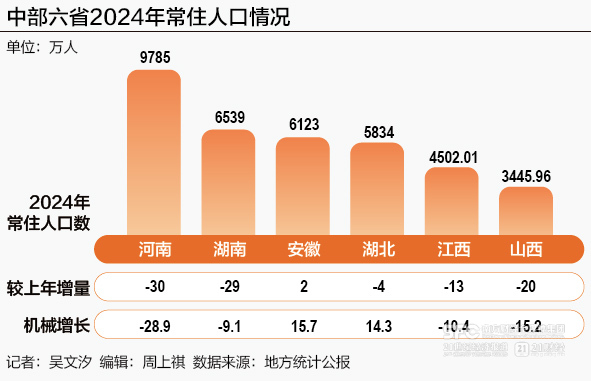
Core Insights - The population data for the six central provinces in China for 2024 has been released, showing that only Anhui experienced positive growth, while the other provinces saw declines in their resident populations [1][3]. Population Trends - As of the end of 2024, the resident populations of the central provinces are as follows: Henan (97.85 million), Hunan (65.39 million), Anhui (61.23 million), Hubei (58.34 million), Jiangxi (45.02 million), and Shanxi (34.46 million) [1]. - Anhui's population increased by 20,000, while Hubei, Jiangxi, Shanxi, Hunan, and Henan saw decreases of 4,000, 13,000, 20,000, 29,000, and 30,000 respectively [1]. Economic and Industrial Factors - The population inflow in Anhui and Hubei is attributed to successful industrial transformation and economic acceleration, with Anhui attracting 157,000 and Hubei 143,000 new residents in 2024 [3][5]. - Anhui's strategic location and policies have enhanced its attractiveness, with its high-tech industries contributing significantly to its economic growth, where the output of strategic emerging industries accounted for 43.6% of industrial output [3][4]. Natural Growth Rates - Henan and Jiangxi have natural growth rates above the national average, with Henan's birth rate at 7.78‰ and a total of 762,000 births in 2024, ranking second in the country [3][6]. - Despite a high birth rate, Henan faces challenges with a declining population, losing 300,000 residents in 2024 compared to its peak of 99.41 million [6]. Policy and Strategic Initiatives - Hubei has implemented various policies to attract and retain population, including reforms in the household registration system and incentives for childbirth [5][10]. - The central provinces are focusing on improving living conditions, employment opportunities, and supportive policies for families to enhance their attractiveness to residents [10]. Urban Development and Collaboration - Major cities in the central provinces, such as Hefei, Changsha, Nanchang, and Wuhan, have shown positive population growth, indicating the importance of urban centers in driving regional population dynamics [7]. - Hefei's integration into the Yangtze River Delta and its development of key industries like artificial intelligence and new energy vehicles have positioned it as a significant urban center [8][9]. Talent Attraction Strategies - The central provinces are shifting their talent attraction strategies towards high-end talent, with initiatives to develop and attract skilled professionals in various sectors [9][10]. - Policies aimed at easing residency requirements and enhancing job opportunities are being implemented to create a more favorable environment for population retention [9][10].
中西部省份发力修运河 区域协调发展注入新动能
Zhong Guo Jing Ji Wang· 2025-03-13 01:36
Group 1 - The construction of artificial canals in central and western provinces like Hunan, Guangxi, and Henan is driven by the need for new transportation routes and economic development opportunities [2][3] - The Xianggui Canal, once completed, will enhance connectivity between the Yangtze and Pearl River systems, benefiting over 40 million people across 55 counties in Hunan and Guangxi [2] - Canal construction is expected to stimulate investment in traditional industries such as construction, steel, and machinery, while also promoting trade growth [2][3] Group 2 - Water transport is more cost-effective and environmentally friendly compared to road and rail transport, with the Jianghuai Canal projected to save approximately 6 billion yuan in freight costs annually and reduce carbon emissions by nearly 1.8 million tons [3] - The development of canals will enhance the economic status of central and western provinces in the national and global economic landscape, providing new access points for trade [3] - Long-term investment in canal construction is anticipated to release greater economic potential and drive coordinated regional development, although careful feasibility assessments are necessary due to high costs [4]