
智能制造

Search documents
CES 2026访学圆满收官,4月,我们汉诺威工业博览会见
吴晓波频道· 2026-01-14 00:29
Core Viewpoint - The article emphasizes the transformative impact of AI on industries, highlighting the shift from discussing AI as a concept to its practical implementation in products and services, particularly observed during the CES 2026 event in Las Vegas [2][3]. Group 1: AI Implementation and Industry Trends - The CES event showcased the integration of AI into various products, with companies like Nvidia and Samsung demonstrating advancements that support the notion that "everything can be AI-enabled" [4]. - Chinese brands are evolving from merely exporting products to a more comprehensive "value export" that includes technology narratives, brand communication, and ecosystem building, reflecting a deeper competitive edge [4][11]. - Lenovo's presentation at CES highlighted its "hybrid AI" strategy, showcasing a personal super-intelligent agent and a complete enterprise solution, marking a significant leap from product output to co-building technology standards and ecosystems [8][9]. Group 2: Insights from Silicon Valley - The visit to Silicon Valley focused on understanding the foundational aspects of innovation, emphasizing that true innovation requires an ecosystem that supports exploration and embraces uncertainty [14][18]. - Discussions with industry leaders revealed that the main barriers to AI implementation are often organizational restructuring rather than technical challenges, underscoring the importance of addressing business pain points [17]. - The experience at tech giants like Google and Meta illustrated the significance of a collaborative culture and the integration of AI with hardware, providing a clearer vision of future possibilities [17][19]. Group 3: Upcoming Opportunities in Germany - The upcoming Hannover Industrial Fair in Germany will focus on "AI in manufacturing," providing insights into smart manufacturing, industrial automation, and AI technologies, which are crucial for Chinese companies aiming to enhance their global competitiveness [30][31]. - The journey to Germany aims to explore the deep-rooted manufacturing practices and standards that can serve as a strategic reference for Chinese enterprises looking to expand into European markets [28][29].

新股消息 | 翼菲科技再度递表港交所 专注于轻工业应用场景的工业机器人
智通财经网· 2026-01-13 23:30
Company Overview - Yifei Technology is a Chinese industrial robotics company focused on the design, research and development, manufacturing, and commercialization of industrial robots, providing comprehensive robotic solutions primarily for light industrial applications [4] - The company ranks fifth among domestic suppliers of industrial robots and related solutions focused on light industrial applications in China, according to a report by Frost & Sullivan [4] - Yifei Technology has developed a full coverage technology ecosystem, enabling large-scale intelligent decision-making, environmental perception, precise control, and autonomous movement [4] Product Offerings - The company offers a range of industrial robot products tailored for light industrial applications, including parallel robots (Bat series), AGV/AMR mobile robots (Camel series), SCARA robots (Python series), wafer handling robots (Lobster series), and six-axis industrial robots (Mantis series) [4] - Yifei Technology also provides intelligent automation system solutions to address specific applications in smart manufacturing, including functions such as loading and unloading, sorting, picking and placing, packaging, visual inspection, assembly, and gluing systems [5] Financial Performance - The company reported revenues of approximately RMB 162.21 million, RMB 201.17 million, RMB 268.01 million, and RMB 104.75 million for the fiscal years 2022, 2023, 2024, and the nine months ending September 30, 2025, respectively [6][9] - Gross profits for the same periods were RMB 43.25 million, RMB 36.87 million, RMB 71.02 million, and RMB 24.99 million [7][9] - The gross profit margins were approximately 26.7%, 18.3%, 26.5%, and 23.9% for the respective years [10][11] Industry Overview - The Chinese smart manufacturing market is projected to grow from RMB 2,194.5 billion in 2020 to RMB 4,058.9 billion by 2024, with a compound annual growth rate (CAGR) of 16.6% [12] - The industrial robotics market in China is expected to expand from RMB 31.6 billion in 2020 to RMB 56.8 billion by 2024, reflecting a CAGR of 15.8% [15] - The market for industrial robotics solutions is anticipated to grow from RMB 94.7 billion in 2020 to RMB 192.9 billion by 2024, with a CAGR of 19.5% [16] - The light industrial robotics market in China is projected to increase from RMB 12.3 billion in 2020 to RMB 20.9 billion by 2024, with a CAGR of 14.2% [17]

专治计量器具软件作弊
Xin Lang Cai Jing· 2026-01-13 21:58
近年来,市场监管总局持续提升计量器具软件测评能力,先后批准发布了《计量器具软件测评指南》 《计量器具软件标识通用要求》等技术规范。国家计量器具软件测评计量站(内蒙古)的建设,将推动 相关技术规范落地实施,加快构建计量器具软件测评体系。内蒙古自治区产品质量检验研究院作为软件 测评计量站的技术依托单位,持续深耕加油机计量软件测评技术研发,率先突破加油机计量软件作弊鉴 定关键技术,在加油机计量作弊检测识别与数据采集分析方面取得了一系列国内领先的技术成果,已服 务全国100余个城市,协助查办800余起加油机计量作弊案件。 市场监管总局将持续推动构建计量器具软件测评体系,指导加快国家计量器具软件测评计量站建设,加 强计量器具软件测评技术与方法研究,筑牢计量数据准确可信基础,支撑法制计量监管,切实保护消费 者合法权益,更好地服务先进制造业高质量发展。 (鞠闻) 随着智能制造、人工智能等高新技术与计量器具深度融合,软件已成为计量器具的"核心模块"。计量器 具软件的可靠与否,已成为影响计量数据准确性、可靠性和可信度的关键因素,特别是加油机、电子计 价秤等通过软件作弊侵害消费者权益的现象时有发生,亟须提升计量器具软件测评能力。 ...
工信部:聚焦冶金、化工、轻工、纺织、机械、船舶等领域 研究制定改造提升方案
Jin Rong Jie· 2026-01-13 12:26
Group 1 - The Ministry of Industry and Information Technology, led by Minister Li Lecheng, will implement a traditional industry revitalization action plan focusing on sectors such as metallurgy, chemicals, light industry, textiles, machinery, and shipbuilding [1] - The plan includes developing tailored transformation and upgrading schemes for each industry and implementing the "Artificial Intelligence +" initiative to promote smart manufacturing and green manufacturing [1] - The goal is to explore the creation of a number of zero-carbon factories and zero-carbon parks, allowing traditional industries to "sprout new buds" [1]
国亮新材:拟首发募资1.94亿元扩产增效 加码智能制造与再生料项目 1月14日申购
Sou Hu Cai Jing· 2026-01-13 10:04
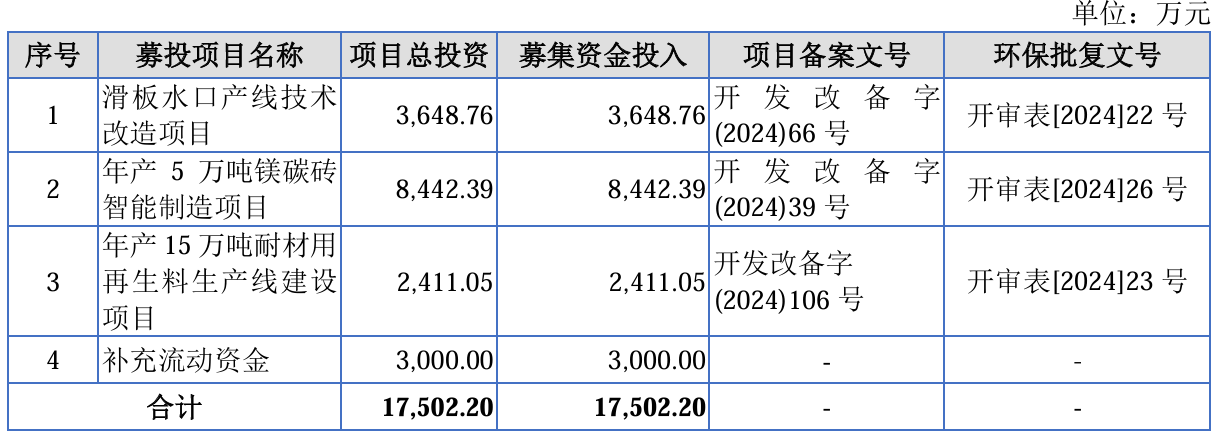
Group 1 - The core objective of the sliding water mouth production line technology transformation project is to enhance production capacity and efficiency through the introduction of advanced automation equipment and optimized factory layout, which will help the company increase its market share and profitability [1] - The annual production capacity of 50,000 tons of magnesium-carbon bricks project aims to address production bottlenecks and improve efficiency by utilizing automated production lines and advanced equipment, contributing to the company's overall economic benefits and market competitiveness [1] - The annual production line for 150,000 tons of refractory material recycled materials will be established to enhance the company's self-sufficiency in recycled materials, reducing reliance on suppliers and aligning with national energy-saving and emission-reduction initiatives [2] Group 2 - The total investment for the sliding water mouth production line technology transformation project is 364.876 million yuan, while the magnesium-carbon brick smart manufacturing project requires an investment of 844.239 million yuan, and the recycled materials production line project is estimated at 241.105 million yuan [3] - The company, Guoliang New Materials, specializes in high-temperature industrial refractory materials and has a strong focus on technological innovation and green development, supported by a research team led by PhDs with extensive industry experience [3] - As of the signing date of the prospectus, the company holds 5 provincial scientific and technological achievement certificates, 33 invention patents, and 52 utility model patents, demonstrating its commitment to research and development [3] Group 3 - The company plans to issue 18.0449 million shares at a price of 10.76 yuan per share, with an expected total fundraising amount of 194 million yuan [4] - The company's revenue and net profit have shown fluctuations over the years, with total revenue reaching 9.844 billion yuan in 2021 and a projected decline in net profit in 2022 [5][6] - The company reported a significant increase in operating cash flow in 2024, amounting to 88.0011 million yuan, which is a 171.75% year-on-year growth [28]
国产领跑,遥遥领先,3.26亿三坐标测量仪年度中标盘点
仪器信息网· 2026-01-13 09:07
Core Insights - The total number of coordinate measuring machines (CMMs) awarded in 2025 reached 359 units, with a total value of 326 million yuan, involving 26 brands including Hexagon, Carl Zeiss, and Qingdao Leyton [1][3]. Market Overview - In 2025, 302 bids related to CMMs were published, with a total awarded amount of 326 million yuan and 359 units awarded [3]. - The demand for CMMs is driven by the aerospace, defense, automotive, medical, electronics, energy, and heavy machinery industries, reflecting their core position in high-end manufacturing [4]. Monthly Trends - The market activity increased in the second half of 2025, with November and December being peak months for procurement, accounting for a significant portion of the total annual figures [5]. - In December alone, 68 units were awarded, with a peak amount of 69.2 million yuan [5]. Quarterly Distribution - The fourth quarter contributed nearly half of the total awarded amount for the year, with approximately 146 million yuan awarded in that quarter [8]. Brand Landscape - Hexagon led the market with over 120 units awarded, followed by Carl Zeiss. Domestic brands like Xi'an Edward and Zhongtu Instrument form a significant second tier, collectively capturing about 25% of the market [11][13]. - Domestic brands are increasingly recognized for their improved measurement accuracy and service levels, with around 65% of mid-to-low-end market sales attributed to them [11]. Procurement Dynamics - The primary demand for CMMs comes from industrial enterprises (39%) and universities (34%), together accounting for over 70% of the market [16][17]. - The dual driving force of industrial applications and research education ensures stable and advanced market demand [17]. Industry Applications - The automotive (38%) and aerospace (26%) sectors dominate the demand for CMMs, together representing 64% of the market, highlighting the technology's critical role in high-end manufacturing [19]. - The increasing precision requirements in the automotive industry, especially for electric vehicles, and the stringent safety standards in aerospace are key factors driving demand [19]. Regional Insights - Regions such as Sichuan, Chongqing, Tianjin, and Jiangsu show strong market activity, driven by their roles in aerospace and heavy machinery [21]. - The Yangtze River Delta region has shifted from large-scale purchases to upgrading existing production lines, reflecting a demand for more intelligent and automated detection solutions [21]. Future Outlook - The CMM market is expected to continue evolving towards automation, intelligence, and 3D measurement capabilities, enhancing measurement precision and exploring various measurement methods [22].

打造世界级标杆!“领航级”工厂如何实现“领跑”中国智造?
Yang Shi Wang· 2026-01-13 08:42
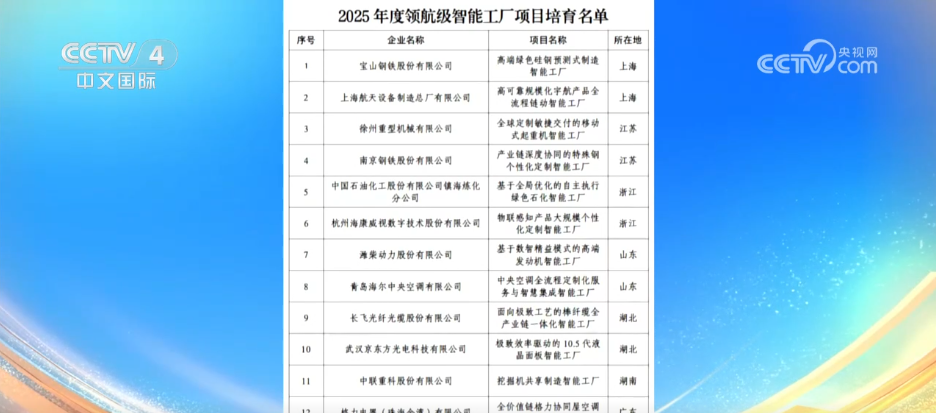
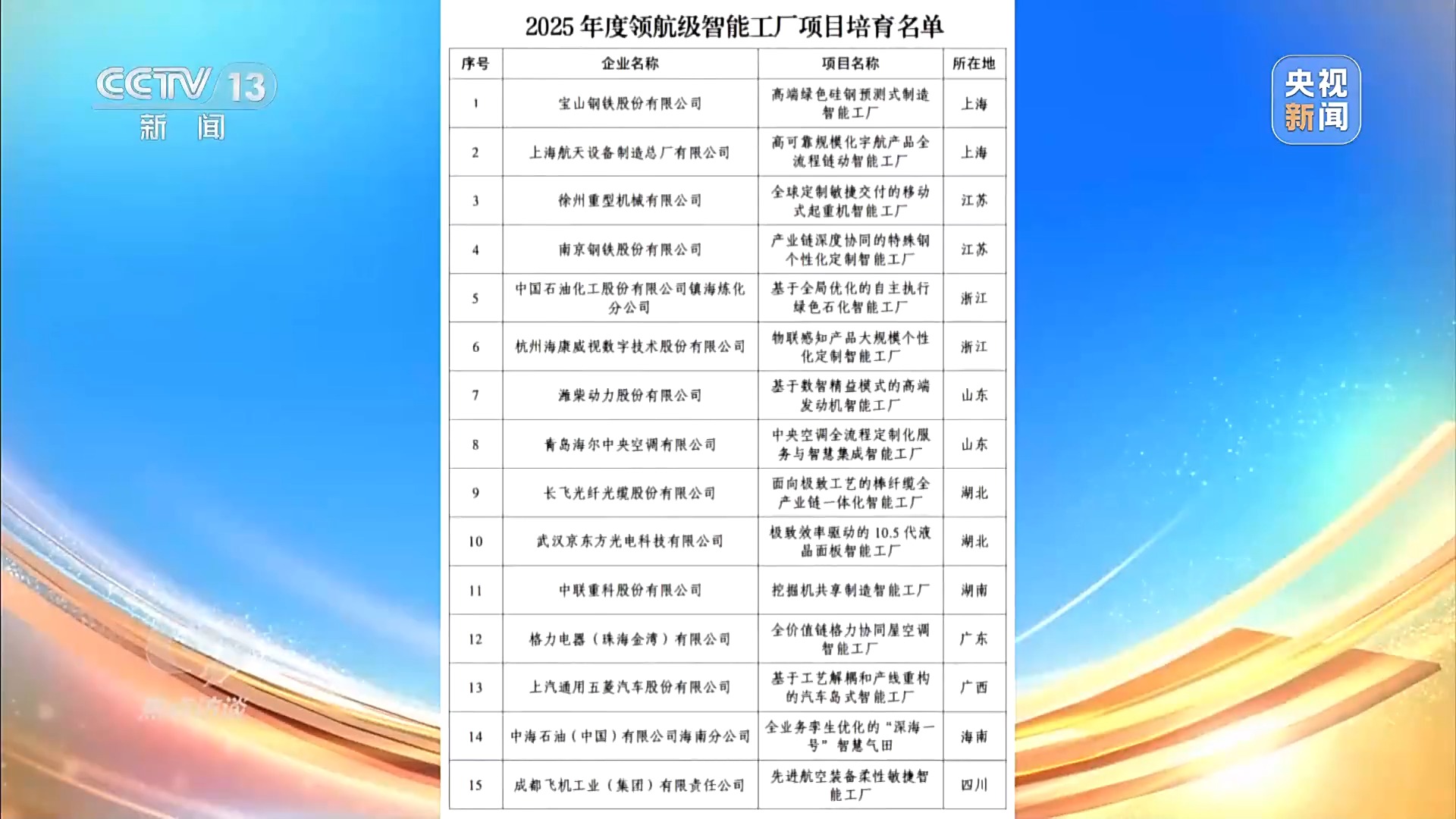
Core Viewpoint - "Smart" manufacturing is the core engine for high-quality development in the manufacturing industry, marking a critical leap from digitalization and networking to intelligence in China's manufacturing sector [1][3]. Group 1: Overview of Leading Smart Factories - The Ministry of Industry and Information Technology and five other departments announced the first batch of 15 leading smart factories, covering key industries such as equipment manufacturing, raw materials, and electronic information [1][2]. - These factories represent the highest level of "intelligent" manufacturing in China and signify a transition towards a more advanced manufacturing model [1][3]. Group 2: Characteristics of Leading Smart Factories - Leading smart factories are characterized by the integration of advanced manufacturing technologies, next-generation information technologies, and lean management concepts, forming the pinnacle of China's manufacturing intelligence pyramid [3][5]. - They aim to be "hexagonal warriors" with six leading identities, focusing on industry, application of AI technology, innovation in smart manufacturing models, performance, replication, and cultivation plans [5]. Group 3: Notable Examples - Changfei Fiber Optic, recognized as a benchmark for intelligent transformation in the electronic information sector, has integrated AI algorithms throughout its production process, achieving a drawing speed of 3,500 meters per minute, the highest globally, without human intervention [7]. - The company has mastered three major mainstream technologies for fiber optic preform preparation, leading to the largest diameter of preforms globally and maintaining the top market share in the fiber optic industry for nine consecutive years [7]. Group 4: Strategic Alignment - The development of leading smart factories aligns with the "14th Five-Year Plan" for intelligent manufacturing and the "15th Five-Year Plan" for building a modern industrial system centered on advanced manufacturing [5][9]. - These factories facilitate collaborative innovation across the industry chain, connecting with national strategic deployments such as "Artificial Intelligence+" and promoting the replication of successful models [9].

智能制造标准密集出台,我国标准体系迈向应用深化新阶段
Xin Hua Wang· 2026-01-13 07:40
Core Insights - The rapid growth in the number of standards published in China's intelligent manufacturing industry in 2025, reaching a total of 21, indicates a comprehensive coverage across key sectors such as machinery, electronics, communications, steel, non-ferrous metals, and power [1][2][3] Group 1: Equipment Manufacturing - Three standards were introduced in the equipment manufacturing sector, including the "Technical Requirements for Digital Workshops of Small Circuit Breakers," which fills a gap in low-voltage electrical equipment standards and provides a replicable implementation path for SMEs' digital transformation [1] Group 2: Electronics Information - Six standards were released in the electronics information sector, including a series of standards for "Digital Design of Radar and Similar Electronic Information Equipment," which establishes a systematic digital design standard framework, enhancing R&D efficiency and product reliability [1] Group 3: Raw Materials Industry - Ten standards were published in the raw materials industry, characterized by "precise control and green orientation," with a focus on energy consumption in steel production and the establishment of a comprehensive smart factory standard system in the non-ferrous metals sector [2] Group 4: Consumer Goods - Two standards were introduced in the consumer goods sector, specifically addressing the tobacco industry, with guidelines for intelligent machinery and smart factory construction that aim to enhance the industry's overall intelligent upgrade [2] Group 5: Policy Coordination - The release of these standards aligns with national strategies for intelligent manufacturing, aiming to eliminate "data silos" and "standard barriers" across different industries and enterprises, thus supporting collaborative upgrades for businesses of all sizes [3]
瞄准全球领先、深化AI融合,领航级工厂领跑中国“智造”
Bei Jing Wan Bao· 2026-01-13 06:16
Core Viewpoint - Smart manufacturing is the core engine for high-quality development in the manufacturing industry, marking a critical leap from digitalization and networking to intelligence in China's manufacturing sector [1][5]. Group 1: Overview of Leading Smart Factories - The Ministry of Industry and Information Technology and five other departments announced the first batch of 15 leading smart factories, covering key industries such as equipment manufacturing, raw materials, and electronic information [1][4]. - These leading factories represent the highest level of smart manufacturing in China and showcase the breadth and depth of the country's intelligent manufacturing development [4][5]. Group 2: Classification and Development of Smart Factories - A four-tier system for smart factory cultivation has been established: foundational, advanced, excellent, and leading levels, with 35,000 foundational, over 7,300 advanced, 500 excellent, and 15 leading smart factories built to date [7]. - The leading level aims for global leadership and deep integration of AI, while the excellent level requires at least 20% AI application scenarios [7]. Group 3: Key Elements for Leading Smart Factories - Six key elements define a leading smart factory: industry leadership, AI technology application, innovative smart manufacturing models, performance leadership, replication leadership, and nurturing plans [10][12]. - Longfei Optical Fiber exemplifies these elements by integrating AI throughout its production process, achieving a global record in fiber drawing speed and precision [12][13]. Group 4: Case Studies of Leading Smart Factories - Weichai Power has implemented a digital twin technology that reduces R&D cycles by 20% and enhances production flexibility through AI-driven systems [20][21]. - Baosteel is innovating with AI-driven predictive manufacturing, aiming to establish 1,200 AI scenarios and 25 benchmark production lines by 2027, while also investing in talent development [25][27]. Group 5: Future Manufacturing Models - The exploration of future manufacturing models focuses on high customization, complex product production, and efficient supply chain organization, aiming to enhance China's position in the global supply chain [17][29]. - The emergence of these leading smart factories not only represents individual breakthroughs but also reflects a systemic transformation in China's manufacturing industry, providing replicable and scalable models for industry upgrades [29].


江海区铁金刚公司投资1.5亿元打造智能制造基地
Nan Fang Du Shi Bao· 2026-01-13 05:56
铁金刚机械有限公司董事长廖来辉满怀信心地表示,该基地将成为企业未来发展的核心战略阵地。选择 落户江南街道,正是看中粤港澳大湾区优越的产业生态和江南街道持续优化的营商环境。他强调,企业 将始终秉持"诚信、务实、创新"的发展理念,全力以赴将项目建成技术领先、绿色低碳的标杆工厂。 江南街道办事处副主任林伟刚在致辞中强调,江南街道始终坚持"项目为王、服务至上"的工作原则,为 铁金刚项目配备专属服务团队,提供从项目申报、审批到建设、投产的全周期精准服务,全力保障项目 高效推进。他指出,该项目的落地将有力提升本地高端装备制造的整体水平,推动产业链条延伸与集群 化发展,为构建现代化产业体系提供重要支撑。 2025年以来,江南街道紧紧围绕区委、区政府战略部署,积极推动"1+3+2"特色产业体系实现规模扩张 与能级提升。截至目前,已成功引进包括凯昇电机绕线及自动化设备、升仕新能源摩托车整车制造、君 盛智能家电研发智造等在内的10个优质项目,计划总投资规模达25亿元,展现出强劲的产业发展势头和 投资吸引力。 铁金刚机械是机械制造领域的标杆型优质规上企业,凭借雄厚实力、前瞻视野与过硬技术,在行业内口 碑卓著。2020年疫情防控期间 ...