
人工智能

Search documents
关于同意国泰海通证券股份有限公司为华夏中证人工智能主题交易型开放式指数证券投资基金提供主做市服务的公告
Xin Lang Cai Jing· 2026-03-25 10:04
Group 1 - The Shanghai Stock Exchange has approved Guotai Haitong Securities Co., Ltd. to provide primary market-making services for the Huaxia CSI Artificial Intelligence Theme Exchange-Traded Fund (ETF) starting from March 26, 2026 [1][2][3] - The approval aims to enhance the market liquidity and stable operation of the AI-themed ETF [1]

GTC 2026|黄仁勋五层蛋糕重构AI价值体系,投资逻辑全解析 | 市场观察
私募排排网· 2026-03-25 09:49
Core Viewpoint - The article discusses Jensen Huang's "AI Five-Layer Cake" framework presented at NVIDIA GTC 2026, which outlines how value in the AI era is created and distributed across various industries, emphasizing the interconnectedness of the AI ecosystem and its implications for investment logic and asset allocation [3][5]. Group 1: AI Five-Layer Cake Theory - The "AI Five-Layer Cake" consists of five interconnected layers that collectively drive the AI industry's growth, where progress in each layer directly impacts the value realization of the upper layers [6]. - The five layers are: 1. **Energy Layer**: The foundation of AI, emphasizing the need for efficient energy supply and the projected doubling of global data center electricity consumption to 945 TWh by 2030 [7]. 2. **Chip Layer**: The core of computational power, with advancements in chip technology critical for AI expansion, including NVIDIA's new GPU architecture expected to achieve 50 PFLOPS [8]. 3. **Infrastructure Layer**: The physical embodiment of AI capabilities, with significant investments in AI factories and supercomputers, highlighting the importance of cooling technologies and innovative data center designs [9]. 4. **Model Layer**: The brain of AI, focusing on the transition from language models to physical AI, with open-source models driving demand across the architecture stack [10]. 5. **Application Layer**: The final interface where AI creates measurable economic value, with a shift towards AI agents capable of executing complex tasks across various sectors [11]. Group 2: Investment Logic from the Five-Layer Cake - Huang's framework provides a comprehensive investment strategy that emphasizes prioritizing foundational layers, driven by the exponential growth of token consumption and the need for heavy asset infrastructure [12][13]. - Key investment logic includes: 1. **Bottom-Up Approach**: Prioritizing investments in energy, chips, and infrastructure, which are expected to see more stable performance compared to upper layers [14]. 2. **Token Economy**: The increasing demand for tokens in AI applications, making "cost per token" a critical competitive metric [14]. 3. **Heavy Asset Infrastructure**: The construction of AI factories and data centers represents a new wave of capital expenditure, akin to a modern infrastructure boom [14]. 4. **Positive Feedback Loop**: The interdependence of applications, models, infrastructure, chips, and energy creates a strong positive cycle that enhances value across the entire AI ecosystem [14]. Group 3: Layer-Specific Investment Strategies - **Energy Layer**: Focus on green energy, grid equipment, and storage technologies as core beneficiaries of AI's energy demands [16]. - **Chip Layer**: Investment in GPUs, LPU, and advanced packaging technologies, driven by domestic alternatives and technological advancements [18]. - **Infrastructure Layer**: Capitalizing on the construction of AI factories and data centers, with a focus on liquid cooling and optical interconnects [20]. - **Model Layer**: Targeting investments in general models and open-source ecosystems, while being mindful of competitive pressures [22]. - **Application Layer**: Emphasizing sectors with high barriers to entry and strong profitability potential, such as embodied intelligence and industry-specific AI applications [24]. Group 4: Overall Industry Outlook - The AI industry is in its early stages of industrialization, with significant long-term growth potential as it transitions from training to inference, driving value across the entire supply chain [26].



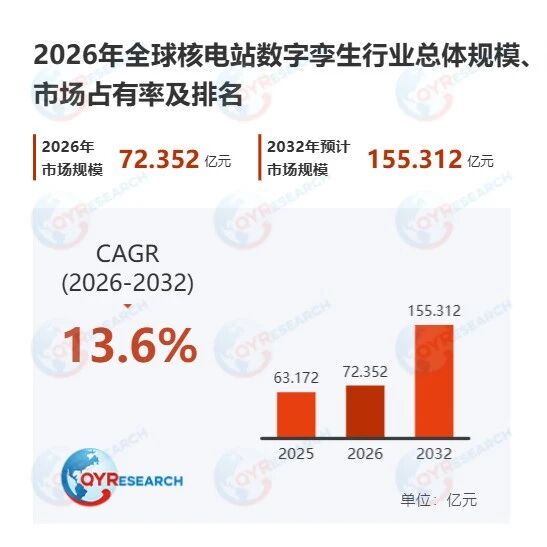
全球核电站数字孪生行业总体规模及头部企业排名情况(附厂商名单)
QYResearch· 2026-03-25 09:40
Global Market Overview - The nuclear power plant digital twin market is transitioning from a "simulation tool" to a "core platform for intelligent operation and maintenance" due to the acceleration of digital transformation in the nuclear energy sector, increasing safety requirements, and the growing demand for predictive maintenance. The global market size is projected to reach $929 million by 2025 and $2.28 billion by 2032, with a compound annual growth rate (CAGR) of 13.57% from 2026 to 2032, driven by modernization needs, enhanced regulatory requirements, and breakthroughs in AI and multi-physics modeling technologies [1][2][3]. Technology Features and Product Classification - The core value of nuclear power plant digital twins lies in creating high-fidelity virtual replicas that evolve synchronously with actual nuclear units, integrating real-time operational data, multi-physics simulation models, and historical performance metrics. The technology is evolving in three main trends: increasing model accuracy, enhanced real-time capabilities, and deeper integration of intelligent algorithms. The market is categorized into three product types: component-level digital twins, system-level digital twins, and plant-level digital twins, with the latter being the fastest-growing segment [5][6][9]. Application Scenarios - The largest application area for digital twins is operation and maintenance, focusing on equipment health management, predictive maintenance, and operational optimization. Planning and design services cater to new unit virtual debugging and scheme validation, while the post-operation phase (life extension and decommissioning) is a rapidly growing potential market [6][9]. Supply Chain and Policy Impacts - Major economies are strengthening supply chain security strategies for critical digital infrastructure in nuclear power, significantly impacting the digital twin industry. Countries like the US and France are enforcing local content requirements and stricter export controls, which are pushing international suppliers to establish local R&D teams. This trend is fostering a regionalized technology ecosystem and increasing the complexity of delivery while promoting local capabilities in emerging markets [7][8][9]. Market Competition Landscape - The global nuclear power plant digital twin market is characterized by a "dual-hero" leadership structure, with Siemens and Schneider Electric dominating nearly half of the market. These industrial giants provide end-to-end solutions from design simulation to operational optimization. The second tier includes EDF, CNNP, and CGN, leveraging their extensive operational experience. The third tier consists of specialized engineering and technology service providers that support the first two tiers with core algorithms and operational support [9][10]. Future Trends and Challenges - Future technological integration will focus on three main lines: deep coupling of AI with physical models, widespread adoption of cloud-edge collaborative architectures, and comprehensive data continuity throughout the equipment lifecycle. However, the industry faces challenges such as high initial investment costs, a severe shortage of multi-disciplinary talent, and the need for agile certification systems that can keep pace with rapid technological iterations [12][13].
首批80个人工智能赋能新型工业化高质量数据集需求发布!公开征集建设单位——
机器人圈· 2026-03-25 09:12
Core Viewpoint - The Beijing Municipal Bureau of Economy and Information Technology has released a notice for the first batch of high-quality data set demand for artificial intelligence-enabled new industrialization in 2026, aiming to support model development and deep industry applications [1]. Group 1: Subject Requirements - The construction units must be legally independent entities registered in Beijing, with good operational status over the past three years and the necessary technical capabilities, talent teams, and financial support for data set construction [1]. Group 2: Construction Requirements - The data sets must align with the specified directions, content, and standards in the demand list, directly usable for AI model development and capable of enhancing model performance [2]. - Data set construction must comply with the Data Security Law and Personal Information Protection Law of the People's Republic of China, ensuring no intellectual property disputes and the absence of sensitive or illegal data [2]. Group 3: Application and Construction Process - Applicants must fill out the "Application for High-Quality Data Set Construction" form based on their strengths and submit it electronically by April 20, 2026 [3][4]. - Each applicant can submit a maximum of five data sets in the same batch to ensure quality and focus [4]. - The Bureau will conduct a strict review based on the applicant's overall strength, feasibility of the construction plan, and expected application outcomes [4]. Group 4: Implementation and Evaluation - Construction units must adhere to the approved application plan, maintaining quality and progress, with a construction period not exceeding 12 months [4]. - Upon completion, both parties will conduct acceptance evaluations, and the construction unit can apply for subsequent funding rewards based on the completed project [4]. Group 5: Other Matters - Applicants are responsible for the authenticity and compliance of their submitted materials, with strict penalties for any fraudulent activities [5]. - Additional data set application needs can be submitted regularly, with the Bureau continuously updating the demand list [5].

快手:2025年第四季度,可灵AI营业收入达人民币3.4亿元
Xin Lang Cai Jing· 2026-03-25 08:53
Core Insights - Kuaishou's AI revenue is projected to reach RMB 340 million by Q4 2025 [1] - In December 2025, Kuaishou's AI monthly revenue surpassed USD 20 million, indicating an annual recurring revenue (ARR) run rate of USD 240 million [1] Summary by Categories - **Revenue Projections** - Kuaishou's AI revenue is expected to achieve RMB 340 million by the end of Q4 2025 [1] - **Monthly Revenue Performance** - In December 2025, Kuaishou's AI generated over USD 20 million in a single month, leading to an ARR of USD 240 million [1]

新股覆盖研究:红板科技
Huajin Securities· 2026-03-25 08:24
Investment Rating - The investment rating for the company is "Buy," indicating an expected relative increase of over 15% compared to the relevant market index within the next 6-12 months [36]. Core Insights - The company, Hongban Technology (603459.SH), specializes in the research, production, and sales of printed circuit boards (PCBs), with a focus on high-end applications. Its main products include HDI boards, rigid boards, flexible boards, rigid-flex boards, and IC substrates. The company is positioned as a significant supplier in the global PCB market, particularly in the mobile HDI board segment, and is actively entering emerging markets such as optical modules and AI servers [7][26]. - The company forecasts revenues of CNY 2.34 billion, CNY 2.70 billion, and CNY 3.68 billion for the years 2023, 2024, and 2025, respectively, with year-over-year growth rates of 6.12%, 15.51%, and 36.06%. The net profit attributable to the parent company is projected to be CNY 105 million, CNY 214 million, and CNY 540 million for the same years, with growth rates of -25.40%, 103.87%, and 152.37% [9][4]. Summary by Sections 1. Basic Financial Status - The company is expected to achieve operating revenues of CNY 2.34 billion in 2023, CNY 2.70 billion in 2024, and CNY 3.68 billion in 2025, with corresponding year-over-year growth rates of 6.12%, 15.51%, and 36.06%. The net profit attributable to the parent company is projected to be CNY 105 million, CNY 214 million, and CNY 540 million for the same years, with growth rates of -25.40%, 103.87%, and 152.37% [9][4]. 2. Industry Situation - The global PCB market is expected to reach USD 73.57 billion in 2024, driven by the recovery of the smartphone market and the demand for AI servers and related high-speed network infrastructure. The market is projected to grow at a compound annual growth rate (CAGR) of 5.2% from 2024 to 2029, reaching USD 94.66 billion by 2029 [15][19]. 3. Company Highlights - Hongban Technology is a key player in the global PCB market, holding a leading position in the mobile HDI board segment. The company has a comprehensive product lineup and has established a significant market share in the mobile HDI mainboard sector, supplying to eight of the top ten global smartphone brands. The company is also expanding into the optical module and AI server markets, with ongoing R&D projects to enhance its product offerings [26][27]. 4. Fundraising Project Investment - The company plans to invest in a project to produce 1.2 million square meters of high-precision circuit boards annually, with a total investment of CNY 2.19 billion and a fundraising target of CNY 2.06 billion over a two-year period [30][31]. 5. Peer Company Comparison - In comparison to peer companies, Hongban Technology's revenue for 2024 is projected at CNY 2.70 billion, with a year-over-year growth rate of 15.51%. The average revenue for comparable companies is CNY 10.64 billion, with an average PE-TTM of 46.03X and a sales gross margin of 18.70% [32][33].
小米集团-W:汽车业务驱动增长,季度盈利短期承压-20260325
国投证券(香港)· 2026-03-25 08:24
Investment Rating - The report maintains a "Buy" rating for the company with a target price of HKD 40.8, indicating a potential upside of 24.8% from the recent closing price [7]. Core Insights - The automotive business has become a key growth driver, achieving a revenue of RMB 372 billion in Q4 2025, representing a year-on-year increase of 123.4% and marking the first quarter of operational profitability at RMB 11 billion [1][2]. - Traditional businesses, such as smartphones and AIoT, are facing short-term pressure due to rising core component and storage costs, impacting overall profitability [1][3]. - The internet services segment showed steady growth, with Q4 2025 revenue reaching RMB 99 billion, a 5.9% year-on-year increase, supported by a record high in advertising revenue [3]. - The IoT and lifestyle consumption segment experienced a decline, with Q4 2025 revenue falling by 20.3% due to a weak domestic appliance market [4]. Summary by Relevant Sections Automotive Business - The automotive segment's revenue reached RMB 372 billion, accounting for 31.8% of total revenue, with a gross margin of 22.7%. The average selling price (ASP) of vehicles increased by 6.6% to RMB 249,846 per unit, driven by higher-value model deliveries [2]. - The company aims to deliver 550,000 vehicles in 2026 and plans to invest over RMB 200 billion in R&D over the next five years, with RMB 60 billion allocated to AI initiatives [4]. Smartphone Business - The smartphone segment's global shipments reached 37.7 million units in Q4 2025, a decline of 11.6% year-on-year, attributed to reduced promotional activities in overseas markets. The ASP increased by 10.7% to RMB 1,176.0 due to a higher proportion of premium models sold [3]. Internet Services - Internet services revenue for Q4 2025 was RMB 99 billion, with a gross margin of 76.8%. Advertising revenue reached RMB 78 billion, marking a 10.4% year-on-year increase and providing solid support for overall profitability [3]. IoT and Lifestyle Consumption - The IoT and lifestyle consumption segment reported a revenue of RMB 246 billion in Q4 2025, down 20.3% year-on-year, primarily due to a downturn in the domestic appliance market [4].

小米集团-W(01810):汽车业务驱动增长,季度盈利短期承压
国投证券(香港)· 2026-03-25 08:10
Investment Rating - The report maintains a "Buy" rating for the company with a target price of HKD 40.8, indicating a potential upside of 24.8% from the recent closing price [7]. Core Insights - The automotive business has become a key growth driver, achieving a revenue of RMB 372 billion, a year-on-year increase of 123.4%, and marking the first quarter of operational profitability at RMB 11 billion [1][2]. - Traditional businesses, such as smartphones and IoT, are facing short-term pressures due to rising costs and market competition, impacting overall profitability [3][4]. - The company plans to focus on delivering 550,000 vehicles in 2026 and has committed to significant R&D investments, exceeding RMB 200 billion over the next five years, with RMB 60 billion specifically for AI [4][5]. Summary by Sections Automotive Business - The automotive segment's revenue reached RMB 372 billion, accounting for 31.8% of total revenue, with a gross margin of 22.7% [2]. - The company delivered 145,115 new vehicles in the quarter, a 108.2% increase year-on-year, driven by strong demand and an increase in average selling price (ASP) to RMB 249,846 per vehicle [2]. Smartphone Business - The smartphone segment's global shipments reached 37.7 million units, but faced an 11.6% year-on-year decline due to reduced promotional activities in overseas markets [3]. - The ASP for smartphones increased by 10.7% quarter-on-quarter to RMB 1,176, supported by higher sales of premium models [3]. Internet Services - Internet services revenue for the quarter was RMB 99 billion, a 5.9% year-on-year increase, with a gross margin of 76.8% [3]. - Advertising revenue reached a record high of RMB 78 billion, growing 10.4% year-on-year, providing solid support for overall profitability [3]. IoT and Lifestyle Products - Revenue from the IoT and lifestyle segment declined by 20.3% year-on-year to RMB 246 billion, primarily due to a weak domestic appliance market [4]. Business Outlook - The automotive sector is positioned as the core growth engine for the company, with ambitious delivery targets and substantial R&D investments planned for the coming years [4][5].
英伟达黄仁勋警示:AI不止冲击白领,蓝领也需警惕
Huan Qiu Wang Zi Xun· 2026-03-25 07:57
Core Viewpoint - The CEO of Nvidia, Jensen Huang, emphasizes that the impact of artificial intelligence (AI) extends beyond white-collar workers, urging blue-collar workers to pay attention and adapt to AI to secure their jobs [1][4]. Group 1: AI's Impact on Employment - Huang points out that blue-collar jobs, previously thought to be less susceptible to AI disruption, can benefit from AI in sectors like agriculture, electricity, and carpentry, where skilled workers can enhance their service capabilities [4]. - He asserts that 100% of jobs will be transformed by AI, with some positions being automated while new roles will emerge [4]. Group 2: Recommendations for Workers - To address employment anxiety caused by AI, Huang advises all professionals to become AI experts, which he believes is crucial for job security [4]. - He expresses a preference for hiring professionals with expertise in AI and suggests that university graduates should possess AI skills upon graduation [4]. Group 3: Future of AI - Huang believes that the era of Artificial General Intelligence (AGI) has arrived, indicating that AI may eventually be capable of performing his current job [4]. - He encourages everyone to proactively utilize AI to transform their work and enhance their skills to avoid being left behind by technological advancements [4].

红板科技(603459):新股覆盖研究
Huajin Securities· 2026-03-25 07:48
Investment Rating - The investment rating for the company is "Buy," indicating an expected relative increase of over 15% in the next 6-12 months compared to the relevant market index [36]. Core Insights - The company, Hongban Technology, specializes in the research, production, and sales of printed circuit boards (PCBs), with a focus on high-end applications. It has established a leading position in the mobile HDI board market and is actively entering emerging markets such as optical modules and AI servers [26][27]. - The company is projected to achieve revenues of CNY 2.34 billion, CNY 2.70 billion, and CNY 3.68 billion for the years 2023, 2024, and 2025, respectively, with year-over-year growth rates of 6.12%, 15.51%, and 36.06% [9][4]. - The company has a comprehensive product structure, including HDI boards, rigid boards, flexible boards, and IC carrier boards, and has developed advanced production technologies that position it competitively in the market [7][8]. Summary by Sections Basic Financial Status - The company is expected to achieve a net profit of CNY 1.05 billion, CNY 2.14 billion, and CNY 5.40 billion for the years 2023, 2024, and 2025, with year-over-year growth rates of -25.40%, 103.87%, and 152.37% [9][4]. - In 2025, the revenue breakdown by product category is projected to be CNY 2.29 billion for HDI boards (66.84% of total revenue), CNY 0.58 billion for rigid boards (16.98%), CNY 0.25 billion for flexible boards (7.30%), and CNY 0.76 billion for IC carrier boards (2.22%) [9]. Industry Situation - The global PCB market is expected to reach USD 73.57 billion in 2024, driven by demand from AI servers and the recovery of the smartphone market, with a projected compound annual growth rate of 5.2% from 2024 to 2029 [15][19]. - The PCB industry in mainland China is projected to grow at a compound annual growth rate of 3.8%, reaching USD 49.7 billion by 2029, supported by the transfer of production capacity and the growth of downstream electronic manufacturing [23][24]. Company Highlights - Hongban Technology is ranked 58th among the top 100 PCB companies globally and has a significant market share in the mobile HDI board sector, supplying to eight of the top ten smartphone brands [26][27]. - The company has successfully developed IC carrier board production capabilities, which are critical components in integrated circuit packaging, and is positioned to benefit from the growing demand in the semiconductor industry [27][29]. Fundraising Project Investment - The company plans to invest CNY 205.69 million in a project to produce 1.2 million square meters of high-precision circuit boards annually, which is expected to enhance its production capacity significantly [30][31]. Peer Comparison - Compared to its peers, Hongban Technology's revenue for 2024 is projected at CNY 2.70 billion, with a net profit of CNY 2.14 billion, while the average revenue for comparable companies is CNY 10.64 billion, indicating room for growth [32][33].