AI技术

Search documents
25项创新举措在全国复制推广——跨境贸易便利化专项行动成效显著
Zhong Guo Jing Ji Wang· 2026-01-16 06:44
Core Insights - The Chinese government is promoting 25 mature policy measures to enhance cross-border trade facilitation, aiming to support the "14th Five-Year Plan" and improve foreign trade quality and efficiency [1] Group 1: Policy Measures - Since 2018, a total of 115 facilitation measures have been introduced to promote cross-border trade, with 29 innovative policies launched during a recent 5-month special action [1] - The 25 nationwide policies focus on efficient cross-border logistics, support for new business models, optimization of special goods regulation, enhancement of smart regulatory services, and improved benefits for enterprises and consumers [1] Group 2: Specific Initiatives - Five measures have been introduced to support new business models, including tax refund policies and simplification of air transport requirements for lithium battery goods [2] - Four measures are aimed at optimizing the regulation of special goods, such as improving inspection processes for exported lithium batteries and establishing a "white list" for pilot enterprises and goods in comprehensive bonded zones [2] Group 3: Regional Developments - Guangzhou has implemented nearly 200 reform measures over seven years, aiming for a foreign trade import and export value of 1.2 trillion yuan by 2025, with a projected growth of 10.4% [3] - Ningbo has innovated with AI technology for customs declaration, achieving a 30% increase in clearance efficiency and significantly reducing inspection times [3] Group 4: E-commerce Growth - Cross-border e-commerce is rapidly growing, with projected imports and exports reaching 2.75 trillion yuan by 2025, a 69.7% increase from 2020 [4] - The establishment of cross-border e-commerce comprehensive pilot zones in 15 cities aims to enhance the development of this sector and improve tax refund processes for enterprises [4] Group 5: International Cooperation - The Customs General Administration is collaborating with the World Customs Organization to build a global "Smart Customs" online cooperation platform, with 146 countries already registered [5] - Efforts are being made to strengthen international trade connectivity through electronic data exchange with 15 countries, enhancing the efficiency of customs processes [5]
40年货代老兵!如何用“科技+金流+商流”破解物流行业动荡困局
Sou Hu Cai Jing· 2026-01-16 04:35
Core Insights - The traditional freight forwarding industry is facing challenges due to escalating trade wars and intense market competition, prompting innovative solutions from Sherry's Group through a combination of legacy experience and AI technology [2][21]. Group 1: Company Background and Leadership - Jerry Huang has 40 years of experience in the logistics industry, having founded Sherry's Group after a successful career that included partnerships with major firms and pioneering AI applications in shipping since 2015 [5][12]. - Jason Huang, with over 9 years of experience in AI and shipping technology, returned to the family business to integrate modern technological solutions into traditional logistics practices [8][21]. Group 2: Innovative Business Model - Sherry's Group has developed a dual-driven model of "logistics technology + supply chain finance" to address cash flow issues for small and medium enterprises (SMEs) amidst rising costs due to trade tensions [12][21]. - The company plans to offer freight financing services to freight forwarders starting in 2026, alleviating their prepayment pressures and expanding its financing services beyond China and the U.S. to Southeast Asia [12][21]. Group 3: Technology Integration - Sherry's Group focuses on empowering freight forwarders by helping them build AI-driven booking and operational platforms at a low cost, rather than selling expensive software [14][15]. - The company emphasizes practical technology solutions that directly address customer needs, avoiding trends like blockchain unless they provide tangible benefits [17][21]. Group 4: Talent Development and Industry Engagement - Jerry Huang is committed to nurturing new talent in the shipping industry by sponsoring students in AI-related fields and facilitating internships to bridge the gap between traditional logistics and modern technology [18][19]. - The company aims to attract young talent to the shipping industry by sharing knowledge and experiences related to AI applications in logistics [19][21].


私募基金经理2025年度10强揭晓!复胜陆航、九坤王琛、国源信达史江辉均居前10!
私募排排网· 2026-01-16 03:33
Core Insights - The performance of private equity fund managers in 2025 has been impressive, with an average return of approximately ***% and a median return of ***%, surpassing the Shanghai Composite Index's return of 18.41% [2] - A total of 574 fund managers have displayed their performance, with 22 achieving returns above ***% and 99 above ***% [2] Group 1: Fund Managers with Assets Over 100 Billion - The top 10 fund managers in this category include Jiang Yunfei, Ma Zhiyu, Lu Hang, Zhang Hua, and others, with a performance threshold exceeding ***% [3][5] - Lu Hang from Fusheng Asset, with 6 products displayed, achieved an average return close to ***% [7] - Lu Hang emphasizes opportunities in new consumption, non-ferrous metals, and traditional midstream industries for 2026 [8] Group 2: Fund Managers with Assets Between 50-100 Billion - The top fund manager in this category is Cai Zhijun from Shengqi Asset, with an average return close to ***% [13] - Other notable managers include He Ruilin from Bopu Technology and Shi En from Yunqi Quantitative, all focusing on stock strategies [10][11] Group 3: Fund Managers with Assets Between 20-50 Billion - Yuan Hao from Beijing Xiyue Private Equity leads this group with an average return exceeding ***% [19] - Other top performers include Huang Litong from Qiantou Investment and Zhai Jingyong from Rongshu Investment [14][16] Group 4: Fund Managers with Assets Between 10-20 Billion - The top performer is Luo Huasen from Shanghai Hengsui Asset, achieving an average return exceeding ***% [24] - Other notable managers include Liu Xianglong from Fuyuan Capital and He Zhenquan from Liangli Private Equity [21][23] Group 5: Fund Managers with Assets Between 5-10 Billion - Niu Xiaotao from Qiaogeli Capital tops this category with an average return exceeding ***% [27] - Other top managers include Du Yanjie from Shanghai Yixin Private Equity and Zhang Ziyao from Haisheng Fund [25][27] Group 6: Fund Managers with Assets Below 5 Billion - Yang Zhongguang from Longhuixiang Investment leads this group with an average return exceeding ***% [31] - Other notable managers include Xie Libo from Jingying Zhitu and Chu Fan from Mojv Asset [29][30]

方正证券谢炎阳:“人心为终”的服务理念,完美诠释了财富管理的信任托付关系
Xin Lang Cai Jing· 2026-01-16 01:24
Core Viewpoint - The forum on January 15, 2026, focused on the new logic of wealth in the AI era and the future of capital markets, emphasizing the importance of emotional connection and professional responsibility in wealth management [1][6]. Group 1: Wealth Management Philosophy - The concept of "human heart as the end" encapsulates the trust relationship in wealth management, highlighting that true wealth management goes beyond asset allocation to include emotional companionship and professional responsibility [1][6]. - Technology can enhance the service process but cannot replace the emotional connections between people, which is a fundamental difference between wealth management and ordinary financial transactions [1][6]. Group 2: Professional Management and Client Relationships - The importance of professional management of clients' account health is emphasized, suggesting that wealth management institutions should not only act as "asset allocators" but also as "investment behavior trainers" [1][6]. - Real-life examples from the company's internal cultural case competition illustrate the establishment of professional companionship and emotional links between financial advisors and clients, reinforcing the company's "people-oriented" service ethos [1][6]. Group 3: Role of AI in Wealth Management - AI technology is viewed as an important leverage tool that can enhance service efficiency and scale, but its core purpose remains to serve people and strengthen trust and warmth between individuals [2][7].

方正证券谢炎阳:摆脱“靠天吃饭”,服务方式必须从“事后应对”向“事中陪伴”乃至“事前预判”根本转变
Xin Lang Cai Jing· 2026-01-16 01:24
Core Insights - The 2026 Global and China Capital Market Outlook Forum highlighted the new logic of wealth in the AI era and the future of capital markets [1][6] - Recent market recovery is seen as a stress test for wealth management institutions' "customer insight capabilities" and "agile service response systems" [1][6] - A fundamental shift from "reactive response" to "proactive accompaniment" and "preemptive prediction" in service methods is essential for building sustainable service advantages [1][6] Company Insights - Founder Securities' core advantage in wealth management lies in its investment advisory business, which has consistently ranked among the industry leaders [1][6] - The company has established a comprehensive customer communication system covering all stages: pre-investment, during investment, and post-investment [1][6] - The company emphasizes personalized service, offering advanced allocation advice for high-risk clients and profit-taking strategy guidance for conservative clients [1][6] Industry Trends - The wealth management sector is actively advancing technology empowerment to create a complete logical chain from customer insight to agile service [2][6] - The integration of digital tools and AI applications in research support, investment advisory, operational management, and customer service aims to achieve a "four-in-one" approach [2][6] - The industry is shifting from passive responses to proactive accompaniment and intelligent prediction, focusing on deepening customer understanding and enhancing service timeliness and personalization [7]
报告:2025年上海甲级办公楼市场需求逐季递增,2026年供应压力有望边际缓解
Feng Huang Wang· 2026-01-16 01:20
Core Insights - The Shanghai office market is expected to navigate through a cyclical downturn, with 2026 being a pivotal year for transitioning between old and new growth drivers [1] Group 1: Market Demand and Supply - The demand for Grade A office space in Shanghai is gradually recovering, with a year-on-year net absorption increase of 76.6% in 2025, driven by increased corporate relocations and expansions [1] - The total net absorption for 2025 reached 218,800 square meters, indicating a narrowing decline of 11 percentage points compared to 2024, suggesting that the demand contraction is nearing its end [2] - The overall market liquidity is showing a mild recovery, with a 55% quarter-on-quarter increase in new supply in Q4 2025, while net absorption grew by 9.3% quarter-on-quarter [1] Group 2: Rental Trends - Rental rates in the central business district (CBD) decreased by 2.8% quarter-on-quarter and 12.1% year-on-year, averaging 6.4 yuan per square meter per day, while non-CBD rents fell by 2.7% quarter-on-quarter and 11.0% year-on-year, averaging 4.2 yuan per square meter per day [1] - The rental market remains favorable for tenants, with landlords maintaining flexible negotiation terms [1] Group 3: Sector-Specific Demand - The TMT sector has surpassed the financial sector, accounting for 20% of the demand, with significant contributions from gaming, e-commerce, and AI companies [2] - The financial sector holds a 19% share, with insurance, funds, and investment banks being the primary demand drivers [2] - Emerging consumer goods sectors, including outdoor and pet products, are also expanding, contributing to a 13% share of the market [2] Group 4: Future Outlook - The supply pressure is expected to ease marginally, with a planned total supply of approximately 3.7 million square meters over the next 3-5 years, continuing the trend of decreasing new supply [3] - The introduction of commercial real estate public REITs is anticipated to provide crucial liquidity support to the market [3] - The year 2026 is projected to be significant for the application of AI technology, which is expected to drive investment and job growth, aiding in inventory reduction [3]
专家共话2026财富管理新周期:结构重塑、科技赋能与生态共赢
Zhong Jin Zai Xian· 2026-01-16 01:15
Group 1: Core Insights - The annual conference hosted by JD Technology focused on the new economic cycle, financial landscape, and wealth management pathways in the context of the "14th Five-Year Plan" [1] - The wealth management industry is entering a high-quality development phase characterized by structural reshaping, professional refinement, and ecological co-creation [1] Group 2: Macro Trends and Technological Empowerment - The evolution of macro trends and technological waves is creating new development opportunities for the wealth management industry [2] - JD Technology emphasizes the importance of its ecosystem, with over 700 million annual active users, to provide rich scenarios and customer bases for wealth management [2] - AI technology, including the AI wealth manager "Jing Xiaobei," is being leveraged to reshape customer service models and enhance operational efficiency [2][3] Group 3: Industry Challenges and Strategic Directions - The direct financing market's importance is increasing, and the wealth management industry must adapt to the diversified asset allocation needs of residents [3] - The industry is facing challenges such as service gaps, insufficient buy-side advisory, and product homogeneity, necessitating a shift towards professional services and diversified product offerings [4] - The transition from asset management to wealth management requires a robust customer service system and technological support [5] Group 4: Asset Allocation and Ecological Co-Building - Investment experts highlighted three main asset allocation themes for the "14th Five-Year Plan" period: asset revaluation due to global monetary restructuring, long-term premiums in technology and high-end manufacturing, and the investment value of competitive Chinese multinational companies [6] - The gold market is evolving from a consumer product to a significant financial and strategic asset, emphasizing the need for a thoughtful investment approach [6] - In the field of pension finance, banks are encouraged to act as long-term planners and ecosystem integrators to meet diverse pension needs [6] Group 5: Future Outlook - By 2026, the wealth management industry will compete based on professional depth, ecological breadth, and technological speed, requiring higher standards for institutional capabilities and service models [7] - The industry must embrace a collaborative spirit and focus on asset exploration, customer service, and technology application to create a healthier and more prosperous wealth management future [7]
彭先觉:混合堆是未来能源的理想之选|科创院士谈
Di Yi Cai Jing· 2026-01-16 00:37
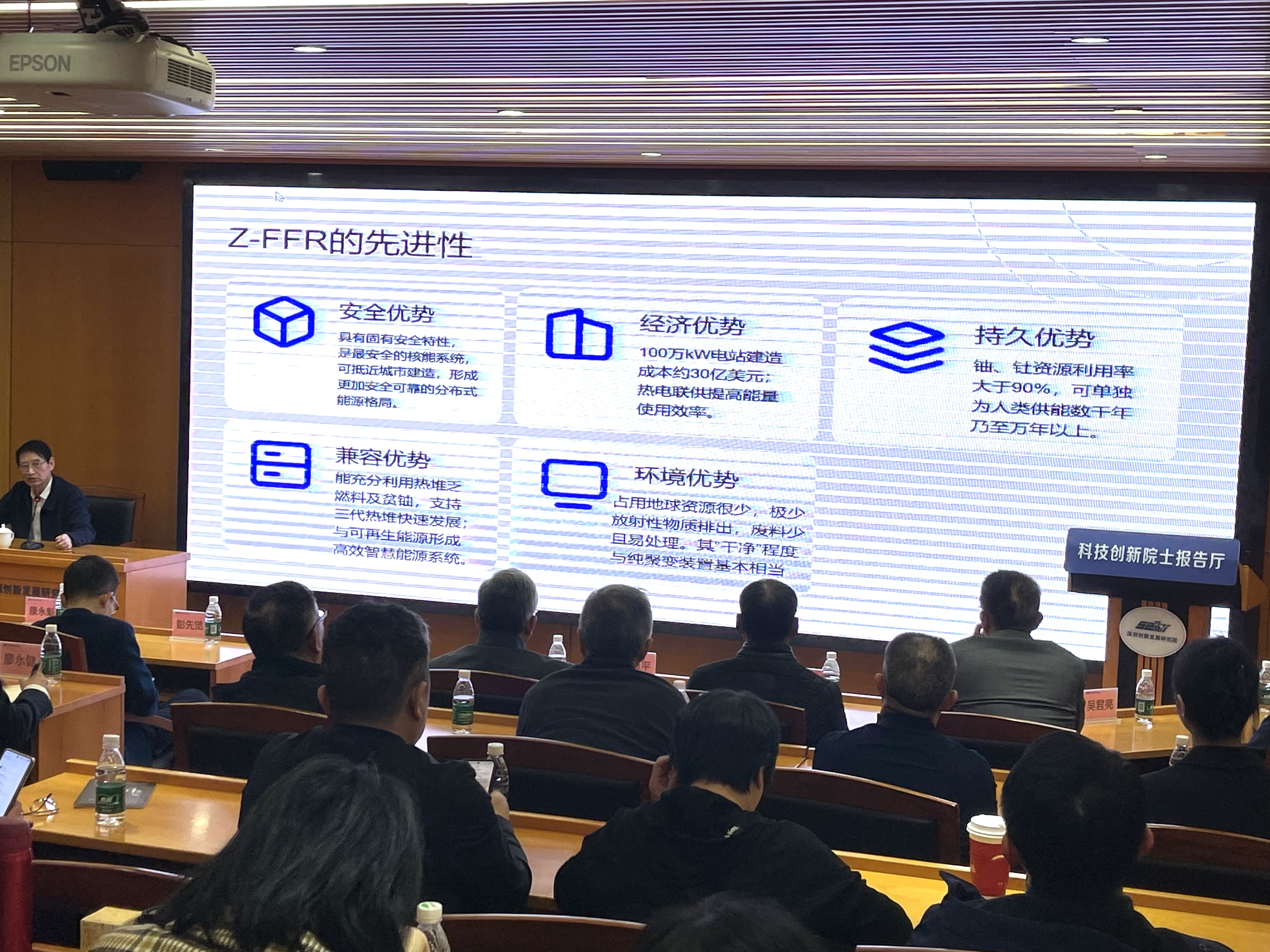
Core Viewpoint - The Z-FFR (Z-pinch Fusion-Fission Reactor) represents a promising hybrid nuclear energy system that combines the advantages of fusion and fission, addressing the limitations of traditional nuclear power and pure fusion energy [1][4][5]. Summary by Sections Nuclear Energy Challenges - Traditional nuclear fission faces issues such as low uranium resource utilization, spent fuel management difficulties, and safety concerns [1][4]. - Pure fusion energy is still far from commercial viability due to stringent conditions required for its realization [1][4]. Z-FFR System Overview - The Z-FFR system utilizes a Z-pinch device to create extreme physical conditions for inertial confinement fusion, releasing high-energy neutrons that trigger fission reactions in surrounding materials [5][6]. - This hybrid approach aims to leverage the strengths of both fusion and fission, enhancing energy output and addressing safety and waste management issues [5][6]. Safety and Economic Advantages - The Z-FFR system is designed with absolute safety in mind, featuring underground placement and a deep subcritical state that prevents chain reactions without external neutron sources [6][7]. - Estimated costs for a million-kilowatt Z-FFR demonstration plant are around 20 billion RMB, with operational costs of approximately 1 billion RMB annually, leading to a projected electricity price of about 0.1 RMB per kilowatt-hour [6][7]. Resource Utilization and Environmental Impact - The system can utilize existing spent fuel and abundant thorium resources, potentially alleviating uranium resource shortages and addressing long-term nuclear waste disposal challenges [6][7]. - The Z-FFR's design allows for efficient energy output control, making it compatible with renewable energy sources and reducing reliance on large-scale energy storage [7][8]. Industrialization Path and Challenges - Transitioning from theoretical principles to practical applications involves overcoming various technological and supply chain challenges [8][10]. - The establishment of the Tianfu Innovation Energy Research Institute aims to accelerate the commercialization of the Z-FFR technology [8][10]. Global Context and Competitive Landscape - China is building a comprehensive supply chain for the Z-FFR, leveraging its strengths in nuclear physics and engineering, while facing challenges in developing mature components [10][12]. - The U.S. has historical advantages in magnetic confinement fusion, but China's integrated approach in hybrid systems positions it favorably in the global nuclear energy landscape [12][13].
25项跨境贸易便利化措施全国推广
Xin Hua Wang· 2026-01-15 23:43
据宁波经济技术开发区管委会主任叶苗介绍,在出口管制监管领域,宁波创新打造"甬智"AI审单智 能体,完成出口报关单全量智能审核应用,在"管得好""管得住"的前提下,通关效率提升30%。同时, 宁波率先将AI技术运用在海关机检查验,智能审图平均识别时间压缩至12秒,查验时间最快缩短至4分 钟。在铁矿石、铜精矿等进口口岸加装高速图像识别、自动采样机器人等设备,平均通关时长压缩15小 时以上。"下一步,宁波将用好港口这个最大资源,深化智慧海关、智慧口岸建设。" 商务部外贸司二级巡视员常晖说,跨境电商是当前发展速度最快、潜力最大、带动作用最强的外贸 新业态。商务部将会同有关部门,加强统筹协调,强化央地协同,推动各项工作落实落细,促进跨境电 商健康持续创新发展。今年重点工作包括扎实推进综试区建设,指导各综试区深入开展跨境电商规范发 展、赋能产业带等专项行动,提升企业合规经营水平,积极利用跨境电商赋能本地产业发展等。(记者 王俊岭) 新疆吉木乃口岸优化通关服务,压缩通关时间,实现"即到即验",让"丝路美食"加速走向餐桌。图 为进口帝王蟹通过查验后准备装箱发往市场。记者 李亚楠摄 记者1月15日从海关总署获悉,2025年4月 ...

分众传媒江南春:AI技术+情绪价值成为品牌传播核心力量
Shang Hai Zheng Quan Bao· 2026-01-15 18:01
Core Viewpoint - AI technology is reshaping various industries, and companies like Focus Media are adapting to retain user attention in the face of challenges posed by AI-generated content and changing consumer behavior [2][5]. Group 1: Industry Challenges and Strategies - Focus Media is addressing the challenge of audience attention diversion in elevator advertising, where many users are distracted by their phones [3]. - The company emphasizes the need for repeated exposure to advertisements to effectively engage consumers, as mere coverage is insufficient without capturing attention [3]. - To combat these challenges, Focus Media has introduced interactive features like the "tap" function on elevator screens, achieving an average daily interaction of 1.4 million times, primarily among younger users [3]. Group 2: Emotional Marketing and Consumer Engagement - The shift in consumer demand from functional attributes to emotional and value-driven connections is influencing marketing strategies [4]. - Focus Media is leveraging "emotional marketing" to create advertisements that resonate with consumers on a deeper level, such as linking product durability to family safety [4]. Group 3: AI Empowerment and Operational Efficiency - The company is utilizing AI technology to enhance its advertising capabilities, enabling precise targeting, attribution, interactivity, and optimization [5][6]. - Focus Media's "thousand buildings, thousand faces" operational model allows advertisers to select target demographics based on various criteria, improving ad targeting efficiency [5]. - A data-driven evaluation system has been established to quantify advertising effectiveness, allowing clients to track consumer behavior changes resulting from ad exposure [6]. Group 4: Brand Development and Market Expansion - Focus Media's strategy includes creating significant value without competing solely on price, addressing consumer pain points to maintain pricing power [7]. - The company is focusing on international expansion, particularly in emerging markets like the Middle East and South America, to capitalize on the global competitiveness of top domestic brands [7].