
业务重组

Search documents
QuantaSing(QSG) - 2025 Q4 - Earnings Call Transcript
2025-09-17 12:02
Financial Data and Key Metrics Changes - Total revenue for Q4 FY2025 reached RMB 617.8 million, with a net income of RMB 108 million, resulting in a net profit margin of 17.5% [18][19] - Sales and marketing expenses improved significantly to 47.6% of revenue from 69.2% in the previous quarter [19] - Gross profit for the quarter was RMB 467.6 million, with a gross margin of 75.7%, down from 85.9% in the same period last year [21] Business Line Data and Key Metrics Changes - Revenue from the property business totaled RMB 65.8 million, accounting for 10.6% of total revenue, indicating its growing significance [20] - Individual online learning services generated revenues of RMB 456.9 million, down from RMB 906.7 million in Q4 FY2024, primarily due to decreases in skills upgrading and financial literacy courses [20] - Revenues from enterprise services were RMB 35.7 million, down from RMB 56.6 million a year ago, due to a reduction in marketing services [20] Market Data and Key Metrics Changes - The company held over RMB 1 billion in cash and cash equivalents, providing a strong foundation for its transition into the property business [6] - Online GMV exceeded RMB 18 million in August, which is over nine times that of April [10] Company Strategy and Development Direction - The company is restructuring to divest all non-property businesses to focus exclusively on its high-growth property business [4][5] - The strategy includes strengthening IP creation, driving agile execution, and delivering sustainable returns to shareholders [15][16] - The company aims to capitalize on the cultural transformation driven by young, digitally savvy consumers seeking emotional connections and unique collectible experiences [6] Management's Comments on Operating Environment and Future Outlook - Management expressed confidence in the growth potential of the property market and the company's ability to scale its IP portfolio and expand internationally [24][25] - The company expects revenues from the property business to be in the range of RMB 100 million-RMB 110 million for Q1 FY2026 and RMB 750 million-RMB 800 million for the full fiscal year 2026 [24][25] Other Important Information - The company has established a joint venture with Juehua Entertainment to leverage cross-industry resources for IP promotion and user engagement [54][55] - The company plans to open three to five flagship stores by the end of the year, enhancing its offline presence [13][38] Q&A Session Summary Question: Recent revenue run rate and confirmed order backlog - Management noted that Wakuku's growth has been explosive, with monthly production capacity reaching approximately 20 times the level at the beginning of the year, and confirmed order backlog is significant with a delivery rate of less than 50% [29][30] Question: Details on Last One's equity arrangements - The acquisition of Last One's remaining equity is in the settlement process, with approximately 60% paid in newly issued shares and 40% as long-term incentives vesting over eight years [32][33] Question: Revenue guidance and toy revenue surpassing education business - Management stated that guidance for FY2025 and FY2026 was based on a prudent assessment of market conditions, with expectations for continued growth driven by strong product performance and channel expansion [36][38] Question: Pipeline for new product categories - The company has a structured roadmap for IP launches and is exploring new product categories, including smaller figures and plush products, set to debut in Q4 [50][51] Question: Collaboration with Juehua Entertainment - The joint venture with Juehua Entertainment focuses on IP design and supply chain support, aiming to develop new IPs that leverage both companies' strengths [54][55]

迅游科技(300467) - 2025年9月12日投资者关系活动记录表
2025-09-12 13:27
Group 1: Company Operations and Future Plans - The company may consider acquiring Shansi Kaiwu Technology through a share issuance in the second half of 2025, pending legal disclosures [1] - The company is monitoring the situation regarding the auction of shareholder shares and will disclose any updates as required by law [1] - The company is actively exploring new business opportunities beyond its core game acceleration services to increase revenue [2] Group 2: Partnerships and Collaborations - The company has currently terminated its cooperation with Shansi Kaiwu and any related investments should be verified through official announcements [2] - The company’s subsidiary in Guiyang is focused on network acceleration services, indicating a strategic expansion in operations [2] Group 3: Investor Relations and Communication - Investors can contact the company through the dedicated investor relations hotline and email for inquiries and visit arrangements [2]

Culp(CULP) - 2026 Q1 - Earnings Call Transcript
2025-09-11 14:02
Financial Data and Key Metrics Changes - Net sales for the first quarter were $50.7 million, down from $56.5 million in the prior year period, primarily due to market softness and tariff-related shipment pauses [21][22] - Gross profit improved to $7.2 million or 14.3% of sales, compared to $5.1 million or 9% of sales in the prior year, reflecting a 530 basis point increase driven by restructuring benefits [21][22] - Operating income was $1.6 million, a significant improvement from a loss of $6.9 million in the prior year [21][22] - Net loss for the quarter was $231,000 or $0.02 per diluted share, compared to a net loss of $7.3 million or $0.58 per diluted share in the prior year [22] Business Line Data and Key Metrics Changes - Bedding segment sales were $28 million, flat compared to the previous year, with gross profit at $2.9 million or 10.5% of sales, a significant improvement from a negative gross profit in the prior year [24] - Upholstery segment sales were $22.6 million, down approximately 20% from $28.5 million in the prior year, with gross profit at $4.3 million or 18.9% of sales, down from $5.5 million or 19.4% [25][26] Market Data and Key Metrics Changes - The bedding industry is still in a down cycle, but analysts suggest that demand may be close to bottoming out, with potential for recovery driven by product replacement and household formation [8][9] - The upholstery segment faced challenges due to high tariffs on imports from China, which significantly impacted sales during the quarter [11][12] Company Strategy and Development Direction - The company is focused on restructuring and integration initiatives to improve operating efficiency and profitability, with expectations for sequential sales growth throughout fiscal 2026 [31][32] - Project Blaze aims to unify operations and share resources across divisions, which is expected to enhance overall business performance [16][18] - The company is strategically positioned to capitalize on market recovery by maintaining flexibility in its supply chain and not limiting production capacity [42][43] Management's Comments on Operating Environment and Future Outlook - Management acknowledges the ongoing challenges from tariffs and market conditions but remains optimistic about gaining market share and improving profitability [9][31] - The company expects adjusted EBITDA results to range from near breakeven to slightly positive for the second quarter, with continued improvements anticipated throughout fiscal 2026 [31][32] Other Important Information - The company reported $11.1 million in total cash and $18.1 million in outstanding debt, maintaining a net debt position of $7.1 million [26][28] - Capital expenditures were reduced to $179,000 for the quarter, reflecting a focus on managing costs and efficiency [29] Q&A Session Summary Question: Are all known tariff impacts accounted for in your initiatives? - Management indicated that they have adjusted pricing and operations to mitigate tariff impacts, and they feel confident in their current strategies [34][35] Question: What is the elasticity of pricing in the current market? - Management acknowledged the competitive nature of the market but emphasized the need to pass on costs to maintain profitability [37] Question: How does the current market downturn compare to past cycles? - Management noted that while down cycles are common, the current downturn has been prolonged, but they are confident in a future recovery [40][42] Question: Will the company be able to meet increased demand with the existing cost structure? - Management assured that they have not limited capacity and can grow as demand increases, leveraging existing cost structures for better margins [43][44] Question: What is the estimated market value of real estate and the future use of NOLs? - Management provided a net book value of $12 million for real estate, with an estimated market value of $40 to $45 million, and discussed the potential future benefits of NOLs once profitability is achieved [45][46]

Culp(CULP) - 2026 Q1 - Earnings Call Transcript
2025-09-11 14:02
Financial Data and Key Metrics Changes - Net sales for the first quarter were $50.7 million, down from $56.5 million in the prior year, primarily due to market softness and tariff-related shipment pauses [21] - Gross profit increased to $7.2 million or 14.3% of sales, compared to $5.1 million or 9% of sales in the prior year, reflecting a 530 basis point improvement driven by restructuring initiatives [21] - Operating income was $1.6 million, a significant recovery from a loss of $6.9 million in the prior year [21] - Net loss for the quarter was $231,000 or $0.02 per diluted share, compared to a net loss of $7.3 million or $0.58 per diluted share in the prior year [22] Business Line Data and Key Metrics Changes - Bedding segment sales were $28 million, flat compared to the previous year, with gross profit improving to $2.9 million or 10.5% of sales from a negative $326,000 or negative 1.2% [24] - Upholstery segment sales were $22.6 million, down approximately 20% from $28.5 million in the prior year, with gross profit at $4.3 million or 18.9% of sales, down from $5.5 million or 19.4% [25][26] Market Data and Key Metrics Changes - The home furnishings industry continues to experience depressed demand, with challenges from consumer spending and housing market trends impacting both business segments [10][11] - Despite the downturn, there are indications of pent-up demand in the mattress market, with analysts suggesting that demand may be close to bottoming out [8][9] Company Strategy and Development Direction - The company is focused on restructuring and integration initiatives to improve operational efficiency and profitability, with expectations for sequential sales growth throughout fiscal 2026 [31][32] - Project Blaze aims to unify the two former divisions into a single Culp-branded business, enhancing operational capabilities and cost efficiencies [16][18] - The company is strategically positioned to leverage its global supply chain and manufacturing flexibility to navigate tariff challenges and capitalize on market recovery [19][12] Management's Comments on Operating Environment and Future Outlook - Management acknowledges the ongoing challenges from tariffs and a low demand environment but remains optimistic about gaining market share and improving profitability [31][32] - The company expects adjusted EBITDA results to range from near breakeven to slightly positive for the second quarter, with continued improvements anticipated throughout the fiscal year [31] - Management emphasizes the importance of not waiting for market recovery but instead making proactive adjustments to enhance profitability [42] Other Important Information - The company reported $11.1 million in total cash and $18.1 million in outstanding debt, maintaining a net debt position of $7.1 million [26] - Capital expenditures were reduced to $179,000 for the quarter, reflecting a strategic focus on managing capital and operational efficiency [29] Q&A Session Summary Question: Are all known tariff impacts accounted for in your initiatives? - Management indicated that they have adjusted pricing and operational strategies to mitigate tariff impacts, and they feel confident in their current position regarding tariffs [35][36] Question: What is the elasticity of pricing in the current market? - Management acknowledged the competitive nature of the industry but emphasized the need to pass on costs to maintain profitability, while being fair and aggressive in pricing strategies [37] Question: How does the current market downturn compare to past cycles? - Management noted that while down cycles are common, the current downturn has been prolonged since 2020, but they remain confident in a future recovery [40][42] Question: Will the company be able to meet increased demand with the existing cost structure? - Management assured that they have not limited capacity and can grow as needed, indicating significant cost leverage available when demand increases [43][44] Question: What is the estimated market value of real estate and the future use of NOLs? - The net book value of real estate is approximately $12 million, with an estimated market value of $40 to $45 million, and NOLs will provide future tax benefits once profitability is achieved [45][46]
Culp(CULP) - 2026 Q1 - Earnings Call Transcript
2025-09-11 14:00
Financial Data and Key Metrics Changes - Net sales for the first quarter were $50.7 million, down from $56.5 million in the prior year, primarily due to market softness and tariff-related shipment pauses [21] - Gross profit increased to $7.2 million or 14.3% of sales, compared to $5.1 million or 9% of sales in the prior year, reflecting a 530 basis point improvement [21] - Operating income was $1.6 million, a significant recovery from a loss of $6.9 million in the prior year [21] - Net loss for the quarter was $231,000 or $0.02 per diluted share, compared to a net loss of $7.3 million or $0.58 per diluted share in the prior year [22] Business Line Data and Key Metrics Changes - Bedding segment sales were $28 million, flat compared to the previous year, with gross profit improving to $2.9 million or 10.5% of sales from a negative $326,000 or negative 1.2% [24] - Upholstery segment sales were $22.6 million, down approximately 20% from $28.5 million in the prior year, with gross profit at $4.3 million or 18.9% of sales, down from $5.5 million or 19.4% [25] Market Data and Key Metrics Changes - The home furnishings industry continues to experience depressed demand, impacting both bedding and upholstery segments [5][12] - Analysts suggest that mattress demand may be close to bottoming out, with potential for recovery driven by product replacement and household formation [9] Company Strategy and Development Direction - The company is focused on restructuring and integration initiatives to improve operating efficiency and profitability, with expectations for sequential sales growth throughout fiscal 2026 [30] - Project Blaze aims to unify operations and share best practices across divisions, enhancing overall business performance [16] - The company is strategically managing its supply chain to navigate tariff challenges and maintain competitive advantages [13][19] Management's Comments on Operating Environment and Future Outlook - Management acknowledges the ongoing challenges from tariffs and market conditions but remains optimistic about gaining market share and improving profitability [10][19] - The company expects adjusted EBITDA results to range from near breakeven to slightly positive for the second quarter of fiscal 2026, with continued improvements anticipated throughout the year [30] Other Important Information - The company reported $11.1 million in total cash and $18.1 million in outstanding debt, maintaining a net debt position of $7.1 million [26] - Capital expenditures were reduced to $179,000 for the quarter, reflecting a focus on managing capital and operational efficiency [28] Q&A Session Summary Question: Are all known tariff impacts accounted for in current initiatives? - Management indicated that they have adjusted pricing and operations to mitigate tariff impacts, and they are currently able to perform and grow margins despite the challenges [34][35] Question: What is the current pricing elasticity in the market? - Management noted that while pricing is challenging, they are being fair yet aggressive in adjusting prices to cover tariffs and improve margins [36] Question: How far along is the company in realizing the $18 million in initiatives? - Management stated that the $10 to $11 million from the previous year's restructuring is expected to fully impact fiscal 2026, while other initiatives will contribute in the latter half of the year [37][38] Question: How does the current market dip compare to past downturns? - Management described the current prolonged downturn as unusual but expressed confidence in the eventual recovery of the market [39][40] Question: How will the company handle potential increased demand in the future? - Management emphasized that they have not limited capacity and can grow it as needed, allowing for significant cost leverage when demand increases [41][42] Question: What is the estimated market value of the company's real estate and the status of federal NOLs? - Management confirmed the net book value of real estate is around $12 million, with an estimated market value of $40 to $45 million, and noted that federal NOLs will provide future tax benefits once profitability is achieved [43][44]
【环球财经】巴西反垄断机构调查英美资源集团与五矿资源5亿美元镍资产交易
Xin Hua Cai Jing· 2025-09-04 13:39
Core Points - Brazil's antitrust regulator, Cade, has initiated an investigation into Anglo American's nickel asset sale in Brazil, valued at approximately $500 million, to MMG, a subsidiary of China Minmetals [1] - The investigation was prompted by third-party complaints and does not guarantee that the transaction will be blocked [1] - The sale is part of Anglo American's broader restructuring plan after rejecting a £39 billion takeover bid from BHP last year, aiming to divest non-core assets to alleviate financial pressure [1] - Anglo American's coal asset sale fell through in August due to the buyer's withdrawal, and the future of its diamond subsidiary, De Beers, is uncertain due to demands from the Botswana government for increased ownership [1] - The complaint regarding the nickel transaction originated from CoreX Holdings, founded by Turkish investor Robert Yildirim, who recently acquired a nickel-iron mine in Colombia, positioning CoreX as a direct competitor [1]
港股异动 | 微创医疗(00853)尾盘跌超7% 上半年公司主要业务收入端承压 近期计划进行业务重组
Zhi Tong Cai Jing· 2025-09-04 07:48
Core Viewpoint - MicroPort Medical's stock dropped over 7% due to pressure on its main business revenue in the first half of 2025, and the company plans to undergo a business restructuring [1][2] Group 1: Financial Performance - For 1H25, MicroPort Medical reported revenue of $548 million, a year-on-year decrease of 2% [1] - The company recorded a net loss attributable to shareholders of $47 million, an improvement from a loss of $97 million in the same period last year, representing a 52% reduction in loss [1] - Despite revenue challenges, effective cost control and contributions from foreign exchange gains and asset disposals led to a narrower loss than expected [1] Group 2: Business Segment Performance - Major business revenue faced varying degrees of pressure: - Coronary revenue decreased by 2.1%, with domestic revenue remaining stable - Balloon and accessory revenues increased by 38% and 21% respectively - Overseas revenue fell by 10% due to factors like Middle East conflicts and channel adjustments - Orthopedic revenue declined by 3.7% - Arrhythmia management revenue decreased by 1.4% - Revenue from large artery and peripheral segments dropped by 9.2% due to centralized procurement or price reductions - Neurointervention revenue fell by 6.2% [1] Group 3: Strategic Initiatives - The company announced that its board is considering a non-binding proposal for a strategic restructuring of its arrhythmia management business, which may lead to a merger with MicroPort Heart's operations [2] - The company is also planning to sell several properties and other assets, and is in discussions with multiple potential investors for direct investments in its subsidiaries or other assets [2] - These initiatives are expected to help improve the group's debt and cash flow situation [2]
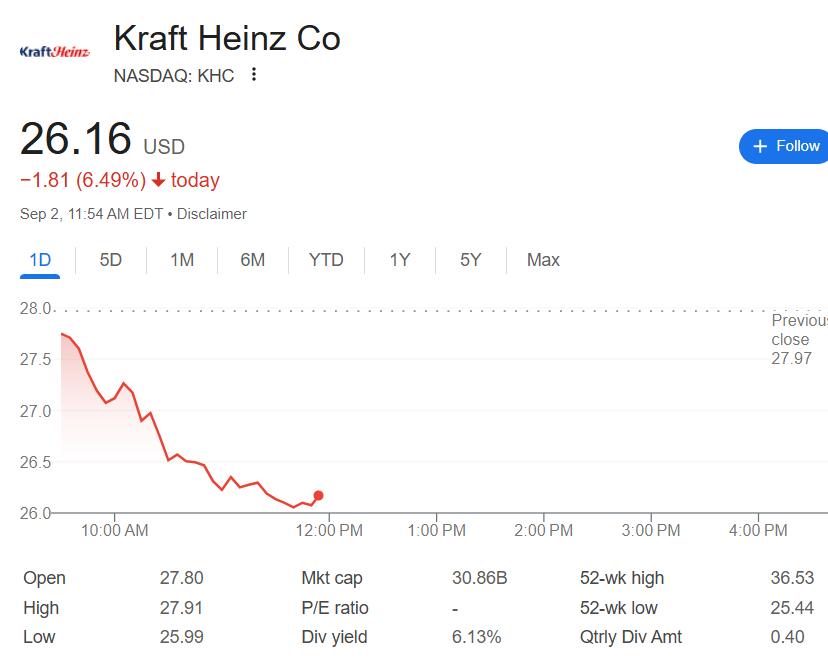
卡夫亨氏联姻十年后分手,"主婚人"巴菲特:对拆分失望,股价一度跌超7%
美股IPO· 2025-09-03 01:20
Core Viewpoint - Buffett expressed disappointment over Kraft Heinz's decision to split, stating that breaking up the company will not resolve its fundamental issues, despite the company's leadership supporting the split as a means to address growth challenges [1][7][9]. Company Summary - Kraft Heinz announced it will split into two independent publicly traded companies, marking the end of the $46 billion merger led by Berkshire Hathaway and 3G Capital in 2015 [5]. - The split will create one company focused on sauces, condiments, and shelf-stable meals with annual sales of $15.4 billion, and another company that includes brands like Oscar Mayer and Kraft Singles with annual revenue of $10.4 billion [6]. - The split is expected to be completed in the second half of 2026 [6]. - Buffett, as the largest shareholder with a 27.5% stake, has not sold any shares since the merger and has previously acknowledged a misjudgment regarding the investment, which led to a $3 billion impairment loss in 2019 [8]. Industry Context - The split of Kraft Heinz is part of a broader trend in the food and beverage industry, where several companies are undergoing similar restructuring efforts, such as Kellogg's recent split into two companies [12]. - The food industry is facing pressures from health-conscious consumers and regulatory scrutiny, prompting significant changes in business strategies [13].


卡夫亨氏联姻十年后分手,"主婚人"巴菲特:对拆分失望,股价一度跌超7%
Hua Er Jie Jian Wen· 2025-09-02 18:30
Core Viewpoint - The decision by Kraft Heinz to split into two independent companies marks the end of a merger led by Warren Buffett's Berkshire Hathaway and 3G Capital, which was valued at $46 billion in 2015. Buffett expressed disappointment, believing that the split will not resolve the company's fundamental issues [1][3][4]. Company Summary - Kraft Heinz announced its plan to split into two companies: one focusing on sauces, condiments, and shelf-stable meals with annual sales of $15.4 billion, and the other including brands like Oscar Mayer and Kraft Singles with annual revenue of $10.4 billion. The transaction is expected to be completed in the second half of 2026 [3]. - Buffett, as the largest shareholder with a 27.5% stake, has not sold any shares since the merger and acknowledged that the merger has not performed well. He stated that splitting the company will not necessarily solve its problems [4][5]. - The leadership of Kraft Heinz supports the split, arguing that the current complex structure hinders effective capital allocation and prioritization of projects. The split aims to enhance focus and resource allocation for each brand [7]. Industry Context - The split of Kraft Heinz is part of a broader trend in the food and beverage industry, where several companies have undergone similar restructuring. For instance, Kellogg split its cereal business in 2023, and Keurig Dr Pepper announced the reversal of its 2018 merger [8]. - The food industry is facing pressures from health advocates and regulatory scrutiny, prompting a significant transformation as consumers become more health-conscious and demand less processed food [8].
微创医疗(00853.HK):上半年收入承压 关注后续修复和减亏兑现
Ge Long Hui· 2025-09-02 12:17
Core Insights - The company reported a revenue of $548 million for 1H25, a year-on-year decrease of 2%, but the net loss attributable to shareholders narrowed to $47 million from $97 million, representing a 52% reduction in loss [1] - Despite revenue pressures, effective cost control and contributions from foreign exchange gains and asset disposals led to better-than-expected profit performance [1] Revenue Trends - Major business segments experienced varying degrees of revenue pressure: - Coronary revenue decreased by 2.1%, with domestic revenue stable and balloon and accessory revenues increasing by 38% and 21% respectively; overseas revenue fell by 10% due to Middle East conflicts and channel adjustments [1] - Orthopedic revenue declined by 3.7%, and cardiac rhythm management revenue decreased by 1.4% [1] - Revenue from large artery and peripheral segments dropped by 9.2%, while neurointervention revenue fell by 6.2% [1] - Structural heart disease revenue increased by 2.7%, surgical robot revenue surged by 77%, and surgical revenue rose by 42.8% [1] - International business revenue grew by 57.3%, reaching $60 million [1] Cost Management and EBITDA - The orthopedic segment's net loss narrowed by 57.9%, with EBITDA increasing by 28.5% [2] - Cardiac rhythm management achieved positive EBITDA, while Heartlink Medical's net loss decreased by 96.2% and minimally invasive robotics' net loss reduced by 58.9% [2] - Overall, total expenses decreased by 14.5% year-on-year, and the operating expense ratio improved by 8.1 percentage points, with R&D expense ratio dropping from 20.6% to 13.2% [2] - The company's overall EBITDA increased to $128 million from $59 million in 1H24 [2] Strategic Initiatives - The company plans to restructure its cardiac rhythm management business, with a potential merger with minimally invasive Heartlink's operations [2] - The company is also looking to sell several properties and other assets, engaging with multiple potential investors to improve its debt and cash flow situation [2] Profit Forecast and Valuation - The profit forecast for 2025/26 remains unchanged at a net profit of -$39 million and $74 million respectively, maintaining an outperform rating [2] - The target price based on DCF model remains at HKD 17, indicating a 40% upside potential from the current price [2]