
以人民为中心的发展思想

Search documents
“牵挂”的力量——中国减贫脱贫启示录①(人民时评)
Ren Min Ri Bao· 2025-11-27 22:20
Core Viewpoint - China's poverty alleviation success has garnered significant international attention, showcasing a unique path and theoretical framework that can serve as a model for other countries [1][2][8] Group 1: Achievements in Poverty Alleviation - Since the 18th National Congress, China has achieved historic milestones in poverty alleviation, establishing a distinctive approach and theory that contributes to global poverty reduction efforts [1][2][8] - The country has successfully lifted 98.99 million rural poor out of poverty, accounting for over 70% of the global poverty reduction population during the same period, achieving the UN's 2030 poverty reduction goals a decade early [8] Group 2: Leadership and Commitment - The commitment of Chinese leadership to poverty alleviation is evident, with significant personal engagement from top officials, reflecting a deep concern for the welfare of the people [2][3][4] - The governance structure emphasizes a coordinated approach, with responsibilities clearly defined from the central government to local levels, ensuring effective implementation of poverty alleviation strategies [6] Group 3: Systematic Approach and Funding - A comprehensive poverty alleviation system has been established, involving substantial financial investment of nearly 1.6 trillion yuan, and mobilizing over 3 million officials to work directly in villages [6] - The strategy includes a multi-faceted approach that combines special, industry, and social poverty alleviation efforts, creating a broad coalition of support [6] Group 4: Future Directions - The ongoing efforts aim to prevent large-scale return to poverty and ensure the sustainability of poverty alleviation achievements, aligning with rural revitalization initiatives [8] - The "14th Five-Year Plan" emphasizes the principle of "people first," indicating a continued focus on improving the lives of citizens [8]
时代专论丨高质量发展是全面建设社会主义现代化国家的首要任务
Zhong Yang Ji Wei Guo Jia Jian Wei Wang Zhan· 2025-11-27 00:24
Core Viewpoint - The articles emphasize the importance of high-quality development as a fundamental requirement for China's economic and social progress, aligning with the strategic goals set by the Communist Party under Xi Jinping's leadership [3][9][12]. Group 1: High-Quality Development - High-quality development is highlighted as the central theme for the 14th Five-Year Plan, reflecting a shift from rapid growth to sustainable and quality-focused growth [9][10]. - The concept of high-quality development encompasses various aspects of economic and social development, including innovation, coordination, green practices, openness, and shared benefits [11][12]. Group 2: Systematic Approach - A systematic perspective is essential for promoting high-quality development, requiring forward-thinking, comprehensive planning, and strategic layout [5][6]. - The integration of Marxist methodology with Chinese cultural values is proposed to create innovative strategies for economic development [5][6]. Group 3: People-Centric Focus - The ultimate goal of high-quality development is to enhance the well-being of the people, addressing their needs and aspirations [6][16]. - Policies and economic strategies should prioritize the improvement of living standards and equitable distribution of resources [6][16]. Group 4: New Development Stage - China has entered a new development stage characterized by a transition from high-speed growth to high-quality development, necessitating adjustments in economic strategies [9][10]. - The new normal of economic development includes changes in growth speed, structural optimization, and a shift towards innovation-driven growth [10][11]. Group 5: Market Economy and Governance - The construction of a high-level socialist market economy is essential, emphasizing the balance between market forces and government intervention [19][20]. - Effective market mechanisms should be utilized to enhance resource allocation while ensuring government actions support high-quality development [19][20]. Group 6: Safety and Development Interaction - High-quality development must be coupled with high-level safety, ensuring that economic growth does not compromise national security [20][21]. - The interaction between development and safety is crucial for maintaining stability and promoting sustainable growth [20][21].


学习手记丨站在人民立场考虑问题
Xin Hua She· 2025-11-26 13:52
Core Points - The article emphasizes the importance of adhering to the people's standpoint in governance and development, as articulated by General Secretary Xi Jinping during his visit to Guangdong Province after the 20th Central Committee's Fourth Plenary Session [3][4][5] - The focus is on achieving common prosperity and improving the quality of life for all citizens as a primary goal of economic and social development in the upcoming "14th Five-Year Plan" [5][6] Group 1 - The visit to Meizhou highlights the historical significance of the region and the commitment to addressing imbalances in development, particularly in areas that have lagged behind [3] - Xi Jinping's declaration to "never forget the original intention" and to prioritize the people's needs reflects the party's enduring mission to enhance the well-being of citizens [3][4] - The "14th Five-Year Plan" aims to solidify the principle of "people first" and to ensure that the improvement of people's living standards is central to economic growth [4][5] Group 2 - The article outlines that common prosperity is a critical indicator for achieving the goal of socialist modernization by 2035, emphasizing the need for substantial progress in this area [5] - The "14th Five-Year Plan" stresses the integration of improving people's livelihoods with economic development, particularly through job creation and investment in education and social security [6] - The narrative underscores that the success of China's modernization efforts relies on the active participation and support of the people, reinforcing the idea that development must be rooted in the populace [6]
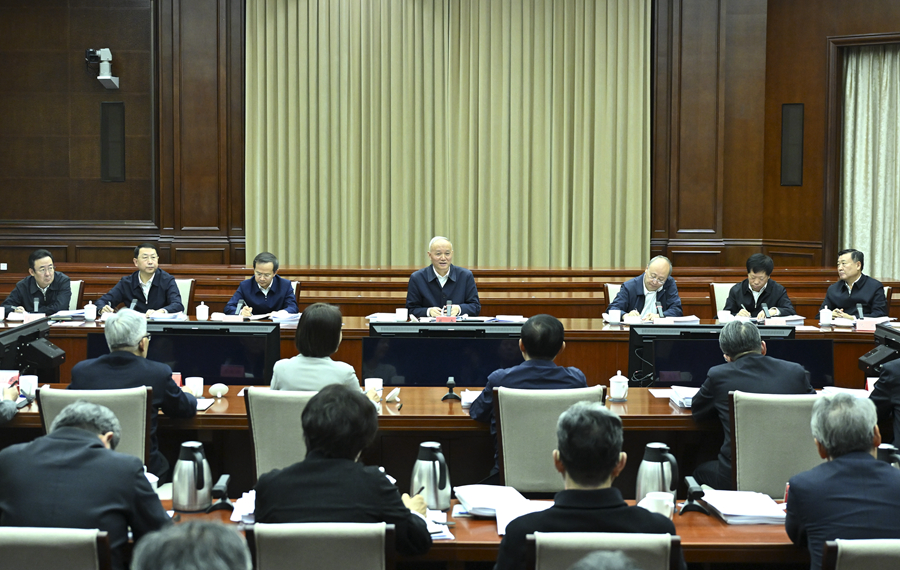
二十届首都规划建设委员会第六次全体会议在京召开 蔡奇出席并讲话 尹力主持
Xin Hua She· 2025-11-22 01:57
Group 1 - The meeting emphasized the importance of the capital's role in China's modernization and the need for urban development to demonstrate leadership in this process [2] - The meeting called for the continuous implementation of various tasks, including improving the governance environment and supporting the construction of the Xiong'an New Area [2][3] - There is a focus on enhancing the protection and utilization of cultural relics, advancing urban renewal, and promoting major collaborative construction projects [2] Group 2 - The meeting highlighted the need for a unified leadership under the Party Central Committee to improve the working mechanism of the Capital Planning Committee [3] - Beijing is tasked with fulfilling local responsibilities, while member units are encouraged to innovate policy measures [3] - The meeting reviewed the implementation status of the 2024 Beijing Urban Master Plan and related regulatory frameworks [4]
传达学习习近平总书记重要讲话精
Zheng Zhou Ri Bao· 2025-11-17 00:55
Core Points - The meeting emphasized the importance of integrating the spirit of Xi Jinping's important speech during his inspection in Guangdong with the implementation of the 20th National Congress of the Communist Party of China, focusing on strategic thinking and comprehensive planning for the "14th Five-Year Plan" and the upcoming "15th Five-Year Plan" [1] - The meeting highlighted the need to promote high-quality development through comprehensive deepening of reforms and opening up, particularly in key areas such as state-owned enterprises, administrative approvals, and the business environment [1] - The meeting discussed enhancing the 12345 government service hotline, stressing a people-centered development approach and improving the satisfaction rate of service requests [1] Group 1 - The meeting addressed the need for a strong focus on urban governance, aiming to resolve persistent issues affecting citizens' daily lives and the city's image, thereby enhancing the overall management level [2] - The meeting underscored the importance of prioritizing education, aiming to establish a first-class education system and a well-known brand "Learning in Zhengzhou," which will support high-quality development through talent cultivation [2] Group 2 - The meeting also covered other miscellaneous matters that were not specified in detail [3]
踔厉奋发新征程 | 坚持人民至上的根本政治立场
Zhong Yang Ji Wei Guo Jia Jian Wei Wang Zhan· 2025-11-17 00:35
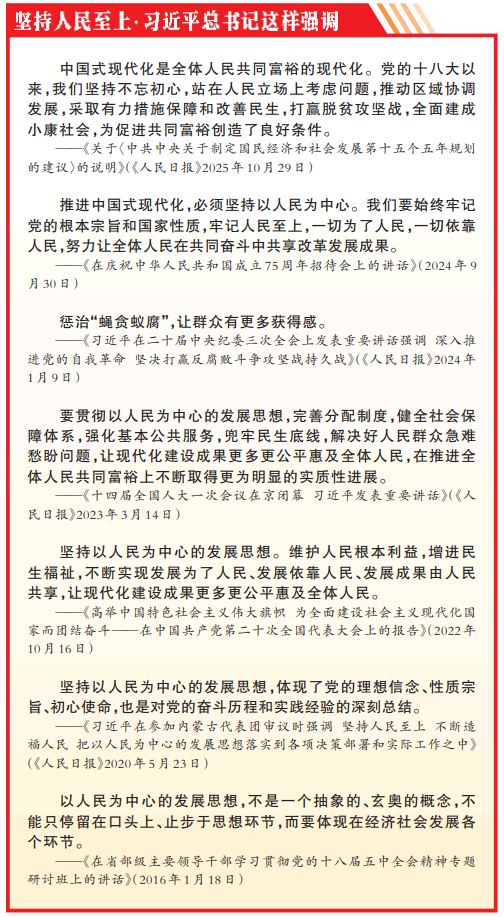
2012年,在十八届中央政治局常委同中外记者见面时,习近平总书记就强调,人民对美好生活的向往,就是 我们的奋斗目标。2015年,在党的十八届五中全会上,习近平总书记首次提出要坚持以人民为中心的发展思 想。党的十九大报告对"坚持以人民为中心"这一重要命题的丰富内涵作了深入阐述:"人民是历史的创造者, 是决定党和国家前途命运的根本力量。必须坚持人民主体地位,坚持立党为公、执政为民,践行全心全意为 人民服务的根本宗旨,把党的群众路线贯彻到治国理政全部活动之中,把人民对美好生活的向往作为奋斗目 标,依靠人民创造历史伟业。" 中央纪委国家监委网站 王雅婧 王珍 人民立场是我们党的根本政治立场。党的十八大以来,以习近平同志为核心的党中央始终坚持把人民利益放 在最高位置,把人民对美好生活的向往作为奋斗目标,推动改革发展成果更多更公平惠及全体人民。习近平 总书记厚植人民情怀,多次就坚持人民至上作出重要论述,强调"一切为了人民、一切依靠人民。" 不断实现人民对美好生活的向往,是我们党的庄严承诺。纪检监察机关作为政治机关,始终坚定人民至上的 根本政治立场,把人民至上理念贯穿纪检监察工作高质量发展的全过程、各方面,持续推动全面从严 ...
坚持投资于物和投资于人紧密结合
Jing Ji Ri Bao· 2025-11-15 01:01
Core Viewpoint - The essence of Chinese-style modernization is the modernization of people, which requires a close integration of investment in material and investment in people [1][2] Group 1 - The "15th Five-Year Plan" emphasizes the need to combine investment in material and investment in people, highlighting the importance of expanding domestic demand as a strategic foundation [2] - The plan aims to enhance the quality of life for the people by improving the supply of quality products and services, thereby supporting the overall development of society [2] - The focus is on creating a comprehensive population service system that addresses various life stages, including marriage, childbirth, education, employment, healthcare, housing, and elderly care [2]
时代提出新考题,中国如何回答?
Bei Jing Ri Bao Ke Hu Duan· 2025-11-11 00:19
Core Views - The article emphasizes the importance of addressing the "Four Questions" posed by the current era, which are essential for guiding China's development and governance strategies [1][2][3][4][5][6][7] Group 1: China's Modernization - The "Chinese Question" focuses on the fundamental issues concerning the nation's future and aims to achieve the great rejuvenation of the Chinese nation, which is a central theme of the Communist Party's century-long struggle [2] - The 20th Central Committee's Fourth Plenary Session provided a strategic framework for advancing Chinese-style modernization, emphasizing that achieving socialist modernization is a historical process that requires continuous development [2] Group 2: Global Engagement - The "World Question" highlights the need for a higher level of openness to address global challenges and promote the construction of a community with a shared future for mankind [3] - The session acknowledged the complexities of the international landscape, including rising protectionism and systemic disruptions, and aimed to contribute Chinese wisdom and solutions to global governance [3] Group 3: People's Welfare - The "People's Question" centers on addressing new demands and challenges in people's livelihoods, emphasizing a people-centered development approach [4] - The session recognized the need to respond to the evolving social dynamics and the diverse needs of the populace, aiming to ensure that economic and social development meets the growing aspirations for a better life [4] Group 4: Technological Advancement - The "Era Question" focuses on the transition from "scale dividends" to "innovation dividends," stressing the importance of high-level technological self-reliance and innovation in driving development [5][6] - The session underscored the urgency of seizing opportunities in the context of a new technological revolution and industrial transformation, aiming to position China as a leader in innovation [6]
进一步科学回答“四个之问”
Bei Jing Ri Bao Ke Hu Duan· 2025-11-09 23:07
Group 1: Core Perspectives - The article emphasizes the importance of addressing the "Four Questions" posed by the current era, which are more complex and challenging than in the past, necessitating scientific responses from both theoretical and practical perspectives [1][2][3][4][5][6][7] Group 2: China's Modernization - The "Chinese Question" focuses on the fundamental issues concerning the nation's future and aims to achieve the great rejuvenation of the Chinese nation, which is a central theme of the Communist Party of China (CPC) [2] - The 20th Central Committee's Fourth Plenary Session provided a strategic framework for advancing Chinese-style modernization, emphasizing a step-by-step historical process towards achieving socialist modernization [2] Group 3: Global Engagement - The "World Question" highlights the need for a higher level of openness to address global challenges and promote the construction of a community with a shared future for mankind [3] - The session acknowledged the complexities of the international landscape, including rising protectionism and systemic disruptions, and aimed to contribute Chinese solutions to global governance [3] Group 4: People's Welfare - The "People's Question" centers on addressing new demands and needs of the populace in pursuit of a better life, emphasizing the necessity for the CPC to respond to these concerns [4] - The session outlined measures to ensure that economic and social development during the 15th Five-Year Plan period focuses on meeting the growing needs of the people [4] Group 5: Technological Advancement - The "Era Question" stresses the importance of accelerating technological self-reliance and transitioning from "scale dividends" to "innovation dividends" in China's development [5][6] - The session highlighted the need for China to lead in innovation rather than merely catch up, marking a shift in the approach to technological development [6]
解决急难愁盼不能“撒胡椒面”,要用心用情、精准施策
Ren Min Wang· 2025-11-06 05:30
Core Viewpoint - The article emphasizes the importance of a people-centered approach in addressing public welfare and improving living standards, advocating for precise and targeted measures rather than a broad, superficial approach [1][2]. Group 1: Issues in Current Welfare Approaches - There is a phenomenon of "spreading pepper" in welfare work, which leads to resource waste and fails to address actual problems effectively [2]. - This approach can manifest as average distribution of resources, neglecting differentiated needs, or as a lack of follow-up management, resulting in a disconnect between investment and public satisfaction [2]. Group 2: Importance of Precision in Welfare Work - Precision is crucial for enhancing public welfare, requiring accurate identification of issues and alignment of resources with community needs, akin to targeted medical treatment [3]. - Successful examples include targeted poverty alleviation strategies and tailored urban renewal projects that address specific community needs rather than generic solutions [3]. Group 3: Necessity of Ground-Level Research - To understand true public demands, it is essential for officials to engage directly with communities, conducting thorough research to identify urgent issues and needs [4]. - This involves avoiding one-size-fits-all solutions and focusing on detailed case studies to uncover common problems and underlying patterns [4]. Group 4: Balancing Universal and Targeted Support - Effective welfare strategies must balance universal public services with targeted support for vulnerable groups, ensuring that both general and specific needs are met [5]. - The approach should be gradual and sustainable, focusing on pressing issues while also seeking systemic solutions for broader challenges [5].