南向资金流入

Search documents
南向资金创纪录!今年净买入额突破6300亿港元,港股有哪些吸引力
Hua Xia Shi Bao· 2025-05-28 03:15
Core Viewpoint - The emergence of DeepSeek has led to a global reassessment of the value of Chinese tech stocks, with the Hang Seng Tech Index rising approximately 16% year-to-date as of May 27, 2025 [1][5] Group 1: Southbound Capital Inflow - Southbound capital has surged this year, with a net buying amount reaching 633.35 billion HKD as of May 27, 2025, indicating a strong market interest [2][4] - The daily net inflow exceeding 10 billion HKD has become a common occurrence, particularly noted during the period from April 1 to 9, where net buying consistently surpassed 10 billion HKD [2][4] - The net buying amounts from 2020 to 2024 were 672.125 billion HKD, 454.396 billion HKD, 386.291 billion HKD, 318.842 billion HKD, and 807.869 billion HKD, showing a significant increase in 2025 [2] Group 2: Market Dynamics and Investor Sentiment - Improved economic data and enhanced corporate profit expectations have increased investor risk appetite, making the Hong Kong stock market more attractive [4] - The unique advantages of the Hong Kong market, including the listing of mainland companies, have provided more investment options for southbound capital [4] - The deepening financial cooperation between mainland China and Hong Kong has reduced the costs and risks associated with capital flow, further promoting the inflow of southbound funds [4] Group 3: Internet Companies and Stock Buybacks - The Hang Seng Tech Index has risen approximately 16% year-to-date, with major internet companies like Alibaba, Tencent, and Kuaishou leading the charge [5][6] - A total of 189 Hong Kong-listed companies have conducted buybacks this year, totaling approximately 3.3 billion shares, with Tencent being the largest repurchaser at over 24 billion HKD [5] - Tencent's buyback amounts from 2021 to 2024 were approximately 2.6 billion HKD, 33.8 billion HKD, 49 billion HKD, and 112 billion HKD, showing a consistent increase [5] Group 4: Positive Market Outlook - Many institutions remain optimistic about the Hong Kong stock market, citing improved domestic demand and macroeconomic conditions as key factors [7] - The current market is seen as a phase of policy support and rebalancing uncertainty, with new economic sectors becoming new growth engines [7] - The Hang Seng Index and Hang Seng Tech Index are currently at relatively low valuations, presenting high investment value [7][8]



南向资金本周继续净流入 红利板块成避风港
Zhong Guo Zheng Quan Bao· 2025-05-23 21:14
Group 1 - The Hong Kong stock market shows resilience with the Hang Seng Index rising by 1.1% and a net inflow of southbound funds amounting to HKD 18.959 billion this week, bringing the total net inflow for the year to over HKD 622.9 billion, a 1.5 times increase compared to the same period last year [1][3] - Dividend sectors, particularly banks, are favored by investors, with China Construction Bank attracting nearly HKD 6 billion in net inflows this week [1][2] - The AH share premium index has dropped to a near four-year low, with the premium of A-shares over H-shares narrowing to 31%, down from a high of 61% in 2024 [3] Group 2 - Southbound funds have shown a preference for the banking sector, with net inflows of HKD 7.196 billion, while the pharmaceutical and telecommunications sectors received net inflows of HKD 4.859 billion and HKD 3.287 billion, respectively [1][2] - Major stocks such as China Construction Bank, Meituan-W, and China Mobile saw significant net inflows, while Tencent Holdings and Alibaba-W experienced net outflows [2] - The overall sentiment in the Hong Kong market is improving, with institutions optimistic about the long-term value of Hong Kong stocks, suggesting a focus on dividend stocks as a stable investment during uncertain times [4] Group 3 - The liquidity of Hong Kong stocks has improved significantly due to the inflow of southbound and overseas funds, with the proportion of Hong Kong Stock Connect holdings increasing from 8% in September 2020 to 20% [3] - The internationalization of the Hong Kong stock market is accelerating, with significant foreign investment interest, as evidenced by the participation of non-U.S. foreign investors in major listings [4] - Analysts suggest that as the U.S. economy weakens and the dollar enters a downtrend, Hong Kong stocks are positioned to benefit from the resulting liquidity influx [4]



南向资金“狂飙”流入,港股科技ETF(513020)聚焦中国科技“七巨头”,指数长期走势较同类更优
Mei Ri Jing Ji Xin Wen· 2025-05-15 03:20
Group 1 - The Hong Kong stock market has entered a technical bull market since 2025, with the CSI Hong Kong Stock Connect Technology Index rising by 31.27% from January 13 to April 30, 2025, leading globally [1] - The rebound is primarily driven by the strong recovery of Hong Kong technology stocks and active inflows of southbound capital, with net purchases exceeding 38,202 billion yuan as of April 30, 2025 [3] - The recent easing of US-China tariff tensions is expected to alleviate operational pressures on related companies and boost international collaboration and market demand within the technology industry [1][6] Group 2 - The outlook for the Hong Kong stock market remains positive, with expectations of further upward movement due to economic policy stimulus and potential interest rate cuts by the Federal Reserve [2] - The Hong Kong technology sector is benefiting from domestic economic recovery and innovation, supported by a favorable liquidity environment and policy easing, which is expected to activate the "internal growth momentum" of technology stocks [6] - The Hong Kong Technology ETF (513020) tracks the CSI Hong Kong Stock Connect Technology Index, which includes major tech companies like Alibaba, Xiaomi, and Tencent, making it a quality target for investors looking to capitalize on the rebound [7] Group 3 - The CSI Hong Kong Stock Connect Technology Index has outperformed other Hong Kong technology indices, with a one-year return of 58.39% compared to 37.00% for the Hang Seng Technology Index [12] - The index's balanced industry distribution allows it to effectively capture growth opportunities across various sectors, contributing to its superior long-term performance since 2017 [9] - Investors interested in Hong Kong technology can consider the Hong Kong Technology ETF (513020) or its linked funds for exposure [13]


高盛:大幅上调今年南向净流入港股预测至1100亿美元 定价能力增强
news flash· 2025-04-28 01:10
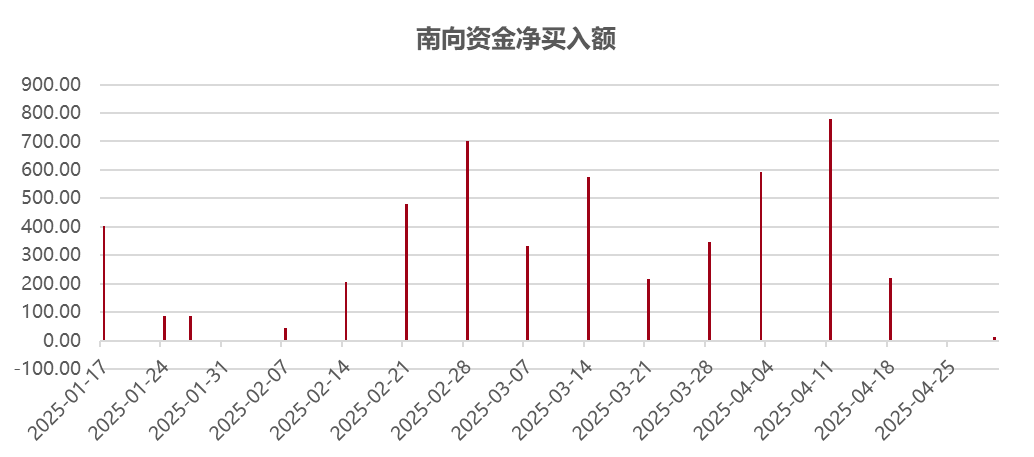
高盛称,将2025年南向资金流入预测从750亿美元上调至1100亿美元,以反映境内投资者加大跨境资产 投资,H股受益盈利增长、估值和股息率更有吸引力等因素。 ...
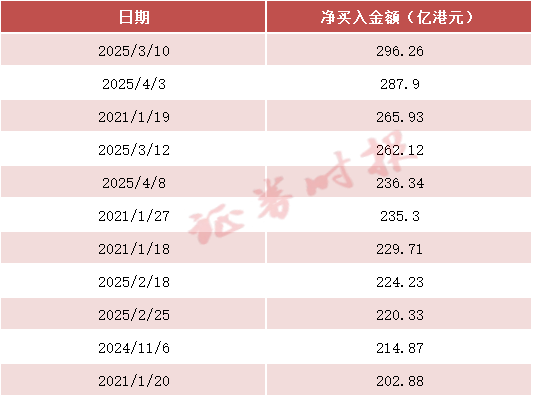
历史第五!爆买
Zheng Quan Shi Bao· 2025-04-08 11:49
Group 1 - Southbound funds have been aggressively buying into the Hong Kong stock market, with a net purchase of 236.34 billion HKD on April 8, marking the fifth highest single-day net purchase in history [1][2] - Since the beginning of April, southbound funds have accumulated nearly 1,000 billion HKD in net purchases over just five trading days, and year-to-date net purchases have approached 5,400 billion HKD [1][3] - The inflow of southbound funds is attributed to the decline in domestic risk-free interest rates and the improved industry outlook benefiting from more AI-related companies in the Hong Kong market [1][3] Group 2 - The sectors that have seen significant net purchases from southbound funds over the past three months include retail, banking, media, telecommunications, pharmaceuticals, and electronics [1][3][4] - In the last month, the most net purchases by southbound funds were in retail (180.7 billion HKD), banking (183.88 billion HKD), media (110.89 billion HKD), and pharmaceuticals (147.47 billion HKD) [5][4] - Southbound funds have shown a preference for a "barbell" investment strategy, focusing on high-dividend assets on one end and technology growth and consumer discretionary sectors on the other [3][5] Group 3 - Since October 2024, southbound funds have consistently demonstrated large-scale and rapid net purchases, with net purchases reaching 838.15 billion HKD in October 2024 and peaking at 1,250.20 billion HKD in November 2024 [6] - The trading volume of southbound funds has significantly increased, accounting for approximately 42.80% of the total trading volume of the Hang Seng Index this year [6][7] - The role of southbound funds in the Hong Kong market has become increasingly important, driven by active participation from individual and private investors, as well as ongoing allocations from public and insurance funds [7]