
汽车安全

Search documents
雷军周日亲自下场回应,能改变小米的风评么?
Sou Hu Cai Jing· 2025-11-16 15:00
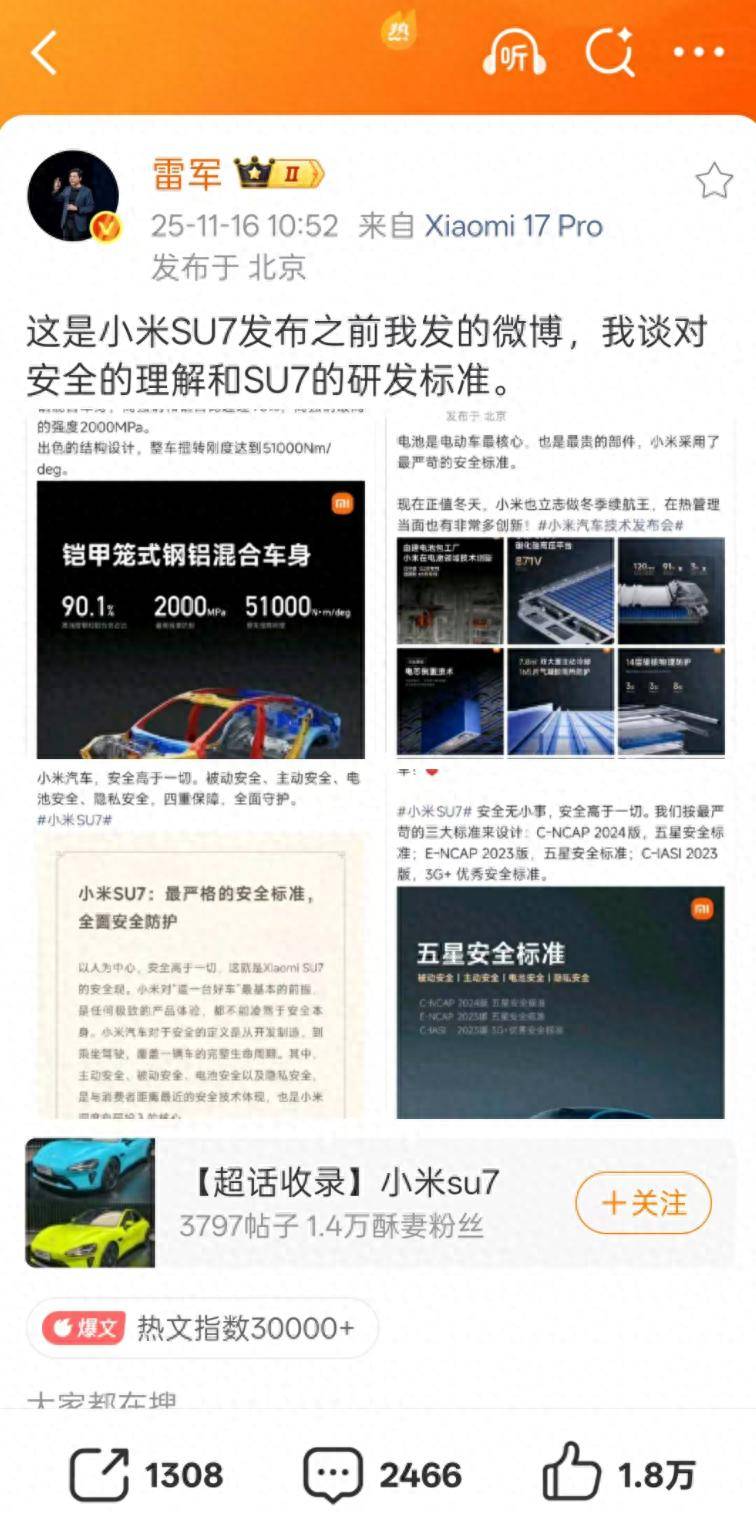
Core Viewpoint - Lei Jun emphasizes the importance of safety in the design and development of the Xiaomi SU7, asserting that safety standards are paramount in the automotive industry [1][2]. Group 1: Safety Standards and Design - The Xiaomi SU7 is designed with a focus on safety, featuring a structural strength of 2000MPa and a torsional rigidity of 51,000Nm, highlighting the company's commitment to rigorous safety standards [1]. - The vehicle aims to be a leader in winter range performance, showcasing innovative thermal management solutions [1]. Group 2: Public Relations and Response - Lei Jun's recent social media activity appears to be a response to public criticism, indicating a serious tone and a desire to address safety concerns directly [2][5]. - Despite his efforts, the public relations strategy may not be effective, as ongoing skepticism and criticism persist in the comments [5][8]. - The response strategy has been criticized for lacking logical coherence, with some statements potentially exacerbating the situation rather than alleviating it [8][12]. Group 3: Implications for Brand Management - The incident illustrates the dual-edged nature of a CEO as a brand spokesperson, where both positive and negative perceptions can significantly impact the brand [14]. - The automotive industry must prioritize safety in both marketing and product development to withstand consumer scrutiny [14]. - The rapid dissemination of information in the digital age can amplify both praise and criticism, suggesting that companies must navigate public perception carefully [14].


每经热评丨新国标拟划定5秒加速红线 汽车行业竞争不比速度比安全
Mei Ri Jing Ji Xin Wen· 2025-11-16 14:27
当"百公里加速5秒内"成为部分车企乐于炫耀的技术时,一纸征求意见稿或将为这场非理性竞赛按下暂 停键。 11月12日,由公安部组织起草的国家标准计划《机动车运行安全技术条件》向社会征求意见(以下简称 征求意见稿)。 征求意见稿在"超速报警和限速功能"技术指标中拟新增两项要求:乘用车每次上电/点火后(发动机自 动启停除外),应处于百公里加速时间不小于5秒的默认工作状态。 此外,征求意见稿还要求纯电动、插电式混合动力载客汽车应具备踏板误踩加速抑制功能,在静止、蠕 行时能检测,抑制动力输出并通过一个明显的信号装置(例如声或光信号)提示驾驶人。 近年来,汽车行业尤其是新能源转型浪潮中,"数字内卷"愈演愈烈,百公里加速时间成为部分车企最热 衷炒作的核心指标,2秒级、3秒级的加速数据频频出现。 究其原因,在燃油车市场,百公里加速时间是很重要的动力参考指标,能够反映出车辆的加速能力和动 力系统性能,也是豪华燃油车的主要溢价来源之一。而在电动车时代,受益于电机技术特性,传统燃油 车需要复杂机械结构和巨额成本才能提升的加速性能,能够以更低的成本实现。车企通过宣传这一指 标,能够展示其技术实力,提升品牌技术形象。 然而,正如北方工 ...
冲上热搜!雷军连发多条微博辟谣
Sou Hu Cai Jing· 2025-11-16 13:52
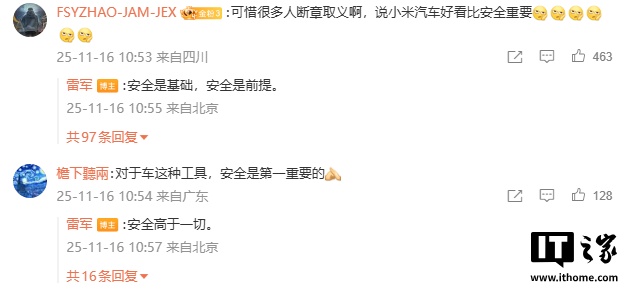
Core Viewpoint - The founder and CEO of Xiaomi, Lei Jun, emphasizes the company's commitment to safety in the design of its vehicles, particularly the upcoming Xiaomi SU7, stating that "safety is the foundation" and "safety is above all" [2][12][14]. Group 1: Safety Standards - Xiaomi's automotive division adopts the strictest safety standards in its design, with a focus on both the vehicle body and battery safety [14]. - The vehicle body is constructed using a steel-aluminum hybrid design, with high-strength steel and aluminum making up 90% of the composition, and the highest strength of the steel reaching 2000 MPa [14]. - The overall torsional rigidity of the vehicle is reported to be 51,000 N·m/deg [14]. Group 2: Design Philosophy - Lei Jun previously stated that aesthetics are important in vehicle design, but he clarifies that this does not contradict the emphasis on safety [12][14]. - The company aims to meet or exceed the safety benchmarks set by the 2024 version of C-NCAP five-star rating, the 2023 version of Euro NCAP five-star rating, and C-IASI 3G+ as the design baseline [14]. Group 3: Public Perception and Response - Lei Jun addresses criticisms and misinterpretations regarding the company's focus on aesthetics over safety, asserting that many comments online are taken out of context [12]. - He highlights that Xiaomi's vehicles have faced significant online criticism since their announcement, urging the industry to focus on safety and resist negative public relations tactics [12][14].

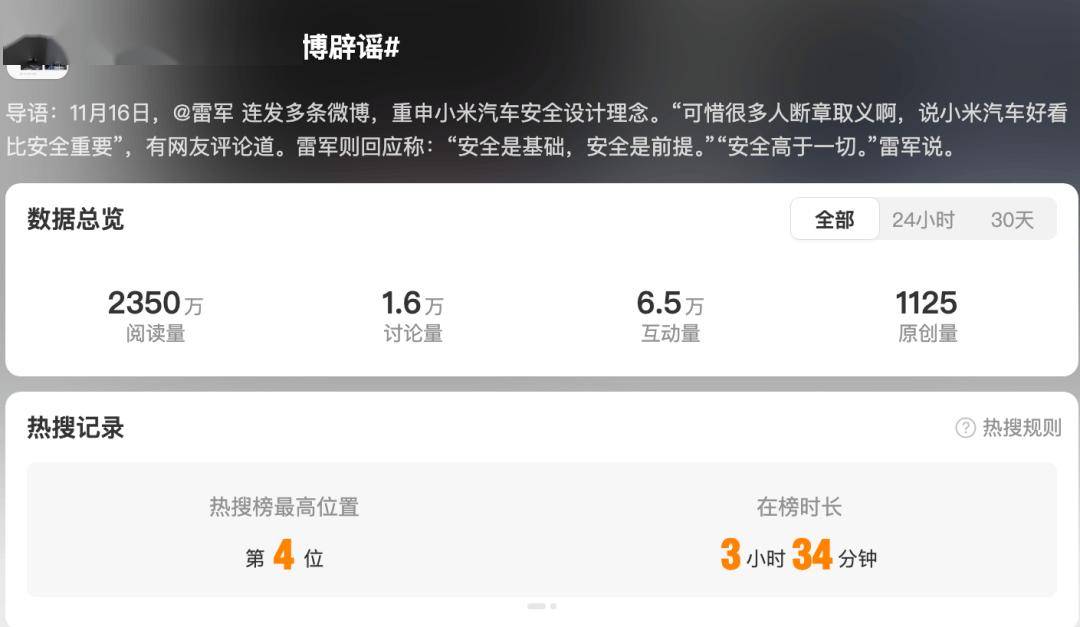
雷军怒了?连发多条微博回应质疑
Guan Cha Zhe Wang· 2025-11-16 11:10
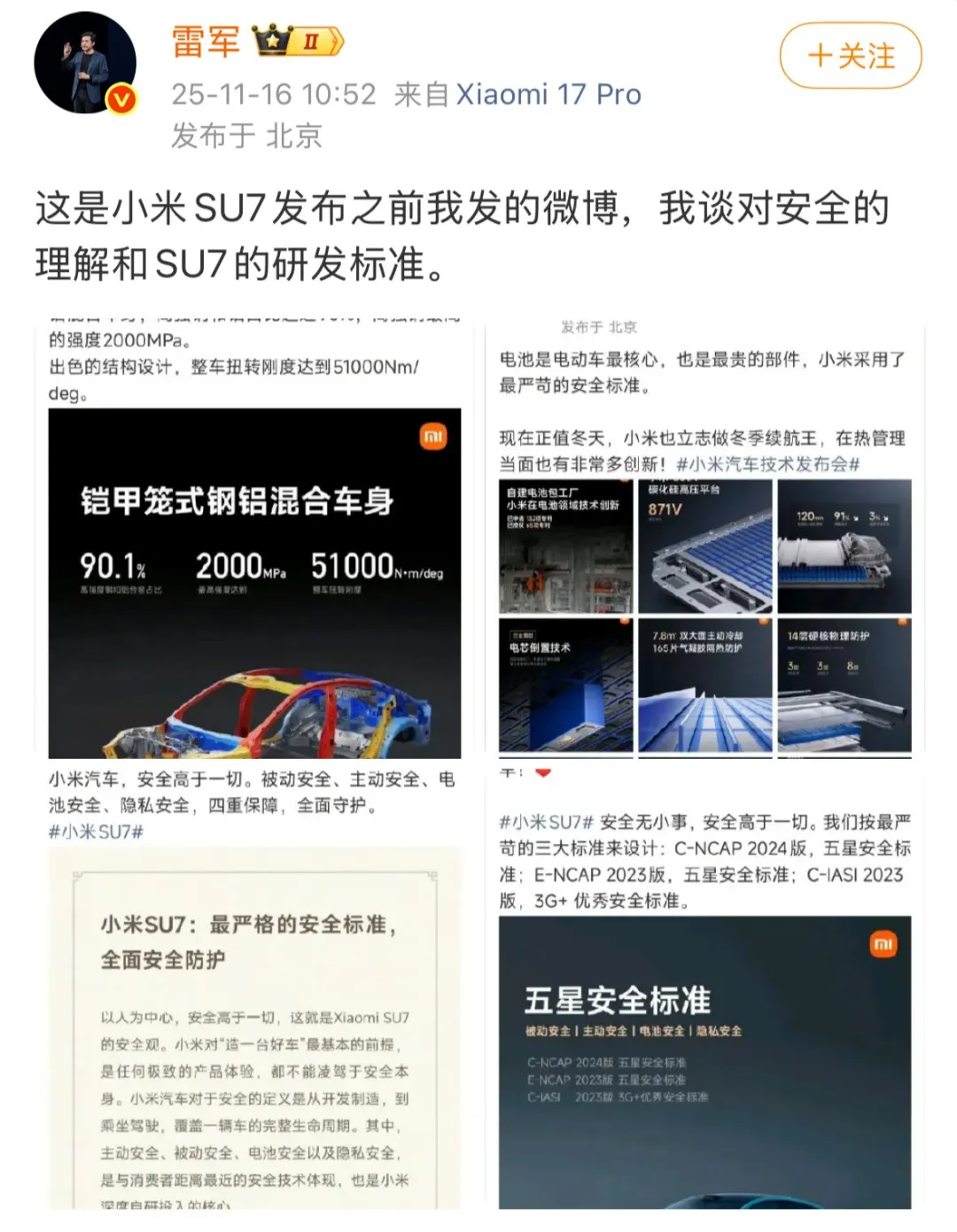
Core Viewpoint - The founder of Xiaomi, Lei Jun, emphasizes the company's commitment to safety in automotive design, asserting that aesthetics should not compromise safety standards [1][10]. Group 1: Safety Standards - Xiaomi's automotive safety philosophy includes four key areas: passive safety, active safety, battery safety, and privacy safety, which are integral to the vehicle's lifecycle [5]. - The company adheres to the stringent 2024 C-NCAP standards as the baseline for vehicle safety development, incorporating extensive redundancy in design to mitigate accident risks [5][7]. - Xiaomi aims to achieve top safety ratings, including five-star ratings from C-NCAP 2024 and E-NCAP 2023, as well as a 3G+ excellent safety standard from C-IASI 2023 [7]. Group 2: Battery Technology - The battery is highlighted as the most critical and expensive component of electric vehicles, with Xiaomi implementing rigorous safety standards in its battery technology [8]. - Innovations in battery management include a self-built battery pack factory and advanced thermal management systems, with numerous patents filed and granted [8]. Group 3: Public Perception and Communication - Lei Jun addresses public misconceptions regarding the prioritization of aesthetics over safety, reiterating that safety is paramount [10].

雷军回应质疑
Xin Jing Bao· 2025-11-16 09:59
Core Viewpoint - Lei Jun clarified his previous comments regarding the design and safety standards of the Xiaomi SU7, emphasizing that safety is paramount and should not be compromised for aesthetics [1][12]. Group 1: Safety Standards - Xiaomi SU7 adheres to the strictest safety standards, including C-NCAP 2024 five-star standard, E-NCAP 2023 five-star standard, and C-IASI 2023 3G+ excellent safety standard [11][15]. - The company defines safety comprehensively, covering the entire lifecycle of the vehicle from development and manufacturing to driving and riding [10][15]. Group 2: Design Philosophy - Lei Jun's earlier statement that "a car should look good first" was made in the context of discussing design challenges, not as a dismissal of safety concerns [12]. - The design philosophy of Xiaomi emphasizes that no extreme product experience should override safety [10][15]. Group 3: Safety Features - Xiaomi's safety approach includes four key areas: active safety, passive safety, battery safety, and privacy safety, which are crucial for consumer protection [9][10]. - The structural integrity of the vehicle is highlighted, with a torsional rigidity of 51,000 Nm/deg and a body made of a steel-aluminum hybrid design [8].
雷军重申安全是小米汽车基础和前提:“好看”和“安全”并不矛盾,网上有人断章取义、歪曲抹黑
Xin Lang Cai Jing· 2025-11-16 09:23
Core Points - Xiaomi's founder and CEO Lei Jun emphasizes that safety is the fundamental principle for Xiaomi's automotive division, stating that "safety is the foundation, safety is the premise" [1][6] - Lei Jun defends Xiaomi against online criticism, asserting that many comments are taken out of context and misrepresented [2][3] - The company adopts stringent safety standards in the design of its vehicles, including a steel-aluminum hybrid body with over 90% high-strength steel and aluminum, and a maximum strength of 2000MPa [6] Safety Standards - Xiaomi's automotive design philosophy prioritizes safety above all else, with a focus on both passive and active safety measures [3][6] - The vehicle's torsional rigidity is reported to reach 51,000 Nm/deg, indicating a robust structural integrity [6] - The company highlights the importance of battery safety, labeling it as the most critical and expensive component of electric vehicles [6] Public Perception - Following the launch of Xiaomi's automotive products, the brand has faced significant online backlash, becoming one of the most criticized brands on the internet [6]
雷军连续发文回应质疑
财联社· 2025-11-16 08:09
2023年12月28日,雷军发文表示,电池是电动车最核心,也是最贵的部件,小米采用了最严苛的安全标准。 今日,雷军连发多条微博,重申小米汽车安全设计理念。雷军发文称,在去年4月的一次采访中,我在谈产品定义时说,"一辆车,好看是第 一位的",这和"安全是基础、安全是前提"矛盾吗?还是在这次采访,我谈设计时候说轮毂最难设计,这有啥问题? 同日,雷军还发布了他于2023年和2024年发布的四则微博截图,称"这是小米SU7发布之前我发的微博,我谈对安全的理解和SU7的研发标 准。" 雷军 的 I 》 185 l H 13 23-12-28 17:08 小米创办人,董事长... 发布于 北京 小米汽车采用最严苛的安全标准来设计,车身采用钢 铝混合车身,高强钢和铝占比超过90%,高强钢最高 的强度2000MPa。 出色的结构设计,整车扭转刚度达到51000Nm/ deg。 铠甲笼式钢铝混合车身 xiaomi su7 2024年1月3日,雷军发文称,小米汽车,安全高于一切。被动安全、主动安全、电池安全、隐私安全,四重保障,全面守护。 雷军 首 可》 178 24-1-4 06:50 小米创办人,... 已编辑 发布于 北京 ...
雷军发布小米YU7前向碰撞测试实拍:乘务舱结构均完好
Sou Hu Cai Jing· 2025-11-15 14:29
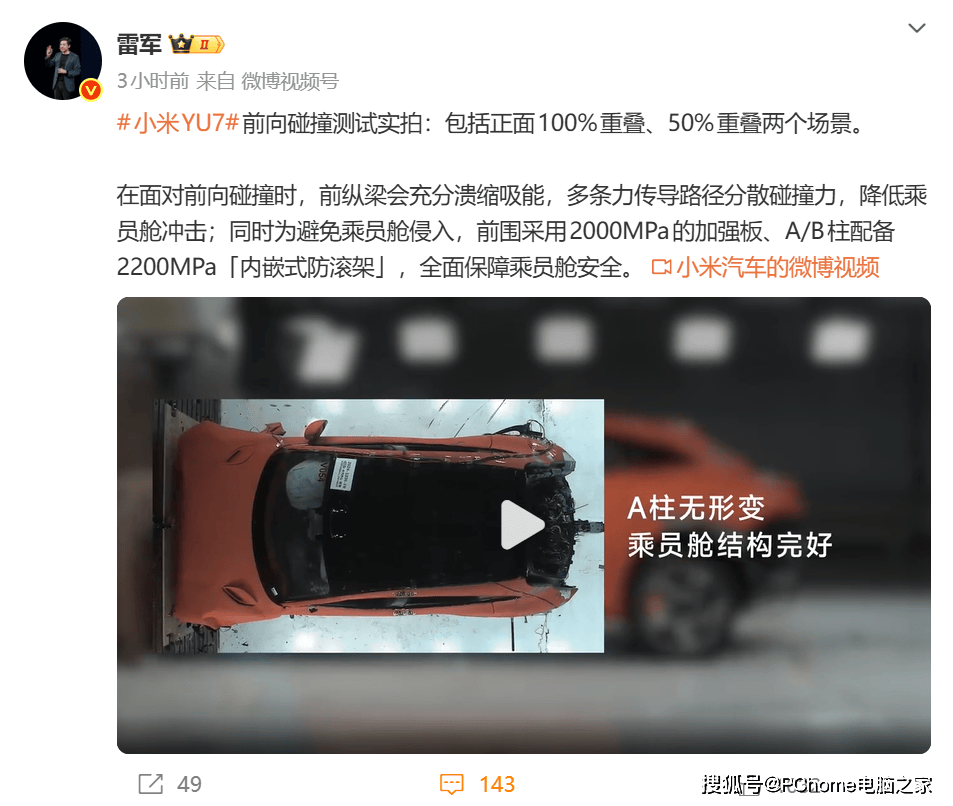
11月14日,小米创办人,董事长兼CEO雷军在社交媒体平台发布了小米YU7前向碰撞测试实拍的视频,其中包括正面100%重叠、50%重叠两个场景。 据视频中官方介绍:"在面对前向碰撞时:前纵梁会充分溃缩吸能,多条力传导路径分散碰撞力,降低乘员舱冲击;同时为避免乘员舱侵入,前围采用 2000MPa的加强板、A/B柱配备2200MPa'内嵌式防滚架',全面保障乘员舱安全。"小米汽车在视频中表示,安全是前提,安全是基础,安全是一切。 据了解,小米YU7是小米旗下中大型纯电SUV,售价25.35-32.99万元,提供后驱与双电机四驱版本。 车身轴距达3000mm,5门5座布局搭配1970L最大储物 容积,主副驾零重力座椅、36处收纳位等设计兼顾舒适与实用。续航补能表现亮眼,后驱版CLTC续航820km,支持5分钟补能400km的兆瓦闪充。 智能配置 拉满,搭载骁龙8芯片与英伟达Thor计算平台,标配激光雷达及多传感器,支持高阶辅助驾驶。 ...
小米汽车发布YU7前向碰撞测试视频,称“安全是一切”
Xin Lang Ke Ji· 2025-11-14 05:18
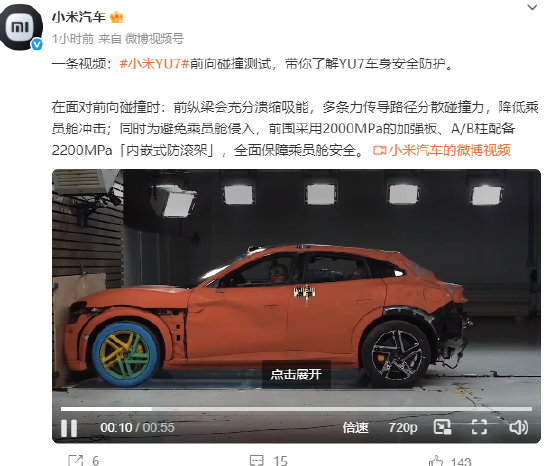
小米汽车在视频中表示,安全是前提,安全是基础,安全是一切。 11月14日消息,小米汽车官方微博发布#小米YU7#前向碰撞测试视频。 "在面对前向碰撞时:前纵梁会充分溃缩吸能,多条力传导路径分散碰撞力,降低乘员舱冲击;同时为 避免乘员舱侵入,前围采用2000MPa的加强板、A/B柱配备2200MPa'内嵌式防滚架',全面保障乘员舱 安全。" 责任编辑:李思阳 ...
汽车安全要求强化:配备机械式把手,百公里加速时间不少于5秒
Zheng Quan Shi Bao Wang· 2025-11-13 11:36
Core Viewpoint - The recent draft of national standards for vehicle safety emphasizes the need for stricter regulations on acceleration performance, particularly for electric vehicles, to enhance safety and mitigate risks associated with high initial power output [1][2][3] Group 1: Acceleration Standards - The draft stipulates that passenger vehicles must have a default acceleration time of no less than 5 seconds from 0 to 100 km/h after each start [1] - Some electric vehicle models, such as those from Xiaomi, have been criticized for promoting rapid acceleration as a marketing gimmick, which may not align with actual consumer driving needs [1][2] Group 2: Safety Features - The draft requires electric and plug-in hybrid vehicles to have a pedal misapplication acceleration suppression feature that detects and limits power output during stationary or crawling conditions [2] - New requirements for electronic door locking systems mandate that non-collision side doors automatically unlock during certain emergency situations, such as battery thermal events [2][3] Group 3: Industry Response - Recent incidents involving vehicle fires and malfunctioning door handles highlight the urgent need for improved safety standards in the automotive industry [3] - Experts emphasize that safety should be prioritized over speed and flashy marketing, advocating for a balance between innovation and safety in the rapidly evolving automotive sector [3]