租购并举

Search documents
租房新规今起实施,租客、房东们面临这些变化→
第一财经· 2025-09-15 12:56
Core Viewpoint - The implementation of the "Housing Rental Regulations" aims to encourage more people to rent housing, thereby promoting consumption and facilitating the "rent-purchase" housing system in China [3] Impact on Different Stakeholders - The regulations significantly impact tenants by enhancing their rights, particularly regarding deposit issues, as it specifies conditions under which deposits can be deducted and prohibits landlords from unjustly withholding deposits [6] - Landlords are also protected under the new regulations, which provide legal grounds for addressing issues such as noise disturbances and other tenant misconduct [6] - Housing rental companies are required to comply with contract registration and rent supervision, promoting a more professional and market-oriented rental service [6] Practical Implementation for Stakeholders - Tenants should verify the landlord's identity and property ownership before signing contracts, ensure the property meets safety standards, and understand the terms related to deposits [7] - Landlords must ensure their properties comply with legal standards and verify tenant identities before signing contracts [8] - Housing rental companies are required to report their business information to local authorities and maintain accurate records of rental transactions [8] Supporting Measures - There is a need for adjustments in housing supply to meet the evolving needs of tenants, such as accommodating families with children [10] - The rental market should enhance supporting facilities, including services for families and elderly care [11] - Recommendations include improving housing rental management platforms for efficient contract registration and information management, as well as establishing a credit evaluation system for all market participants [11]


租房新规今起实施,租客、房东们面临哪些变化?
Di Yi Cai Jing· 2025-09-15 07:06
Core Viewpoint - The implementation of the Housing Rental Regulation aims to encourage more people to rent housing, thereby promoting consumption and facilitating the "dual rental and purchase" housing system [1] Group 1: Impact on Stakeholders - The regulation significantly impacts tenants by enhancing the protection of their rights, particularly regarding deposit issues, as it specifies conditions under which deposits can be deducted and prohibits landlords from unjustly withholding deposits [2] - Landlords are also protected under the regulation, which provides them with legal grounds to address issues related to tenant misconduct, such as noise disturbances and property damage [2] - Housing rental enterprises are required to comply with contract registration and rent supervision, promoting a more market-oriented and professional rental service [2] Group 2: Practical Implementation for Stakeholders - Tenants should verify the landlord's identity and property ownership before signing contracts, ensure the property meets safety standards, and understand the terms related to deposits and their return [3] - Landlords must ensure their properties comply with legal standards, verify tenant identities, and complete rental registrations in a timely manner [4] - Housing rental enterprises must report their business information to local authorities within 30 days of obtaining a business license and maintain accurate records of rental transactions [4] Group 3: Supporting Measures - There is a need to adjust housing supply to better match the evolving needs of tenants, such as accommodating families with children, which may require changes in property size and layout [5] - Supporting facilities for tenants, especially those with children or elderly family members, should be developed to meet their needs [6] - Enhancements in regulatory and service frameworks are necessary, including the establishment of efficient housing rental management platforms and improved inter-departmental collaboration for effective market oversight [6]
《住房租赁条例》今起正式施行 完善市场规则和各方权益
Zheng Quan Ri Bao· 2025-09-14 16:31
Core Viewpoint - The implementation of the Housing Rental Regulation aims to enhance the supervision and management of the housing rental market, standardize rental activities, and protect the rights of both landlords and tenants [1][2]. Group 1: Regulation Implementation - The Housing Rental Regulation officially took effect on September 15, serving as the first administrative regulation in the housing rental sector [1]. - Various local departments, including those in Beijing, Chengdu, and Hefei, have organized training sessions to ensure effective implementation of the regulation [1][3]. Group 2: Key Provisions of the Regulation - The regulation specifies that non-residential spaces such as kitchens, bathrooms, and garages cannot be rented out for residential purposes [1]. - Housing rental agencies are required to verify and record the identity of landlords and the ownership of properties before publishing rental listings [1]. - From September 15, landlords must register rental contracts with local property management departments through designated platforms [1][2]. Group 3: Impact on the Rental Market - Experts believe that the regulation will effectively standardize the housing rental market and support the establishment of a dual rental and purchase housing system [1][2]. - The regulation is expected to stimulate housing rental consumption and play a significant role in expanding domestic demand [1]. - The regulation's implementation will facilitate easier access for tenants to public services such as education and housing security through contract registration [2]. Group 4: Regulatory Oversight - The Ministry of Housing and Urban-Rural Development has indicated that there will be a focus on improving supporting systems to ensure the regulation is effectively enforced [2][3]. - Local governments are expected to develop relevant supporting regulations to enhance the operability of the new rules [2].
房地产这次真急了!9月新一轮救市政策潮开启了
Sou Hu Cai Jing· 2025-09-03 14:32
Core Viewpoint - The new round of real estate rescue policies in China, initiated in September 2025, aims to stabilize the market amid severe challenges, reflecting a strong commitment from policymakers to address the industry's difficulties and the broader macroeconomic context [1][3][15]. Group 1: Urgency of Policy Implementation - The real estate market is under significant pressure, with a projected decline in investment growth of around 7% in 2025, despite ongoing policy efforts [2][3]. - High inventory levels, substantial homebuyer burden, and persistent credit risks for some developers are major constraints hindering market recovery [2][3]. - In major cities like Beijing, recent policy changes have led to a surge in demand for certain property types, but the overall market remains challenged, particularly for entry-level housing [2][3]. Group 2: Macroeconomic Implications - The real estate sector contributes approximately 20% to China's GDP and is crucial for employment, making its downturn a significant concern for the overall economy [3][15]. - A continued decline in the real estate market could adversely affect consumer spending, with retail sales growth projected at 4-5% in 2025, facing uncertainty if the housing market remains weak [3][15]. Group 3: Policy Features and Innovations - The new policies represent a shift from "single-point breakthroughs" to a "systematic collaboration" approach, focusing on demand stimulation, supply optimization, and financial coordination [6][9]. - Demand-side measures include differentiated policies in major cities, allowing for more targeted interventions that avoid overheating the market while addressing specific needs [6][9]. - Financial innovations include enhanced public housing fund policies and the removal of interest rate differentials for first and second homes, significantly reducing monthly repayment burdens for buyers [7][9]. Group 4: Long-term Strategic Reforms - The current policies emphasize both "revitalizing existing stock" and "improving quality," marking a departure from solely stimulating demand [9][10]. - Local governments are supported through special bonds to acquire existing properties for affordable housing, while new construction standards are being promoted to enhance quality [9][10]. - This dual approach aims to address inventory issues while fostering a transition towards higher quality developments in the real estate sector [9][10]. Group 5: Market Response and Challenges - Initial market reactions to the policies have shown promise, with new home purchases in certain areas increasing by over 50%, indicating a potential recovery during the traditional sales peak [10][11]. - However, long-term challenges persist, particularly in lower-tier cities facing high inventory and population outflows, which may delay recovery despite policy support [11][12]. - The complexity of resolving developer credit risks remains a significant hurdle, with over 500 billion yuan in debts maturing in 2025, impacting overall market confidence [11][12]. Group 6: Balancing Act in Policy Implementation - Policymakers must balance short-term stimulus with long-term transformation, ensuring that market interventions do not hinder the transition to a new housing model [12][15]. - There is a need to manage market vitality alongside risk prevention, particularly regarding rising non-performing loans in the housing sector [12][15]. - Regional policy disparities must be addressed to prevent irrational market behaviors in lower-tier cities as a result of policies in major urban centers [12][15].

《住房租赁条例》将正式施行 会如何改变租赁行业生态?又如何影响租房人?
Yang Guang Wang· 2025-08-30 16:33
Core Points - The implementation of the "Housing Rental Regulations" on September 15 aims to standardize housing rental activities, protect the legal rights of parties involved, stabilize rental relationships, and promote high-quality development in the rental market [1][3] - The regulations include 50 articles across 7 chapters, focusing on the rights and obligations of both landlords and tenants, and establishing a legal framework for rental agreements and practices [1][3] Industry Impact - The regulations will enhance tenant rights protection by prohibiting landlords from unlawfully forcing tenants to terminate contracts or vacate properties, thus providing a legal basis for tenants to defend their rights [1][2] - Housing rental companies are required to provide accurate and complete information about rental properties, including addresses, sizes, and rental prices, to prevent misleading or false listings [2][3] - The introduction of a contract filing system is expected to stabilize rental relationships and foster a more robust rental market, with penalties for non-compliance ranging from 20,000 to 100,000 yuan [3][4] - The regulations encourage the professionalization of the rental market, leading to an increase in property management services and a shift from individual landlord management to professional agency management [5][6] - The government supports the conversion of old commercial properties into rental housing, which is anticipated to increase the supply of rental units and improve the efficiency of existing housing stock [6]
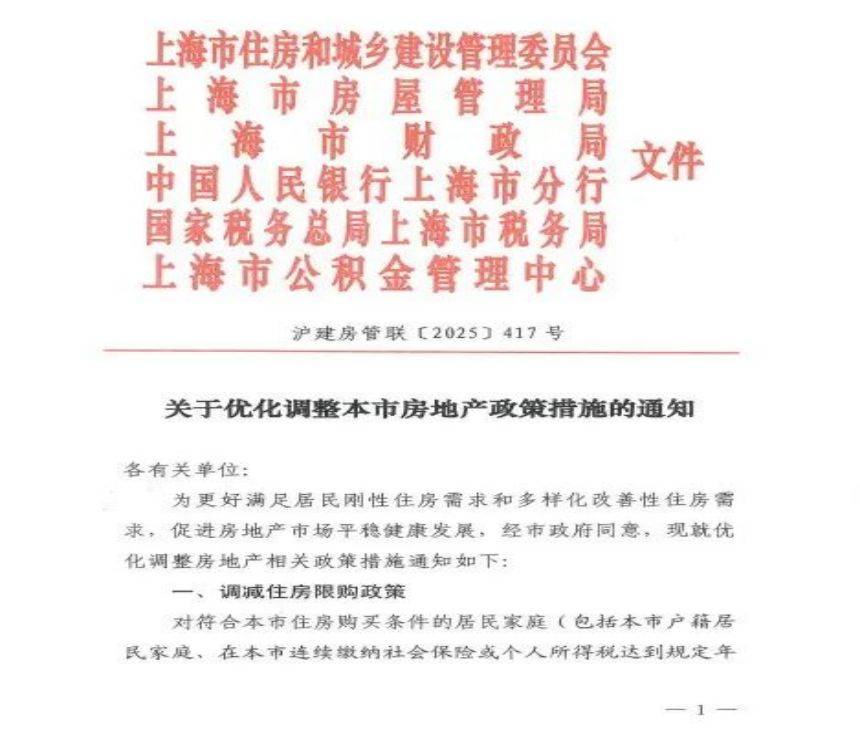
上海楼市新政释放积极信号 多维度优化购房环境 助力城市能级提升
Sou Hu Cai Jing· 2025-08-28 02:40
Group 1 - The core viewpoint of the article is that Shanghai's new real estate policies aim to stimulate market activity and improve living conditions through targeted measures in key areas such as purchase restrictions, public funds, credit, and taxation [1][5][10] Group 2 - The most notable adjustment is the complete removal of purchase restrictions outside the outer ring, allowing eligible local and non-local families to buy new and second-hand homes without limit on the number of properties [5][6] - The new policy also optimizes conditions for non-local buyers, reducing the social security requirement for purchasing within the inner ring from 5 years to 3 years, and further to 1 year in key areas like Lingang [6] Group 3 - In the housing finance sector, the new policy enhances residents' purchasing power through a three-pronged approach of increasing loan limits, reducing burdens, and innovating [7][8] - The adjustment in public fund policies allows families purchasing green buildings to increase their first loan limit from 1.6 million to 1.84 million yuan, with multi-child families eligible for up to 2.16 million yuan [8] Group 4 - The adjustment in commercial loan policies is significant, as it eliminates the distinction between first and second home loan interest rates, leading to lower costs for buyers [9] - The first home loan interest rate in Shanghai has dropped to 3.05%, while the second home rate is at 3.45%, both at historical lows [9] Group 5 - The new tax policies link property tax exemptions to talent policies, allowing non-local families to purchase their first home tax-free and providing significant tax relief for second homes [10] - For example, a family of three purchasing an 8 million yuan second home can enjoy a tax-exempt area of 180 square meters, significantly reducing their taxable area and annual tax burden by 40%-50% [10] Group 6 - The coordinated effect of the new policies is highlighted, with purchase restrictions being lifted to activate market liquidity, public fund reforms lowering purchasing thresholds, and tax adjustments achieving precise regulation [11] - This "combination punch" reform not only continues Shanghai's tradition of innovation in housing policy but also provides replicable experiences for real estate governance in other mega cities [11] Group 7 - The policy adjustments are seen as a means to reshape the housing market ecosystem rather than merely a "market rescue" effort, reflecting a development philosophy centered on the people and long-term urban competitiveness [12]
2026年的房价,已有3大信号!业内人:买卖房子,提前做好准备
Sou Hu Cai Jing· 2025-08-28 01:04
Core Insights - The real estate market is expected to stabilize and differentiate by 2026, moving away from the previous trend of rapid price increases and speculative buying [2][14] Group 1: Policy Signals - The government maintains a strong commitment to the principle that "houses are for living in, not for speculation," indicating a long-term policy direction rather than a temporary slogan [4] - Future policies are likely to be more precise and supportive of genuine homebuyers, while making it increasingly difficult for speculators to profit [5] Group 2: Market Differentiation - The real estate market is experiencing increased differentiation, with a focus on major cities and prime locations becoming crucial for investment decisions [7] - The era of universally rising property prices is over, and buyers must now be more strategic in their choices, as properties in weaker markets may face prolonged adjustments [7] Group 3: Housing Supply Changes - The government is enhancing the housing supply structure, promoting a rental and purchase system that provides more options for first-time buyers and lower-income families [9] - The market is expected to become more rational, with a shift in demand due to the increased availability of various housing types, impacting the resale value of less desirable properties [9] Group 4: Recommendations for Buyers and Sellers - For first-time buyers, it is advisable to remain calm and not expect significant price drops, while being ready to act when a suitable property is found [11] - For those looking to upgrade, it is recommended to replace older, less desirable properties with higher-quality homes that have better long-term value [13] - Investors should reassess their portfolios, considering selling properties that lack location advantages or rental potential, and diversifying investments to mitigate risks [13]

2025年8月房地产市场跟踪:《住房租赁条例》正式出台,完善“租购并举”制度保障
Zhong Cheng Xin Guo Ji· 2025-08-27 08:15
Investment Rating - The report does not explicitly state an investment rating for the real estate industry Core Insights - The introduction of the "Housing Rental Regulations" is a significant step towards standardizing housing rental activities and promoting high-quality development in the real estate market [3][7] - The regulations aim to enhance the rights and interests of rental parties and support the transition from a single sales model to a diversified development model in the real estate sector [3][7] - The report highlights the importance of the "rent-purchase dual-track" system in stabilizing the real estate market and addressing housing issues for various demographics [5][7] Market Tracking Summary Supply Side - The "Housing Rental Regulations" encourage families to rent out their properties and support enterprises in repurposing old buildings for rental use, which is expected to increase the supply of rental housing [4][6] - The report notes that the total area of unsold commercial housing has decreased for five consecutive months, but inventory levels remain high, indicating ongoing pressure to reduce stock [10] Demand Side - In July, the sales area and sales amount of commercial housing decreased by 8.40% and 14.08% year-on-year, respectively, with significant month-on-month declines [9] - The report indicates that the rental market is becoming more attractive to investors, with rental yields approaching the rates of five-year fixed deposits, leading to increased interest from institutional investors [6][12] Market Trends - The report observes that new home prices have shown signs of stabilization, while the second-hand housing market is experiencing a decline in transaction volume [8][11] - The introduction of supportive policies by local governments, such as optimizing housing purchase restrictions and increasing loan support, is expected to help stabilize the market [9][10]
未来5年,持有“2套”及以上房产的人会面临2大难题,征兆已显现
Sou Hu Cai Jing· 2025-08-26 20:27
Core Viewpoint - The Chinese real estate market, which has experienced significant price increases since the housing reform in 1998, is now facing challenges due to market saturation and government regulations aimed at curbing speculation and promoting affordable housing options [1][2][4][6] Group 1: Market Dynamics - The rise in real estate prices has led to the emergence of "speculators" and a booming real estate agency industry, with large enterprises and institutions also participating in property accumulation to create a false sense of demand [1] - Government policies are shifting towards a "rent and purchase" model, with an emphasis on affordable housing options like rental and shared ownership, which will limit the potential for significant price increases in the commodity housing market [2][4] Group 2: Challenges for Property Owners - Investors holding multiple properties will face increased difficulty in liquidating their assets due to a saturated market and the competitive nature of government-subsidized housing options [2][6] - The risk of asset depreciation is significant, as the actual purchasing power of money decreases over time, meaning that even if property values remain stable, their real value may diminish [4][6]

储户注意了:存取5万以上不用登记?新规之下这些细节要明白
Sou Hu Cai Jing· 2025-08-25 01:18
Group 1: International and Domestic Trends - The Federal Reserve maintained the federal funds rate at 4.25%-4.5% in March 2025, but signals of potential rate cuts were released by Powell at the Jackson Hole meeting on August 23, leading to a 91.3% market bet on a September rate cut [1][2] - The international trend of rate cuts has impacted the Chinese financial market, with household deposits increasing by 10.77 trillion yuan in the first half of 2025, but a decrease of 1.11 trillion yuan in July, indicating a shift of funds towards wealth management and funds [1][3] Group 2: Effects of Rate Cuts on Capital Flow - Following three rate cuts by the Federal Reserve in 2024, foreign institutions increased their holdings of Chinese bonds by over 300 billion yuan in Q4 2024, while enterprises in the Shanghai Free Trade Zone saw a 45% year-on-year increase in cross-border purchases of high-yield foreign deposits [3] - In response to the Fed's rate cuts, the People's Bank of China lowered the reserve requirement ratio by 0.5 percentage points in September 2024 and again in May 2025, resulting in a historical low average interest rate of 3.68% for new corporate loans in the first half of 2025 [3] Group 3: Structural Changes in Domestic Deposits - The acceleration of fund migration is evident as non-bank institution deposits surged by 2.14 trillion yuan, while the interest rates on three-year large deposits fell from 2.8% in 2023 to 1.8%-2.2% in 2025, contrasting with an average return of 4.5% for balanced stock and bond funds during the same period [3] Group 4: New Regulations and Their Implications - The new regulation allows cash withdrawals of over 50,000 yuan without mandatory registration of the source or purpose, addressing previous concerns over excessive scrutiny [4] - Financial institutions must still adhere to the "Know Your Customer" principle, with enhanced scrutiny for high-risk clients, while technology is being utilized to streamline processes and protect customer privacy [4][5] Group 5: Economic and Real Estate Impacts - The central bank's liquidity injection of 600 billion yuan through a one-year MLF operation aims to alleviate market pressure and direct more funds into the real economy [6] - The rental market is expected to grow due to new housing rental regulations, which may divert some funds from home purchases and ease pressure on the housing market [7] Group 6: Expert Analysis on Regulatory Changes - The new regulations do not relax anti-money laundering efforts but instead focus resources on higher-risk areas, ensuring that banks maintain rigorous checks on clients from high-risk regions [9] - Innovations in local policies, such as the introduction of combination products by banks, aim to enhance customer returns while maintaining compliance with new regulations [12]