
资源循环利用

Search documents
再生材料应用推广路线图明确
Jing Ji Ri Bao· 2026-01-04 22:34
Group 1 - The core viewpoint of the news is the release of the "Recycled Materials Application Promotion Action Plan," which aims to enhance the supply capacity, application intensity, management systems, and promotion policies for recycled materials, establishing a clear roadmap for increasing the application ratio of recycled materials [1][2] - The plan emphasizes the importance of promoting recycled materials as a key pathway for achieving green and low-carbon transformation, resource security, and carbon peak and neutrality goals [1][2] - China has established the world's largest and most comprehensive resource recycling and reuse system, with significant annual processing capacities for various recycled materials, including 180 million tons of scrap steel, 63 million tons of recycled pulp, 16.4 million tons of recycled plastics, and 19.15 million tons of major recycled non-ferrous metals [1][2] Group 2 - The "Action Plan" focuses on key sectors such as steel, non-ferrous metals, plastics, and paper, with targets set for 2030, including recycling volumes of over 300 million tons of scrap steel and 8 million tons of waste paper, and annual production of over 25 million tons of recycled non-ferrous metals and 19.5 million tons of recycled plastics [2] - The plan identifies specific industries, including automobiles, electronics, textiles, and packaging, as priorities for the application of recycled materials, encouraging leading enterprises to develop implementation plans for promoting recycled materials [2][3] - The initiative aims to provide new directions for developing new productive forces, align with international trade trends, and create new scenarios for promoting a green and low-carbon lifestyle [2]
全文 | 国务院关于印发《固体废物综合治理行动计划》的通知
Xin Lang Cai Jing· 2026-01-04 10:00
来源:中国政府网 国务院关于印发《固体废物综合治理行动计划》的通知 国发〔2025〕14号 各省、自治区、直辖市人民政府,国务院各部委、各直属机构: 现将《固体废物综合治理行动计划》印发给你们,请认真贯彻执行。 国务院 2025年12月27日 (本文有删减) 固体废物综合治理行动计划 为加强固体废物综合治理,推进美丽中国建设,加快经济社会发展全面绿色转型,制定本行动计划。 一、总体要求 以习近平新时代中国特色社会主义思想为指导,深入贯彻党的二十大和二十届历次全会精神,完整准确 全面贯彻新发展理念,按照减量化、资源化、无害化的原则,坚持系统推进和重点攻坚,加快补齐短板 弱项,紧盯重点领域、重点地区、重点问题,深入开展专项整治,严格实施闭环管理,构建源头减量、 过程管控、末端利用和全链条无害化管理的固体废物综合治理体系,优先治理与群众生活、安全生产密 切相关的固体废物,加快完善综合治理长效机制,坚决遏制固体废物增长势头。到2030年,重点领域固 体废物专项整治取得明显成效,固体废物历史堆存量得到有效管控,非法倾倒处置高发态势得到遏制, 大宗固体废弃物年综合利用量达到45亿吨,主要再生资源年循环利用量达到5.1亿吨 ...
重磅!国务院印发重要行动计划!
中国能源报· 2026-01-04 09:26
1月4日,国务院印发的《固体废物综合治理行动计划》提出,到20 30年,重点领域固体废物专项整治取得明显成效,固体废物历史 堆存量得到有效管控,非法倾倒处置高发态势得到遏制,大宗固体废弃物年综合利用量达到4 5亿吨,主要再生资源年循环利用量达 到5 .1亿吨,固体废物综合治理能力和水平显著提升。 以下为原文 国务院关于印发《固体废物综合治理行动计划》的通知 国发〔2 02 5〕14号 各省、自治区、直辖市人民政府,国务院各部委、各直属机构: 现将《固体废物综合治理行动计划》印发给你们,请认真贯彻执行。 国务院 2 025年12月27日 (本文有删减) 固体废物综合治理行动计划 为加强固体废物综合治理,推进美丽中国建设,加快经济社会发展全面绿色转型,制定本行动计划。 一、总体要求 以习近平新时代中国特色社会主义思想为指导,深入贯彻党的二十大和二十届历次全会精神,完整准确全面贯彻新发展理念,按照减 量化、资源化、无害化的原则,坚持系统推进和重点攻坚,加快补齐短板弱项,紧盯重点领域、重点地区、重点问题,深入开展专项 整治,严格实施闭环管理,构建源头减量、过程管控、末端利用和全链条无害化管理的固体废物综合治理体系,优 ...

抱团发展走出生态致富路
Xin Lang Cai Jing· 2026-01-03 22:20
Core Insights - The article discusses the successful transformation of a previously impoverished village in Inner Mongolia into a self-sustaining community through innovative agricultural practices and cooperative economic models [1][2][3] Group 1: Economic Development Strategies - The village implemented a "hugging cycle" model for collective economic development, focusing on "one piece of land, one stalk, and a group of sheep" [1][2] - The land consolidation strategy involved leasing over 4,000 acres from 170 households, generating an average annual income of approximately 1.2 million yuan [1] - A feed processing plant was established to utilize agricultural straw, reducing environmental impact and providing job opportunities for villagers [2] Group 2: Cooperative Models - A cooperative sheep farming model was created by uniting 14 villages, leading to stable income for farmers and employment for over 140 individuals, with monthly earnings reaching over 4,000 yuan for many [2] - The cooperative structure allows for resource sharing and efficient utilization, creating a "wealth chain" that benefits both the community and the environment [2] Group 3: Skills Training and Employment - The village provided skills training for various practical jobs, helping residents transition from dependency to self-sufficiency [3] - A "guaranteed dividend" mechanism was introduced to support those without skills or labor, enhancing their income through land leasing [3] Group 4: Sustainable Practices - The village has expanded its circular industrial chain by introducing new crops and processing facilities, increasing product value [3] - The integration of ecological farming practices, such as raising free-range chickens and goats, has diversified income sources and improved community wealth [3]
邦普循环取得磷铁渣回用方法专利
Sou Hu Cai Jing· 2026-01-02 02:11
Group 1 - The State Intellectual Property Office of China has granted a patent for a method of recycling phosphorous iron slag to Guangdong Bangpu Recycling Technology Co., Ltd. and Hunan Bangpu Recycling Technology Co., Ltd. The patent announcement number is CN117545714B, with an application date of September 2023 [1] - Guangdong Bangpu Recycling Technology Co., Ltd. was established in 2005 and is located in Foshan City. The company primarily engages in technology promotion and application services, with a registered capital of 1,474.7326875 million RMB. It has invested in 13 companies, participated in 110 bidding projects, and holds 2,620 patents along with 292 trademark registrations and 333 administrative licenses [1] - Hunan Bangpu Recycling Technology Co., Ltd. was founded in 2008 and is based in Changsha City. The company focuses on comprehensive utilization of waste resources, with a registered capital of 60 million RMB. It has invested in 3 companies, participated in 96 bidding projects, and holds 2,575 patents along with 244 administrative licenses [1]
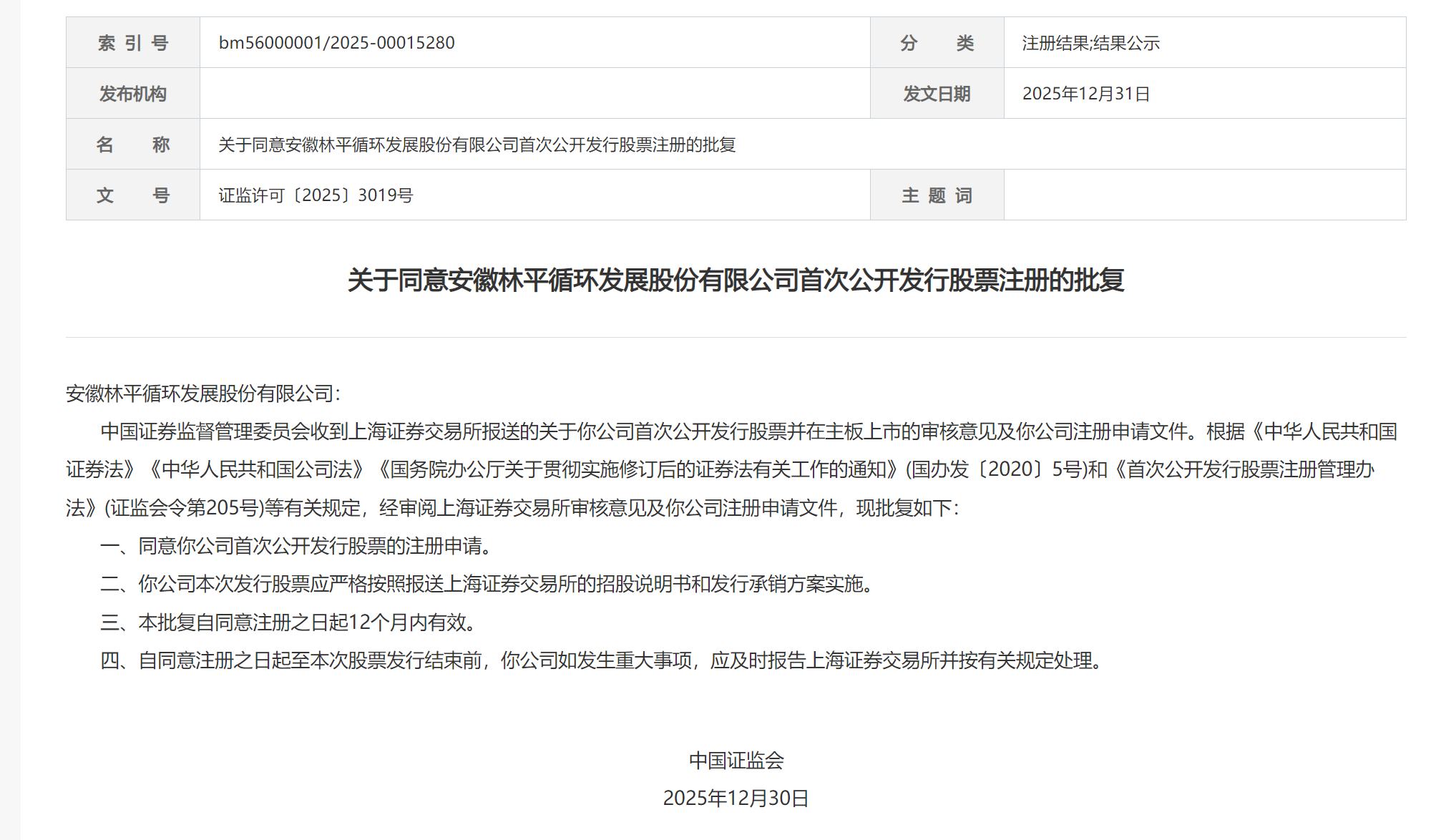
证监会同意林平发展上交所IPO注册
智通财经网· 2025-12-31 09:08
Group 1 - The China Securities Regulatory Commission has approved Anhui Linping Circular Development Co., Ltd. for its initial public offering registration, with plans to raise 1.2 billion yuan [1] - Linping Development aims to list on the Shanghai Stock Exchange, with Guolian Minsheng Securities acting as its sponsor [1] Group 2 - Linping Development is primarily engaged in the research, production, and sales of corrugated paper and boxboard products, recognized as a high-tech enterprise with independent research and innovation capabilities [4] - The company has evolved into a resource comprehensive utilization enterprise, integrating waste paper utilization, cogeneration, and green papermaking [4] - Linping Development emphasizes environmental protection and energy conservation, employing various processes for resource recycling and sustainable development [4] - The main products include corrugated paper and boxboard, which are widely used in logistics, industrial goods, and consumer goods packaging [4]
国家发展改革委 财政部关于2026年实施大规模设备更新和消费品以旧换新政策的通知
中汽协会数据· 2025-12-31 06:32
Core Viewpoint - The article outlines the implementation of a large-scale equipment update and consumer goods trade-in policy starting in 2026, aimed at promoting economic growth, enhancing consumer spending, and supporting green and low-carbon development. Group 1: Promotion of Large-Scale Equipment Updates - Support for equipment update projects across various sectors including industrial, electronic information, energy, transportation, and healthcare, with an emphasis on meeting public safety and welfare needs [3][4] - Continued support for the scrapping and updating of old commercial vehicles, prioritizing low-emission and electric trucks, with subsidies following existing guidelines [3] - Encouragement of the electrification of urban public transport through subsidies for new energy buses and battery updates [3] Group 2: Implementation of Consumer Goods Trade-In - Financial support for consumers who scrap old vehicles and purchase new energy vehicles or low-emission fuel vehicles, with subsidies of 12% (up to 20,000 yuan) for new energy vehicles and 10% (up to 15,000 yuan) for low-emission vehicles [6] - Subsidies for household appliances trade-in, providing 15% of the product price (up to 1,500 yuan) for energy-efficient appliances [9] - Support for the purchase of digital and smart products, offering 15% of the product price (up to 500 yuan) for eligible items [7] Group 3: Recycling and Circular Economy - Development of a comprehensive recycling network for waste equipment and consumer goods, including support for resource recycling companies to enhance their capabilities [8][9] - Encouragement of the "Internet + recycling" model to improve the efficiency of waste collection and processing [8] - Promotion of the resource recycling industry through funding and regulatory support to ensure compliance with environmental standards [9] Group 4: Standardization and Supervision - Acceleration of the establishment of standards for energy efficiency and pollution control in key industries, ensuring strict adherence to regulations [10] - Strengthening of supervision over the implementation of equipment updates and consumer goods trade-in policies to prevent misuse of funds [15] - Establishment of a transparent environment for participation in the equipment update and trade-in programs, ensuring fair treatment of all market players [16]

特稿丨原铝“天花板”下,再生铝如何走通“再生”路径
Xin Lang Cai Jing· 2025-12-31 04:12
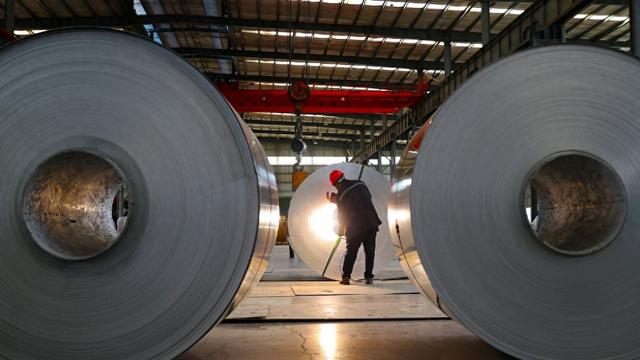
Core Viewpoint - The Chinese aluminum industry is experiencing growth in both production and consumption, but faces significant challenges such as high dependence on imported bauxite and substantial energy consumption and carbon emissions. The rise of recycled aluminum is seen as a crucial solution to address resource and environmental constraints [2][3][4]. Industry Overview - In 2024, China's aluminum production and consumption continued to grow, maintaining its position as the world's largest producer for 23 consecutive years. The industry comprises over 4,000 enterprises and employs more than 800,000 people [2]. - The global demand for aluminum is increasing, with global consumption reaching 72.77 million tons in 2024, a 3.8% year-on-year increase. China's consumption accounted for over 60% of this total [5]. Recycled Aluminum Significance - Recycled aluminum is viewed as a key pathway for reducing carbon emissions in the aluminum industry, with significant advantages in energy consumption and cost savings compared to primary aluminum production [3][4][8]. - In 2024, China's recycled aluminum production surpassed 10 million tons, marking an 11.1% increase year-on-year, and accounted for approximately 24% of the total aluminum production [7]. Economic and Strategic Benefits - The production of recycled aluminum consumes only 3-5% of the energy required for primary aluminum production, leading to a cost advantage of 1,500-2,500 yuan per ton [9]. - Recycled aluminum reduces dependence on foreign bauxite resources, with China's bauxite import dependency reaching 68% in 2024. The development of recycled aluminum is essential for enhancing resource security [10]. Challenges in the Recycled Aluminum Sector - The supply of scrap aluminum remains a significant constraint, with domestic recycling systems still developing. The quality and stability of scrap aluminum supply are critical for the industry's growth [11][12]. - The current recycling system is fragmented and dominated by informal players, leading to challenges in quality control and cost management [12][13]. Policy and Industry Development - The Chinese government is increasingly focusing on the development of the recycled aluminum sector, with initiatives aimed at establishing standardized recycling systems and promoting technological advancements [13][14]. - The "Implementation Plan for High-Quality Development of the Aluminum Industry (2025-2027)" aims to increase recycled aluminum production to over 15 million tons by 2027 [19]. Market Dynamics and Future Outlook - The recycled aluminum market is experiencing structural differentiation, with high demand from sectors like electric vehicles and aerospace, while traditional sectors remain price-sensitive [21]. - The industry is witnessing a shift towards high-quality development, with calls for improved governance and collaboration among government, industry associations, and enterprises to address existing challenges [22].
事关国补,最新政策发布
新华网财经· 2025-12-30 10:57
Core Viewpoint - The article discusses the implementation of a large-scale equipment update and consumer goods replacement policy starting in 2026, aimed at promoting economic growth and enhancing consumer spending through subsidies for various products [5]. Group 1: Support for Equipment Updates - The policy supports the update of equipment in various sectors including industrial, electronic information, energy, transportation, and healthcare, with a focus on improving public safety and meeting consumer needs [6]. - It includes provisions for the installation of elevators in old residential areas and updates for elderly care facilities and fire rescue equipment [6]. - The policy aims to lower the investment threshold for small and medium enterprises and streamline the application process for equipment updates [6]. Group 2: Consumer Goods Replacement - The policy provides subsidies for consumers replacing old household appliances, offering 15% of the product price as a subsidy for energy-efficient appliances, capped at 1500 yuan per item [15]. - For digital and smart products, a similar subsidy of 15% is available, with a cap of 500 yuan for items priced under 6000 yuan [16]. - The policy also includes support for smart home products, with local governments given the flexibility to set specific subsidy standards [3]. Group 3: Automotive Support - Consumers who scrap their old vehicles and purchase new energy vehicles or low-emission fuel vehicles can receive subsidies of up to 20,000 yuan for new energy vehicles and 15,000 yuan for low-emission vehicles [12][14]. - The policy encourages the replacement of old operational trucks with low-emission models, prioritizing electric trucks [7]. - It also supports the update of old agricultural machinery, with specific subsidy standards outlined in existing regulations [9]. Group 4: Recycling and Resource Utilization - The policy emphasizes the establishment of a comprehensive recycling network for old equipment and consumer goods, promoting the development of a national resource recycling platform [18]. - It encourages the growth of the resource recycling industry and the use of recycled materials, while enhancing regulatory oversight of recycling practices [20]. Group 5: Standardization and Supervision - The article highlights the need for improved standards in energy efficiency and pollution control, aligning with international benchmarks [21]. - It stresses the importance of strict enforcement of vehicle scrapping and product quality standards to prevent fraud and ensure compliance [22]. - The policy outlines a framework for monitoring and evaluating the implementation of these initiatives, ensuring accountability and transparency [29][30].
两部门:2026年继续实施消费品以旧换新 支持汽车置换更新
智通财经网· 2025-12-30 10:56
智通财经APP获悉,12月30日,国家发展改革委、财政部发布关于2026年实施大规模设备更新和消费品 以旧换新政策的通知。通知指出,实施消费品以旧换新。支持汽车置换更新。个人消费者转让登记在本 人名下的乘用车,并购买纳入《减免车辆购置税的新能源汽车车型目录》的新能源乘用车或2.0升及以 下排量燃油乘用车的,给予汽车置换更新补贴支持,购买新能源乘用车补贴车价的8%(最高不超过1.5万 元)、购买2.0升及以下排量燃油乘用车补贴车价的6%(最高不超过1.3万元)。 (二)支持老旧营运货车报废更新。继续支持报废国四及以下排放标准营运货车更新为低排放货车,优先 支持更新为电动货车,补贴标准按照《关于实施老旧营运货车报废更新的通知》(交规划发〔2025〕17 号)执行。 支持家电以旧换新。个人消费者购买冰箱、洗衣机、电视、空调、电脑、热水器等6类家电中1级能效或 水效标准的产品,按产品销售价格的15%给予补贴,每位消费者每类产品可补贴1件,每件补贴不超过 1500元。 支持数码和智能产品购新。个人消费者购买手机、平板、智能手表手环、智能眼镜等4类产品(单件销售 价格不超过6000元),按产品销售价格的15%给予补贴,每 ...