
险资入市

Search documents
有关A股,重磅利好!
Zheng Quan Shi Bao· 2025-12-05 11:36
Core Viewpoint - The recent notification from the Financial Regulatory Bureau aims to ease solvency pressure on insurance companies, encouraging long-term investments and enhancing their management capabilities in asset-liability matching [1][2]. Group 1: Adjustments to Risk Factors - The risk factor for stocks in the CSI 300 index and the CSI Dividend Low Volatility 100 index held for over three years has been reduced from 0.3 to 0.27, based on a weighted average holding period over the past six years [1]. - The risk factor for Sci-Tech Innovation Board stocks held for over two years has been lowered from 0.4 to 0.36, based on a weighted average holding period over the past four years [1][2]. - The notification also reduces the premium risk factor for export credit insurance and overseas investment insurance from 0.467 to 0.42, and the reserve risk factor from 0.605 to 0.545 [4]. Group 2: Encouragement for Long-term Investment - The adjustments are designed to cultivate patient capital and support technological innovation, with a focus on increasing the investment ratio and extending assessment periods for state-owned insurance companies [2]. - The Financial Regulatory Bureau previously indicated that the adjustments to solvency regulations would encourage insurance companies to increase their market participation and stabilize the market [2][3]. - The overall industry solvency adequacy ratio is expected to improve by 18.6 percentage points due to these adjustments [3]. Group 3: Future Guidance - The Financial Regulatory Bureau will guide insurance companies to implement the notification's requirements, enhancing their long-term investment management capabilities and ensuring accurate solvency data [5].
险资股票投资风险因子调降10%落地!业内测算或可释放千亿入市资金
Di Yi Cai Jing· 2025-12-05 11:28
对偿付能力的占用一直是险资在进行权益投资时的一大重要考量因素,也在一定程度上掣肘了险资的权 益投资步伐。 险资权益投资部分的偿付能力风险因子下降10%的政策落地。 12月5日,国家金融监管总局发布《关于调整保险公司相关业务风险因子的通知》(下称《通知》), 将保险公司持仓时间超过三年的沪深300指数成分股、中证红利低波动100指数成分股的风险因子从0.3 下调至0.27;保险公司持仓时间超过两年的科创板上市普通股的风险因子从0.4下调至0.36,降幅均为 10%。 早在5月7月的国新办发布会上,国家金融监管总局局长李云泽就已预告下一步"将股票投资的风险因子 进一步调降10%,鼓励保险公司加大入市力度",此次《通知》正是该政策的落地。 "《通知》优化降低权益因子,有助于提升险资权益配置意愿。若释放最低资本全部增配沪深300股票, 对应资金为1086亿元。"中泰证券非银金融行业首席分析师葛玉翔回复第一财经称。 如何计算加权平均持仓时间?金融监管总局相关负责人表示,以投资科创板上市普通股为例,保险公司 季度末持仓的科创板股票按照先进先出原则,采用加权平均的方式计算其过去四年持仓时间(超过四年 的按照四年计算),持仓 ...
股市迎新增量资金!监管降险资投资“保证金”,哪些方向受益
Nan Fang Du Shi Bao· 2025-12-05 10:12
12月5日,金融监管总局发布《关于调整保险公司相关业务风险因子的通知》(下称《通知》),宣布 对保险公司投资沪深300指数成分股、中证红利低波动100指数成分股及科创板上市普通股的风险因子进 行下调,同时引入了持仓时间限制,释放出引导长期资金更多流向科技创新、蓝筹价值公司等信号。 配置以红利股为主,科技成长板块投资加强 近年来,在市场利率持续走低与推动中长期资金入市的政策指引下,保险资金入市规模与占投资资产比 例持续提升。 据wind数据,截至2025年三季度末,保险资金运用余额规模攀升至37.5万亿元,较去年末增长13%。其 中,股票投资规模由2022年底的1.9万亿元增长至3.6万亿元,连续6个季度实现同比正增长。进入2025年 后,保险资金股票投资同比增速一度超过40%,明显快于债券投资,股票资产在险资总投资中的占比连 续7个季度上升,至2025年三季度末达10%。 国泰海通证券策略研究团队指出,2025年以来,保险资金举牌热情显著升温,年内举牌次数已超30次, 突破2020年的阶段性高点,达到了2015年有举牌披露记录以来的新高,且标的集中在金融、公用事业等 行业,高度契合险资对经营稳、估值低、股息高 ...


非银金融行业周报:多只券商股被调入重要指数,关注被动资金流入、调整公告日-20251130
Shenwan Hongyuan Securities· 2025-11-30 10:45
Investment Rating - The report maintains a positive outlook on the non-bank financial sector, particularly highlighting the potential benefits for brokerage firms and insurance companies in the upcoming year [3][4]. Core Insights - The report emphasizes the expected inflow of passive funds into newly included stocks in major indices, which could enhance liquidity and market performance for these stocks [4]. - It identifies key trends for 2026, including a shift in insurance companies' focus towards asset-liability matching and the stabilization of core business indicators due to new regulatory standards [4]. - The report recommends specific brokerage firms such as Dongfang Securities, GF Securities, Huatai Securities, and China Galaxy, as well as insurance companies like China Life and Ping An, based on their competitive positioning and growth potential [4]. Summary by Sections Market Performance - The Shanghai Composite Index closed at 4,526.66 with a weekly increase of 1.64%, while the non-bank index rose to 1,932.15, reflecting a 0.68% increase [7]. - The brokerage sector index reported a 0.74% increase, and the insurance sector index saw a 0.20% rise [7]. Brokerage Sector Insights - Notable stocks in the brokerage sector included Guosheng Securities and Xinyi Securities, which saw increases of 3.68% and 3.36%, respectively [9]. - The average daily trading volume for the Shanghai and Shenzhen markets was 17,370.85 billion, a decrease of 6.87% week-on-week, but a year-to-date increase of 61.11% [20]. Insurance Sector Insights - The insurance sector is expected to experience a systematic revaluation in 2026, driven by long-term interest rate increases and continued investment from insurance funds into the stock market [4]. - The report highlights the performance of major insurance companies, with A-shares like China Life and Ping An showing modest increases [9]. Key Data Points - As of November 28, 2025, the average daily trading volume was 19,147.38 billion, and the margin trading balance was 24,720.45 billion, reflecting a year-on-year increase of 32.6% [51][20]. - The report notes that the total market value of private equity funds reached 22.05 trillion, marking a historical high [21].




“重估牛”系列之资金篇(三):A 股增量资金空间测算:居民存款与机构资金潜展望
Changjiang Securities· 2025-11-26 11:21
Group 1 - The report indicates that A-shares are expected to gradually emerge from a structural "slow bull" market, with potential liquidity support from resident deposits and institutional funds in the medium to long term [3][18] - By 2030, the reallocation of resident assets is projected to bring in approximately CNY 5.4 to 12.0 trillion into the market, with contributions from deposit "migration" estimated at CNY 3.5 to 6.2 trillion and asset reallocation contributing CNY 1.9 to 5.7 trillion [3][7] - Insurance funds are expected to cumulatively increase their allocation to stocks and funds by about CNY 4.5 to 6.5 trillion over the next nine quarters [3][8] Group 2 - The potential "migration" space for resident deposits in China by 2030 is estimated to be between CNY 15.1 trillion and 24.0 trillion, based on different GDP growth scenarios and historical deposit decline rates [6][30] - The report outlines two scenarios for deposit migration: a rapid transfer scenario (2013Q1-2015Q2) leading to an upper limit of CNY 23.8 to 24.0 trillion, and a moderate transfer scenario (2020Q2-2021Q4) resulting in a lower limit of CNY 15.1 to 15.2 trillion [6][31] - The potential incremental funds from resident asset reallocation to the A-share market could range from CNY 3.5 to 6.2 trillion under different scenarios of deposit migration [7][34] Group 3 - The report estimates that by 2026, the potential incremental funds for the A-share market could be around CNY 6.0 to 9.6 trillion, with contributions from various channels including the primary market, active funds, private equity, and ETF funds [9][20] - The primary market is projected to contribute approximately CNY 347.2 to 559.4 billion, while private equity funds could contribute CNY 1.25 to 2.32 trillion, and ETF funds could add CNY 2.61 to 3.95 trillion [9][20] - The current margin balance as a percentage of the circulating market value remains healthy, indicating further potential for leverage funds to be released [9][35]
真金白银出手!A股上市银行迎来“增持潮”
Jin Rong Shi Bao· 2025-11-13 12:47
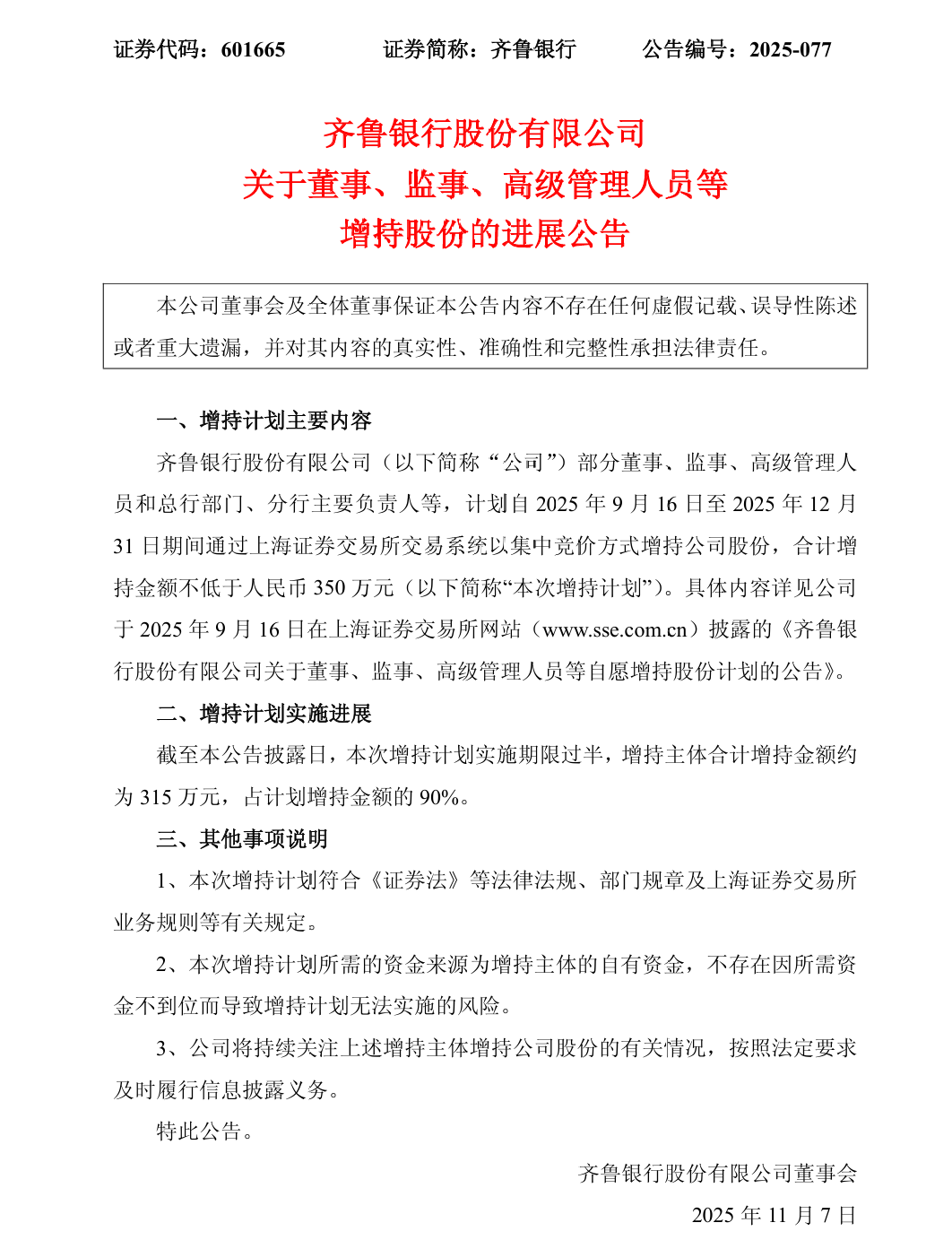
Core Insights - Recent surge in share buybacks by multiple A-share listed banks indicates a strong confidence from various funding sources in the banking sector [1] Group 1: Share Buybacks by Bank Executives - Local commercial banks' board members and senior management have become the main force behind the share buybacks, demonstrating confidence in their own banks [2] - Qilu Bank disclosed that its board and senior management plan to buy back shares from September 16 to December 31, with a total buyback amount of approximately 3.15 million yuan, accounting for 90% of the planned buyback amount [2] Group 2: Significant Share Purchases by Major Shareholders - Xiamen Bank announced that its board and senior management have cumulatively bought back 254,400 shares for a total of 1.6857 million yuan, completing their buyback plan [5] - Qingdao Bank's major shareholder, Guoxin Chanin Holdings, increased its stake by acquiring 243 million H-shares from September 15 to November 5, amounting to 957 million yuan, thus becoming the largest shareholder with a 19.17% stake [5][6] Group 3: Insurance Capital Involvement - Insurance funds have significantly increased their allocation to the banking sector since the third quarter, with Ping An Life raising its stake in Postal Savings Bank to 16.01% after investing approximately 7.068 million HKD [8] - China Ping An also announced an increase in its holdings of Postal Savings Bank H-shares, raising its stake from 6.09% to 17.01% after investing about 3.441 million HKD [8] - Other insurance companies have also made notable investments in various banks, indicating a trend of insurance capital favoring the banking sector due to its high dividend characteristics [9]


保险行业2025年三季报业绩综述:资、负两端均表现亮眼,3Q25A股险企利润大增68%
Shenwan Hongyuan Securities· 2025-11-05 12:12
Investment Rating - The report maintains a positive outlook on the insurance sector, recommending several companies including China Life, New China Life, Ping An, PICC, China Pacific Insurance, and AIA, while suggesting to pay attention to China Taiping [5][70]. Core Insights - In Q3 2025, A-share insurance companies saw a significant profit increase of 68%, with investment performance contributing 79% to the pre-tax profit increment. The total net profit attributable to shareholders for the first three quarters reached CNY 426 billion, a year-on-year increase of 33.5% [3][11][12]. - The new business value (NBV) continued to show strong growth, with a year-on-year increase ranging from 18% to 77% among listed insurance companies, driven by preemptive product demand due to expected interest rate cuts [3][31]. - The insurance premium growth exhibited differentiation, with property insurance companies showing varied premium growth rates, influenced by structural optimization and operational strategies [4][45]. Summary by Sections Profit Performance - A-share insurance companies reported a total net profit of CNY 263.7 billion in Q3 2025, reflecting a year-on-year growth of 68.3% [8][11]. - The profit structure showed that investment performance accounted for 79.2% of the pre-tax profit increment, with insurance service performance contributing 22.6% [12][24]. Liability Side - The NBV growth remained robust, with the first three quarters showing a year-on-year increase of 14.2% to CNY 557.8 billion, and Q3 alone saw a 38.7% increase [3][35]. - The cost of risk (COR) continued to improve, indicating effective cost management among leading insurers [4][45]. Asset Side - Investment returns showed significant improvement, with total investment income for the first three quarters reaching CNY 886.4 billion, a year-on-year increase of 36% [24][57]. - The FVOCI equity assets increased by CNY 92.5 billion, reflecting a strong performance in the equity market [3][62]. Investment Analysis - The report highlights a positive outlook for the insurance sector, driven by ongoing capital market participation and external environment improvements, suggesting a potential revaluation of the sector [5][70].



3Q25保险资金重仓流通股深度跟踪:逆势继续加仓银行,减仓电力设备及有色金属
ZHONGTAI SECURITIES· 2025-11-03 12:34
Investment Rating - The report indicates a positive investment outlook for the banking sector, while suggesting a reduction in exposure to the power equipment and non-ferrous metals sectors [3][4]. Core Insights - The insurance funds have continued to increase their holdings in banks despite a low interest rate environment, while reducing their positions in power equipment and non-ferrous metals [3]. - As of October 2025, the new money investment yield for insurance funds is estimated at 2.77%, showing a recovery of nearly 10 basis points from the bottom [6][17]. - The total market value of insurance funds' holdings in A-shares reached 6,510 billion yuan, with a notable presence in 633 A-share companies [60][62]. Summary by Sections Insurance Fund Allocation Trends - Insurance funds are increasingly allocating to stocks, with a significant rise in stock investment proportion to 8.8% by the end of Q2 2025, reflecting an 8.9% increase from the previous quarter [18][20]. - The total stock investment by insurance companies reached 6,406 billion yuan in the first half of 2025 [20]. Sector Performance and Holdings - In Q3 2025, the banking sector had the highest market value held by insurance funds at 3,165.2 billion yuan, followed by public utilities and transportation [62]. - The report highlights that 26 out of 28 sectors experienced growth, with TMT and new energy sectors showing significant strength [59]. Key Stock Recommendations - The report suggests focusing on companies such as Xinhua Insurance, China Life, China Property Insurance, China Ping An, AIA, China Taiping, and China Pacific Insurance as potential investment opportunities [5]. Changes in Holdings - In Q3 2025, insurance funds increased their holdings in 11 sectors, including banking, communication, steel, computing, and food and beverage [69]. - Conversely, they reduced their positions in 18 sectors, notably in power equipment, non-ferrous metals, transportation, coal, and electronics [6]. Regulatory Environment - The report notes that regulatory measures are encouraging long-term capital to enter the market, with insurance funds being a focal point of this initiative [28]. - The China Securities Regulatory Commission has mandated that from 2025, 30% of new insurance premiums should be allocated to A-share investments [32].


非银三季报密集发布,频频超预期!全市场唯一港股通非银ETF(513750)盘中涨超3%
Xin Lang Cai Jing· 2025-10-21 02:42
Group 1 - The non-bank financial sector has reported better-than-expected performance in Q3, with several companies announcing profit increases for the first three quarters of 2025 [1] - Xinhua Insurance expects a net profit attributable to shareholders of the parent company to be between 29.986 billion and 34.122 billion yuan, an increase of 9.306 billion to 13.442 billion yuan compared to the same period in 2024, representing a year-on-year growth of 45% to 65% [1] - China Life anticipates a net profit of approximately 156.785 billion to 177.689 billion yuan for the first three quarters of 2025, an increase of about 52.262 billion to 73.166 billion yuan compared to 2024, indicating a year-on-year growth of about 50% to 70% [1] Group 2 - As of the end of 2024, the balance of insurance fund utilization reached 33.26 trillion yuan, a year-on-year increase of 15.08%, outpacing the average growth rate of the asset management industry [2] - The asset allocation structure is increasingly favoring standard products, with bond allocation rising to 50.7% and stock allocation increasing to 8.3% [2] - Insurance companies are actively increasing their equity asset allocation in the context of a recovering capital market, with China Life's stock and fund allocation growing by approximately 36% compared to the same period last year [2] Group 3 - As of October 20, 2025, the latest scale of the Hong Kong Stock Connect Non-Bank Financial ETF reached 20.778 billion yuan, with net inflows of 9.62 billion yuan over the past five trading days [3] - The Hong Kong Stock Connect Non-Bank Financial ETF is the first and only ETF tracking the Hong Kong non-bank index, with over 60% of its allocation in insurance stocks [3] - The ETF selects up to 50 listed companies that meet the non-bank financial theme from the Hong Kong Stock Connect securities range to reflect the overall performance of these companies [3]

料非银三季报业绩亮眼,关注金融街论坛期间增量政策预期:——非银金融行业周报(2025/10/13-2025/10/17)-20251019
Shenwan Hongyuan Securities· 2025-10-19 09:29
Investment Rating - The report maintains a positive outlook on the non-bank financial sector, indicating an "Overweight" rating for the industry [5][6]. Core Insights - The report highlights strong performance in the non-bank financial sector, with significant growth in both the brokerage and insurance segments, driven by favorable market conditions and policy expectations [5][6]. - It emphasizes the potential for policy announcements during the upcoming Financial Street Forum, which could further support market stability and growth [5][6]. - The report notes that the insurance sector is expected to outperform, with several companies already issuing profit increase announcements for the third quarter of 2025 [5][6]. Summary by Sections Market Review - The Shanghai Composite Index closed at 4,514.23, with a decline of 2.22% over the week, while the non-bank index fell by 1.34% [8]. - The brokerage sector index decreased by 3.13%, whereas the insurance sector index increased by 3.65% [8]. Non-Bank Financial Data - As of October 17, 2025, the 10-year government bond yield was 1.82%, reflecting a decrease of 1.37 basis points [12]. - The average daily trading volume for the stock market was reported at 21,931.34 billion yuan, a decrease of 15.76% week-on-week [14]. Key Company Announcements - New China Life Insurance reported a projected net profit increase of 45% to 65% for the first three quarters of 2025, with expected profits between 299.86 billion yuan and 341.22 billion yuan [33][34]. - China Pacific Insurance also announced a projected net profit increase of 40% to 60% for the same period, driven by favorable market conditions [35]. Investment Recommendations - The report recommends focusing on leading brokerage firms with strong competitive positions, such as GF Securities and CITIC Securities, as well as insurance companies with high growth potential like China Life and New China Life [5][6].