Workflow
AI泡沫
icon
Search documents
大空头的观点解析
傅里叶的猫· 2025-11-28 03:32
Core Viewpoints - Michael Burry emphasizes that the primary indicator of a bubble is supply-side greed, which leads to over-expansion and ultimately market crashes, rather than demand shortages or profit deficiencies [7][11][12] - The current AI boom mirrors the 1990s internet bubble, with significant investments in AI infrastructure that may not align with actual demand [12][13] Group 1: Historical Analysis of Bubbles - The internet bubble of the 1990s was driven by excessive capital investment in data transmission infrastructure, leading to a supply-demand imbalance [7][8] - Major companies like AT&T and MCI invested heavily in infrastructure, but the actual demand for broadband was not met, resulting in a significant market crash by 2002 [8][11] - Similar patterns of over-investment leading to market corrections have been observed in the real estate bubble of the 2000s and the shale oil revolution of the 2010s [11] Group 2: Current AI Landscape - Major tech companies plan to invest nearly $3 trillion in AI infrastructure over the next three years, raising concerns about potential overcapacity [12] - OpenAI's projected spending of $1.4 trillion over eight years, with revenues not even close to covering this expenditure, highlights the unsustainable nature of current valuations [12] - The rapid pace of technological advancement in AI, particularly with companies like NVIDIA, raises questions about the longevity and economic viability of older chip models [22][23] Group 3: Financial Practices and Risks - Burry points out that major tech firms are extending the depreciation periods of their assets, which artificially inflates reported profits [20][21] - This accounting practice can lead to significant risks, as seen in the case of Baidu, which had to write down substantial asset values after extending depreciation periods [25] - The rapid obsolescence of technology, particularly in data centers, poses a risk of "zombie assets" that may not generate expected returns [24] Group 4: Clarifications on Misinterpretations - Burry clarifies that his positions in options against companies like Palantir and NVIDIA have been misrepresented in the media, emphasizing the importance of accurate reporting [26] - He distinguishes between criticizing accounting practices and directly accusing companies of fraud, asserting that his concerns are about industry-wide practices rather than specific companies [26]
外资集体唱多中国科技股
财联社· 2025-11-28 03:26
瑞银(UBS)最新警告称,受人工智能(AI)营收不及预期、地缘政治紧张等风险影响, 明年全球市场波动性或加大,但这家国际投行仍看好中 国科技股和黄金 。 "我们可以非常肯定的一点是,波动性将会更大。"瑞银财富管理大中华区投资总监及亚太区宏观经济主管胡一帆周四在一场新闻 发布会上表示。她指出,虽然全球对AI的投资将继续下去,但市场越来越质疑此类支出能产生多少实际利润。 富达国际首席投资官(股票投资)Niamh Brodie-Machura表示, 在技术进步和创新方面,中国越来越接近美国,两国之间的差距正迅速 缩小,但中国科技公司的估值仍然很 低。 "我们预计,技术与人工智能的应用普及将开始惠及更广泛的经济领域,"他补充道。 李智颖指出, 由于在AI应用领域处于领先地位,中国科技公司明年的盈利增幅或高达37%,她补充称,中国科技股"仍不贵" 。 瑞银将恒生科技指数2026年底目标价设定在7100点的水平,较周四收盘价5598点高出近27%。 今年以来,该指数已经累计飙升近30%。 就更广泛的市场而言, 瑞银预计MSCI中国指数明年有望触及100点,较最新收盘价高出约19% 。 李智颖还表示,高风险也带来高回报,她 ...
Polymarket:近四成投资者押注AI泡沫将于2026年底破灭
Jin Rong Jie· 2025-11-28 01:52
Core Insights - Polymarket has launched a betting platform on the question of when the "AI bubble will burst," with specific indicators set for settlement [1] - The market sentiment has shifted from optimism to caution regarding the AI sector, as reflected in the betting prices [1] Group 1: Betting Indicators - The indicators for determining the burst of the AI bubble include a 50% drop in Nvidia's stock price, a 40% decline in the semiconductor ETF (SOXX), or bankruptcy/acquisition announcements from OpenAI or Anthropic [1] - Additional indicators involve supply chain and computing power prices, such as H100 GPU rental prices falling below $1 for five consecutive days, or a 50% drop in stock prices of major AI chip manufacturers like TSMC, ASML, Broadcom, and AMD [1] Group 2: Market Sentiment and Betting Trends - The total amount wagered on this betting platform has approached $150,000, with only 2% of participants believing the AI bubble will burst by the end of this year [1] - A significant 15% of bettors think the AI bubble will burst by March next year, while nearly 40% predict it could happen by the end of 2026 [1] - The current prices for "Buy Yes" and "Buy No" bets reflect a cautious market sentiment, with prices at 2.6 cents and 97.7 cents respectively for this year, and 39 cents and 63 cents for the end of 2026 [1]
对近期重要经济金融新闻、行业事件、公司公告等进行点评:晨会纪要-20251128
Xiangcai Securities· 2025-11-27 23:30
Financial Engineering - The report discusses the tracking of index enhancement strategies, indicating a focus on optimizing investment returns through strategic adjustments in index fund management [1] Market Performance - For the week of November 17-21, 2025, the Shanghai Composite 50 and CSI Dividend Index had the highest returns at -2.72% and -3.69% respectively, while the Micro Index and ChiNext Index had the lowest returns at -7.80% and -6.15% [2] - Year-to-date, the Micro Index and ChiNext Index led with returns of 66.12% and 36.35%, while the CSI Dividend and Shanghai Composite 50 Index lagged with returns of -0.48% and 10.10% [2] - The CSI 1000 Index enhancement strategy yielded a return of -5.89% for the week, underperforming the index return of -5.80%, resulting in an excess return of -0.09% [2] - For the month, the CSI 1000 Index enhancement strategy returned -6.45%, compared to the index return of -5.85%, leading to an excess return of -0.60% [2] - Year-to-date, the CSI 1000 Index enhancement strategy achieved a return of 21.60%, outperforming the index return of 18.63% with an excess return of 2.97% [2] Market Analysis - The CSI 1000 Index has shown weak performance recently, attributed to external uncertainties and internal market pressures, with significant declines observed [3] - External factors include reduced expectations for Federal Reserve interest rate cuts and concerns over an AI bubble, which have negatively impacted global risk appetite and valuations in technology and small-cap sectors [3] - Internally, the market's previous gains have led to a need for risk aversion and portfolio rebalancing as the year-end approaches [3] - The report suggests that the recent market pullback is a result of a combination of external sentiment and technical factors, indicating potential continued volatility in the near term [3] - Investors are advised to be cautious of the high volatility associated with the CSI 1000 Index moving forward [3]
华尔街大空头:AI泡沫破灭将先从英伟达开始
财富FORTUNE· 2025-11-27 13:05
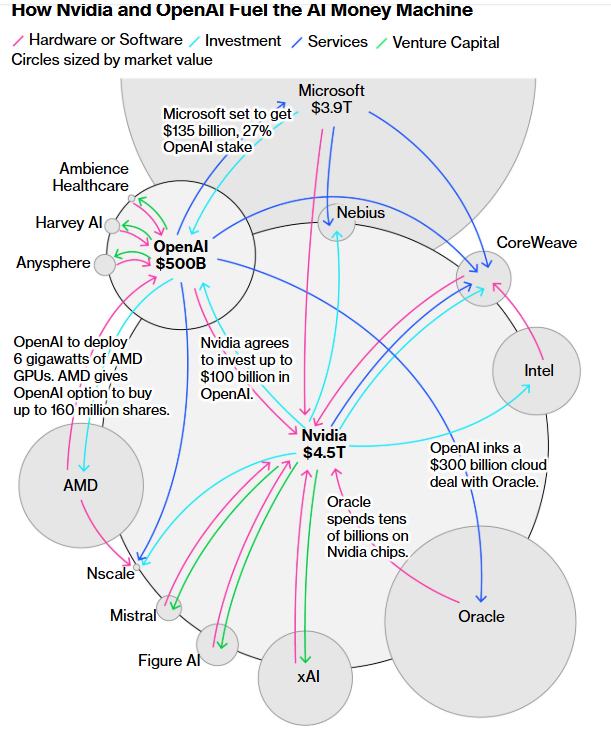
Core Viewpoint - Michael Burry expresses concerns about the current AI hype, comparing it to the late 1990s internet bubble, particularly highlighting Nvidia as a potential indicator of an impending industry bubble burst [2][3]. Group 1: AI Hype and Nvidia - Burry labels the current AI trend as a "brilliant absurdity," identifying Nvidia as a central player in this bubble, akin to Cisco during the internet bubble [2]. - He draws parallels between the tech giants of the past, such as Microsoft and Cisco, and today's AI leaders, which he refers to as the "five knights": Microsoft, Google, Meta, Amazon, and Oracle [2]. - Nvidia's market capitalization has surged to approximately $5 trillion, making it the highest-valued company globally, raising concerns about its inflated valuation [5]. Group 2: Historical Comparisons - Cisco's stock price skyrocketed by 3,800% from 1995 to 2000, reaching a market cap of about $560 billion before crashing over 80% at the turn of the century, which Burry believes is a historical pattern repeating itself with Nvidia [3]. - Burry's hedge fund, Scion Asset Management, purchased over $1 billion in put options against Nvidia and Palantir, indicating skepticism about their future performance [4]. Group 3: Industry Dynamics - Concerns are raised about the interconnected financing among AI companies, with Nvidia committing significant investments to firms like OpenAI and Anthropic, creating a cycle of funding that may inflate valuations further [5]. - Nvidia's CFO refutes Burry's claims regarding the lifespan of its chips, asserting that their hardware is durable and efficient due to the CUDA software system [5]. - CEO Jensen Huang counters bubble concerns by stating that the company has not yet allocated any actual funds and that planned investments represent a small fraction of its revenue, emphasizing a long-term growth cycle in computing technology [6].
AI泡沫没破!两大‘死亡开关’未触发,真正危险期是在2026年中?
Sou Hu Cai Jing· 2025-11-27 09:37
Core Viewpoint - Despite concerns about an AI bubble, there are currently no key signals indicating an imminent collapse, with the two critical "death switches" of massive capital withdrawal and core application failure not yet triggered [1][3] Group 1: Market Conditions - The recent decline in the US stock market is primarily due to liquidity issues rather than an AI bubble burst, with factors such as government shutdowns and the Federal Reserve's ambiguous stance contributing to a sudden liquidity crunch [1][3] - The US Treasury's account balance surged to nearly $1 trillion during the government shutdown, draining market liquidity significantly [3] - The market is currently experiencing a liquidity crisis, affecting asset prices across the board, including traditionally safe-haven assets like gold and cryptocurrencies [1][3] Group 2: AI Sector Analysis - The AI sector is not as overvalued as during the internet bubble, with leading companies like Nvidia and Google maintaining lower capital expenditure ratios and strong cash flows [4][6] - AI-related capital expenditures have shifted towards debt financing, but major tech firms have sufficient resources to sustain their operations, as evidenced by Microsoft's projected capital expenditure increase of 58% to $88.2 billion in fiscal year 2025 [6] - The current monetary environment is favorable for the AI sector, contrasting with the conditions that led to the internet bubble's burst, as the Federal Reserve is expected to maintain a loose monetary policy until at least 2026 [6][8] Group 3: Future Outlook - The potential risk window for the AI sector may extend to mid-2026, where a combination of deteriorating fundamentals and tightening liquidity could pose significant threats [3][9] - Key indicators to monitor include the performance of gold and cryptocurrencies, as well as the Federal Reserve's interest rate decisions, which could signal worsening liquidity conditions [8][9] - The AI industry is currently characterized as a "top-tier banquet," with major players investing heavily in infrastructure, while the application layer is still in exploratory phases, indicating that a true bubble has not yet formed [9]
“大空头”再狙英伟达
3 6 Ke· 2025-11-27 09:12
Core Viewpoint - Michael Burry, a prominent investor known for his short-selling strategies, has recently criticized Nvidia and other AI companies, claiming they are in a bubble and expressing his intention to short these stocks [1][7]. Group 1: Criticism of Nvidia - Burry has intensified his criticism of Nvidia, stating that the company's recent memo to Wall Street analysts was disappointing and filled with logical fallacies [1][2]. - He argues that the memo misrepresents his concerns, particularly regarding the depreciation of assets, which he believes is a significant issue for AI companies [5][6]. - Burry's main concern revolves around how AI companies handle depreciation accounting, suggesting that spreading costs over longer periods can artificially inflate profits and asset values [5][6]. Group 2: Market Position and Actions - Burry's hedge fund, Scion Asset Management, reportedly held $1.1 billion in put options against Nvidia and Palantir as of late September, with each option costing around $10 million [6][7]. - He has publicly stated that he is shorting both Nvidia and Palantir, indicating a bearish outlook on these companies [1][5]. - Following Nvidia's recent financial report, Burry warned that the actual demand for AI technology is significantly lower than what is currently projected, contributing to a decline in Nvidia's stock price by approximately 14% since its peak on November 3 [7]. Group 3: Broader Market Implications - Burry likens the current AI hype to the internet bubble, suggesting that Nvidia could be a precursor to a market correction in the AI sector [7]. - He highlights concerns about oversupply and insufficient demand in the AI market, which could lead to significant financial repercussions for companies involved [7].
“大空头 vs 英伟达”论战继续!“大空头”逐条反驳英伟达回应:不敢相信这来自全球市值最高公司
华尔街见闻· 2025-11-27 07:54
Core Viewpoint - The ongoing conflict between Michael Burry, known as the "Big Short," and Nvidia highlights concerns over the AI industry's potential bubble and the company's accounting practices [1][3][12]. Group 1: Burry's Critique - Burry criticized Nvidia's internal memo as disappointing and filled with "strawman arguments," claiming it misrepresented his criticisms [1][3]. - He emphasized that he never questioned Nvidia's depreciation policy, arguing that as a chip design company, its capital expenditure is minimal, making depreciation irrelevant [4][5]. - Burry's focus is on the future obsolescence of new chips, suggesting that they may become functionally outdated between 2026 and 2028 [4][5]. Group 2: Accounting Practices and Risks - The core of Burry's argument revolves around the accounting practices of AI companies, particularly regarding the depreciation policies of hyperscalers that purchase AI chips [7]. - He warned that extending the useful life of chips and servers for accounting purposes could misrepresent profits and asset values, especially given the rapid technological advancements in AI [7]. - Burry referenced Microsoft CEO Satya Nadella's comments about slowing down data center construction due to concerns over overbuilding for a generation of AI chips [7]. Group 3: Market Context and Positioning - Burry disclosed that he continues to hold put options against Nvidia and Palantir, indicating his bearish outlook on these AI companies [3][10]. - His asset management firm, Scion Asset Management, reported holding put options with a nominal value of $1.1 billion, but the actual cost was approximately $10 million each, providing a clearer picture of his investment scale [10]. - The market has shown increased scrutiny of AI-related companies, with Nvidia's stock dropping about 14% since its peak on November 3, reflecting changing investor sentiment [3][10]. Group 4: Nvidia's Defense - In response to criticisms, Nvidia distributed a seven-page memo to Wall Street analysts, addressing allegations of accounting fraud and AI bubble concerns [12][13]. - The memo clarified that Nvidia's business is economically sound, with transparent reporting that does not compare to historical accounting fraud cases [12]. - Nvidia defended its depreciation practices, stating that customers typically set the depreciation period for GPUs at 4 to 6 years, aligning with actual usage [13].
暴跌40%!软银成为“OpenAI链”风向标
华尔街见闻· 2025-11-27 07:54
Core Viewpoint - The stock price of SoftBank Group has become a key indicator of market confidence in the non-public company OpenAI, amid rising concerns over overvaluation in the AI sector and changes in industry competition dynamics [1][3]. Group 1: SoftBank's Stock Performance - Since the end of October, SoftBank's stock has plummeted approximately 40%, resulting in a market value loss of over 16 trillion yen (about 102 billion USD) [3]. - The recent sell-off is primarily driven by market anxiety regarding competitive pressures faced by OpenAI, especially following the release of Alphabet's highly praised Gemini 3.0 model [3][9]. - The stock's decline reflects SoftBank's sensitivity to OpenAI's valuation and market position rather than a general downturn in the AI sector [9]. Group 2: Financial Implications and Investments - SoftBank previously benefited from its deep exposure to the AI sector, recording an unrealized gain of 14.6 billion USD from its investment in OpenAI, leading to a surprising net profit of 2.5 trillion yen in the second fiscal quarter [5]. - However, this same exposure has made SoftBank vulnerable to fluctuations in the AI industry [6]. - SoftBank is committed to paying 22.5 billion USD to OpenAI in December, part of a total investment commitment of 32 billion USD, which could represent over 20% of its net asset value if OpenAI's valuation reaches 500 billion USD [9]. Group 3: Strategic Moves by Masayoshi Son - Masayoshi Son aims to build a comprehensive AI ecosystem, going beyond being a financial investor in OpenAI, by engaging in various mergers and investments [10]. - SoftBank has sold shares in Nvidia and Oracle to raise funds for its AI chip and infrastructure strategy, believing that future devices will require high-efficiency AI chips [11]. - The company has acquired nearly 90% of Arm and completed a 6.5 billion USD acquisition of Ampere Computing, a server processor manufacturer [11]. Group 4: Market Dynamics and Investment Logic - The market is witnessing a shift in AI investment logic, moving away from indiscriminate buying of AI-related stocks to a more selective approach [13]. - Reports indicate that companies like Meta Platforms Inc. are planning to use Google's Gemini AI chips, raising concerns for Nvidia's business and affecting its Japanese suppliers [13][14]. - Conversely, companies like Toppan Holdings Inc. have seen stock price increases due to their partnerships in AI chip design, indicating a more nuanced evaluation of winners and losers within the AI supply chain [14].
AI泡沫论升温,智能体为何迎来爆发元年?
Xin Lang Cai Jing· 2025-11-27 07:13
Core Viewpoint - The AI industry is experiencing a dual narrative in 2025, with a significant market correction in global tech stocks while the AI agent sector is witnessing explosive growth, particularly in China, where the market size is projected to increase from 4.75 billion yuan in 2024 to 7.84 billion yuan, representing over 60% growth [1][6]. Group 1: Evolution of AI Agents - AI agents are defined as software programs capable of autonomously understanding, planning, and executing complex tasks, fundamentally differing from traditional AI assistants [2]. - The emergence of AI agents is a result of technological advancements, transitioning from early models that were primarily for demonstration to sophisticated systems capable of logical reasoning and multi-modal understanding [3][4]. - The core value of this evolution is transforming intelligence from a cost into a productivity driver, as articulated by industry leaders [5]. Group 2: Major Investments and Market Dynamics - The growth of AI agents is fueled by strategic investments from global tech giants, which are based on clear commercial return expectations, creating a positive cycle of research, implementation, and profitability [6]. - Companies like Baidu and Tencent are leading the charge with innovative AI solutions, such as Baidu's self-evolving AI agent and Tencent's integration within its WeChat ecosystem [7]. - The commercial value of AI agents is evident across various sectors, including healthcare, retail, and finance, where they are significantly enhancing operational efficiency and reducing costs [8]. Group 3: Underlying Factors for Growth - The rapid growth of AI agents is attributed to the convergence of technological maturity, rising demand, and an improved ecosystem [9]. - Breakthroughs in technology have drastically reduced the cost of large model inference by 90% and increased speed by tenfold, addressing previous scalability issues [10]. - The pressing need for cost reduction and efficiency in businesses drives the adoption of AI agents, which offer non-intrusive solutions that integrate seamlessly with existing systems [11]. Group 4: Future Outlook - The future of AI agents is expected to shift from scaling to refinement, ushering in a new era of human-machine collaboration, with predictions indicating that 60% of enterprises will rely on AI agents for core operations by 2026 [12]. - Despite existing challenges such as communication delays and talent shortages, the evolution of AI agents is seen as a necessary phase in technological advancement, distinguishing them from past speculative bubbles [13].