
数字孪生

Search documents
趋势研判!2026年中国电网自动化设备行业背景、产业链全景、市场规模、竞争格局及未来发展趋势分析:电网投资重心倾斜,行业自动化市场持续扩容[图]
Chan Ye Xin Xi Wang· 2025-10-27 01:04
Core Insights - The electric grid automation equipment industry in China is experiencing significant growth driven by policy incentives and technological advancements, with a projected market size of 128.6 billion yuan in 2024, representing a year-on-year increase of 9.7% [1][8][9] - The industry is supported by a series of national policies aimed at achieving carbon neutrality, emphasizing digital and intelligent transformation in the power system [5][6] - Key players in the market include State Grid NARI, XJ Electric, and Huawei, with a competitive landscape characterized by both state-owned enterprises and cross-industry entrants [2][9][10] Industry Overview - Electric grid automation equipment is essential for monitoring, controlling, protecting, and regulating electrical energy, ensuring efficient and safe operation of power systems [1][3] - The industry has evolved from relying on foreign technology to achieving self-innovation, with significant advancements in automation and integration of new technologies like AI and cloud computing [5][6] Market Dynamics - The investment structure is shifting towards the grid side, with a forecasted investment growth of 15.32% in grid engineering for 2024, further increasing by 14% in the first eight months of 2025 [6][8] - The market is segmented into various fields, with substation automation holding a 40% market share and distribution automation growing at an 11.9% rate [1][9] Competitive Landscape - The industry is characterized by a "one strong, many strong" competitive structure, with State Grid NARI leading in high-end markets, while companies like XJ Electric and Sifang Co. have established unique advantages in niche areas [9][10] - Cross-industry players like Huawei are entering the market leveraging ICT technologies, indicating a trend towards collaboration and competition among traditional and new entrants [10][12] Future Trends - The industry is expected to transition towards deep intelligence and system integration, with a focus on predictive maintenance and self-healing capabilities [10][11] - The role of electric grids is shifting from a simple energy distribution channel to a complex energy system hub, necessitating significant investments in distribution network automation [11][12] - The traditional supply chain model is evolving into a cross-industry collaborative ecosystem, where companies must seek strategic partnerships to thrive in the new market landscape [12]


工业世界迎来Copilot时刻!未来工业环境中人类的最强辅助
Xin Lang Cai Jing· 2025-10-26 04:53
Core Insights - The article highlights the transformation of manufacturing into a smart factory era, emphasizing the integration of AI and automation technologies to enhance operational efficiency and productivity [1][3][5]. Group 1: Smart Manufacturing as a Competitive Edge - A Deloitte survey indicates that 92% of U.S. manufacturing executives believe smart manufacturing will be a key driver of competitiveness within the next three years [3]. - Nearly half of the surveyed executives prioritize operational efficiency as the main value of adopting smart manufacturing [3]. - 78% of executives plan to allocate over 20% of their existing budgets to smart manufacturing initiatives [3]. Group 2: AI and Automation in Production Processes - The unmanned workshop of Shangmei showcases a fully automated production process, utilizing AGV robots and AI systems for material handling and packaging [3]. - Industrial robots at Shangmei perform 252,000 standardized operations daily, creating an efficient and precise production system [3]. Group 3: Digital Transformation and Integration - Companies are focusing on the cosmetics industry's production characteristics by integrating IoT, 5G, big data, and AI to create a digital collaborative system across the entire supply chain [5]. - Schneider Electric and Microsoft launched the Industrial Copilot system, combining AI with industrial automation to enhance productivity and redefine human-machine collaboration [5][7]. Group 4: Key Technologies Driving Industrial Intelligence - The digital twin simulation optimization system developed by Wuhan Huagong Saibai Data System Co., Ltd. enables comprehensive digital mapping and optimization of manufacturing processes [7][9]. - This system has led to production efficiency improvements of 10-25% and operational cost reductions of 10-20% in various manufacturing sectors [9]. Group 5: Challenges in the Transformation Journey - Talent shortages are a significant challenge, with 35% of executives citing the adaptation of existing employees to smart factories as a primary concern [11]. - Information security risks, including unauthorized access and intellectual property theft, are also major obstacles [11]. Group 6: Future Prospects of Industrial AI - The industrial AI market is projected to grow from $43.6 billion in 2024 to $154 billion by 2030, with a compound annual growth rate of 23% [12]. - The Chinese government has elevated the application of AI technologies to a national strategic level, promoting intelligent integration across all industrial elements [12].

万钢到中国能建湖北应城压缩空气储能项目调研
Xin Lang Cai Jing· 2025-10-26 02:36
Core Insights - The successful implementation of the first compressed air energy storage project marks the beginning of further innovations rather than an endpoint [1] Group 1: Project Development and Innovation - The project aims to shift from engineering innovation to service innovation, enhancing the lifecycle service capabilities of compressed air energy storage plants to create greater economic and social value [1] - There is a focus on accelerating the establishment of a "digital twin" system to accurately simulate and monitor the operational status of equipment and storage facilities, predicting safety risks and material wear [1] - The project will utilize the first engineering test platform to monitor current operational efficiency while emphasizing long-term quality monitoring and technological iteration for future scalability [1] Group 2: Support for New Energy Systems - The initiative is positioned to actively support the construction and development of new power systems, exploring typical application scenarios and enhancing the value of energy regulation and supply functions [1] - The project aims to contribute positively towards achieving carbon neutrality goals [1]

索辰科技涨2.05%,成交额6751.54万元,主力资金净流出484.53万元
Xin Lang Zheng Quan· 2025-10-24 02:36
Core Insights - The stock price of Suochen Technology has increased by 86.25% year-to-date, with a recent rise of 8.54% over the last five trading days [2] - The company has a market capitalization of 9.017 billion yuan and reported a net outflow of 484.53 thousand yuan in main funds [1] Company Overview - Suochen Technology, established on February 24, 2006, focuses on the research, development, sales, and service of CAE software [2] - The company went public on April 18, 2023, and is classified under the software development industry, specifically in vertical application software [2] Financial Performance - For the first half of 2025, Suochen Technology achieved operating revenue of 57.35 million yuan, reflecting a year-on-year growth of 10.82% [3] - The net profit attributable to the parent company was -45.70 million yuan, showing a year-on-year increase of 31.21% [3] Shareholder Information - As of June 30, 2025, the number of shareholders decreased by 14.55% to 5,763, while the average circulating shares per person increased by 18.64% to 8,543 shares [3] - The company has distributed a total of 67.92 million yuan in dividends since its A-share listing [4] Institutional Holdings - Notable institutional investors include Nuoan Active Return Mixed A, which is the sixth largest circulating shareholder with 953.6 thousand shares, and Nuoan Growth Mixed A, which remains the tenth largest with 730 thousand shares [4]

汉威科技涨2.03%,成交额2.55亿元,主力资金净流入991.07万元
Xin Lang Cai Jing· 2025-10-24 02:26
Core Viewpoint - Hanwei Technology's stock has shown significant volatility and growth, with a year-to-date increase of 168.69% and a recent drop of 21.42% over the past 20 days [1][2]. Financial Performance - For the first half of 2025, Hanwei Technology reported a revenue of 1.177 billion yuan, representing a year-on-year growth of 5.67%, and a net profit attributable to shareholders of 59.073 million yuan, up 14.47% [2]. - The company has distributed a total of 239 million yuan in dividends since its A-share listing, with 94.8185 million yuan distributed over the last three years [3]. Stock Market Activity - As of October 24, Hanwei Technology's stock price was 54.84 yuan per share, with a market capitalization of 17.957 billion yuan [1]. - The stock has experienced a trading volume of 255 million yuan on the same day, with a turnover rate of 1.65% [1]. - The company has appeared on the "Dragon and Tiger List" five times this year, with the most recent instance on September 16, where it recorded a net purchase of 374 million yuan [1]. Shareholder Structure - As of June 30, 2025, Hanwei Technology had 74,300 shareholders, an increase of 18.45% from the previous period, with an average of 3,811 circulating shares per shareholder, down 15.57% [2]. - The top ten circulating shareholders include various mutual funds, with notable changes in their holdings, such as a decrease of 210,000 shares for Penghua Carbon Neutral Theme Mixed A [3].

亚马逊澄清“用机器人取代 60 万工人岗位”:只是为了降本增效
Sou Hu Cai Jing· 2025-10-23 08:51
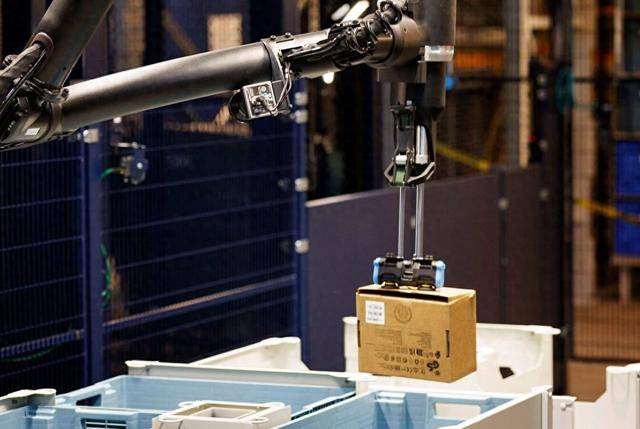
Core Insights - Amazon's internal documents suggest that automation can enable the company to sell more products without increasing its workforce [1] - The company showcased various robotic and delivery technologies, including AI-connected AR smart glasses and VR training for drivers, indicating a more optimistic outlook [1] - The Blue Jay robot is highlighted as a key technology that can handle 75% of Amazon's stored items and is expected to support same-day delivery operations [3] Group 1 - The Blue Jay robot was developed in just over a year and integrates multiple robotic arms to streamline tasks, consolidating previously separate workstations into a single efficient workspace [3] - Amazon's CTO of the robotics division emphasized that the focus is on people and the future of work being developed together with technology [3] - The company plans to hire 250,000 positions during the holiday season, reinforcing its commitment to job creation despite automation [3] Group 2 - CEO Andy Jassy acknowledged that while some positions may require fewer employees due to increased efficiency from AI, other roles may need more personnel [3] - The long-term impact of automation on overall employee numbers remains uncertain, but the expectation is a reduction in total workforce as AI is widely adopted [3] - Amazon's strategy aims to lower e-commerce costs by allowing warehouses to handle more items with fewer employees, shifting employee focus towards managing robots [3]


走进中关村科技园区房山园暨储能产业链智能升级沙龙活动预通知
中关村储能产业技术联盟· 2025-10-23 07:23
Core Insights - The energy storage industry is transitioning from a phase of scale expansion to a critical period of high-quality development, focusing on production quality improvement, product design upgrades, and optimization of trading methods [2] - Technologies such as AI deep learning, digital twins, and industrial internet platforms are enhancing automation in battery cell assembly, optimizing system integration processes, and enabling real-time energy consumption monitoring [2] - The integration of big data, blockchain, and intelligent algorithms is facilitating real-time processing of trading data, digital asset rights confirmation, and market pricing model construction [2] Event Details - The event theme is "Cross-border Integration, Collaborative Evolution: Building a New Intelligent Landscape for the Entire Energy Storage Chain" [3] - Scheduled for October 31, 2025, at the Zhongguancun Science Park, Fangshan Garden [3] - The event will host approximately 80 participants [4] Organizational Structure - Organized by the Zhongguancun Energy Storage Industry Technology Alliance and the Fangshan District Science and Technology Committee [4] - Supported by companies such as Beijing Haibo Sichuang Technology Co., Ltd. and New Source Intelligent Storage Energy Development (Beijing) Co., Ltd. [4] Event Features - Policy support from the Beijing Municipal Science and Technology Commission and local government to provide service backing for the industry [4] - Discussions on the application of AI deep learning, digital twins, and industrial internet platforms in energy storage production, system integration, and energy consumption monitoring [4] - Exploration of intelligent management models for the entire lifecycle of energy storage products, enhancing safety, reliability, and resource utilization efficiency [4] Agenda Overview - The agenda includes various thematic reports from industry experts on topics such as intelligent manufacturing solutions for energy storage systems and the application of industrial AI in production assembly [5] - A factory visit is scheduled for invited participants [5] Registration Information - The event is free of charge, with participants responsible for their own transportation costs [6] - Interested parties are invited to register by October 26, 2025 [6]

人民日报等央媒持续点赞岚图汽车 赴港上市冲击高端新能源乘用车领导者
Xin Lang Cai Jing· 2025-10-23 06:56
Core Viewpoint - The article highlights the significant achievements of Lantu Automotive as a model of innovation in China's new energy vehicle sector, reflecting the historical accomplishments of high-quality development under the "14th Five-Year Plan" [1][3]. Group 1: Company Development and Achievements - Lantu Automotive has rapidly developed since its inception, focusing on brand building, product launches, technological innovation, channel construction, and overseas expansion [3]. - The company has adopted cutting-edge technologies such as artificial intelligence and the Internet of Things, reducing new car production preparation time by at least 20%, lowering process design costs by over 15%, and improving product quality by over 10% [3]. - Lantu Automotive aims to transition from a fuel vehicle production capacity to a new energy vehicle capacity, establishing a 5C smart charging network for green electricity [3][4]. Group 2: Market Position and Product Range - Lantu Automotive has established a comprehensive product matrix covering sedans, SUVs, and MPVs, becoming one of the most comprehensive high-end new energy vehicle companies in the industry [7]. - The Lantu Dreamer, as the world's first high-end new energy MPV, is projected to achieve sales of 47,000 units in 2024, securing the second position in the high-end new energy MPV market [7]. - The company has the fastest patent growth in the new energy vehicle sector, with 1,519 granted patents and 4,783 pending applications as of July 31, 2025 [7][8]. Group 3: Financial Performance - Lantu Automotive's sales are expected to grow at a compound annual growth rate of 103.2% from 2022 to 2024, with a delivery volume of 15,224 vehicles in September 2025, representing a 52% year-on-year increase [8][9]. - The gross profit margin has improved from 8.3% in 2022 to 21.0% in 2024, further increasing to 21.3% in the first seven months of 2025 [8][9]. - The company achieved its first quarterly profit in Q4 2023 and has maintained profitability in the first seven months of 2025, indicating a shift towards a focus on quality and efficiency [9]. Group 4: IPO and Market Strategy - Lantu Automotive is set to go public on the Hong Kong Stock Exchange through an introduction listing, which marks a significant step in its regulatory review process [10]. - The company's unique combination of being a state-owned enterprise and a high-end new energy brand provides significant scarcity value in the current Hong Kong market [10]. - The IPO is expected to enhance Lantu's brand influence globally and support its overseas business expansion, which is crucial for increasing its valuation [10][11].

索辰科技涨2.13%,成交额7256.32万元,主力资金净流入1047.19万元
Xin Lang Cai Jing· 2025-10-23 02:42
Core Insights - The stock price of Suochen Technology increased by 2.13% on October 23, reaching 98.63 CNY per share, with a market capitalization of 8.789 billion CNY [1] - Year-to-date, the stock has risen by 81.54%, with a recent 5-day increase of 0.72% and a 20-day decline of 3.60% [1] Financial Performance - For the first half of 2025, Suochen Technology reported revenue of 57.35 million CNY, a year-on-year growth of 10.82%, while the net profit attributable to shareholders was -45.70 million CNY, reflecting a 31.21% increase in losses [2] - Cumulative cash dividends since the company's A-share listing amount to 67.92 million CNY [3] Shareholder Structure - As of June 30, 2025, the number of shareholders decreased by 14.55% to 5,763, while the average circulating shares per person increased by 18.64% to 8,543 shares [2] - Notable institutional shareholders include Nuoan Active Return Mixed A, which is the sixth largest shareholder with 953,600 shares, and Nuoan Growth Mixed A, which remains the tenth largest shareholder with 730,000 shares [3] Business Overview - Suochen Technology, established on February 24, 2006, focuses on the research, development, sales, and services of CAE software, with its main revenue sources being simulation product development (56.93%) and engineering simulation software (29.33%) [2] - The company operates within the computer software development sector, specifically in vertical application software, and is involved in concepts such as industrial software and digital twins [2]
亚马逊(AMZN.US)“眼镜+机械臂”组合拳直击物流痛点!大摩:2027年或省40亿美元成本
智通财经网· 2025-10-23 02:22
Core Insights - Amazon is accelerating its delivery services through technological innovations, aiming to reduce delivery times to same-day and even one-hour delivery, leveraging robotics, AI, and smart wearable devices [1][2] - The introduction of the smart glasses "Amelia" for delivery drivers is expected to enhance operational efficiency, with preliminary tests showing a potential time savings of 30 minutes per shift [2][3] - The automation of warehouses is projected to save Amazon up to $4 billion by 2027, as the company continues to expand its use of robotics and AI in logistics [1][3] Technological Innovations - The smart glasses "Amelia" provide real-time navigation and package scanning capabilities, improving delivery efficiency and safety for drivers [2] - The "Blue Jay" robotic system, designed to work alongside warehouse employees, can handle approximately 75% of the product types stored at a site, reducing the risk of injury and space requirements [2][3] - The development of the Blue Jay system showcases rapid technological advancement, taking just over a year from concept to production, compared to previous systems that took three years or more [3] Workforce Implications - Amazon plans to reduce the hiring of 160,000 employees in the U.S. over the next two years due to increased automation, while simultaneously preparing to hire 250,000 temporary workers for the upcoming holiday season [3] - The company emphasizes the importance of the "last 100 yards" in delivery, focusing on the most expensive and time-consuming part of the logistics process [2] Market Performance - Amazon's stock price fell by 1.8% to $217.95, making it the only one among the "seven major tech stocks" to experience a cumulative decline this year [4]