关税

Search documents
特朗普顾问临时任美联储理事被拷问,提名人Miran:没人要求我承诺支持降息
Sou Hu Cai Jing· 2025-09-05 01:29
Core Points - The independence of the Federal Reserve is emphasized as crucial for the economy, with Stephen Miran asserting that he was not pressured to support interest rate cuts during his confirmation hearing [1][2][3] - Miran plans to temporarily step down from his role as a senior economic advisor to Trump if confirmed as a Fed governor, which raises concerns about the potential conflict of interest and the independence of the Fed [4][5][6] - Miran has faced scrutiny regarding his past proposals that could increase presidential power over the Fed, including the ability to dismiss Fed officials, which he claims is part of a broader system of checks and balances [6][10] Summary by Sections Federal Reserve Independence - Miran stated that the independence of the Federal Reserve is "vital" for the U.S. economy and that he agrees with the need for the Fed to remain independent from political influence [2][3] - He acknowledged that while Trump selected him based on his policy views, he would act independently if confirmed [2][6] Confirmation Hearing Dynamics - Concerns were raised by Senate Banking Committee members about Miran's ability to maintain the Fed's independence, especially given his close ties to the Trump administration [1][5] - Miran's temporary leave from his White House role during his tenure as a Fed governor was criticized as potentially undermining the Fed's independence [5][6] Regulatory and Economic Policy Views - Miran expressed the need for a comprehensive review of regulatory costs and benefits, particularly regarding capital requirements under Basel III [3] - He criticized the Fed's focus on climate change as a sign of political influence and stated he would resist any actions that exceed the Fed's core responsibilities [3][6] Employment Data and Economic Impact - Miran commented on the quality of employment data released by the Bureau of Labor Statistics (BLS), suggesting it has deteriorated over time, although he did not confirm any allegations of data manipulation [7][8] - He maintained that tariffs have not significantly impacted inflation, despite concerns raised by other senators [9] Interest Rate Policy and Market Reactions - Miran predicted that the bond market would not resist potential interest rate cuts by the Fed, indicating a belief in the market's adaptability to changes in monetary policy [10]
X @外汇交易员
外汇交易员· 2025-09-05 01:16
Trade Policy & Investment - US may impose tariffs on chip companies not investing in the US [1] - Companies investing or planning to build factories in the US may be exempt from tariffs [1] - Tariffs will be "considerable, but not too high" [1] - Apple committed to invest $600 billion in the US over four years [1] Semiconductor Industry - TSMC, Samsung, and SK Hynix have already announced plans to build factories in the US [1]
美联储古尔斯比:关税对物价上涨的影响取决于行业。
Sou Hu Cai Jing· 2025-09-05 00:55
Group 1 - The impact of tariffs on price increases varies by industry [1] - Federal Reserve's Goolsbee emphasizes that the relationship between tariffs and inflation is not uniform across sectors [1] - Different industries may experience different levels of price sensitivity to tariff changes [1]
美联储报告:美国经济两大支柱正双双承压
Zhong Guo Xin Wen Wang· 2025-09-05 00:35
Group 1 - The latest Federal Reserve "Beige Book" indicates that both employment and consumer spending in the U.S. are under pressure due to tariffs, leading to a slowdown in hiring and investment by businesses, while consumers are tightening their spending in response to rising prices [1][2] - The report highlights that all Federal Reserve districts have experienced price increases related to tariffs, which have raised production costs for businesses and increased the cost of living for consumers [1][2] - Many businesses across various Federal Reserve districts express concerns about the economic outlook, with worries about trade policy changes, high interest rates, and stricter immigration policies [1] Group 2 - Consumers are facing a dual challenge of rising prices and reduced employment, with wage growth not keeping pace with inflation, particularly as companies adjust labor costs in response to tariffs [2] - The "Beige Book" reveals increasing economic uncertainty, with the term "uncertainty" mentioned 80 times, reflecting a more cautious decision-making environment for both businesses and consumers [2]
关税大消息!特朗普签署行政命令
Zhong Guo Ji Jin Bao· 2025-09-05 00:02
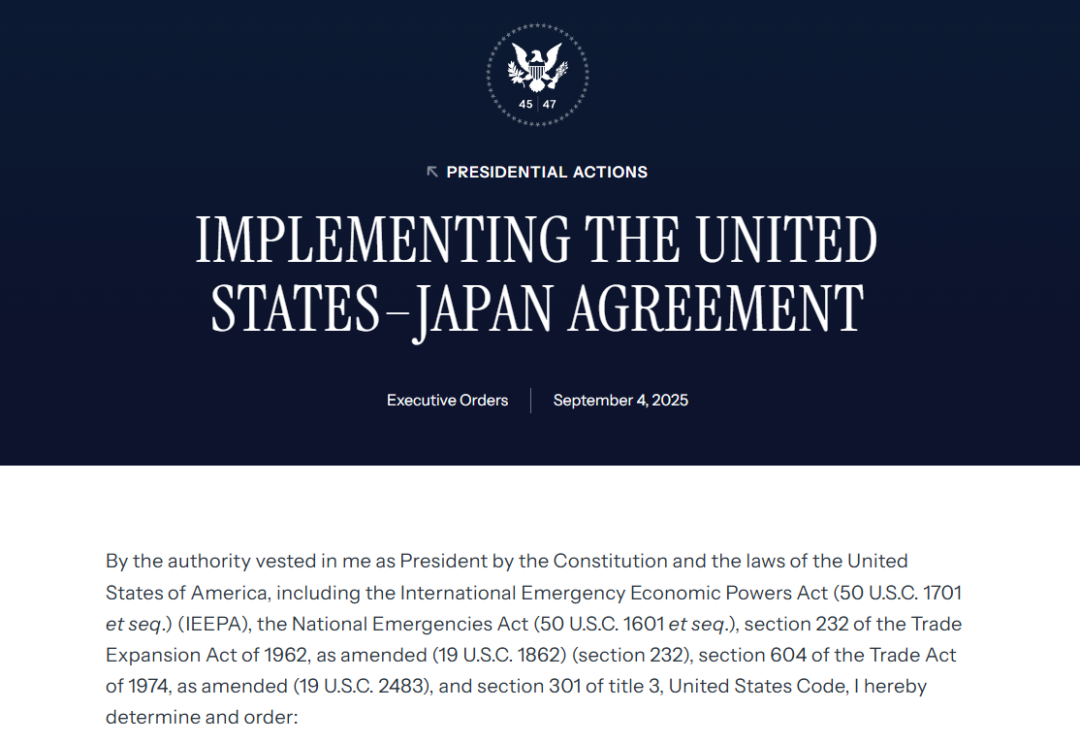
Group 1 - The White House announced the implementation of a trade agreement between the U.S. and Japan, which includes a 15% baseline tariff on nearly all Japanese goods exported to the U.S. [2][4] - Specific sectors such as automotive, aerospace, generic drugs, and natural resources will have differentiated tariff treatments under the new framework [2][4]. - The new tariff framework aims to reduce the U.S. trade deficit with Japan and promote a more balanced overall trade situation [4]. Group 2 - Japan is committed to increasing its procurement of U.S. agricultural products, including a 75% increase in U.S. rice purchases and an annual total of $8 billion in various U.S. agricultural goods [4]. - The Japanese government will facilitate the sale of U.S.-made passenger cars in Japan without additional testing, as long as they meet U.S. safety certification standards [4]. - Japan plans to purchase U.S.-manufactured commercial aircraft and defense equipment, providing significant market access for U.S. manufacturers [4]. Group 3 - The Trump administration is seeking a swift Supreme Court ruling to overturn a previous court decision that deemed the imposition of tariffs on multiple countries illegal [5]. - The U.S. Treasury Secretary stated that delaying the ruling could lead to significant financial chaos, with tariffs collected potentially reaching $750 billion to $1 trillion by mid-2026 [5]. - As of August 24, U.S. companies have paid over $210 billion in tariffs that have been ruled illegal, which may require refunds if the appellate court's decision is upheld [5]. Group 4 - The U.S. trade deficit widened significantly in July, reaching $78.3 billion, driven by increased imports ahead of the anticipated new tariffs [6]. - Analysts suggest that businesses imported more goods and materials in anticipation of the new tariffs, contributing to the highest trade deficit in four months [6]. - The expectation of increased tariffs also led to a surge in gold shipments, further boosting overall U.S. imports [6].

关税大消息!特朗普签署行政命令
中国基金报· 2025-09-04 23:58
Core Viewpoint - The article discusses the implementation of a new U.S.-Japan trade agreement, which includes a 15% baseline tariff on nearly all Japanese goods entering the U.S. market, aimed at reducing the trade deficit and balancing trade relations between the two countries [4][6]. Group 1: U.S.-Japan Trade Agreement - The U.S. will impose a 15% baseline tariff on almost all Japanese imports [4]. - Specific sectors such as automobiles, aerospace products, generics, and natural resources that cannot be sourced domestically will have differentiated tariff treatments [4]. - The new tariff framework is expected to help reduce the U.S. trade deficit with Japan and promote a more balanced overall trade situation [6]. Group 2: Market Access for U.S. Products in Japan - Japan will provide significant market access opportunities for U.S. manufacturers in key sectors including aerospace, agriculture, food, energy, and automobiles [7]. - Japan aims to increase its procurement of U.S. rice by 75% under the "minimum market access" rice plan, with total annual purchases of U.S. agricultural products reaching $8 billion [7]. - U.S.-made passenger cars that meet U.S. safety standards will be allowed to sell in Japan without additional testing [7]. Group 3: Legal and Economic Context - The Trump administration is appealing a court ruling that deemed the imposition of tariffs on multiple countries illegal, arguing it undermines the president's ability to conduct foreign policy and protect national security [8]. - As of August 24, U.S. companies have paid over $210 billion in tariffs that may be deemed illegal, with potential refunds causing significant disruption if the ruling is upheld [8]. - The U.S. trade deficit widened to $78.3 billion in July, significantly higher than the adjusted $59.1 billion in June, driven by increased imports ahead of the new tariffs [10].
他还觉得冤枉?美联储111年历史上首次!特朗普质疑上诉法院判决
Sou Hu Cai Jing· 2025-09-04 23:20
Group 1 - The conflict between President Trump and Federal Reserve Governor Lisa Cook marks a significant political event, as it is unprecedented for a sitting president to attempt to dismiss a Federal Reserve official [1][3] - The legal basis for Trump's action hinges on allegations of "mortgage fraud," which raises questions about the independence of the Federal Reserve and the legitimacy of political interference in its operations [3][6] - The market is reacting to these political tensions, with a notable inversion in the yield curve indicating concerns over short-term interest rate cuts versus long-term inflation risks [4][9] Group 2 - The independence of central banks is crucial for macroeconomic stability, and any perceived erosion of this independence could have severe implications for both the U.S. and global economies [6] - The legal proceedings initiated by Cook could set a precedent regarding what constitutes "just cause" for dismissing Federal Reserve officials, potentially impacting future political interactions with the central bank [6][7] - Trump's dual strategy of applying pressure both domestically on the Federal Reserve and internationally on the EU reflects a broader approach to economic management, aiming for favorable outcomes in trade and monetary policy [9]
巴西今年前8个月外贸额创纪录 对华出口增长强劲
Xin Lang Cai Jing· 2025-09-04 22:47
Core Insights - Brazil's total exports from January to August 2025 reached $227.6 billion, marking a 0.5% year-on-year increase, with both total exports and trade volume hitting historical highs [1] - Exports of agricultural and manufactured products saw growth, with increases of 0.4% and 4% respectively [1] - Exports to the United States decreased by 18.5% in August compared to the same month last year, significantly affecting sectors such as aircraft and related equipment, sugar, meat, oil, and steel products [1] - Conversely, exports to China surged, with an impressive 31% year-on-year increase in August, while exports to Mexico and Argentina also showed significant growth, at 43.82% and 40.37% respectively [1]
Logitech International (LOGI) 2025 Conference Transcript
2025-09-04 21:12
Summary of Conference Call Company Overview - The conference call pertains to Logitech, a company operating in the technology sector, particularly focusing on peripherals and video conferencing solutions. Key Points Demand Environment - Demand is characterized as resilient, with overall growth in the high single digits year-over-year, primarily driven by B2B sales, particularly in North America and Europe [2][3] - Consumer demand in North America was impacted by timing of price increases due to tariffs, but Europe and China, especially in gaming, showed strong demand [3][6] Price Increases and Demand Elasticity - Price increases of approximately 10% were implemented in the U.S. for B2B customers, with demand remaining strong [6][10] - The consumer side experienced delays in price implementation, making it too early to assess demand elasticity [7][8] Tariff Mitigation Strategies - Approximately one-third of Logitech's revenue is affected by tariffs, with efforts to reduce reliance on Chinese imports from 100% in 2018 to 40% currently, aiming for 10% by 2025 [12][13] - The net impact of tariffs on margins was about 50 basis points in the first quarter, with expectations of a range between 0 and negative 100 basis points for the second quarter [13][16] Inventory Management - The company ended the fiscal year with a healthy channel inventory, correcting previous low levels that caused variability in sell-in and sell-through [42][43] - Proactive inventory acquisition before new tariffs were enacted led to elevated inventory levels, which the company views positively [43] Segment Performance - Video conferencing segment saw double-digit growth, driven by a low penetration rate of video-enabled conference rooms globally [20][21] - The gaming segment, particularly in China, experienced strong demand, attributed to a focused initiative and favorable demographics [26][27] Competitive Landscape and Product Innovation - Logitech's competitive advantage lies in customer-centric product development, with a focus on innovation across various product lines [32][36] - AI is seen as a significant tailwind, enhancing product capabilities and internal efficiencies [36][40] Capital Allocation Strategy - Logitech plans to reinvest cash into the business, maintain dividends, pursue small acquisitions, and accelerate share buybacks [48][49] - The company emphasizes a conservative financial approach while being shareholder-friendly [51] Long-term Growth Outlook - Logitech operates in a $20 billion market with significant growth opportunities, maintaining a focus on innovation and resilience in challenging environments [50][51] Additional Insights - The company is committed to R&D, ensuring that it does not cut costs in this area despite tariff-related austerity measures [48] - The management expressed confidence in the company's ability to navigate the current macroeconomic challenges while continuing to deliver growth [51]